Push It was the lead single off of Garbage’s second studio album, Version 2.0. The video was directed by an Italian photographer named Andrea Giacobbe, who was selected after the band saw and was impressed by his video for Death in Vegas’s Dirt. Though Shirley Manson said that the songs lyrics were intentionally meant to be surreal and that the song was about, “the schizophrenia that exists when you try to reconcile your desires and demons with the need to fit in,” even the band was surprised by the bizarre storyboards that Giacobbe prepared for the video.
What’s happening in the video is definitely open to interpretation, as the action goes from three nuns assassinating Shirley Manson’s rotoscoped “partner” to Manson living in the suburbs with a man who has a light bulb for a head. Demonic children and aliens also make an appearance. In the end, the video feels like a throwback to the early days of MTV, when it was more important to be weird and challenging than to craft your image for the adolescent Total Request Live crowd. It certainly feels as if it’s taking place in a separate universe than the one where MTV is now the exclusive property of Rob Dyrdeck.
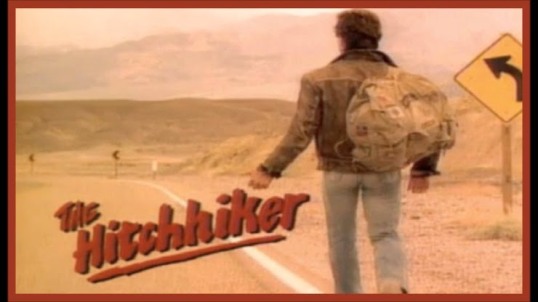
For tonight’s episode of The Hitchhiker, our narrator (played by Page Fletcher) takes a look at Jeremy (John Shea) and Julie (Alexandra Paul).
Jeremy and Julie are a couple who are taking a road trip and whose relationship is strained due to Jeremy’s obsession with organization and control. However, when Jeremy and Julie meet two people that Jeremy can’t control — a biker (Dean Hallo) and his pregnant girlfriend (Nancy Isaak) — Jeremy finds himself taking a trip through time and learning a lesson about letting go.
This episode features good performances from John Shea, Alexandra Paul, Dean Hallo, and Nancy Isaak and it also features the Hitchhiker offering up some memorably judgmental commentary. The Hitchhiker is apparently not a fan of control freaks. I’m not really a fan of control freaks either but there’s nothing wrong with having a to-do list to help guide you through your day.
This episode originally aired on February 24th, 1987.
First released in 1982, Madman takes place on the last night of camp.
Max (Carl Fredericks), the jovial and beloved owner of the camp takes his senior counselors and his campers on one last outdoor adventure. As they sit around the campfire, he tells them the story of a farmer named Marz who, years before, went crazy and hacked up his family with an axe. The local townspeople attempted to hang Marz but somehow, he escaped from the noose and disappeared into the wilderness, along with the bodies of all of his victims. The locals say that Madman Marz is still out there in the wilderness, waiting for someone to shout his name so that he can return to life and kill again. Max tells his campers that it’s very important that they only whisper the name of Madmam Marz.
“MADMAN MARZ!” Richie (Jimmy Steele), one of the campers, shouts.
Everyone tells Richie not to shout his name so Richie shouts it again.
Max announces that it’s time to return to camp. He specifically tells none of the campers to deviate from the path back to the camp. He tells everyone to follow their counselor. He makes the directions very specific and clear.
So, of course, Richie decides to wander off by himself. As he wanders through the wilderness, he comes across Madman Marz’s old cabin and he breaks a window….
Now, if you’ve ever seen a slasher film before, you are probably expecting Richie to be the first victim of rejuvenated Madman Marz. Well, you would be incorrect. In fact, Richie turns out to be a bit of a Karma Houdini because, while Madman Marz does return with his axe, he never actually goes after Richie. Instead, Madman Marz just stalks the various counselors who go into the woods in search of Richie. Don’t get me wrong. Richie is definitely a bit traumatized by what he sees inside of Madman Marz’s cabin. But it’s still hard not to feel that Richie got off pretty easy when compared to everyone else.
But that’s really what makes Madman a superior slasher film. It defies our expectations when it comes to who dies and who doesn’t. Though it was obviously inspired by the camp-centric horror of Friday the13th, Madman isn’t afraid to break the rules of the genre. It’s one of the rare slashers where it feels like anyone could fall victim to the killer depending on how their luck goes that night. As opposed to slashers where it sometimes seems that the victims are being punished for having sex or doing drugs or going against the rules of society, the victims in Madman tend to just be in the wrong place at the wrong time. Marz doesn’t really have a complicated motivation. He’s a madman and he’s so ruthless and relentless that he becomes a genuinely frightening monster.
Madman Marz is not only genuinely frightening but so is the film featuring him. Madman was a low-budget, non-union production, with the majority of the cast and crew credited under pseudonyms. (Dawn of the Dead‘s Gaylen Ross, who appears as one of the counselors, is credited as Alexis Dubin.) But that low budget does prevent Madman from being an atmospheric and suspenseful slasher film, one that will not only inspire nightmares but also probably cure most people of any desire to go camping.
Ugh. It’s hard for me to think of any film that left me feeling as icky as the 1972 film, I Dismember Mama. Seriously, who would have guessed that a film with a title like I Dismember Mama would be disturbing and offensive?
Zooey Hall stars as Albert, a puritanical young man who idealizes the Victoria Age, when “men were gentlemen and women were pure.” Albert has tried to murder his rich mother three times for being “a whore,” and he’s now living in a minimum security mental hospital where he spends his time watching pornographic movies. When Albert escapes from the mental hospital, he heads straight to his mother’s house. His mother isn’t there but Alice (Marlene Tracy), the maid, is. After raping and murdering Alice, Albert heads down to the living room where he meets Alice’s 9 year-old daughter, Annie (Geri Reischl, who would later take on the role of Fake Jan onthe Brady Bunch Variety Hour). Albert doesn’t know Annie but Annie instantly recognizes Albert from the pictures that his mom has up around the house.
Suddenly enchanted by Annie and her innocence, Albert lies and tells Annie that Alice has been taken ill and had to go see a doctor but she asked Albert to keep an eye on Annie until she got back. (Is there a reason why everyone’s name starts with an A? My ADD is going crazy just trying to type this up.) Albert then takes Annie for a ride around town, telling her about how much he loves the Victoria era and eventually checking into a motel with her. (Ewwwwww!) When Albert murders a woman that he picked up at a bar, Annie runs away from the hotel and Albert, suddenly convinced that Annie is now a harlot, chases after her. It all leads to a properly violent conclusion. Say what you will about the film but the final five minutes make great use of slo mo of doom as Albert and Annie run through a mannequin factory in slow motion.
My favorite character in this film was the police detective played by Greg Mullavey. When Albert’s liberal doctor (Frank Whiteman) argues that even Albert can be cured with the right amount of treatment, the detective just smirks and complains about how his tax dollars are being used “to baby murderers.” Normally, I would argue that the doctor has a point but Albert is such a creep and his fixation on Alice is so disturbing that I was totally on the Detective’s side. Whether he could be cured or not, Albert deserved a bullet in the head.
It’s a competently-made and well-acted film and Zooey Hall deserves a lot of credit for making Albert into an all-too plausible madman. It’s also a thoroughly icky film, the type of film the features flashbacks to scenes of rape and violence that occurred mere minutes before. This is one of those grimy films that leaves the viewer feeling as if they’re going to need to take multiple showers after watching.
The film is today is best remembered for the gimmicks that were used to promote it. Theater patrons were given an upchuck cup, in case the film proved to be too intense for them. And, of course, the film’s famous trailer featured people who had been driven insane by watching the film.
Director Paul Leder and Greg Mullavey would reunite for another grindhouse horror film, My Friends Need Killing. Look for my review of that film tomorrow!
In a remote army base, three busty scientists create a busty robot named Raquel (Melissa Brasselle). General Griffin (Arthur Sellers) is impressed that Raquel has mastered all forms of combat but he is not happy by her dominatrix outfit because, according to him, America’s enemies don’t fear cleavage.
One night, while the scientists all have hot dates, Raquel escapes from the base and goes to a nearly deserted desert town, where she kills a leering gas station attendant and a busty diner owner. Meanwhile, a group of busty teenagers and their boyfriends run out of gas while driving through town and find themselves being stalked by Raquel.
This is a Jim Wynorski film so you know what you’re going to get, a lot of cleavage (though, for once, no actual nudity), a splattering of blood, and some deliberately corny humor that is sometimes self-aware enough to be funny. Murderbot was originally named Killbot, a reference to Wynorski’s first film, Chopping Mall. Murderbot even duplicates that film’s famous exploding head scene, though it’s the entire body that explodes this time.
This is pretty dumb but Wynorski fans should be happy. Even though no one will be watching this movie for the acting, I actually did like the performances of Walker Mintz and Sylvia Thackery, playing respectively a trumpet player and the girl that he likes. As Raquel, Melissa Brasselle is no Arnold Schwarzenegger but she still handles dreadful one-liners like “You’ve been deleted,” with enough aplomb to make them tolerable.
Murderbot is proof that, no matter how much things change, Jim Wynorski will always by Jim Wynorksi.
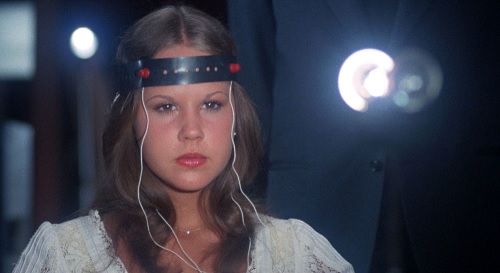
Today’s horror scene that I love features Linda Blair in 1977’s The Exorcist II: The Heretic, the sequel to the film for which she received an Oscar nomination.
Linda Blair was only 13 when she was cast a Regan McNeil, the girl who is possessed by a demon inThe Exorcist. She was nominated for Best Supporting Actress, only losing the award after it was revealed that Mercedes McCambridge had dubbed Blair for the scenes in which she was possessed. Blair has gone on to have a long career, appearing in movies that may not have been as honored by the Academy as TheExorcist was but which are still often very entertaining when taken on their own terms.
In The Exorcist II, Blair returned to the role of Regan. Now in her late teens, Regan says that she can’t remember anything about being possessed. Father Philip Lamont (Richard Burton) and Dr. Gene Tuskin (Louise Fletcher) think that Regan is repressing her memories and, in this scene …. well, I don’t really know how to describe this scene. Seriously, The Exorcist II is such a strange movie! Basically, Dr. Tuskin has a hypnosis machine while allows people to link minds. Dr. Tuskin links with Regan’s mind and then Lamont links with Tuskin’s mind. It’s all incredibly silly but it does allow for this scene in which “good Regan” shares the screen with “possessed Regan.”
Here is a weird scene from a weird movie, featuring a total of four Oscar-nominated performers. (For the record, Burton was nominated multiple times and, the same year he appeared in this film, he also appeared in Equus, for which he received his final nomination. Louise Fletcher won for One Flew Over The Cuckoo’s Nest. Max von Sydow would later be nominated for Pelle the Conqueror and Extremely Loud and Incredibly Close. And, of course, Linda Blair was nominated for The Exorcist.)
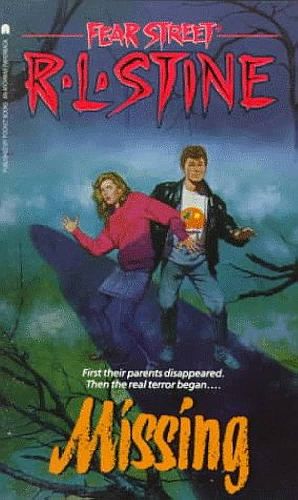
First published in 1990, Missing tells the story of Mark and Cara Burroughs. They’re siblings who have just moved to the town of Shadyside. Along with their parents and their cousin Roger, they live in a house located on Fear Street. Even though they are new students, they’re already popular enough that Mark is dating Gena and everyone from school shows up to party at their house while their parents are gone for the night.
Now, there’s a lot of negative things that you can say about the town of Shadyside and Fear Street in general. I mean, it’s kind of a violent town. How many homicidal maniacs have lived in Shadyside? Over the years, how many students at Shadyside High have either been murdered or seriously injured? But, it should be noted that Shadyside High is notably welcoming to new students. I know that, when I was in high school, the new transfer students were always initially viewed with suspicion. That was especially true if they were from any other place than Texas. (Since my family moved around a lot when I was a kid, I knew far too well what it was like to be the new kid at school so I always tried to be nice to everyone, even if they were from up north.) At Shadyside High, though, new students can go from moving into new home to throwing a huge party in just a matter of weeks.
Anyway, this party comes to an end when a cop shows up, not to complain about the noise but just to ask if Mark and Cara know anything about a nearby burglary. After all of their guests leave, Mark and Cara realize that their parents have yet to come home. What has happened to their parents and how is it connected to Roger, Gena, and a strange monkey statue? And why is a mysterious van parked outside the house? And what’s happening in Fear Street Woods!? That’s a lot of questions and fortunately, Mark and Cara decide to solve the case themselves as opposed to going to the police. (It should be noted that the phones at the house are all dead and, since this book was published in 1990, Mark and Cara are dependent on their landline. The 90s were a difficult time.)
Missing was the fourth of R.L. Stine’s Fear Street novels and it’s fast-paced with a lot of enjoyably silly melodrama. This is one of those books where no one is who they originally claim to be, including the parents. One could argue that all of the plot contrivances don’t hold together under close scrutiny but Stine keeps the plot moving so quickly and fills the book with so many weird moments that it really doesn’t matter. The book is full of cliffhangers and Stine wisely doesn’t let things like realism get in the way of resolving those cliffhangers. By the time a major supporting character shows up, from out of nowhere, with a gun in order to save the heroic siblings, I was giggling with joy. Seriously, does every resident of Shadyside just happen to have a weapon just casually lying around the house?
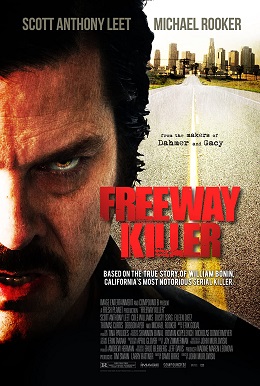
The 2010 film, Freeway Killer, opens with a desperate woman named Ruth (Debbon Ayer) visiting a man named William Bonin (Scott Anthony Leef).
Bonin, who has a quick smile and a mustache that makes him look like a wannabe porn star, is an inmate on California’s Death Row. In just a few days, Bonin is scheduled to be the first man to be executed by lethal injection in the state of California. Ruth explains that she has done everything that she can to try to save Bonin’s life. She has written to the review board. She had written to the governor. She has asked that Bonin be spared and she’s even used the exact words that Bonin suggested that she use in her letters. However, she’s gotten no response. Still, she now wants Bonin to uphold his side of the bargain. She wants to know if her son was among the thirty-six men that Bonin is suspected of having murdered.
William Bonin merely smirks and points out that he never actually agreed to tell Ruth anything. He suggested that Ruth write the letters but never did he say that he would actually do anything in return. That was just something that he allowed Ruth to assume. Even while sitting on Death Row and facing an inevitable execution, Bonin enjoys the power that he gets from manipulating people. Instead of telling Ruth about her son, he tells the story of his life as a serial killer.
The film flashes back to 1980, when William Bonin has already started his career as a murderer. A Vietnam vet who has a war story for every occasion, he cruises the freeways of California and picks up young hitchhikers. Sometimes, he is accompanied by an accomplice. Vernon Butts (Dusty Sorg) is a self-styled occultist who wears a wizard hat at home and who knows more about Dungeons and Dragons than real life. When they’re not killing hitchhikers, Bonin and Vernon tend to bicker. Vernon constantly points out that Bonin was not the great war hero that he claims to have been. Bonin makes fun of Vernon’s hobbies. At times, they seem to genuinely despise each other but one of the few times that Bonin shows any emotion is when Vernon tries to kill himself in a pique of hurt feelings.
One night, Bonin sees a teenager named Kyle (Cole Williams) being yelled at by both his boss and his girlfriend. As he does with all of his victims, Bonin pulls up in his van and asks Kyle if he wants a ride. However, when Kyle gets in the van, it turns out that Bonin doesn’t want to kill him. Instead, he sees Kyle as a kindred spirit and soon, he’s recruited Kyle as his second accomplice. Unlike Vernon, Kyle believes all of Bonin’s stories. However, Kyle grows more confident with each murder and soon, he’s even suggesting that Bonin should kill Vernon. Frustrated with both Kyle and Vern, Bonin search for a third accomplice, an act that ultimately leads to his downfall.
Watching Bonin, Vern, and Kyle, I was reminded of a creepy group of older men who always seemed to be hanging out on campus when I was in college. Though none of them were enrolled in classes and all of them were notably older than the majority of the people on campus, they still spent all of their time hanging out around the student union, smoking cigarettes, and trying to impress people who were half their age. They approached me and my friend a few times, making awkward comments about whatever we happened to be talking about or studying at the moment. One thing that I quickly learned was that being rude would not get rid of them. Instead, you had to literally stand up and walk somewhere else to get away from them. (They had no problem approaching people but were too lazy to follow after them.) At the time, my friends and I used to joke that they were probably serial killers. Most realistically, they were probably just three losers who didn’t want to have to grow up. Still, they definitely gave off a bad vibe.
Based on a true story, Freeway Killer focuses on the relationship between Bonin, Vernon, and Kyle. Though he’s their self-declared leader, Bonin is incapable of doing anything without the help of Vernon and Kyle. At the same time, the film leaves us to wonder if Vernon and Kyle would have become killers if they hadn’t fallen under William Bonin’s influence. One gets the feeling that if Bonin and Vernon had never met each other, they both would have spent the rest of their lives as obscure losers, living alone and working a dead-end job. Certainly, if Bonin and Vernon had never met, Bonin would never have subsequently felt the need to recruit Kyle into their activities. But, because they did meet, at least 30 innocent people were murdered in California. The film is unsettling, not just because of the murders (of which only a few are discreetly portrayed) but because of the feeling that the murders themselves would never have happened if only William Bonin had not served an earlier prison sentence at the same time as Vernon Butts.
Scott Anthony Leet gives a good performance as William Bonin, playing him as man whose quick smile is just a cover for the raging feelings of inadequacy that are churning just below the surface. Dusty Sorg and Cole WIlliams are also well-cast as, respectively, Vernon and Kyle. Sorg, especially, makes Vernon into a monster who is frightening because it’s very easy to imagine running into him (or someone like him) in everyday life. Michael Rooker brings his quiet intensity to a small role as the detective who investigates the Freeway Killer murders.
The real-life William Bonin was executed in 1996. I’m against the death penalty because I don’t think we should normalize the idea of the government killing anyone but that still doesn’t mean that the world isn’t better off without William Bonin in it.
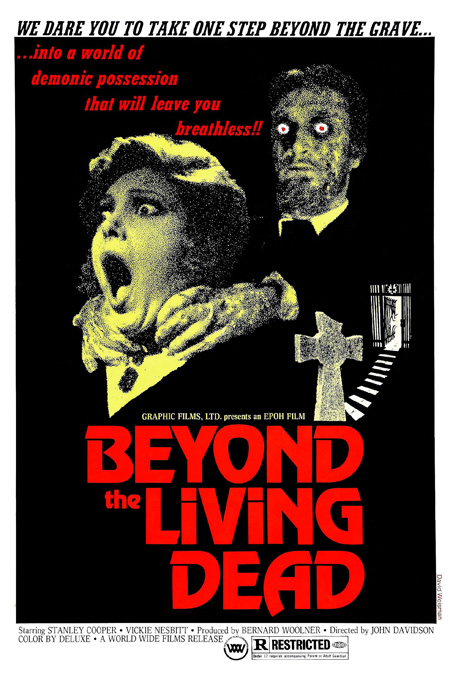
First released in 1973 and also known as The Hanging Woman, Beyond The Living Dead is a Spanish horror film that is just incoherent enough to be intriguing.
Having inherited the estate of his uncle, Serge Chekhov (Stelvio Rosi) arrives in the town of Skopje and is stunned to discover that, even though it’s only 6:00 in the evening, there’s no one in the streets. Everyone has retired to their homes. Even after Serge stumbles across a woman hanging in the cemetery, no one is willing to open their doors when he pounds on them. Serge finally finds his uncle’s place, where he discovers that the hanging woman was the daughter of his uncle’s widow, Countess Nadia Minalji (Maria Pia Conte). While Serge speaks to the police (who seem to view Serge as being the most likely suspect), Nadia retreats to her room, performs a black magic ceremony, and sends out a mental summons to Igor (Spanish horror great Paul Nashcy), a gravedigger who is also a necrophile and who has a huge collection of photographs of naked corpses in his shack.
Once Serge is finally able to convince the police that he’s not a murderer, he helps them when they chase Igor around the village. Later, Serge returns home and is promptly seduced by Nadia. The next morning, Nadia’s servant, Doris (Dyanik Zurakowska), begs Serge not to fire her and her father, Prof. Droila (Gerard Tischy). It turns out that Prof. Droila has a laboratory in the house’s basement where he’s been doing experiment on how to reanimate the dead. Serge has Doris undress for him and then, once she’s crying, he tells her that he already talked to the professor and agreed to allow him and his daughter to remain. WHAT THE HELL, SERGE!?
Got all that? I hope so because the film only gets stranger from there, with multiple murders occurring and Serge falling in love with Doris just as quickly as he fell in love with Nadia. As Igor stumbles around the village and peeps through people’s windows, Nadia holds a séance and eventually, a few decaying zombies show up. The plot is nearly impossible to follow, which is actually something that I tend to find to be true with a lot of Spanish horror films that were released during the Franco era. Making movies full of murder and nudity under a puritanical regime leads to a certain narrative incoherence. That said, the film plays out at such a strange pace and contains so many bizarre red herrings that it does achieve the feel of a particularly vivid dream.
Today, Beyond The Living Dead is best-remembered for Paul Naschy’s memorably weird performance as Igor. Naschy originally turned down the role, thinking that it was too small. The director allowed Naschy to rewrite the script to make Igor more interesting and it was Naschy who came up with the idea of making Igor not just a grave robber but also a necrophile. For English-speaking audiences, it can be hard for us to judge Naschy as an actor because we usually only see him in poorly dubbed films. (The English-language version of Beyond The Living Dead was apparently dubbed by a group of cockney voice actors.) But Naschy definitely had an imposing physical presence and this film makes good use of it.
Full of atmospheric visuals and surprisingly effective gore effects, Beyond The Living Dead does capture the viewer’s imagination, as long as one is content to not worry too much about trying to make much sense of it!
4 Shots From 4 Films is just what it says it is, 4 shots from 4 of our favorite films. As opposed to the reviews and recaps that we usually post, 4 Shots From 4 Films lets the visuals do the talking!
This October, we’re using this feature to recognize and honor some of our favorite horror directors! Today, we honor the one and only Jack Arnold!
4 Shots From 4 Jack Arnold Films
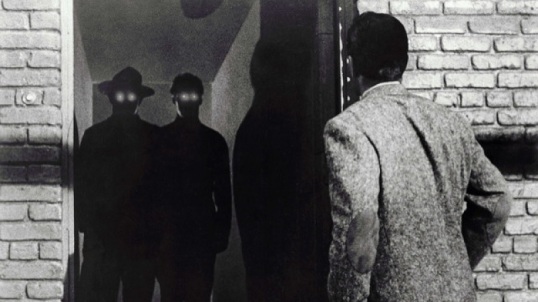
It Came From Outer Space (1953, dir by Jack Arnold, DP: Clifford Stine)
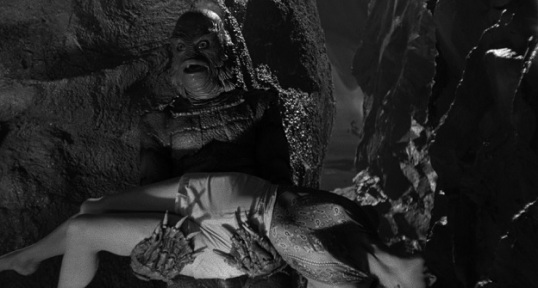
The Creature From The Black Lagoon (1954, dir by Jack Arnold, DP: William E. Snyder)
Tarantula (1955, dir by Jack Arnold, DP: George Robinson)
The Incredible Shrinking Man (1957, dir by Jack Arnold, DP: Ellis W. Carter)





 Through the Shattered Lens