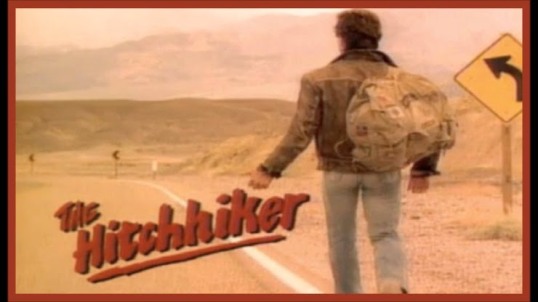
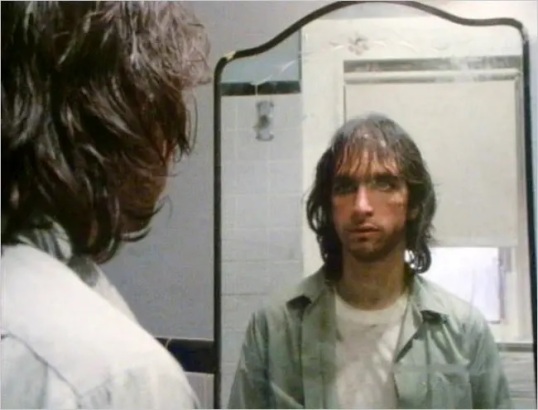
At the tail end of the 60s, the so-called king of acid rock, guitarist Billy Baltimore (Brad Dourif) was assassinated on stage. Or was he? When tabloid journalist Jane L. (Kirstie Alley) is told by her morally conflicted photographer, Hodie (Andy Summers of the Police), that he believes Billy Baltimore faked his own death and is actually living in a mansion and plotting his comeback, Jane L. decides to break into the mansion and find out for herself.
That turns out to be a big mistake. But, as badly as things go for Jane L. and Hodie, this is an entertaining episode that features Kirstie Alley at her most neurotic and Brad Dourif at his most off-beat. The ending might not make much sense but the journey is still worth it. For the record, the Hitchhiker (Page Fletcher) really does not like tabloid reporters.
The 1986 film, Sorority House Massacre, tells the story of two people who share a psychic bond.
Beth (Angela O’Neill) is a college student who can’t remember anything about her childhood and who was raised by her aunt. After her aunt dies, Beth joins a sorority and moves into their house. Almost from the minute that she arrives, Beth starts to have disturbing visions and dreams of a man with a knife and blood dripping from the ceiling. With most of the members of the sorority leaving for the Memorial Day weekend, Beth ends up staying with Linda (Wendy Martel), Sara (Pamela Ross), and Tracy (Nicole Rio). The other girls want to have a fun weekend but instead, they find themselves dealing with Beth and her glum attitude. Linda and Sara sincerely want to help. Tracy is a bit annoyed with the whole thing and I don’t blame her.
Meanwhile, a man named Bobby (John C. Russell) is a patient at a mental asylum. He’s been a patient ever since he was arrested for murdering almost his entire family. Bobby has been in a rage for the past few days, beating his head on the walls and attacking anyone who enters the room. Just as Beth finds herself having visions of Bobby, Bobby has visions of Beth. When Bobby does finally manage to escape from the hospital, the first thing he does is break into a hardware store and steal a hunting knife. (He uses the knife to take care of the owner of the store.) Then he steals a car and promptly drives off towards Los Angeles and the sorority house.
Sorority House Massacre was produced by Roger Corman and, just as he did with Slumber Party Massacre, he hired a woman to both direct and write the film. As such, while Sorority House Massacre has all of the usual scenes of sorority girls taking showers, trying on clothes, and running around in states of undress, it’s still never as misogynistic as some other slasher films. Beth, Sara, Linda, and Tracy all come across as being fully-rounded characters and the viewer doesn’t want anything bad to happen to any of them. If anything, in this film, it’s the various boyfriends who are portrayed as being somewhat disposable and easily victimized. Certainly, not a single one of the guys proves to be particularly useful once Bobby shows up at the sorority house and starts his massacre.
Why is Bobby fixated on the sorority house and Beth in particular? Director Carol Frank does a good job of portraying the killer’s mental state, with a good deal of the film’s scenes being shot from his own point of view. (Perhaps the scariest moments are not the ones featuring blood and knives but the ones in which the killer moves from location to location and we see, through his point of view, just how relentless he is.) Frank also takes us straight into Beth’s mind, showing us her vivid hallucinations as they happen and the end result is that Sorority House Massacre often has an unexpectedly surreal feel to it. It’s a low-budget slasher film that plays out like a filmed nightmare and it sticks with you, even after the end credits.
In the late 80s, Staten Island was the worst place on Earth.
That was one of the takeaways that I got from watching the 1986 film, Combat Shock. The film was shot on location on Staten Island and, indeed, it’s a grim viewing experience. Frankie Dunlan (played by Rick Giovinazzo, the brother of the film’s director, Buddy Giovinazzo) is a Vietnam war vet who, having spent time in a coma as a result of his war injuries, has returned home to a country that doesn’t have much use for him. He lives in a run-down and dirty apartment with his wife (Veronica Stork) and their gray, constantly-crying mutant baby. (The baby’s mutation is explained by Frankie’s exposure to Agent Orange.) Because Frankie has no skills, he can’t get a job. Because he can’t get a job, he has no money and his wife keeps yelling at him to call his father. But Frankie doesn’t want anything to do with his father, who was apparently a jingoistic racist and who currently believes that Frankie was killed in Vietnam.
(And perhaps Frankie was. There’s a part of me that wonders if the whole film was meant to be Frankie’s end-of-life vision as he lay dying in Vietnam.)
The television at the apartment only show static but Frankie and his wife watch it anyways. The milk in the refrigerator is expired but Frankie drinks it regardless. Frankie gets a note announcing that he and his family are about to be evicted but he doesn’t seem to be particularly upset about it. Frankie, who has the 1,000-yard stare of a man continually woken up by nightmares and the ever-present dirty stubble of a meth addict, is too trapped in the horrors of the past to fully comprehend the horrors of the present.
Leaving his apartment, Frankie wanders around the dirtiest and most depressing areas of Staten Island. The buildings are abandoned. Every wall is covered in graffiti. Gangs roam the streets. Frankie runs into a desperate drug addict who is later seen ripping open his arms so that he can sprinkle heroin into his flesh. Outside an employment office, a mysterious blonde on a motorcycle looks at Frankie and appears to invited him to join her but Frankie refuses to move. Inside the employment office, Frankie’s case worker speaks in non-sequiturs. “Life is hot, and because life is hot, I must take off my jacket,” the case worker says while Frankie stares at him with a blank look on his face.
Frankie has visions and hears voices. His flashbacks to Vietnam are filmed in haunting slow motion, all the more to make us wonder if he’s actually seeing what happened in the past or if he’s hallucinating an entirely different existence for himself. Combat Shock is a horror film but it’s the horror of Frankie’s fractured mind. Frankie served his country but now his country views him with disgust. The film ends on a dark note, one that is not pleasant to watch but one that equally feels pre-destined.
Combat Shock is a film that is so grim and dark that it’s developed a semi-legendary reputation. Watching the film, I respected the filmmaker for staying true to his dark vision and essentially refusing to compromise or let up in the least. At the same time, I have to admit that I got a little bit bored with film’s nonstop darkness. As a character, Frankie is not particularly compelling. (The film has been frequently compared to David Lynch’s Eraserhead but Combat Shock has none of that film’s quirky humor and Frankie is nowhere near as sympathetic as Jack Nance’s Henry.) The film succeeds by staying true to itself but, in the end, it’s not a film that most people will want to watch a second time. And perhaps that’s the point. Frankie may be too desensitized to be angry but the film is outraged at way the country treats men like Frankie, who carry the scars of serving their country but who have simply been pushed to the side by a society that doesn’t want to be reminded of the bad times. Much like An American Hippie In Israel, Combat Shock is a film that demands that we stop pushing buttons and take care of each other.
Today’s Blast From The Past comes to us from 1990 and it’s a scary one.
In The Fourth Man, Peter Billingsley (yes, the kid from A Christmas Story) plays Joey Martelli, an insecure high schooler who thinks that he’ll be more attractive to girls if he becomes more like his best friend, friendly jock Steve Guarino (Vince Vaughn, making his film debut and already physically towering over everyone else in the cast). With Steve’s encouragement, Joey tries out for the track team and, to everyone’s surprise, he makes it!
Joey is now an athlete. He finally has friends. Girls (including Nicole Eggert) are talking to him. His father (Tim Rossovich) is finally proud of him. But Joey soon discovers that staying on the track team is not an easy task. His coach tells Joey that he has to pick up his speed. Feeling desperate, Joey does what so many other television teenagers before him have done. He starts taking steroids! (Dramatic music cue!) Soon, the kid from A Christmas Story is breaking out in pimples, throwing temper tantrums, and becoming a rage-fueled monster! Joey only took the steroids because he wanted to be as cool as Steve but, unfortunatey, Joey learns too late that Steve’s success and popularity are not due to how big and strong he is but to the fact that he is played by a young Vince Vaughn.
(Myself, I was fortunate enough to go to a high school where the emphasis was placed more on the arts and intellectual pursuits than athletic success. My school didn’t even have its own football field. We had to share with the high school down the street! Anyway, as a result, I don’t think knew anyone in high school who was abusing steroids and I never had to deal with anyone suddenly flying into a rage and punching a hole in a wall or any of the other stuff that always happens whenever anyone abuses steroids on television.)
The Fourth Man was written and directed by Joanna Lee, who is perhaps best known for playing Tanna the Alien in Ed Wood’s Plan Nine From Outer Space. (Lee, it should be noted, had a very long and respected career as a writer and director of television dramas. In many ways, she had the career that Ed Wood imagined that he would someday have.) Along with Billingsley and Vaughn, the cast includes horror mainstay Adrienne Barbeau as Joey’s mother and football player-turned-horror-actor Lyle Alzado as a man who has his own history with steroids. The film has good intentions and a good message about not taking shortcuts and being happy with who you are but I imagine that most people will just want to watch it to see Peter Billingsley descend into roid rage. And I will say that, for all the film’s melodrama, there is something a little bit disturbing about watching fresh-faced Peter Billingsley turn into a physically aggressive bully.
From October of 1990 (and complete with the commercials than ran during the program’s first broadcast), here is The Fourth Man.
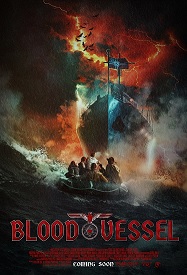
In the waning days of World War II, a group of Allied soldiers and reporters find themselves floating in a lifeboat, having survived the torpedoing of the troop transport on which they were previously traveling. A mix of Australians, Brits, Russians, and Americans, the survivors are on the verge of giving up when they spot an apparently abandoned German boat floating in the middle of the ocean.
The survivors board the boat and discover that the crew is missing or dead. The only survivor on the boat is a little girl (Ruby Isobel Hall) who hungrily eyes any open cut. The survivors discover that the boat was supposed to be shipping art that had been stolen by the Nazis but that the boat instead picked up some unexpected passengers who wiped out the crew and who are still hungry for blood. While one weaselly survivor resorts to trying to contact the Germans for help, the others try to stay alive in an environment that they can’t control.
Blood Vessel owes an obvious debt to the Alien franchise, with the survivors roughly corresponding to the space marines who failed to stop the Xenomorphs in Aliens and the ship acting as a water-bound version of the rickety spaceships that have appeared throughout all of the Alien films. There’s no real surprise to the nature of the monsters that have taken over the boat. The film’s entire premise is right there in the title. But Blood Vessel is claustrophobic and the monsters, when they do make their eventual appearance, are frightening in both their ruthless savagery and the mocking joy that they take in their activities.
All the more memorable for having been shot on an actual boat, Blood Vessel is effective low-budget horror.
A true American success story, Bruce Campbell first met and befriended Sam Raimi when the two of them were high school students in Michigan. Campbell first gained attention in Raimi’s Evil Dead films and he’s been a mainstay in Raimi’s films ever since. He’s also been a favorite of the Coen Brothers, Don Coscarelli, William Lustig, and scores of other director. Few actors can balance both drama and comedy with the adroitness of Bruce Campbell.
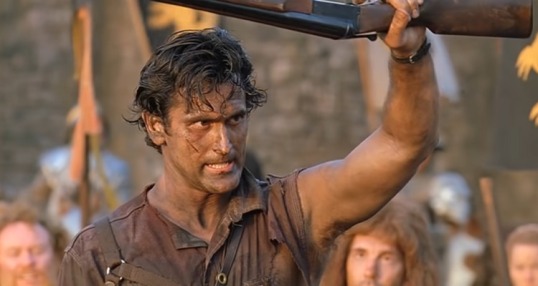
Campbell, of course, is best-known for his performance as Ash Williams, the S-Mart store clerk who lost his hand while spending the weekend at a cabin, spent some time in the past, and later earned the right to tell us all to say “hail to the king, baby.” Campbell’s ability to do often violent slapstick comedy, along with his ability to deliver the most absurd of dialogue with a straight face, came together to make him into a true pop cultural icon. Though Campbell has since announced his retirement from playing Ash (saying that, at his age, he can no longer physically spends hours a day getting beaten up), he remains a beloved actor to horror fans everywhere.
Today’s scene that I love comes from 1992’s Army of Darkness and it features Bruce Campbell at his best. All Ash has to do is remember three simple words and say them before taking the Necronomicon from its place. Of course, Ash being Ash, things don’t quite work out that simply….
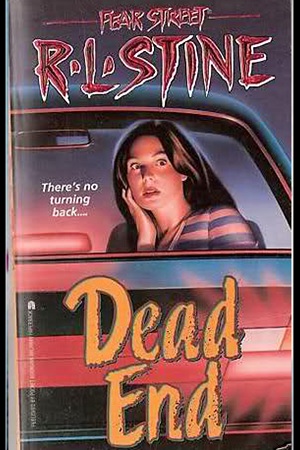
First published in 1995, Dead End begins with Natalie making what seems like the right decision.
Realizing that her boyfriend, Keith, has had way too much to drink at a party, Natalie refuses to ride home with him. Instead, she joins her friends Carlo, Gillian, and Todd in getting a ride from their sweet and responsible friend, Randee. Seriously, Keith has already fallen down a flight of stairs and made the party awkward by throwing up all over the place. Drunks are so annoying!
Anyway, Randee is driving everyone home when a sudden fogs rolls in and makes it difficult to see the road ahead of her. Uh-oh! Better pull over until that fog clears up or your might — AGCK! Randee smashes into a car! And then she drives off, without even bothering to get out of the car and make sure that the other driver is okay! Natalie freaks out but all of her friends explain to her why they can’t run the risk of going to the police. I mean, Randee wasn’t even supposed to be driving the car! Someone else has a relative in the hospital! Todd’s father has just started a new job and it would be really awkward if his son got arrested for being a passenger in a car! Natalie eventually agrees to keep quiet about the accident.
But then, the next day, she discovers that the car they hit belonged to the mayor’s sister. And now the mayor’s sister is dead! Can Natalie and her friends keep the secret, even though there now appears to be someone stalking them and doing stuff like leaving spoiled meat around as a warning that they’re dead meat as well? Can Natalie figure out who the mysterious stalker is before all of her friends are killed? And will she be able to work out her relationship issues with Keith? Seriously, priorities!
If this sounds familiar, it’s because R.L. Stine pretty much just transported the plot of I Know What You Did Last Summer to Shadyside and he really didn’t bother to add any surprising twists or turns. The end result is one of the more forgettable entries in the Fear Street series. There is one nicely macabre death scene in which someone basically loses their face but otherwise, this is Stine on autopilot.
In the end, I guess the important thing is that the book reminds its readers not to drink and drive and that’s a good thing. As well, if a sudden fog rolls in, pull over. It’s just not worth the risk!
Over a three week period, in 2002, a sniper shot 27 people in Maryland, Virginia, and Washington, D.C., killing 17 of them. For that three week period, the nation lived in fear of an unknown evil that was traveling the highways and killing people seemingly at random. Even though the murders occurred in the area surrounding our nation’s capitol, there was very much a feeling that the sniper could turn up anywhere and at anytime. There was a lot of speculation about who the sniper was, with many theorizing that it was Al Quaeda while others argued that the killer was just another home-grown serial killer with a grudge.
When John Allen Muhammad and Lee Malvo were eventually arrested, it turned out that both sides were correct. Muhammad was an American-bred spree killer, a man who had a grudge against the entire world and who brainwashed a teenage Lee Malvo into serving as his accomplice. However, Muhammad also turned out to be a terrorist, someone who admired Osama Bin Laden and sympathized with Al Quaeda, even if he never personally had any contact with the group itself.
When Muhammad went on trial for the murders, there was never really any doubt that he would be found guilty and given the death penalty. There was also little doubt that Ulli Lommel would eventually make a movie about him.
Ulli Lommel was a German director who got his start working with the legendary Rainer Werner Fassbinder. Lommel starred in several of Fassbinder’s early films and went on to have a successful directorial career in Germany. Eventually, he came to the U.S., where he married heiress Suzanna Love and hung out with people like Andy Warhol. In the U.S., Lommel continued to direct. He was responsible for some of the first documentaries about punk rock. His film Cocaine Cowboys featured Andy Warhol playing himself. His horror films, The Boogeyman and the Devonsville Terror, may not have been beloved by critics but they both quickly amassed cult followings. However, after getting divorced from Love, Lommel seemingly disappeared until he reemerged in the 2000s as a director who specialized in cheap, direct-to-video true crime films. Lommel directed films about Richard Ramirez, Son of Sam, Gary Ridgway, the Zodiac Killer, and many others. While most critics dismissed Lommel’s later films as being exploitive trash, Lommel claimed that he was using the serial killer genre as a way to explore and expose the hypocricy of American society.
Myself, I love the idea of a crazy auteur so nothing would make me happier than to be able to declare that there was some sort of overlooked genius to Lommel’s later films. However, from what I’ve seen of them, I have to say this is a rare case where I find myself agreeing with the critics. For the most part, Lommel’s later films were trash. While I have no doubt that Lommel probably was being serious in his belief that his serial killer films had a deeper meaning, the majority of them were cheaply made and dramatically incoherent.
That said, D.C. Sniper actually is one of Lommel’s better serial killer films. A lot of that is due to the intense and intimidating performance of Ken Foree in the role of John Allen Muhammad. Foree is credited with co-writing the script and the scenes in which he discusses his resentments while staring straight at the camera are truly frightening and they probably do capture what was going on in Muhammad’s head at the time of the killings. The scenes between Muhammad and Lee Malvo (played by Tory N. Thompson) also have a creepy feeling of authenticity to them as we watch as Muhammad turns Malvo into a killer. In the scenes with Thompson, Foree plays Muhammad as being alternatively nurturing and fearsome and again, one gets the feeling that the scenes are probably close to the truth.
That said, it’s still a Lommel film, which means that the budget is low, there’s a lot of meandering shots of people driving from one location to another, and the majority of the film looks like it was filmed on a phone. When the film isn’t following Muhammad, it’s following an FBI agent (Christopher Kiesa), who is working undercover as a tourist. The FBI agents wanders around various D.C. monuments and takes pictures. We hear his voice-over, in which he explains that he’s more worried about his runaway daughter, who is apparently being turned into an “internet slut” by her boyfriend. At one point, the FBI agent stands at the Potomac River and wonders if George Washington would be considered a terrorist by modern standards. Lommel himself plays the FBI’s enigmatic partner, a detective known as the Cowboy due to his choice of headgear. As one point, the Cowboy promises that he will help the FBI agent find his daughter. The plotline is dropped after that and we don’t hear another word about it, leaving us to wonder why it was even brought up in the first place.
In the end, D.C. Sniper is good Lommel just because regular Lommel is so bad.
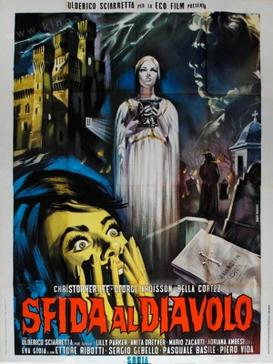
A criminal named Carlo lands in Italy and soon finds himself being pursued a group of gangsters. An extended shoot-out leads to Carlo being serious wounded. Carlo stumbles into a church, where he is met by a monk who used to be an friend of his. Carlo explains that he has been blackmailing a Beirut crime lord and now the crime lord’s men are after him. Unfortunately, Carlo gave all the evidence to an exotic dancer and now he needs the evidence back but, obviously, he can’t show his face in the streets. The monk goes to a nightclub and, after watching several different cabaret acts that have nothing to do with the rest of the film, he finally gets a chance to talk to the dancer. The dancer is also an old friend of his but hasn’t seen him since he became a monk and she demands to know what led to this development in his life. The monk tells her the story of his past, in return for her giving him the evidence.
In the distant past, the monk was a part of a motorcycle gang led by wannabe gangster Gian (Mario Polletin) and a failed poet, Gugo (Giorgio Ardisson). One day, Gian, Gugo, the future monk, and their respective girlfriends decided to break into an apparently deserted castle, where they decided to have a wild party. Of course, to them, a wild party meant playing the bongos and drinking wine. However, it turned out that the castle wasn’t totally deserted. There was an old man (Christopher Lee) living in the castle and the old man explained that the love of his life had died years before and that her body was somewhere in the castle. If Gugo and the gang found her body and brought her to the old man so that he could give her a decent burial before his own death, the old man would give them the castle. The greedy and drunken gang agreed but they soon discovered that the castle was full of secrets and the old man was not quite who he claimed….
Challenge The Devil is a thoroughly disjointed film, one with a plot that is almost impossible to follow. Some of that is because of the film’s troubled production history. Originally, the film was titled Katarsis and it was simply about the gang coming across the castle and meeting Christopher Lee. However, after the film was shot, the production company went out of business and the film’s new owner decided to re-edit the film and tack on the scenes involving Carlo, the dancer, and the monk. None of the new scenes fit with the style of the old scenes and, indeed, all of the nonsense with Carlo and the dancer means that the film’s main story doesn’t even get started until after about 20 minutes of filler. Of course, it should be noted that even the original version of the film doesn’t look like it was that good. This was director Giuseppe Vegezzi’s only feature film and he shows very little natural ability when it comes to framing shots or creating atmosphere.
But what about Christopher Lee, you may be asking. He’s fine. I mean, Christopher Lee is imposing and his physical presence is so strong that he even makes an impression in a bad film. But Lee only gets a few minutes of screen time. For his part, Lee said that this was one of the film that he did for the money and he never actually saw the finished product. I don’t blame him. This one is for Lee completists only.
4 Shots From 4 Films is just what it says it is, 4 shots from 4 of our favorite films. As opposed to the reviews and recaps that we usually post, 4 Shots From 4 Films is all about letting the visuals do the talking.
This October, I am going to be using our 4 Shots From 4 Films feature to pay tribute to some of my favorite horror directors, in alphabetical order! That’s right, we’re going from Argento to Zombie in one month!
Today’s director is Charles Band, the legendary founder of Full Moon Pictures!
4 Shots From 4 Charles Band Films
Meridian: Kiss of the Beast (1990, dir by Charles Band, DP: Marc Ahlberg)
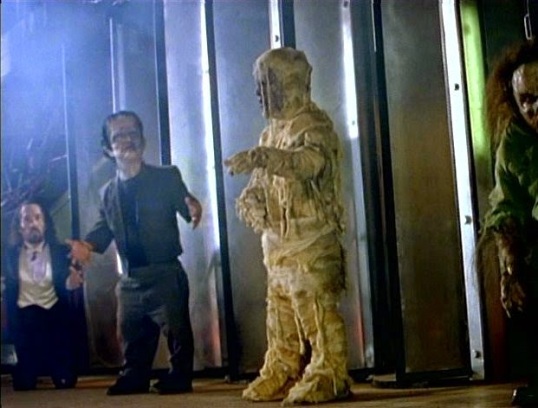
The Creeps (1997, dir by Charles Band, DP: Adolfo Bartoli)
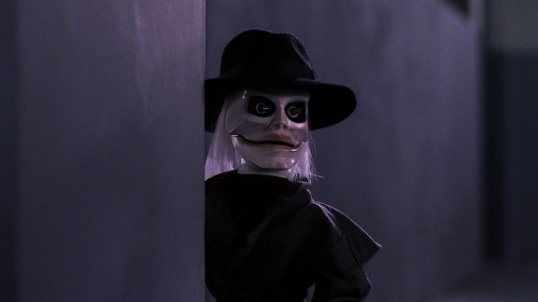
Puppet Master: The Legacy (2003, dir by Charles Band, DP: Marc Ahlberg)
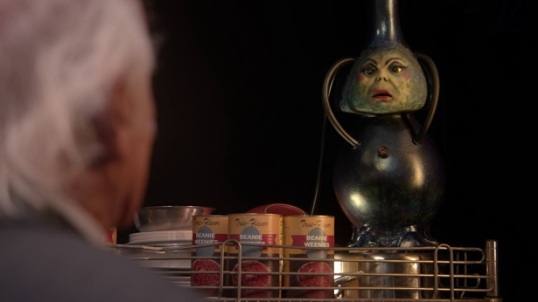
Evil Bong 888: Infinity High (2022, dir by Charles Band, DP: Alex Nicolaou)



 Through the Shattered Lens