Dead Man’s Gold (1948, directed by Ray Taylor)


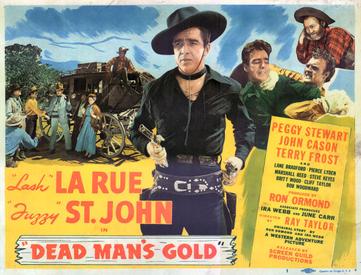
Jim Thornton (Britt Wood) has discovered a gold mine so he writes to his old friends, Lash LaRue (Lash La Rue) and Fuzzy (Al St. John), asking them to come help him guard it.  When Lash and Fuzzy arrive, Jim is nowhere to be found.  With the help of Jim’s niece (Peggy Stewart), they discover that Jim’s been murdered.  It doesn’t take a genius to realize that the murder was carried out by Conway (Jason Cason) and his men and that’s a good thing because a genius is something you will never find in a Lash La Rue western.  However, Lash suspects that Conway was following someone else’s orders.  He and Fuzzy set up a trap to reveal the true identity of the mastermind.

Lash dresses in all black and often uses a whip instead of a gun but this is still a standard B-western.  Historically, it’s important because it was the first movie that La Rue made with producer Ron Ormond.  Ormond later went from producing Lash La Rue films to directing them and Lash’s career never really recovered.  (Ormond, whose non-Lash LaRue films included Mesa of Lost Women and If Footmen Tire You, What Will Horses Do?, was never much of a director.)  Fortunately, Dead Man’s Gold was directed by the dependable Ray Taylor, who keeps the action moving and crafts an adequate if not exactly memorable western.

There is one cool scene in Dead Man’s Gold, in which Lash uses his whip to knock a shot glass out of a bad guy’s hand.  Let’s see The Lone Ranger do that!

Return of the Lash (1947, directed by Ray Taylor)


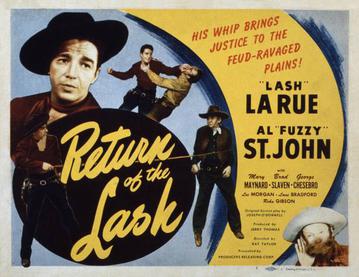
There’s another range war brewing on the frontier.  Big Jim Kirby (George Chesebro) knows there’s plans for a new railroad so he wants to steal the land from the ranchers so he can make a fortune off a selling it.  Kirby calls in everyone’s mortgage, knowing they’ll never be able to pay.  Rancher Tom Grant (Buster Slaven) reaches out to Cheyenne Davis (Lash LaRue, a look alike for Humphrey Bogart)) and Fuzzy Q. Jones (Al St. John) for help.  Cheyenne raises the money but then he makes the mistake of trusting Fuzzy to deliver it.  Fuzzy takes a knock to the noggin and now, he’s got amnesia.  Where’s the money?

This is a standard B-western and you know the drill.  Big Jim’s henchmen don’t want that money to get paid.  Cheyenne is on the side of the angels.  Fuzzy provides comic relief.  Lash LaRue appeared in several B-westerns.  He never became as big a star as some of his contemporaries but he did have a gimmick that made him memorable.  Most westerns stars used guns.  LaRue had a bullwhip.  When LaRue was first offered the role of Cheyenne, he lied and said he could crack a whip.  After he struggled to teach himself, tiny production company PRC hired a professional trainer.  That was a huge expense for a poverty row studio but it paid off because LaRue became proficient with the whip and he had a surprisingly long career.  He was born Alfred LaRue.  The studio came up with the Lash nickname.  Many western stars, like Johnny Mack Brown, played characters who shared their name.  Lash almost always played Cheyenne Davis.

Lash LaRue’s movies were cheap and never that memorable.  In this one, Lash barely appears and most of the action is carried out by Al St. John as Fuzzy.  But Lash LaRue did play an important part in Hollywood history when he briefly came out of retirement to teach Harrison Ford how to crack a whip for a little film called Raiders of the Lost Ark.

Bar-Z Bad Men (1937, directed by Sam Newfield)


After getting kicked out of town for shooting the place up during a night of friendly fun, cowboy Jim Waters (Johnny Mack Brown) drops in on his old friend, rancher Ed Parks (Jack Rothwell).  Ed has got a strange problem.  There are cattle rustlers about but instead of stealing Ed’s cattle, they’re adding cattle to Ed’s herd.  It’s an obvious scheme to try to create a feud between Ed and his neighbor, rancher Hamp Harvey (Frank LaRue).  Before Jim and Ed can solve the problem, Ed is gunned down.  Harvey is the number one suspect but Jim figures out the truth, that Harvey has been betrayed by one of his own employees and that all of this is a part of a scheme by Sig Bostell (Tom London) to take control of both ranches.

Bar-Z Bad Man is a B-western with a notably twisty plot as Bostell plays both sides against each other for his own benefit.  As usual, Johnny Mack Brown makes for a good and convincing western hero.  Whether he’s chasing someone on his horse or drawing his guns, Brown is always a convincing cowboy.  What makes this film interesting is that it opens with Johnny Mack Brown engaging in the type of behavior that most B-western heroes would never think of doing.  Shooting up the town and then getting exiled for his actions adds an element of redemption to Jim’s efforts to get to the bottom of Bostell’s schemes.  Or it would if Jim ever really seemed to feel bad about shooting the town up.  His excuse is that he was just having a good time.  Try to get away with that in the real old west, Jim!

Bar-Z Bad Men is a good B-western for those who like the genre.  The story is solid and Johnny Mack Brown is as convincing saving the west as he was shooting it up.


Chip of the Flying U (1939, directed by Ralph Staub)


In this B-western, Johnny Mack Brown plays Chip Bennett, the foreman of the Flying U Ranch.  The ranch is owned by J.G. Whitmore (Forrest Taylor) and his daughter (Doris Weston), who has just returned from college and who has eyes for Dusty (Bob Baker), a singing ranchhand.

Ed Duncan (Anthony Warde) and his gang are in the arms smuggling business.  To make their business a success, they need access to the ranch, which sits on the shore of a lake.  Knowing that Chip would never let them take over, Duncan tries to frame Chip for a bank robbery and murder.  Chip responds by kidnapping two of Duncan’s men, leading to a final and explosive shootout.

Chip of the Flying U is a western that doesn’t seem to know what era it’s supposed to be taking place in.  Chip, Duncan, and all of the other ranch hands dress like they’re in the late 1800s.  Doris Weston dresses like she’s just stepped out of a 1930s photoshoot.  Duncan is trying to smuggle hand grenades, which were invented in 1908 but not commonly used until World War I.  The movie’s time period is all over the place but that was frequently the case with the B-westerns of the 30s.  Shot on studio backlots and for a very low budget, these films were not concerned with historical accuracy.  Instead, they were about shootouts and a few songs.  Chip of the Flying U offers up both, along with Fuzzy Knight as the comedic sidekick who turns out to be very good with a rifle.

With lots of horse chases and bloodless shoot-outs and not too much romance, this movie may seem creaky by today’s standards but probably thrilled the kids who caught while spending an afternoon at the movies in 1939.  Today, the appeal of movies like this is that the good guys are unquestionably good and the bad guys are unquestionably bad.  They remind us of a simpler time that may have never existed but we all hope it did.

Roaring Rangers (1946, directed by Ray Nazarro)


Another frontier town is in trouble.

Sherriff Jeff Conner (Jack Rockwell) is having trouble ridding his town of outlaws so his son, Larry, (Mickey Kuhn) writes a letter to his hero to ask for help.  He addresses the letter to “Durango Kid, Texas.”  That’s all it takes for Steve Randall (Charles Starrett) and his sidekick, Smiley Burnette, to show up in town.

Steve and Smiley apply to be deputies but Sheriff Conner explains that someone is circulating a petition to get him fired.  Steve dresses up as the Durango Kid and pressures the citizens to give the Sheriff another chance.  Realizing that the Durango Kid is making them look bad, the outlaws decide to dress up one of their own as Durango and make the Kid look bad.  With the town turning on Durango, will Durango and Smiley be able to save Sheriff Conner from an assassination attempt?

This Durango Kid film is different from the rest of the series in that, for once, Steve is hired to be a deputy instead of a sheriff.  This really is Sheriff Conner’s story, as he tries to win the respect of the town and keep its citizens safe, even while his own brother (Ed Cassidy) is working with the outlaws.  There are all the usual horse chase and shootouts but this time, Durango and Smiley are mostly around to provide support to a man who is trying to do the right thing.  B-western fans will enjoy it.

Smiley sings a few songs, as always.  This time, musical accompaniment is provided by Merle Travis and his Bronco Busters.

Landrush (1946, directed by Vernon Keays)


Steve Harmon (Charles Starrett) rides again!  This time, he’s investigating the murder of a Pony Express rider.  The murderer is outlaw leader Claw Hawkins (Bud Geary), who is working with rancher Kirby Garvey (Steve Barclay) to cheat the local homesteaders out of their land.

When local newspaper editor Jake Parker (Emmett Lynn) is attacked for trying to expose Claw Hawkins, Steve puts on a mask and dark clothing and, as the Durango Kid, he moves Jake to the carpentry shop owned by Durango’s old friend, Smiley Burnette.  While Jake continues to spread the word to the homesteaders, Durango works to prevent Claw and Kirby from taking all of the land for themselves.

This is a typical Durango Kid film.  This is not the first time that I’ve seen the Durango Kid protect the rights of homesteaders and, as usual, the main villain is not the outlaw that everyone fears but the respectable citizen who is controlling him.  Along with the usual gunfights and horse chases, Landrush has an exciting sequence where Durango and the homesteaders have to deal with a series of fires that have been set by Claw to keep the homesteaders from reaching their land.  Charles Starrett is as authentic a cowboy as ever.  Unfortunately, Bud Geary and Steve Barclay aren’t very interesting as the villains.  People who have watched several Durango Kid films will regret that series regulars Frank Fenton and Jock Mahoney weren’t cast in the roles.

As usual, Smiley Burnette provides comedy relief and sings two songs.  This time, he’s accompanied by Ozie Waters and His Colorado Rangers.

The Desert Horseman (1946, directed by Ray Nazarro)


Steve Godfrey (Charles Starrett) is in trouble again.  He has been accused of stealing another payroll and the only man who can clear his name has just been murdered.  Steve thinks that he is being set up by outlaws who want to take control of the dead man’s ranch, which is now owned by Mary Ann Jarvis (Adele Roberts).

Luckily, Steve’s old friend, Smiley Burnette, is working as a cook at the Jarvis Ranch.  When Smiley isn’t singing songs with the Colorado Hillbillies, he tries to help Steve clear his name.  He explains that Mary Ann Jarvis won’t listen to Steve but maybe she’ll listen to Steve’s alter ego, The Durango Kid!

Durango rides again in this movie, though, the majority of the hour runtime is made up of Smiley Burnette singing songs and making jokes.  Smiley Burnette is not for everyone.  I enjoy the broad humor he brought to these films but I can understand why others might not.  Whenever Smiley sings a song, it does bring the action to a halt but that’s true of every Durango Kid film.  If you’re a fan of the series, you either like Smiley or you can at least tolerate him.  Smiley does do more than just sing in this movie.  He also throws black pepper in the eyes of one of the bad guys.

Even with all of the attention paid to Smiley, The Desert Horseman delivers all of the expected horse chases and gunfights.  The story is a little more interesting than usual.  Steve has been framed for not one but two crimes that he didn’t commit and that adds some urgency to the proceedings.  Charles Starrett, as always, is a believable western hero and he takes the role seriously.


The Lone Hand Texan (1947, directed by Ray Nazarro)


Oil’s been discovered on the Texas frontier and Sam Jason (Fred Sears) has got the rights to several wells.  Someone in town keeps sabotaging his operations and blowing up his oil wells.  Sam sends a telegram to his old friend, Steve Driscoll (Charles Starrett).  Steve shows up in town to help Sam set up his business.  Meanwhile, Steve’s alter ego, the masked Durango Kid, works to discover who has been targeting Sam.

This is actually more of a Smiley Burnette movie than a Durango Kid film.  As always, Smiley is the Kid’s sidekick in the movie.  Smiley owns a general store and he’s the towns postmaster.  Everywhere Smiley goes, he is followed by two musicians, Mustard and Gravy.  Smiley sings even more songs than usual in this movie and he even has a brief romance with the local widow (Mary Newton), who unfortunately is also behind the efforts to drive Sam out of business.  Smiley may be the sidekick but he gets more screentime than the Durango Kid in The Lone Hand Texan and he does a mighty fine job with it.

One of the curious things about The Lone Hand Texan is that one of the bad guys also decides to wear a mask and claim to be The Durango Kid.  I wish the movie has done more with that because I have never really understood why Steve feels like he has to pretend to be Durango in the first place.  It’s not as if it’s difficult to recognize Steve, even when he’s wearing a mask.  I have never understood why no one in his movies ever notices that you never see Steve and the Durango Kid in the same place at the same time.  Even Lois Lane should have been able to figure out Durango’s secret identity.

The Lone Hand Texas is a standard Durango Kid outing, albeit not as dependent on stock footage as some of Durango’s other films.  Smiley gets to do more than usual, which is the only thing that really sets it apart.  As with most of the Durango Kid films, it will be best appreciated by those who are already fans.

Streets of Ghost Town (1950, directed by Ray Nazarro)


Years ago, Bill Donner (George Cheseboro) double-crossed the other members of the Selby Gang and ran off with all of their stolen gold.  Now, Donner is blind and half-crazy.  When he says that he hid the gold in the ghost town of Shadeville, the Durango Kid (Charles Starrett), Smiley Burnette, and Sheriff Dodge (Stanley Andrews) ride off to find it.

Shadeville is long abandoned and, as the three men spend the night in a deserted saloon, Smiley is worried about ghosts.  The Durango Kid tells the story of the first time he met the Selby Gang.  The next morning, they discover that they are not the only ones who have come to Shadeville to look for the gold.

Like many of the later Durango Kid movies, Streets of Ghost Town is mostly made up of stock footage to Starrett’s earlier films.  This was a cost-cutting technique on the part of Columbia Pictures but it actually works because the flashbacks were always to the horse chases and the gunfights that the audience came to see in the first place.  In the days before home video and cable, those scenes were probably still new to many of the people sitting in the theater.

Starrett always made for a good hero and Smiley Burnett’s comic relief never took away from the films’s storylines.  This outing features a great scene where Durango shoots a skull in the dark just to let anyone watching him know that he’s a good shot.  I also enjoyed George Cheseboro’s manic performance as a man who really loves his gold.  Despite all of the stock footage, Streets of Ghost Town is still an above average Durango Kid film, predictable but entertaining if you’re a fan of the genre.