The Unnominated #16: The Mortal Storm (dir by Frank Borzage)


Though the Academy of Motion Picture Arts and Sciences claim that the Oscars honor the best of the year, we all know that there are always worthy films and performances that end up getting overlooked.  Sometimes, it’s because the competition too fierce.  Sometimes, it’s because the film itself was too controversial.  Often, it’s just a case of a film’s quality not being fully recognized until years after its initial released.  This series of reviews takes a look at the films and performances that should have been nominated but were, for whatever reason, overlooked.  These are the Unnominated.

Oh, how this movie made me cry!

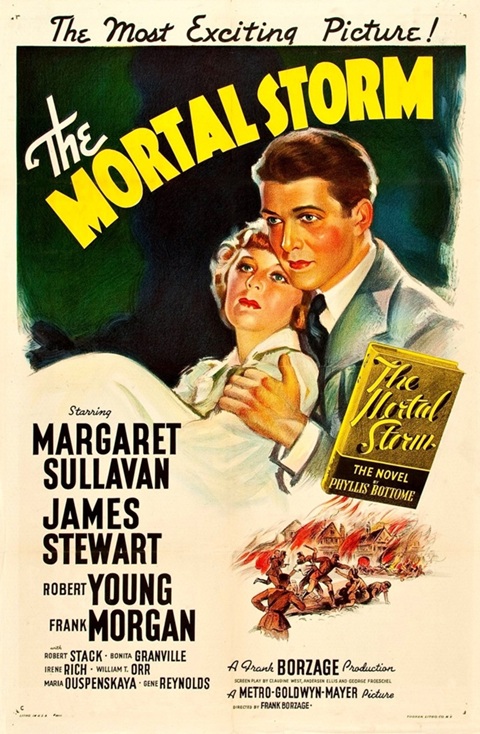
Released in 1940, at a time when war was spreading across Europe, Asia, and Africa but the United States was still officially neutral, The Mortal Storm opens on January 30th, 1933.  In the mountains of Germany, near the Austrian border, Professor Viktor Roth (Frank Morgan) is celebrating his 60th birthday.  He starts the day being applauded by his students at the local college.  In the evening, he returns home for a celebration with his family, including wife (Irene Rich), his daughter Freya (Margaret Sullivan), his son Rudi (Gene Reynolds), and his two stepsons, Otto (Robert Stack) and Erich von Rohn (William T. Orr).  Also present are Freya’s fiancé, Fritz (Robert Young) and one of Roth’s students, a pacifist named Martin Breitner (James Stewart).  It’s a joyous occasion and the film takes its time introducing us to Prof. Roth and his extended family.  At first, everyone seems very kind.  They seem like people who most viewers would want to spend time with or live next to….

But then, the family’s maid excitedly enters the room and announces that it’s just been announced that Adolf Hitler is the new chancellor of Germany.  Otto and Erich are overjoyed and head out to celebrate with the other members of the Nazi Youth Leage.  Martin is less happy and excuses himself to return home.  Roth and his wife worry about what this means for people who do not agree with Hitler’s beliefs.  Freya says that they shouldn’t talk politics.  It is jokingly mentioned that Hitler has taken away Roth’s special day but Roth’s young son Rudi says that he’s learned in school that the needs of the individual will never be more important than the needs of the state.  If Hitler wants to take away your day, it’s your duty to give it up or face the consequences.

Based on a 1937 novel, The Mortal Storm was not the first Hollywood production to take a stand against Hitler and the Nazis but it was one of the best.  I say this despite the fact that the film only hints at the fact that Prof. Roth is Jewish, something that was made very clear in the book.  (In the movie, Roth and his wife worry what will happen to “Non-Aryans” and “freethinkers.”)  That said, the film perfectly captures how quickly and insidiously the authoritarian impulse can spread.  The town, which once seemed so friendly, becomes a very dark place as the students at the university put on their swastika armbands and start to hunt down anyone who dissents from the party line.  When Roth says that, as a scientist, he does not believe one race can be genetically superior to another, his students walk out on him.  A local teacher is beaten when he fails to return to the Nazi salute.  When Martin refuses to join the Party, Otto and Erich turn against him despite being lifelong friends.  When Martina and Freya flee for the border, Fritz pursues them.  And even after Prof. Roth is sent to a concentration camp, Otto and Erich continue to follow the orders of Hull (Dan Dailey), the sinister Youth Party Leader.

It’s a powerful film, one that remains just as relevant today as it was when it was first released.  Hull and Erich’s fanaticism would, today, find a welcome home on social media.  The scenes in which the townspeople eagerly threaten to report their former friends and neighbors for failing to salute or show proper enthusiasm for the government have far too many modern day equivalents for me to even begin to list them all.  This film was also the last the James Stewart made with frequent co-star Margaret Sullivan and they both give great performances.  (All-American Jimmy Stewart might seem a strange choice to play a German farmer but he is never less that convincing as Martin, one of the few people in the town not to surrender his principles and beliefs to the crowd.)  The film’s final moments, with the camera panning around the empty Roth home, brought very real tears to my eyes.

Despite being a powerful film, The Mortal Storm was not nominated for a single Oscar.  (Jimmy Stewart did win his only Oscar that year but it was for The Philadelphia Story.)  It’s temping to assume that, at a time when America was still divided about how to react to the war in Europe and when many Americans still remembered the trauma of the first World War, The Mortal Storm was too explicitly political and anti-Nazi to get a nomination but, the same year, The Great Dictator was nominated for Best Picture.  It seems more likely that, in those days when the studios ruled supreme, MGM decided to puts it weight behind The Philadelphia Story rather than The Mortal Storm.

That said, The Mortal Storm was definitely worthy of being nominated, for Picture, Director, Screenplay, Actress (Margaret Sullivan), Actor (Stewart), Supporting Actor (Frank Morgan and Robert Stack), and Supporting Actress (Irene Rich and, in the role of Stewart’s mother, Maria Ouspenskaya).  The film may not have been nominated but it remains a powerful and important work of art.
Previous entries in The Unnominated:

  1. Auto Focus 
  2. Star 80
  3. Monty Python and The Holy Grail
  4. Johnny Got His Gun
  5. Saint Jack
  6. Office Space
  7. Play Misty For Me
  8. The Long Riders
  9. Mean Streets
  10. The Long Goodbye
  11. The General
  12. Tombstone
  13. Heat
  14. Kansas City Bomber
  15. Touch of Evil

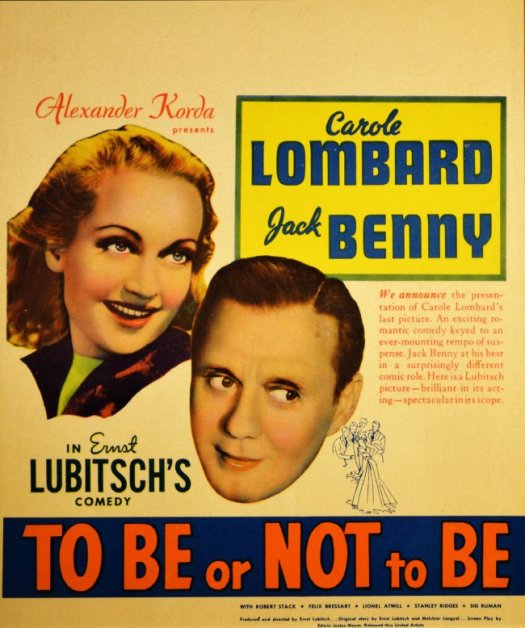
Polish Ham: Jack Benny in TO BE OR NOT TO BE (United Artists 1942)


gary loggins's avatarcracked rear viewer

Comedian Jack Benny got a lot of mileage (and a lot of laughs) making fun of his movie career, especially THE HORN BLOWS AT MIDNIGHT . While that film isn’t half as bad as Jack claimed it was, even better was Ernst Lubitsch’s TO BE OR NOT TO BE, a topical (at the time) tale of a band of Polish actors taking on the invading Nazis during WWII. Jack’s got his best film foil here, the marvelous Carole Lombard, and the movie’s got that wonderful “Lubitsch Touch”, a blend of sophistication and sparkling wit evidenced in classic films ranging from THE MERRY WIDOW and DESIGN FOR LIVING to NINOTCHKA and HEAVEN CAN WAIT.

Benny plays Joseph Tura, the self-proclaimed “greatest actor in the world”, and Lombard is his bantering wife Maria. Together, they lead a troupe of actors in Warsaw in a production of “Hamlet”, but every time Tura begins…

View original post 546 more words

Halloween Havoc!: Tod Browning’s FREAKS (MGM 1932)


gary loggins's avatarcracked rear viewer

Ex-carnival and sideshow performer Tod Browning had combined his love for the macabre and carny life in films before in two silent films with the great Lon Chaney Sr (THE UNHOLY THREE, THE UNKNOWN), but with FREAKS Browning took things to a whole new level. The cast is populated with genuine “abnormalities of nature”, legless and armless wonders, bearded ladies and skeletal men, a crawling human torso and microcephalic pinheads, parading across the screen to shock and frighten the audience. Yet it’s not the “freaks” that are the monsters in this movie, but two specimens of human physical perfection, their healthy bodies hosting malice and murder.

The film opens with a sideshow barker drawing a crowd to a horror hidden in a box, victim of what happens when you dishonor the code of the freaks – “offend one and you offend them all”. A flashback introduces us to the members of this dark carnival…

View original post 858 more words

A Quickie on a Quickie: KING OF THE ZOMBIES (Monogram 1941)


gary loggins's avatarcracked rear viewer

koz1

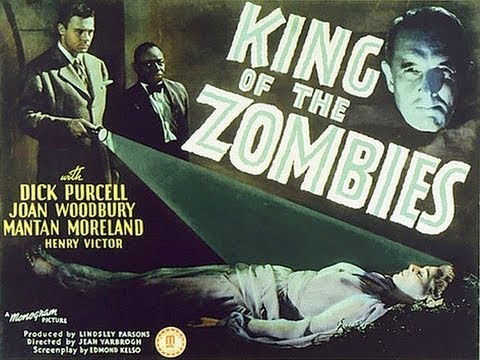
KING OF THE ZOMBIES is a 1941 Monogram horror quickie that does not star Bela Lugosi. Apparently, the great Hungarian actor was too busy at the time. I don’t see how, it’s not like he was making A-list epics that year.  Looking at his 1941 output, Lugosi starred in the studio’s THE INVISIBLE GHOST, SPOOKS RUN WILD with the East Side Kids, and had small roles in Universal’s THE BLACK CAT and THE WOLF MAN . That’s what, about 4-5 weeks worth of work? Anyway, the part of zombie master Dr. Sangre was taken by Henry Victor, best known as strongman Hercules in Tod Browning’s FREAKS.

koz2

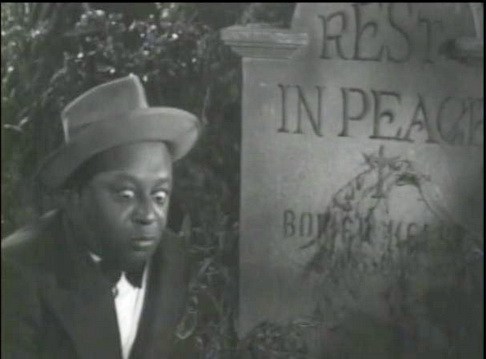
What KING OF THE ZOMBIES does have is black comic actor Mantan Moreland . In fact, I’m pretty sure if it wasn’t for Mantan, this film would’ve been lomg forgotten. I know many people today find his pop-eyed, mangled English, “feets do yo stuff” scairdy-cat schtick offensive and…

View original post 244 more words

Horror Film Review: The Mummy (dir by Karl Freund)


220px-the_mummy_1932_film_poster

Did H.P. Lovecraft enjoy movies?  I’d love to think that he did but in all probability, he didn’t.  After all, Lovecraft frequently wrote, in both his fiction and his personal correspondence, that he found the modern world to be “decadent.”  He was not a fan of technological development, viewing it as being the source of civilization’s decline.

In all probability, Lovecraft did not enjoy the movies.  When The Mummy was first released in 1932, it’s probable that Lovecraft did not rush out to a local Providence movie theater and buy a ticket.

And, really, that’s a shame.  Of the many horror films released by Universal Pictures in the 1930s, The Mummy was perhaps the most Lovecraftian.  The bare bones of the film’s plot could have easily been lifted from one of Lovecraft’s stories: a group of rational and educated men are confronted with an ancient evil that defies all reason.  When the title character is brought back to life by a man foolishly reading from the fictional Scroll of Thoth, one is reminded of not only the Necronomicon but also of the dozens of other fictional-but-plausible texts that have appeared in the works of both Lovecraft and his successors.  Just the sight of the Mummy coming back to life causes one man to have an immediate nervous breakdown, a fate shared by almost every Lovecraft protagonist who was unfortunate enough to learn about Cthulhu, Azathoth, and the truth concerning man’s insignificant place in the universe.

The story of The Mummy goes something like this:  In ancient Egypt, a priest is caught trying to bring his dead lover back to life and, as punishment, he is mummified alive and locked away in a tomb.  Centuries later, a group of explorers discover the tomb.  The mummy comes back to life and, ten years later, he abducts the woman (played by the very beautiful Zita Johann) whom he believes to be the reincarnation of his former love.

I’ve watched The Mummy a few times and one thing that always surprises me is how little we actually see of the Mummy as a mummy.  After he’s accidentally resurrected by Ralph Norton (Bramwell Fletcher), the Mummy steps out of his sarcophagus and stumbles out into the streets of Cairo, leaving a now insane Norton to giggle incoherently about how the mummy just stepped outside for a walk.  That is pretty much the last time that we ever see the Mummy wrapped up in bandages.  When we next see the Mummy, he’s going by the name Ardath Bey and he bears a distinct resemblance to Boris Karloff.

Karloff gives one of his best performance as the sinister and calculating Bey.  Of all the horror films that were released by Universal in the 1930s, The Mummy is perhaps the only one that can still be considered to be, at the very least, disturbing.  That’s largely due to the fact that, as played by Karloff, Bey is the epitome of pitiless and relentless evil.  I’m always especially shaken by the scene in which Bey uses his magical powers to make a man miles away die of a heart attack.  It’s not just the fact that Bey has the power to do something like this.  It’s that Bey seems to get so much enjoyment out of it.  There’s a sadistic gleam in Karloff’s eyes during these scenes and his expression of grim satisfaction is pure nightmare fuel.

Just compare Bey to the other Universal monsters: The Invisible Man was driven insane by an unforeseen side effect of his formula.  Frankenstein’s Monster was destructive because he didn’t know any better.  The Wolf Man spent five movies begging people to kill him and put him out of his misery.  And while Dracula was certainly evil, he had as many limitations as he had power.  He couldn’t go out in daylight.  He was easily repelled by both crosses and garlic.  He often didn’t do a very good job of hiding his coffin.  Ardath Bey, on the other hand, was not only evil but apparently unstoppable as well.

The rest of the cast is pretty much overshadowed by Karloff but fans of the old Universal horror movies will enjoy picking out familiar faces.  They’ll recognize David Manners from Dracula.  Edward Van Sloan also shows up here, fresh from playing Van Helsing in Dracula and Dr. Waldman in Frankenstein.  But ultimately, it is Karloff who dominates the film and that’s the way it should be.  There’s a reason why Boris Karloff could get away with only his last name appearing in the credits.  He was an icon of both cinema and horror and The Mummy reminds us why.

For a film that was first released 84 years ago, The Mummy holds up surprisingly well.  There have been countless movies about homicidal mummies over the years but none have yet to match the original.