Late Night Retro Television Reviews: Highway to Heaven 1.8 “A Divine Madness”


Welcome to Late Night Retro Television Reviews, a feature where we review some of our favorite and least favorite shows of the past!  On Thursdays, I will be reviewing Highway to Heaven, which aired on NBC from 1984 to 1989.  The entire show is currently streaming on Tubi and several other services!

This week, things get a bit silly on the highway.

Episode 1.8 “A Divine Madness”

(Dir by Michael Landon, originally aired on November 7th, 1984)

Oh, this episode.

Years ago, a ruthless land developer named Arthur Krock (Ron Moody) built a castle for his beloved wife.  Tragically, his wife passed away and Arthur had a nervous breakdown.  Now, he spends all of his time in his castle and he believes that he actually is King Arthur.  He says that he’s waiting for the return of his Guinevere.  Only Marian (Helen Kleeb), his loyal maid, has remained with him over the years.  He, of course, calls her Maid Marian even though that’s a Robin Hood reference and not anything from the Arthurian legends.

Though the elder Arthur Krock is still the head of his company, the day-to-day business is handled by his son, Arthur Krock, Jr. (played by a young and beardless Jonathan Frakes).  Bitter over his unhappy childhood, Arthur, Jr. is just as ruthless as his father once was.  Arthur, Jr. has a 12 million dollar deal to force a woman named Gwen (Jean Allison) off of her land and he’s determined to get it done, even if it means displacing all of the dogs that she and her veterinarian son (Scott Stevenson) look after.

Arthur, Sr.’s daughter, Linda (Ellen Maxted), hires two new handyman and you can probably already guess that they’re going to be Jonathan and Mark.  Working around the castle, Jonathan arranges for Arthur, Sr. to meet Gwen.  When Arthur, Sr. discovers that Gwen is short for Gweneviere, he announces that she can stay on her land.  Arthur, Jr. goes to court to get his father declared incompetent.

Can you guess what happens?  Well, if you think that Arthur, Sr. hires Jonathan to be his lawyer and then announces in court that he has not been the father that he should have been …. you’re absolutely correct!

When people talk about Highway to Heaven being a campy or cheesy show, it’s usually episodes like this that they’re talking about.  Unabashedly sentimental in its approach, this episode suffers from the fact that Arthur, Jr. has a point.  Arthur, Sr. is clearly mentally ill and allowing him to run the company is totally unfair to his employees and the people who have invested in his business.  Just because Arthur, Jr. isn’t particularly likable, that doesn’t make him incorrect.  If the episode had merely portrayed Arthur, Sr. as an eccentric who didn’t want to have to deal with the pain of the real world, that would be one thing.  But this episode has Arthur, Sr. living in a literal castle, sitting on an actual throne, and referring to his son as being Lancelot.  It’s all just a bit too much and Ron Moody’s over-the-top performance doesn’t particularly help.  To the show’s credit, it does eventually acknowledge that Arthur, Sr. needs some help but still, the whole thing just feels a bit …. well, silly.

Next week, Jonathan and Mark help a movie star become a better father!  Hopefully, he doesn’t think that he’s Prester John or Robin Hood or anyone like that.

Late Night Retro Television Reviews: Highway to Heaven 1.6 and 1.7 “One Fresh Batch of Lemonade”


Welcome to Late Night Retro Television Reviews, a feature where we review some of our favorite and least favorite shows of the past!  On Thursdays, I will be reviewing Highway to Heaven, which aired on NBC from 1984 to 1989.  The entire show is currently streaming on Tubi and several other services!

This week’s episode finds Jonathan and Mark working as physical therapists!

Episodes 1.6 and 1.7 “One Fresh Batch of Lemonade”

(Dir by Michael Landon, aired on October 24th, 1984 and October 31st, 1984)

Deke Larson, Jr. (Ken Olandt) is a high school baseball star who is being watched by the scouts, much to the joy of his father, Deke, Sr. (Jim Haynie).  The elder Deke was quite an athlete in his day and his house is still full of the trophies that he won through the years.  Deke, Sr. was recruited to play professional baseball but he never made it out of the minor leagues.  As a result, Deke, Jr. has spent his entire life being prepared to do what his father never accomplished.

However, that dream comes to an end when Deke, Jr. has a motorcycle accident and is hit by a truck that is being driven by Richie Halbertson (Bart Conner), a gymnast who attends a rival high school.  As a result of the accident, Deke, Jr. loses both his legs.  Now, he spends his time at a rehab clinic, consumed by his own bitterness.

Jonathan and Mark are the clinic’s newest physical therapists.  While Jonathan tries to get Deke, Jr. to accept his condition and forgive Richie, Mark tries to talk to Deke, Sr.  With the help of a quadriplegic law student named Scotty (James Troesh), Deke, Jr. starts to realize that it’s better to focus on what he has instead of obsessing on what he’s lost.  Deke, Jr. starts to recover from his bitterness and soon, he’s even being nice to the classmate (Samatha Paris) who has a crush on him.  But when Jonathan suggests that Deke, Jr. could still compete as gymnast, will Deke, Jr. be able to accept being trained by Richie Halbertson?  And will Deke’s parents be able to set aside their own anger to support their son?

If you answered no to any of those questions, you’ve obviously never seen this show before.

This two-parter is pretty much the epitome of a typical Highway to Heaven episode.  It’s earnest, heartfelt, well-intentioned, and there’s isn’t a moment of cynicism to be found.  It’s the type of episode where Jonathan tells two snotty teenage boys that they shouldn’t park in a handicapped spot and, when the boys ignore him and go into a nearby bookstore, God turns their car upside down.  (Plus, they get a ticket!)  Even the episode’s title, which refers to the old-saying about making lemonade whenever life gives you lemons, pretty sums up Highway to Heaven‘s unapologetically positive outlook.   At the same time, it’s also an episode that, because it is so earnest, won’t take anyone by surprise.  If you can’t guess how this episode is going to end, I can only assume that you’ve never watched television or a movie before.

Predictable as it may be, it’s still an effective episode, largely because it is so unashamed of being sentimental and heartfelt.  You do have to wonder just how exactly Deke, Jr. managed to become a competition-worthy gymnast in what appears to have just been a matter of weeks but still, this is a case where the good intentions make up for the rough spots.

Next week, Jonathan and Mark help an industrialist who thinks that he is King Arthur.  Who does the grail serve?

Retro Television Review: A Little Game (dir by Paul Wendkos)


Welcome to Retro Television Reviews, a feature where we review some of our favorite and least favorite shows of the past!  On Sundays, I will be reviewing the made-for-television movies that used to be a primetime mainstay.  Today’s film is 1971’s A Little Game.  It  can be viewed on YouTube!

Twelve year-old Robert Mueller (played by 13 year-old Mark Gruner, who would later go on to play one of Chief Brody’s kids in Jaws) just hasn’t been the same since his father died.  Robert idolized his father, who was an architect who built bridges and reportedly pushed his workers to take a lot of dangerous risks to get the job done.  Perhaps that explains why Robert is not getting along with his new stepfather, Paul Hamilton (Ed Nelson).  Robert’s mother, Elaine (Diane Baker), is convinced that Robert will eventually come to accept Paul but Paul isn’t so sure.

Robert is a student at a private military academy.  When he comes home for the holidays, he brings his “best friend” with him.  Stu Parker (Christopher Shea) is friendly and polite but he’s also easily led and has a difficult time standing up for himself.  Paul immediately sees that Robert is bullying Stu.  Elaine, however, thinks that Paul is being too critical.  That’s just the way boys are!

In his diary, Robert has written that he killed someone and that he’s sure that he got away with it.  When Paul comes across the entry, he worries that Robert might be telling the truth.  Paul goes as far as to hire a private detective (Howard Duff) to investigate whether there’s been any mysterious deaths at Robert’s school.  Stu, meanwhile, explains that he and Robert sometimes play “a little game” where they imagine that best way to murder someone and get away with it.  But Stu assures Paul that it’s just a game.  They don’t actually kill anyone.

Is Stu telling the truth or is Robert just as dangerous as his deceased father, a man who Paul claims was a psychopath?  Or is Paul himself the one who has become delusional with jealousy of his stepson?

The answer to those questions is pretty obvious from the minute that Robert and Stu show up at the house.  In fact, it’s so obvious that it kind of leaves the viewer wondering how everyone else in the film could be so clueless.  On the one hand, it’s understandable that Elaine would not want to admit that there is something seriously wrong with her son.  On the other hand, how many times can anyone close their eyes to a very obvious truth?  From the minute that Robert shows up, wearing his uniform and curtly ordering around the family’s maid (played by High Noon‘s Katy Jurado, who deserved a better role), he might as well have psychopath tattooed on his forehead.

That said, evil children movies are always somewhat effective, even the ones that are a bit too obvious in their approach.  Psychologically, we’ve been conditioned to always associate children with innocence, optimism, and hope.  Children are the future, so the saying goes. As such, it does carry some impact when they’re portrayed as being a force of danger.  As I watched this film, I did find myself wondering if there was any hope for Robert.  With all that he had done, could someone still reach him and turn him around?  Or was he destined to go from being an evil child to an evil adult?  It really does get to the question of whether evil is a real, almost supernatural force or if it’s something that’s created by a combination of environment and social taboos.  Was Robert born evil or did he become evil?  A Little Game doesn’t answer that question but I doubt that anyone could.  Some questions are destined to be forever unanswered.

Embracing the Melodrama Part II #20: Magnificent Obsession (dir by Douglas Sirk)


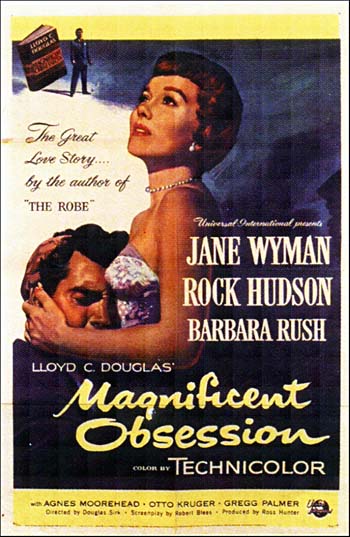
Magnificent_obsessionThere’s a scene early on in the 1954 melodrama Magnificent Obsession in which formerly carefree millionaire Bob Merrick (Rock Hudson) meets with an artist named Edward Randolph (Otto Kruger).  We know that Randolph’s brilliant because he speaks in a deep voice, tends to be unnecessarily verbose, and often stares off in the distance after speaking.  Bob wants to know about a dead doctor who was a friend of Randolph’s.  Randolph explains the late doctor’s philosophy of doing anonymous good works.  Bob’s mind is blown.  (Hudson, who was never the most expressive of actors, conveys having his mind blown by grinning.)

“This is dangerous stuff,” Randolph warns him, “One of the first men who used it went to the cross at the age of 33…”

And a heavenly chorus is heard in the background…

And that one line pretty much tells you exactly what type of film Magnificent Obsession is.  It’s a film that not only embraces the melodrama but which also holds on tight to make sure that the melodrama can never escape.  There’s not a single minute in this film that is not hilarious overwritten.  It’s not just Randolph who tends to be portentous in his pronouncements.  No — everyone in the film speaks that way!

The dead doctor is dead specifically because of Bob.  Apparently, the doctor had a heart attack but the local hospital’s only resuscitator was being used to save the life of Bob who, while the doctor was dying, was busy recklessly driving a boat.

Helen (Jane Wyman), the doctor’s widow is, at first, bitter towards Bob and when Bob offers to donate $250,000 to the hospital, Helen refuses to accept his check.  This leads to Bob doing a lot of soul-searching and eventually having his life-changing conversation with Randolph.  Excited at the prospect of doing anonymous good works for the rest of his life, Bob tracks down Helen and tries to tell her that he’s a changed man.  Helen, however, wants nothing to do with Bob and ends up getting hit by a car while running away from him.  Helen survives but now, she’s blind!

Now, at this point, you might think that Bob has done enough to ruin Helen’s life.  At least, that’s the way that Helen’s family views it and when Bob attempts to visit her in the hospital, they order him to go away.

Eventually, Helen comes home from the hospital and starts to adjust to a life without eyesight.  One day, she meets a man on the beach and they start up a tentative romance.  What she doesn’t realize, at first, is that the man is Bob!  By the time she does realize who the man is, Helen has fallen in love with him.  However, she feels that it wouldn’t be fair to Bob to pursue a relationship with him and she leaves him.

So, of course, Bob’s response is to go to medical school and become a neurosurgeon.  Many years later, Helen has a brain tumor and needs an operation to survive.

Can you guess who her surgeon turns out to be?

Magnificent Obsession is almost a prototypical 1950s melodrama.  It’s big, it’s glossy, it’s self-important, and undeniably (and occasionally unintentionally) funny.  Even the total lack of chemistry between Hudson and Wyman somehow adds to the film’s strange charm.  It’s hard not to admire a film that starts out over-the-top and just grows more excessive from there.

Watching Magnificent Obsession is a bit like taking a trip into a parallel, technicolor dimension.  It’s strange, fascinating, and far more watchable than it should be.


Back to School #8: Halls of Anger (dir by Paul Bogart)


Halls Of Anger

Everybody loves Jeff Bridges.

Last month, the Democratic senator from Montana, John Walsh, announced that he wouldn’t be running for reelection because, much like Lianne Spiderbaby, he had been caught plagiarizing.  (Incidentally, I was one of the many bloggers caught up in Lianne’s web of thievery.  If you have ever read Lianne’s review of Mario Bava’s Black Sabbath, you were essentially reading my review of Black Sabbath.)  Unfortunately, for the Montana Democratic Party, Walsh had already won the Democratic primary.  So, the Montana Democrats held an emergency meeting to select a new nominee.

Governors, ranchers, former congressmen — nearly every prominent Democrat in Montana announced that he didn’t want the nomination.  It looked like all hope was lost but then a petition appeared online, asking the Democrats to nominate Jeff Bridges for the U.S. Senate!  This petition made national headlines and, in just a few hours, it had received thousands of signatures.  For a few brief days, everyone was truly excited about the prospect of U.S. Sen. Jeff Bridges.  I even signed the petition myself, despite the fact that 1) I don’t live in Montana and 2) I’m not even a Democrat!

(I’m a member of the Personal Choice Party.  PCP in 2016!)

Ultimately, he announced that he had no interesting running and wasn’t even sure if he was registered to vote but, until that happened, why were so many of us excited about Jeff Bridges running for the Senate?

Because, in this time of division and conflict, everybody loves Jeff Bridges!

He’s just an incredibly likable actor.  Even when he’s playing a villain, like in Iron Man, he still comes across like someone you would want to live next door to.  He’s everyone’s perfect hippie uncle, the guy that even people who don’t smoke weed want to get stoned with.  If you ever watch any of his early films — and Bridges has been making movies for nearly 50 years now — you’ll discover that this unique and likable charm is something that Jeff Bridges has always possessed.

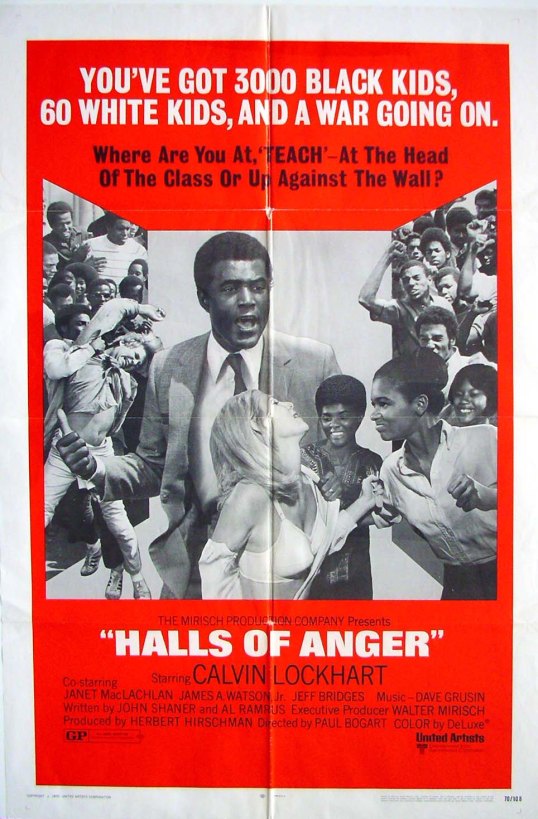
It’s certainly present in 1970’s Halls of Anger.  This was Jeff Bridges’s film debut, made at a time when he could still pass for a high school student.  He was 20 when he made this film and I have to say that for those of us who best know him as the Dude, Rooster Cogburn, and whoever he was playing in Crazy Heart, it’s always interesting to see just how handsome Jeff Bridges was when he was young.

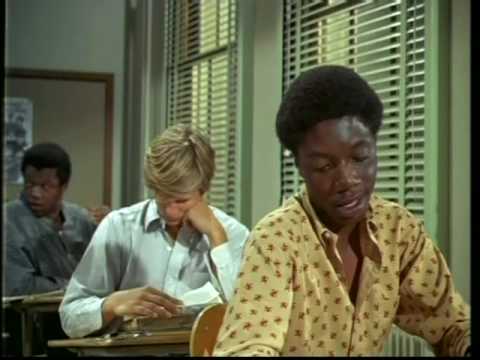
Jeff Bridges, hiding his face in Halls of Anger

Jeff Bridges, hiding his face in Halls of Anger

In Halls of Anger, he plays Doug, one of 60 white kids who have been transferred to a majority black inner city high school in an attempt to integrate it.  Of all the new white students, Doug is probably the most confident and the most open-minded.  He’s also the most friendly.  His attempt to join the high school basketball team upsets the other students but — even after getting beaten up — Doug sticks with it.  You knew that he would because, after all, he’s played by Jeff Bridges.

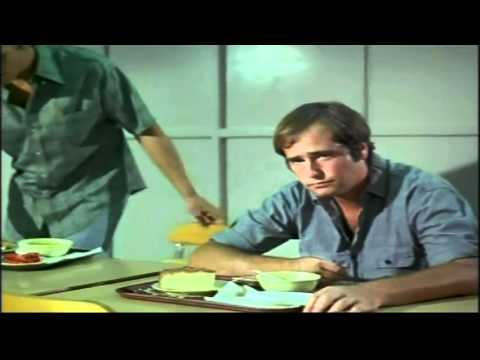
Of course, Doug’s story is just one of the many stories told in Halls of Anger.  Another one of the transfers — a weak-willed and balding racist named Leaky (played by future director Rob Reiner!) — tries to provoke a fight with a black student, hoping that he’ll be sent back to his old school for his own protection.  White Sherry (Patricia Stich) dates a black classmate and is savagely assaulted as a result.  Newly assigned vice principal Quincy Davis (Calvin Lockhart) tries to both keep the peace and teach a group of functionally illiterate students how to read.  Militant J.T. Walsh (James Edwards) wanders the hallways and speaks of revolution…

Rob Reiner in Halls of Anger

Rob Reiner in Halls of Anger

Actually, I’m probably making Halls of Anger sound a lot more interesting than it actually is.  For the most part, it’s pretty much your standard 1970 social problem film, in that it’s full of good intentions but those good intentions don’t always add up to compelling drama.  Paul Bogart’s direction is often flat (the scene where Davis teaches his students how to read seems to drag on for hours) and the characters don’t so much talk to each other as they make narratively convenient speeches.

That said, Halls of Anger is worth watching just to see Calvin Lockhart’s authoritative performance, Rob Reiner’s hilariously bad performance, and Jeff Bridges’s charismatic debut performance.  He may never be a member of the U.S. Senate but everybody will always love Jeff Bridges.

You can watch Halls of Anger below!

http://www.youtube.com/watch?v=7btGxM2rSCY