Retro Television Reviews: The Love Boat 1.8 “Lost and Found / The Understudy / Married Singles”


Welcome to Retro Television Reviews, a feature where we review some of our favorite and least favorite shows of the past!  On Wednesdays, I will be reviewing the original Love Boat, which aired on ABC from 1977 to 1986!  The series can be streamed on Paramount Plus!

Love exciting and new….

Come aboard!  We’re expecting you!

Episode 1.8 “Lost and Found / The Understudy / Married Singles”

(Directed by Stuart Margolin, originally aired on November 19th, 1977)

This week’s cruise is all about secrets and lies.

For instance, Durwood Moss (Steve Allen) and Maisie Nolan (Polly Bergen) are currently separated and their therapist has suggested that they try taking separate vacations.  Maisie books a cabin on the cruise so Durwood books the cabin next door.  As Durwood explains it, being in separate cabins counts as being on separate vacations.  Not letting anyone know that they’re married (albeit unhappily so), Durwood pursues Barbie (Loni Anderson) and Maisie flirts with Jack (Joshua Plymouth).  Of course, Durwood and Maisie end up realizing that they’re still in love.  Fortunately, Jack and Barbie also fall in love with each other!

Meanwhile, 8 year-old Theodore Denison, Jr. (James Bond III) lies and says that he has his parents’ permission to be on the cruise by himself.  Of course, it turns out that he’s actually a runaway.  On the cruise, he meets Sharon and Richard Baker (Sandy Duncan and Jim Stafford), a married couple that is struggling to come to terms with the death of their son.  Sharon wants to adopt Theodore and Theodore wants to be adopted.  But then Theodore’s real parents show up and apologize for the fight that caused Theodore to run away in the first place.  Still, Sharon and Richard at least find the courage to try to move on from their tragedy.

Finally, Connie Evans (Jo Ann Harris) is an assistant cruise director who has been assigned to the ship.  Julie (Lauren Tewes) is supposed to be training Connie but it soon becomes clear that, in typical All About Eve fashion, Connie is plotting to steal Julie’s job.  Connie’s plan is … well, it’s interesting.  She continually screws up the simplest of duties and then claims that she was only doing what Julie trained her to do.  When she shows up for dinner in a skimpy outfit, she claims that it’s what Julie told her to wear.  I guess the plan is to make Julie look like she’s bad at training people but just because someone isn’t good at training, that doesn’t mean that they’re bad at their overall job.  In fact, it would seem that most people would look at Connie’s actions and say, “You should have had enough common sense to know better, even if that’s what Julie told you.”  Anyway, it all works out, albeit somewhat bizarrely.  The captain reprimands Connie.  The crew hates Connie and goes out of its way to humiliate her.  And yet, even after it become obvious that Connie has been trying to get her fired, Julie agrees to help Connie because she thinks Connie has the makings of being a great cruise director.  Just how painfully nice is Julie?

This was not a bad episode.  The stuff with Durwood and Maisie was a bit dull but the other two storylines worked.  Sandy Duncan brought a lot of emotional sincerity to her plotline and Jo Ann Harris was hilariously conniving in the role of Connie.  This episode was a cruise that I enjoyed.

Will I also enjoy the next cruise?  Find out next week!
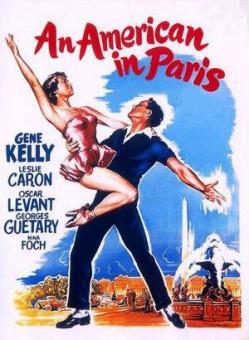
Cleaning Out The DVR #27: An American In Paris (dir by Vincente Minnelli)


(For those following at home, Lisa is attempting to clean out her DVR by watching and reviewing 38 films by this Friday.  Will she make it?  Keep following the site to find out!)

An_American_in_Paris_poster

I can’t believe it took me this long to see the Oscar-winning 1951 film, An American In Paris.  Seriously, I love dancing.  I love Paris.  I love Gene Kelly.  Though this film was made decades before I was born, it still feels like it was literally made for me.  And yet, until last night, I had never seen it.  Thank God for TCM (and thank God for the DVR that I used to record the movie when it aired on TCM).

Gene Kelly plays Jerry Mulligan, an American veteran of World War II who, now that he is out of the army, is making his living as a painter and living in Paris.  (The real Paris is only seen in a few establishing shots.  Most of the film takes place on sets that were clearly designed to look more theatrical than realistic.  This is the Paris of our most romantic fantasies.)  Jerry’s roommate is Adam (Oscar Levant), a pianist who fantasizes about playing before a huge audience.

When the movie begins, Jerry gets his first patron, the wealthy and lonely Milo Roberts (Nina Foch).  Though Milo is in love with Jerry, Jerry falls in love with an innocent French girl, Lise Bouvier (Leslie Caron).  Although Lise falls in love with Jerry, she feels obligated to marry French singer Henri (Georges Guetary) because Henri helped to keep her safe during the Nazi occupation.  And, of course, Henri is friends with Adam who is the roommate of Jerry who is in love with Lise who is engaged…

It sounds a lot more complicated than it actually is.  If anything the plot of An American In Paris is too simple.  (Just compare An American In Paris to Singin’ In The Rain.)  But ultimately, An American In Paris is not about the story.  It’s about George Gershwin’s music and Gene Kelly’s dancing.  It’s a triumph of pure style.  It was said that Fred Astaire made love through dancing and that’s even more true of Gene Kelly, who is literally a force of masculine nature in this film.  So impressive was his choreography that it received a special, noncompetitive Oscar.

Check some of this out:

It all eventually ends with the incredible 17-minute The American In Paris Ballet, which sees Gene Kelly and Leslie Carson dancing through a series of sets that were modeled on Impressionist paintings.  It’s one of those great movie moments that simply has to be seen.

How impressed were the members of the Academy with An American In Paris?  They were impressed enough to name it the best film of 1951.  I don’t know if I would go that far because I’ve seen both A Streetcar Named Desire and A Place In The Sun.  (And An American In Paris‘s victory is considered to be one of the biggest upsets in Oscar history.)  But, with all that said, An American In Paris is still an incredibly enjoyable film to watch.

It is pure joy.

Horror on TV: Thriller 1.29 “The Devil’s Ticket”


Down here in Dallas, channel 133 is the local Me-TV affiliate.  Me-TV specializes in showing old TV shows from the 50s, 60s, and 70s.  The network sells itself as a nostalgic refuge for people who are several decades older than me, a place where they can go to escape from Seth McFarlane cartoons and Maury Povich conducted DNA tests.

But you know what?

I like Me-TV and I’m glad that it exists.  It probably has something to do with me being a history nerd at heart.  I love the chance to see what the world was once like.  Add to that, some very good shows were produced in the 50s and 60s.  Just because a lot of us weren’t there to experience them firsthand doesn’t mean that we can’t appreciate them in rerun syndication.

Case in point: Thriller.

Thriller aired for two seasons in the early 60s.  It was an anthology series, in the tradition ofThe Twilight Zone.  Whereas The Twilight Zone was hosted by Rod Serling, Thriller was hosted by horror icon Boris Karloff, who always introduced the macabre material with a bemused gleam in his eyes.

The Devil’s Ticket was the 29th episode of Thriller and it originally aired on April 18th, 1961.  It’s an effectively creepy little story about an artist (MacDonald Carey) who sells his soul to the Devil.  It was directed by Jules Bricken and written by Robert Bloch.