Film Review: The Murder Man (dir by Tim Whelan)


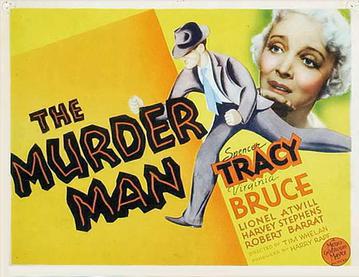
Seven minutes into the 1935 film, The Murder Man, 27 year-old James Stewart makes his film debut.

He’s playing a reporter named Shorty and, since this is a 30s newspaper film, he’s first seen sitting at a table with a bunch of other cynical reporters, the majority of whom seem to be alcoholics and gambling addicts.  Suddenly, words comes down that a corrupt businessman named Halford has been assassinated, shot by an apparent sniper.  (It is theorized that he was shot from one of those carnival shooting gallery games, which was somewhat oddly set up on a street corner.  Maybe there was shooting galleries all over place in 1935.  I supposed people had to do something to keep their spirits up during the Depression.)  While the other reporters run to the scene of the crime, Shorty is on the phone and calling his editors to let them know that a huge story is about to break.

Steve Grey (Spencer Tracy) is the reporter assigned to the story.  Crime is his beat and everyone agrees that no one’s better at covering criminals and understanding what makes them tick.  Unfortunately, it’s not always easy to track Steve down.  He’s a hard drinking reporter and lately, he’s been concerned about the collapse of his father’s business.  Still, when Steve is finally tracked down, he throws himself into covering the story and speculating, in print, about who could have killed Halford.  In fact, his girlfriend (Virginia Bruce) worries that Steve is working too hard and that he’s developing a drinking problem.  She suggests that Steve needs to take some time off but Steve is driven to keep working.

It’s largely as a result of Steve’s actions that a man named Henry Mander (Harvey Stephens) is arrested and convicted of Halford’s murder.  Steve should be happy but instead, he seems disturbed by the fact that he is responsible for Mander going to jail.  When his editor requests that Steve go to Sing Sing to interview Mander, a shocking truth is revealed.

Admittedly, the main reason that I watched The Murder Man was because it was the feature film debut of James Stewart.  (Stewart previously appeared in a comedy short that starred Shemp Howard.)  Stewart is only in a handful of scenes and he really doesn’t have much to do with the main plot.  To be honest, Shorty’s lines could have been given to anyone.  That said, Stewart still comes across as being a natural on camera.  As soon as you hear that familiar voice, you can’t help but smile.

Even if Stewart hadn’t been in the film, I would have enjoyed The Murder Man.  It’s fast-paced mystery and it has a decent (if not totally unexpected) twist ending.  It’s one of those films from the 30s where everyone speaks quickly and in clipped tones.  Casual cynicism is the theme for the day.  Spencer Tracy gives a wonderful performance as the hard-drinking and troubled Steve Grey and the scene where he meets Mander in prison is surprisingly moving.  Clocking in at only 68 minutes, The Murder Man is a good example of 30s Hollywood.
Horror on the Lens: The Bat (dir by Crane Wilbur)


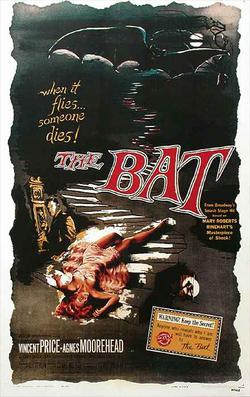
Today’s Horror on the Lens is 1959’s The Bat.  A simple case of bank embezzlement leads to a murder that may or may not be connected to a series of other murders that are apparently being committed by a mysterious killer known as “The Bat.”  The Bat is said to have no face and steel claws and, needless to say, everyone in town is worried about becoming the next victim.

Who is the Bat?  Is Dr. Malcolm Wells (Vincent Price), the shady scientist whose work has led to him doing experiments on bats?  Is it Victor Bailey (Mike Steele), the bank clerk who is a prime suspect in the embezzlement case?  Is it the butler (John Sutton) with a secret past?  Could it even be one of the cops (Gavin Gordon and Robert B. Williams) who has been tasked with capturing The Bat?  Can mystery novelist Cornelia van Gorder (Agnes Moorehead) solve the mystery before becoming The Bat’s next victim!?

The Bat is based on a play and it’s definitely a bit stagey but when you’ve got performers like Agnes Moorehead and Vincent Price onscreen, it really doesn’t matter.  The Bat is an entertaining and atmospheric mystery, featuring a Vincent Price playing another one of his charmingly sinister cads.

Enjoy!

18 Days of Paranoia #1: The Flight That Disappeared (dir by Reginald Le Borg)


Way back in the early days of the site, I did a series of reviews called 31 Days of Paranoia, in which I reviewed films about mysteries, cover-ups, and conspiracies.  Unfortunately, because I wasn’t all that disciplined about posting during the early days of the Shattered Lens, my 31 Days of Paranoia ended up being something like 24 days.  Still, it was a lot of fun and, historically, it was important because it was the very first “themed” series of reviews that I had ever done.  Shattered Politics, Embracing the Melodrama, Back to School, Sprin Breakdown, and all the rest started with 31 Days of Paranoia.

So, with this being the 10-year anniversary of the Shattered Lens’s founding and Spring Breakdown wrapping itself up tomorrow, I figured why not return to where it all started.  From now til April, please enjoy …. 18 Days of Paranoia!

We begin with:

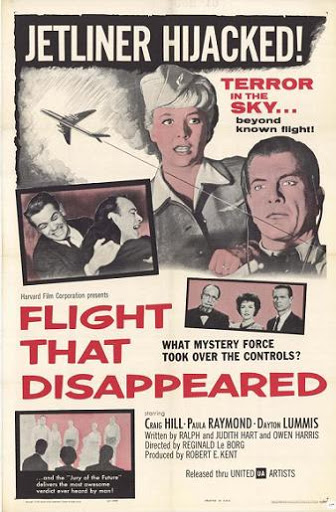
The 1961 film, The Flight That Disappeared, deals with an airplane that …. wait for it …. disappears!

What’s happened to Trans-Coast Airways Flight 60?  When it first took off from Los Angeles, everything seemed fine.  It was carrying a small but well-behaved group of middle-aged people to Washington D.C.  The pilots all seemed like good professionals.  The two flight attendants were busy serving people coffee and having conversations about whether or not one of them would ever get married.  She had every right to be concerned, of course, seeing as how she was in her 20s and still unmarried and childless, despite the fact that this film was made in 1961.

It doesn’t take too long for something strange to happen.  The plane suddenly starts to climb upward, eventually going up over 10 miles high in the sky.  The pilots can’t do anything to get the plane to come back down.  Due to the lack of oxygen, some of the passengers start to pass out.  One passenger panics and opens a door, out of which he promptly falls.  Oddly, this doesn’t create the whole vacuum effects that we always see in other movies where a window or a door is opened while a plane is in the air.  Stranger still, no one thinks to close the door afterwards.  Was this intentional or was it just crappy filmmaking?  It’s hard to say.

Why is the plane being lifted up into the air?  Could it have something to do with the three atomic scientists who are all on the plane?  One of them, Dr. Morris (Dayton Lummis), is wearing glasses and has a van dyke beard so you know he’s smart!  It turns out that Dr. Morris has been working on the Beta Bomb, which is apparently the most powerful atomic bomb ever built.  I kept waiting for someone to ask Dr. Morris why it was called the Beta Bomb and not the Alpha Bomb or the Omega Bomb or the Big Scary Bomb or the …. well, seriously, anything would be better than Beta Bomb!  Everyone in the movie says, “Beta Bomb,” in a tone that’s meant to communicate reverence but it just sounds too much like “Beta Male” for me to really take it seriously.

But, again, who is responsible for the flight climbing?  Is it the Russians?  Is it aliens?  Is it some enemy of the American way?  While everyone else on the plane is passed out, the three scientists find themselves awake.  Their watches are no longer running and, despite the fact that they appear to be alive, their hearts are no longer beating.  Are they dead?  Or have they been transported to the future where they will now be put on trial for the crime of developing the Beta Bomb?

Of course, the thing with being put on trial in the future is that it provides the perfect defense for making weapons in the present.  “Hey,” a smart defense attorney would say, “you’re still alive in the future and you’ve got time travel technology so what are you bitching about?”  But the jurors explain that they’re actually the ghosts of the people who would have been born in the future if not for the Beta Bomb which …. what?  So, is the plane in the future or is it in the afterlife?  The film itself doesn’t seem to be sure.

I’m probably making it sound like this is a more intriguing film than it actually is.  This movie is about 72 minutes long and all the stuff with the people in the future takes place during the final 10 minutes.  That means that the film is essentially just 60 minutes of people saying, “We’re still climbing.”  From a historical point of view, it’s an interesting example of people being paranoid about the arms race.  (If the film were made today, the future the ghostly jurors would be the souls of people who were not born in the future due to climate change.)  From an entertainment point of view, it’s a forgettable dud.

Lisa Cleans Out Her DVR: The Girl In the Red Velvet Swing (dir by Richard Fleischer)


(Lisa is currently in the process of cleaning out her DVR!  How long is it going to take?  Forever!  For instance, she recorded 1955’s The Girl In the Red Velvet Swing off of FXM on February 1st and has now gotten around to actually watching and reviewing it.)

The story of Evelyn Nesbit is an interesting one, even if it is now a largely forgotten one.

In 1901, Evelyn Nesbit was a showgirl in New York City.  While she always claimed that she was 16 at the time, there are some historians that think it more likely that she was only 14.  One night, the beautiful Evelyn was introduced to Stanford White.  At the time, White was 47 years old and the most successful and prominent architect in New York City.  White was also a notorious womanizer and Evelyn soon became his latest mistress.  He moved her into one of his many apartments.  Years later, when the details of their relationship became public knowledge, people were shocked to hear that Stanford White kept a red velvet swing in the apartment and that he enjoyed watching Evelyn swing back and forth.  They would be even more scandalized by the news that Stanford also had a “mirror room.”  As Evelyn would later testify, she “entered the room a virgin” but did not come out as one.

Though Evelyn occasionally claimed that she and Stanford were truly in love, she never married him.  (Indeed, Stanford White apparently never married anyone over the course of his life.)  Instead, she ended up meeting and marrying Harry K. Thaw.  Harry was the heir to a 40 million dollar fortune.  He also had a long history of mental illness.  When he learned that, before meeting him, Evelyn had lost her virginity to Stanford White, he was outraged.

(It’s debatable how well Stanford and Harry knew each other.  Some historians claim that they were barely acquainted.  Other accounts claim that Harry and Stanford were business rivals even before Evelyn Nesbit arrived in New York.)

In 1906, Harry and Evelyn ran into Stanford White at Madison Square Garden.  Harry promptly pulled out a pistol and, in front of hundreds of witnesses, shot Stanford dead.

Harry’s subsequent trial was reportedly the first to ever be described as being “the trial of the century.”  Because hundreds of people had seen Harry Thaw shoot Stanford White and the Thaw family was adamant about not publicizing Harry’s history of mental illness, Harry’s defense team attempted to make the trial about Stanford White.  The defense attempted to portray Stanford as being such a depraved predator that Harry really had no other option but to shoot him in cold blood.  Evelyn took the stand and testified to every single detail of her relationship with Stanford White.  The details appeared in every major newspaper in America.

In the end, Harry was found not guilty by reason of insanity and was committed to the  Matteawan State Hospital for the Criminally Insane.  (Reportedly, due to his great wealth, he had the best room in the hospital.)  Meanwhile, Evelyn became one of America’s first reality stars.  Her notoriety led to her appearing in several silent films.  It’s a fascinating story, one that very much feels ahead of his time.  If Evelyn was a star in 1906, just imagine how famous she would be today.

The Girl in the Red Velvet Swing is about Evelyn Nesbit and her relationships with both Stanford White and Harry Thaw.  It’s a shame that the film isn’t as interesting as the real life story.  Ray Milland plays Stanford White.  Farley Granger is Harry Thaw.  Joan Collins is Evelyn Nesbit.  They all give good performances, especially Farley Granger.  But the film itself is just so bland.  Perhaps because it was made in the 1950s, it leaves out the majority of the sordid details that made the story so fascinating to begin with.  For instance, the red velvet swing appears but, in this film, no time is spent in the mirror room.  This true life story is pure tabloid material but The Girl In The Red Velvet Swing is way too respectful for its own good.  By refusing to come down firmly on the side of Harry Thaw or Stanford White, the film feels shallow and a bit empty.  (All good melodramas — even fact-based ones — need a good villain.)  And poor Evelyn Nesbit!  In real life, she was a savvy self-promoter who knew exactly how to manipulate the press.  In this film, she’s just an innocent ingenue.  Considering the facts of the case, the film version is unforgivably dull.

So, I don’t recommend The Girl In The Red Velvet Swing but I do recommend Paula Uruburu’s fascinating 2008 biography, American Eve: Evelyn Nesbit, Stanford White, The Birth of the ‘It’ Girl, and the ‘Crime of the Century.’  It goes into all of the fascinating details that were left out of this film.

Lisa Reviews An Oscar Nominee: Sergeant York (dir by Howard Hawks)


Sergeant_York_1941_Poster

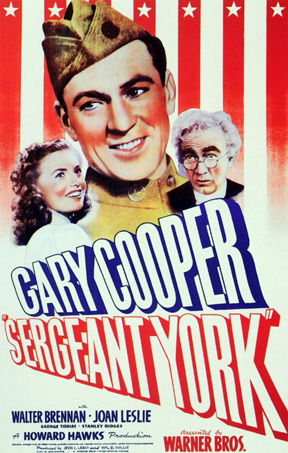
The 1941 film Sergeant York was the American Sniper of its day.  A biopic of Alvin York, one of the most decorated American soldiers of World War I, Sergeant York was not only a huge box office hit but it was a film that celebrated American patriotism in the type of unabashed fashion that you would never see in a film made today.  Though Sergeant York went into production at a time when the United States was officially pursuing a policy of international neutrality, it was released shortly before the Japanese attacked Pearl Harbor and, whether intentionally or not, Sergeant York served as a strong recruiting tool.  According to Wikipedia (and we all know that Wikipedia is never wrong), there were reports of young men going straight from the movie to the nearest military recruitment office.

Clocking in at nearly two and a half hours (and running at least 40 minutes too long), Sergeant York is two films in one.  The second half of the film deals with the military career of Alvin York (Gary Cooper), a plain-spoken and honest Tennessee farmer who, because of his strong religious beliefs, unsuccessfully attempts to register as a conscientious objector.  Forced into the Army, York is, at first, dismissed as a simple-minded hillbilly.  (His fellow soldiers are amused to discover that York doesn’t know what a subway is.)  However, to the shock of his commanding officers, he proves himself to be an expert marksman.  As he explains it, being from the country means that he’s been shooting a rifle his entire life.

On the basis of his skills as a marksman, York is given a promotion but he still says that he refuses to kill.  It’s not until his superior officer reminds him of the sacrifices that past Americans have made that York starts to reconsider his position.  Then, a gust of wind opens York’s bible to a verse about giving unto Caesar what is Caesar’s and York realizes that he can go to war and, if need be, he can kill.

And it’s a good thing that he can!  Because World War I is heating up and York may be the only guy around with the strength and confidence to single-handedly defeat and capture over 170 German soldiers.

The army section of Sergeant York is predictable but well-done.  As you’d expect from a film directed by Howard Hawks, a lot of emphasis is put on how the soldiers work together.  York is portrayed not as being super human but instead as just an honest man who is exceptionally good at his job.  There’s nothing surprising about the second half of Sergeant York but Hawks keeps the action moving and Cooper gives a good performance.

To be honest, I preferred the first half of the film, which examined York’s life before he joined the Army.  When we first meet Alvin York, he drinks too much, he fights too much, and he’s totally irresponsible.  It’s not until he falls in love with Gracie Williams (Joan Leslie) that York starts to change his ways.  The scenes of York in the backwoods of Tennessee had a lively feel to them and it was enjoyable to see Cooper play a somewhat disreputable character.  Cooper seemed to be having fun playing a ne’er-do-well and, in the scenes before York finds God, his bad behavior was a lot of fun to watch.

Considering its success at the box office, it’s not surprising that Sergeant York was nominated for best picture of the year.  While Gary Cooper won the Oscar for best actor, the award for Best Picture went to How Green Was My Valley.