Horror Film Review: The Mummy’s Hand (dir by Christy Cabanne)


In 1940, having brought back The Invisible Man and Frankenstein’s Monster, Universal Pictures decided that it was also a good time to bring back The Mummy!

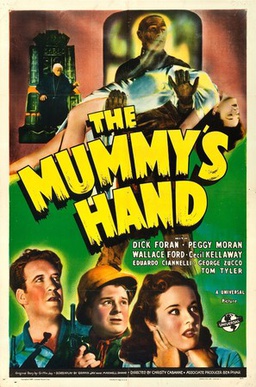
The Mummy’s Hand takes place in what we’re told is Egypt, though it’s obvious just a Universal backlot.  Two archeologists — Steve Banning (Dick Foran) and Babe Jenson (Wallace Ford) — are penniless and stuck in Egypt.  Babe wants to find a way to return to Brooklyn and his ex-girlfriend.  Steve is a bit more serious about archeology, though it must be said that he’s no Indiana Jones when it comes to discovering relics and taking them to museums.  If Indiana is the type who will risk his life to search a hidden cave in the Amazon Rain Forest, Steve is far more likely to just wander around an Egyptian market until he comes across someone selling an ancient vase.

Which is exactly what happens!  Steve finds someone selling a vase and, after he learns where it came from, he buys the vase.  He takes the vase to Prof. Andoheb (George Zucco), not knowing that Andoheb is an Egyptian high priest who has been sworn to protect the tomb of Princess Ananka.  When Andoheb realizes that the vase could lead to the discovery of the tomb, he lies and claims that it’s a forgery.  He then “accidentally” breaks it in order to keep Steve from showing the vase to anyone else.  Steve, however, is not deterred and a chance meeting with an American magician named Tim Sullivan (Cecil Kellaway) leads to Sullivan agreeing to finance Steve’s expedition to discover where the vase came from.  Sullivan’s daughter, Marta (Peggy Moran), worries that Steve and Babe are just trying to steal her father’s money so she insists on coming on the expedition with Steve.  Also following the expedition is Andoheb, who is himself starting to fall for Marta and who is hoping that he can use a secret serum hidden in the tomb to make both himself and Marta immortal.

Of course, the tomb itself is protected by Kharis (Tom Tyler, under a ton of bandages), a mummy who is immortal due to the serum and who has sworn to protect the tomb from any outsiders.  Kharis moves slowly but efficiently.  He’s a ruthless and silent killer, one whose eyes appears to just be two black holes, the better to reflect his own lack of a soul.

The main problem with The Mummy’s Hand is that it takes forever for the Mummy to actually show up.  This is only a 67-minute film and the Mummy mayhem doesn’t really start until around the 50 minute mark.  As a result, the viewer spends a lot of time watching Steve and Babe wander around Egypt and essentially act like stereotypical American tourists.  Even when the expedition finally gets started, the audience still has to sit through endless scenes of Marta accusing Steve of being some sort of con artist.  This is a movie that will truly leave you saying, “When is the mummy going to show up!?”

That said, The Mummy itself is a frightening creature, especially with his empty eyes.  Mummy’s are naturally frightening, especially when they’re walking towards you and dragging their decaying bandages  behind them.  The Mummy is effective, I just wish he had been featured in more of the movie.
Previous Universal Horror Reviews:

  1. Dracula (1931)
  2. Dracula (Spanish Language Version) (1931)
  3. Frankenstein (1931)
  4. Island of Lost Souls (1932)
  5. The Mummy (1932)
  6. The Invisible Man (1933)
  7. The Bride of Frankenstein (1935)
  8. Dracula’s Daughter (1936)
  9. Son of Frankenstein (1939)
  10. Black Friday (1940)
  11. The Invisible Man Returns (1940)
  12. The Wolf Man (1941)
  13. Ghost of Frankenstein (1942)
  14. Invisible Agent (1942)
  15. Frankenstein Meets The Wolf Man (1943)
  16. Son of Dracula (1943)
  17. House of Frankenstein (1944)
  18. The Invisible Man’s Revenge (1944)
  19. House of Dracula (1945) 
  20. Creature From The Black Lagoon (1954)
Lisa Reviews An Oscar Nominee: Alibi (dir by Roland West)


1929 was a transitional year for Hollywood.

On the one hand, more people were going to the movies than ever.  The studio moguls were getting rich and directors, many of whom were influenced by German expressionism, were experimenting with new ways to visually tell their stories.  The days when an motionless camera would just be planted on the floor so that it could record actors moving in and out of the frame were over.

At the same time, Hollywood was also struggling to adjust to the arrival of sound.  Though many assumed that sound would just be a fad, it quickly turned out that audiences preferred sound pictures to the old silent melodramas.  Films that had been originally conceived as being silent were reshot with sound and the results were often mixed as Hollywood technicians struggled to figure out how to get the best and clearest recording possible.  Even harder hit were the actors, who had spent decades giving silent performances but who were now expected to adapt, overnight, to an entirely new style of acting.  Some actors saw their career abruptly end because their voice didn’t match their appearance or because they simply couldn’t memorize the dialogue that they were now required to actually speak.  Even the actors who could handle delivering their dialogue often struggled to find the right balance between acting too much and acting too little.

Take Alibi, for instance.  This crime film was released in 1929 and visually, it’s often a marvel.  But whenever the actors open their mouths and start to recite their dialogue …. yeesh!

Based on a Broadway play, Alibi tells the story of Chick Williams (Chester Morris, whose brooding good looks go a long way towards making up for his awkward screen presence).  Chick is a career criminal who has just been released from prison.  Because he’s a “jailbird,” (as they used to put it in 1929), Sgt. Pete Manning (Purnell Pratt) is convinced that Chick has hooked back up with his old gang and that he’s responsible for a recent robbery that left one policeman dead.  However, Chick has an alibi.  It turns out that, after getting out of prison, one of the first that Chick did was get married.  Chick’s new wife is Pete’s daughter, Joan (Eleanor Griffith)!  And Joan swears that, on the night of the crime, Chick was with her at the theater.

Despite his alibi, Pete is convinced that Chick had something to do with both the robbery and the murder.  Pete decides to send in an undercover cop, Danny McGann (Regis Toomey).  Pretending to be a permanently drunk businessman, Danny works his way into Chick’s mob.  But can Danny find the proof needed to take Chick down?

So, here’s what’s good about Alibi.  First off, it’s a pre-code film, which means that the characters are allowed to occasionally curse and that the gangsters all spend their time at a nightclub, watching the floor show.  It also means that Joan is allowed to openly discuss why she distrusts the police and the film shows the police being brutal in a way that would never be allowed during the production code years.  Secondly, from the very first scene, director Roland West creates an almost dream-like atmosphere, full of looming shadows and art deco sets and close-ups of menacing faces.  West’s camera prowls through the streets and clubs with a restless energy.

But then, as I mentioned earlier, someone will open their mouth and start to speak and the entire film comes to a halt.  The cast — some of whom went on to have long and successful careers — was obviously still struggling to figure out how to act in a sound film and the results are definitely mixed.  Eleanor Griffith delivers all of her lines in the same angry tone while Purnell Pratt stiffly defends the police force.  Regis Toomey, meanwhile, goes so overboard as Danny that you find yourself hoping that he’ll blow his cover and be forced out of the film.  Though he’s occasionally awkward, Chester Morris probably does the best out of the entire cast.  At the very least, he manages to communicate some genuine menace.

Seen today, Alibi is mostly interesting as a historical document.  It represents both the best and the worst of the early sound era.  When it was first released, Alibi was a hit at the box office.  Though no official nominees were announced for the 2nd Academy Awards, notes from the era indicate the Alibi was among the films considered for Best Picture and it’s usually listed as being a nominee.  The award itself was given to Broadway Melody.

Horror Film Review: Frankenstein Meets The Wolf Man (dir by Roy William Neill)


frankenstein_meets_the_wolf_man_movie_poster

Long before Batman v. Superman, there was Frankenstein Meets The Wolf Man!

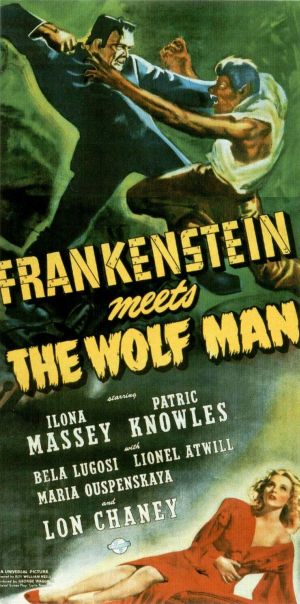
Released in 1943, Frankenstein Meets The Wolf Man was the first of the Universal horror movies to feature the monsters meeting.  (Dracula would join both Frankenstein’s Monster and the Wolf Man in later films.)  In our current age of the MCU and Zack Snyder super hero movies, that might not seem like a big deal but I’m sure it was huge in 1943.  Were the Universal Monster Movies the first example of a shared cinematic universe?  To be honest, I have no idea but it sounds good so let’s go with it.

Frankenstein Meets The Wolf Man starts, as so many Frankenstein films have, with a little bit of grave robbing.  Except, this time, the grave robbers aren’t looking for body parts.  Instead, they break into the Talbot family crypt because they’ve heard that Larry Talbot was buried with a lot of jewelry and money.  As the grave robbers wander around the crypt, they recap for us everything that happened in The Wolf Man.  Finally, they open up Larry’s coffin and are confronted with the dead body of Larry Talbot himself!  (Larry is, once again, played by Lon Chaney, Jr.)

Unfortunately for our grave robbing friends, there’s a full moon out.  As soon as the moonlight shines on Larry, he comes back to life and promptly transforms into … THE WOLF MAN!

After killing one of the robbers, the Wolf Man runs out of the tomb.  The next morning, once again human and alive, Larry Talbot wakes up in some bushes.  He’s arrested by the police.  He’s sent to a mental hospital.  He transforms a few more times and kills a few more stock characters.  And during all of this, Larry tells anyone who will listen that he just wants to be cured of his condition so that he can die and stay dead.

It was at this point that it occurred to me that Larry Talbot is perhaps the whiniest werewolf in film history.

Eventually, Larry decides that maybe the famous Dr. Ludwig Frankenstein could help him!  So, he breaks out of the hospital and travels to Germany (though, since the film was made during World War II, we’re never specifically told that he’s in Germany).  Accompanying him is Malena (Maria Ouspenkaya), the gypsy woman from the first Wolf Man.

In Germany a generic Eastern European country, Larry finds out that Dr. Frankenstein is dead and his research is missing.  Larry does, however, discover the frozen body of Frankenstein’s Monster (now played by Bela Lugosi).  After reviving the monster, Larry is upset to discover that the Monster not only doesn’t know where to find Frankenstein’s research but that, after dealing with their crap for four movies, the Monster doesn’t really seem to care about doing anything other than harassing the local villagers.

Fortunately, Larry does get to meet Ludwig’s widow (Illona Massey) and get a chance to tell her about how much he wishes he was dead.  Probably just to get him to shut up about how terrible his existence is, the widow agrees to help Larry.  She gives him Ludwig’s research and Larry believes that he’s finally found a way to end both his life and the Monster’s!

Unfortunately, it doesn’t quite work that way.  For one thing, Larry is working with a scientist (played by Patric Knowles) who doesn’t think that the Monster needs to be destroyed.  Secondly, Larry keeps forgetting to keep track of the lunar cycles.  That full moon is continually taking him by surprise.

It all leads to a final battle between Frankenstein’s Monster and the Wolf Man.  It only lasts for a little less than 10 minutes so it’s hard not to be a bit disappointed but at least no one talks about having a mother named Martha.

(Can you imagine that conversation?

“Growl growl growl growl”

“Why you say Martha?”

“Growl growl.”

“But Monster’s mother named Martha!”

“Growl!”

“Friends!”

“growl…”)

(It’s been seven months since that damn movie came out and, here at the Shattered Lens, we’re still getting mileage out of “But my mother was named Martha!” jokes.)

Frankenstein Meets The Wolf Man isn’t necessarily a good movie but it is a lot of fun to watch.  It helps, of course, if you’ve seen the other Universal horror films.  Part of the fun is spotting members of the Universal stock company, like Lionel Atwill and Dwight Frye, and seeing who they’ll be playing this time around.  One thing that I did legitimately appreciate is that the film made at least some sort of an effort to maintain a continuity with both The Wolf Man and Ghost of Frankenstein.  It appears that some actual thought was put into explaining how both the Wolf Man and the Monster were still around after the events of the last two films.  That shows more respect for the audience that you’ll find in most modern films.