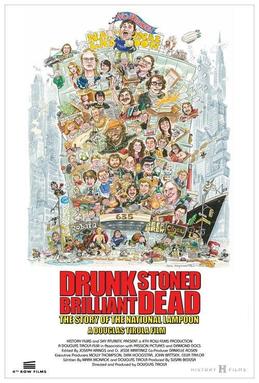
 The documentary Drunk Stoned Brilliant Dead pays tribute to National Lampoon. Founded in 1970, National Lampoon was published for 28 years and, at the height of its popularity, its sensibility redefined American comedy. When it came to National Lampoon, nothing was sacred and nothing was off-limits. The success of National Lampoon led to a stage show called Lemmings and The National Lampoon Radio Hour, which featured everyone from John Belushi and Bill Murray to Chevy Chase and Harold Ramis. Michael O’Donoghue, famed for his impersonations of celebrities having needless inserted into their eyes, went from writing for the Lampoon to serving as Saturday Night Live‘s first head writer. National Lampoon’s Animal House, Vacation, and Caddyshack are three of the most influential film comedies ever made. Everyone from P.J. O’Rourke to John Hughes to The Simpsons‘ Al Jean got their start at National Lampoon.
As influential as it was, National Lampoon is a magazine that would not be able to exist today’s world. Just looking at the cover of most issues of National Lampoon would reduce today’s special little snowflakes to the point of hysteria. In Drunk Stoned Brilliant Dead, National Lampoon‘s publisher claims that the Lampoon ultimately ceased publication because the religious right threatened to boycott any company that advertised in the magazine. Today, it would be the “safe space” crowd complaining that the magazine did not come with proper trigger warnings. Lena Dunham would look at one issue and go into a rage spiral. Salon would publish a hundred hand-wringing think pieces about how National Lampoon was the worst thing since Ted Cruz. Colleges would ban it and religious groups would still burn it. National Lampoon was a magazine that went out of its way to be offensive to both the left and the right but, as editor-in-chief Tony Hendra puts it, the job of satire is to make those in power feel uncomfortable. By poking fun at everything and challenging its readers, National Lampoon exposed the absurdity behind both the country’s prejudices and some of its most sacred beliefs.

Drunk Stoned Brilliant Dead follows the National Lampoon from its founding to its ignominious end. Along with interviews with Lampoon alumni, it also features archival footage of both Lemmings and The Radio Show, providing glimpses of Christopher Guest, Bill Murray, John Belushi, Gilda Radner, and Harold Ramis before they became famous. There are also interviews with celebrity admirers of the Lampoon who talk about how the magazine inspired their own work. It makes sense that Judd Apatow was interviewed and Kevin Bacon made his screen debut in Animal House but what was Billy Bob Thornton doing there?
Unfortunately, drunk, stoned, brilliant, and dead describes some of the most important and talented figures in the Lampoon‘s history. The documentary especially focuses on Doug Kenney, the Lampoon’s co-founder. Everyone interviewed agrees that Kenney was a comedic genius who was also often emotionally troubled and who would vanish for months on end. After the initial critical failure of Caddyshack, Kenney disappeared in Hawaii. His body was later discovered at the bottom of the cliff. Did Kenney jump or did he slip or, as director John Landis suggests, was he murdered by a drug dealer? Nobody seems to know but Kenney’s ghost haunts the documentary. This collection of very funny people get very serious when it comes time to talk about Kenney’s death. Even Chevy Chase briefly redeems himself after years of bad publicity when he gets choked up.
Drunk Stoned Brilliant Dead is tribute to both a magazine and a bygone era. See it before it gets banned.

 I think I was twelve when I first saw Heavy Metal. It came on HBO one night and I loved it. So did all of my friends. Can you blame us? It had everything that a twelve year-old boy (especially a 12 year-old boy who was more than a little on the nerdy side) could want out of a movie: boobs, loud music, and sci-fi violence. It was a tour of our secret fantasies. The fact that it was animated made it all the better. Animated films were not supposed to feature stuff like this. When my friends and I watched Heavy Metal, we felt like we were getting away with something.
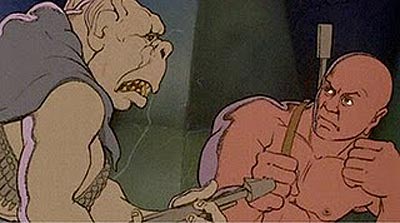 Den (directed by Jack Stokes, written by Richard Corben)
 On a space station orbiting the Earth, Captain Lincoln F. Sternn is on trail for a countless number of offenses. Though guilty, Captain Sternn expects to be acquitted because he has bribed the prosecution’s star witness, Hanover Fiste. However, Hanover is holding the Loc-Nar in his hand and it causes him to tell the truth about Captain Sternn and eventually turn into a bloodthirsty giant. Captain Sternn saves the day by tricking Hanover into getting sucked out of an air lock.
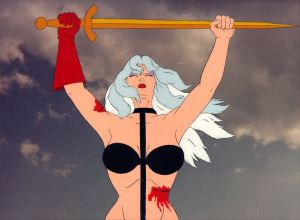 In the film’s final and most famous segment, Taarna, the blond warrior was featured on Heavy Metal‘s poster, rides a pterodactyl across a volcanic planet, killing barbarians, and finally confronting the Loc-Nar. She sacrifices herself to defeat the Loc-Nar but no worries! We return to Earth where, for some reason, the Loc-Nar explodes and the girl from the beginning of the film is revealed to be Taarna reborn. She even gets to fly away on her pterodactyl. Taarna was really great when I was twelve but today, it is impossible to watch it without flashing back to the Major Boobage episode of South Park.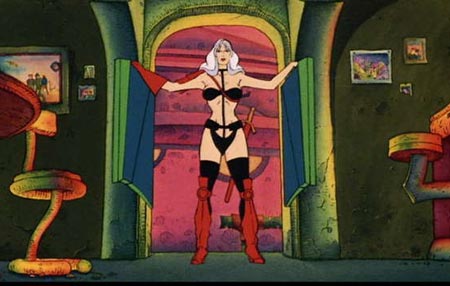



 Through the Shattered Lens