October Positivity: Jerusalem Countdown (dir by Harold Cronk)


2011’s Jerusalem Countdown opens with the world on the verge of destruction.  Israel and a nuclear-armed Iran are negotiating in Washington and not everyone wants the two countries to be at peace.

In Chicago, Daniel (Carey Scott) watches the news of the summit and then looks out his window as his unfriendly and glowering neighbor comes and goes from his house.  Daniel worries that his neighbor is up to something.  He could be a member of a terrorist cell!  Daniel’s wife (Jaci Velasquez) tells him to stop worrying about things that he can’t control but that’s easier said than done.

FBI agent Eve (Anna Zielinski) is approached by her father (Stacy Keach), a former intelligence agent who warns her that the end times are approaching.

Another intelligence agent, Shane Daughtery (David A.R. White) is contacted by a burned-out arms dealer (Lee Majors), who informs him that a group of terrorists are planning on setting off a series of bombs and plunging the world into war.  The arms dealer is assassinated by a man who keeps reciting passages from the Book of Revelations.  Meanwhile, CIA bigwig Jack Thompson (a seriously miscast Randy Travis) continually tells Shane that he can’t share too much information with him because it’s all classified….

Jerusalem Countdown is a faith-based film that also tries to be an action film.  In fact, I would say that far more emphasis is put on action than on faith.  Until the final few minutes of the film, there’s really not much focus put on religion, other than Daniel briefly praying when he finds himself trapped in the neighbor’s house and a scene where a librarian scolds Shane and Eve for not knowing about the Ten Commandments.  One major commandments, by the way, is Thou Shalt Not Kill but Shane and Eve manage to kill quite a few people in this film.  Of course, they were all bad people and Shane and Eve are trying to keep the world from being plunged into a world war so I’m willing to cut them some slack.

The cast, as you may have noticed, has a number of familiar faces in it.  It’s largely a nostalgia cast, the type that’s designed to make people over the age of 60 say, “Lee Majors is in this!”  With the exception of Randy Travis, none of the “stars” have a particularly large role.  One gets the feeling that Stacy Keach filmed his scenes in a handful of hours, collected his paycheck, and then got out of there.  It’s amazing to me that Eric Roberts is somehow not in this film.

As for the film itself, it’s competently made and David A.R. White is one of the better actors amongst the Pureflix regulars.  (White has even managed to maintain a semblance of dignity through five God’s Not Dead films.)  That said, the film itself moves a bit slowly and the low-budget keeps the action from being as memorable as it could be.  There’s a cool helicopter crash but otherwise, it’s never as exciting as it obviously wants to be and there’s a lot — and I do mean A LOT — of filler-type scenes of people talking on their phones while driving from one location to another.  The plot itself feels a bit muddled and there’s a lot of loose ends left dangling, as if the film was meant to be a set up for a sequel that never came.
The Films of 2024: Average Joe (dir by Harold Cronk)


I should admit that I have a bias when it comes to Average Joe.

Two weeks ago, when I watched this movie, I mentioned that I was viewing it on twitter.  I included a picture of the film’s poster with my tweet.  A few days later, I was briefly locked out of my account because someone reported the tweet for a copyright violation.  Apparently, they were offended that I had shared the film’s poster.  The image was removed from twitter and my account was subsequently unlocked.

I mean …. seriously, what the Hell?  Not to brag on myself but I’m probably one of the few secular film bloggers out there who is willing to give a serious, non-snarky review to a faith-based film like Average Joe.  Beyond that, me tweeting that I’m watching the film and sharing the film’s poster is basically free advertising for a film that really hasn’t really gotten a whole helluva lot of attention.  I really have to wonder who thought it would be a good idea to alienate a viewer by complaining about someone sharing the film’s poster on social media.

As for the film itself, it’s based on a true story.  Joe (Eric Close) is a former rebel and delinquent who is straightened out by both serving in the military and marrying Denise (Amy Acker).  After Joe joins a church and shares his testimony, he is asked to take over as coach of a struggling high school football team.  Joe leads them to victory but he also causes controversy by publicly praying before and after the games.  The school board orders Joe to pray in the locker room where no one can see him but Joe refuses.  Joe’s case makes its way to the Supreme Court.  Along the way, Denise goes from being annoyed with her husband’s stubbornness to supporting his right to pray.

Del Close and Amy Acker make for a believable and cute couple.  They definitely have enough chemistry that you buy them as a married couple.  Both Close and Acker are also talented enough actors that they can make the movie watchable, even when it gets more than a bit heavy-handed.  That said, the film also features Joe and Denise looking straight at the camera and narrating their story, which leads to several moments of either Close or Acker saying, “Actually, that’s the not the way it happened.  What really happened was….”  It’s a technique that become popular after Adam McKay used it in The Big Short (though I think it’s entirely probable that McKay himself stole it from Michael Winterbottom’s 24-Hour Party People).  The first time it happens, it works because Joe interrupts some over-the-top footage of him trying to lasso a camel in a desert.  It’s exactly the type of scene that is worthy of a “Wait, this didn’t happen!”  But each subsequent time that Joe and Denise break the fourth wall, it feels less like a clever narrative device and more like a gimmick.  There comes a point where you just want both Joe and Denise to get on with it.

Average Joe is …. it’s okay.  I liked some of the acting.  I liked the score by Andrew Morgan Smith.  Narratively, it was never quite as memorable as it probably should have been.  It’s a film that tries hard but doesn’t really stick with you.

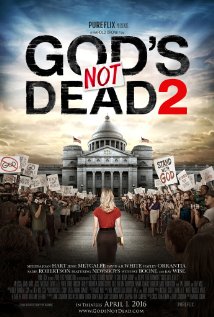
Catching Up With The Films of 2016: God’s Not Dead 2 (dir by Harold Cronk)


gods_not_dead_2_poster

Much like Warcraft and Nine Lives, God’s Not Dead 2 is one of those films that you just know is going to be mentioned on all of the “worst films of 2017” lists.  I imagine that it will get a lot of Razzie nominations and it might even win a few.

But you know what?  I watched God’s Not Dead 2 on YouTube and I enjoyed it, though probably not for the reasons that the filmmakers intended.  God’s Not Dead 2 is one of the most thoroughly over-the-top and shamelessly melodramatic films that I have ever seen.  This is one of those faith-based films where all of the Christians are practically saintly while the atheists are portrayed as being so evil that they might as well be tying people to train tracks and twirling their mustaches.  This is one of those films where the good guys discuss their plans while sitting in quaint kitchens while the bad guys gather in conference rooms and growl about how much they hate religion.  And the propaganda is just so blatant and lacking in subtlety that it becomes undeniably watchable.

God’s Not Dead 2 is, for lack of a better comparison, the Reefer Madness of Christian filmmaking.  It’s a film that makes Rock: It’s Your Decision look like a work of subtle nuance.  You may want to look away but you won’t be able to.

Essentially, God’s Not Dead 2 takes the heavy-handed sanctimonious sermonizing of the first film and then adds a healthy dash of anti-government paranoia.  (And you know how much I love anti-government paranoia.)  In this one, Melissa Joan Hart is a teacher who makes the mistake of 1) mentioning to her class that the Sermon on the Mount inspired Gandhi and Martin Luther King and 2) counseling a student who is struggling to deal with the death of her brother.  (When the student asks Melissa what gives her strength, Melissa replies, “Jesus.”)  Melissa is brought before the school board, which says that Melissa has broken the law and that they want to take away her teaching license.  Offering absolutely no support is her principal (Robin Givens).  Fortunately, a handsome lawyer (Jesse Metcalfe) is willing to help her out.  He doesn’t believe in God but how long do you think that will last?

Prosecuting Melissa is … a lawyer from the ACLU!  We know that this lawyer is evil because his name is Peter Kane and he’s played by Ray Wise.  And here’s the thing — Ray Wise gives perhaps the least subtle performance of the year.  When he talks about the importance of convincing America that there is no God, he does so with the type of evil gleam in his eye that we typically tend to associate with lower tier MCU villains.  When he cross-examines Melissa’s students, he smirks like a serial killer.  Whenever he has to say words like “God” or “Jesus,” he literally spits them out.  The only thing that trips him up is when a Christian admits to having once been an atheist and Wise looks so stunned that you half expect him to say, “But that is illogical and does not compute” before revealing that he’s actually a robot sent from the future. He’s one of the most evil characters of all time and Wise so throws himself into the role that you can’t help but enjoy watching him.

So, on the one side, you have Ray Wise spitting hellfire and, on the other side, you have a literally beatific Melissa Joan Hart.  And let’s give credit where credit is due — Melissa Joan Hart does as well as anyone could with her seriously underwritten and kinda drab character.  (Add to that, Melissa Joan Hart was Sabrina, The Teenage Witch and, therefore, I will always give her the benefit of the doubt.)

Meanwhile, there’s another subplot going on.  The local preacher — who somehow manages to get on the jury, despite the fact that there’s no way a preacher would actually be put on the jury of trial that centered around separation of church and state — is being pressured by the local authorities.  They want to see copies of his sermons.  Damn government!

Of course, what’s interesting is that this actually did happen in Houston.  In 2014, several preachers were presented with subpoenas demanding copies of their sermons, in order to determine if they had been preaching against the Houston Equal Rights Ordinance.  For that matter, there was also recently a story down here about a high school football coach who lost his job because he led his team in a prayer.  There is a basis in reality for both of the film’s main storylines but you’d never guess that from watching God’s Not Dead 2.  God’s Not Dead 2 is so melodramatic and so firmly devoted to its good-vs-evil worldview that it sacrifices whatever real world credibility it could have and probably does more harm than good to the cause that it supports.

That being said, it’s a fun movie in much the same way that the Atlas Shrugged trilogy was fun.  It’s just so silly and over-the-top that you can’t help but watch.  I imagine that believers will enjoy seeing the nonbelievers ridiculed while nonbelievers will enjoy shaking their head and saying, “How can anyone buy into this?”  By taking the side of half the audience but doing so in a way that seems to confirm every pre-conceived notion held by the other half, God’s Not Dead 2 appeals to all.

If nothing else, Ray Wise deserves some sort of award for perfecting the art of villainous overacting.  Though this year, he may have to share it with Kyle Secor.  Secor’s work in The Purge Election Year is impossible to top but Ray Wise sure does come close.

Overacting is not dead.