Late Night Retro Television Review: Highway to Heaven 3.11 “Jonathan Smith Goes To Washington”


Welcome to Late Night Retro Television Reviews, a feature where we review some of our favorite and least favorite shows of the past!  On Thursdays, I will be reviewing Highway to Heaven, which aired on NBC from 1984 to 1989.  The entire show is currently streaming on Tubi and several other services!
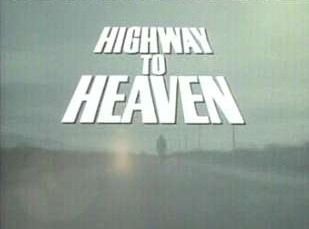
This week, Jonathan invades the Senate.

Episode 3.11 “Jonathan Smith Goes To Washington”

(Dir by Michael Landon, originally aired on December 3rd, 1986)

Mark’s sister is getting married but her future stepdaughter desperately needs an experimental drug to survive a rare illness.  Unfortunately, the Senate is voting on a budget that will cut funding for experimental drugs.  So, Jonathan appears to Sen. Fritz McCorkindale (Eddie Albert) and pressures him to rewrite the budget.  Senator McCorkindale is reluctant until he learns that his grandson will also need an experimental drug.  So, it’s time to redo the end of Mr. Smith Goes To Washington, just with Jonathan providing advice to the Senator in his effort to keep the budget he wrote from being put to a vote.  This is one of those episodes where no one else can see Jonathan but they can see the Senator talking to Jonathan and, for some reason, no one wonders why the Senator is talking to himself.

This episode was sincere, earnest, heartfelt, well-intentioned, and ultimately very, very cringey.  Michael Landon’s heart was undoubtedly in the right place but, and this might just be my civil libertarian side coming out, I’m not really comfortable with the idea of an angel telling a senator how to vote on legislation.  This was kind of like that episode where Mark inspires the President to sign an arms treaty.  It was just too naive to be effective.

On another note, Mark refers to his sister as being his only relative but it seems like Mark visits a new relative nearly every episode.  That type of sloppy writing didn’t occur often on Highway to Heaven so I’m going to guess this episode was written and filmed quickly, so deeply did Landon believe in the episode’s message.  Again, you can’t fault Landon for caring and trying to do good but this episode just felt rushed.

Love On The Lens: The Amy Fisher Story (dir by Andy Tennant)


Poor Mary Jo Buttafuoco!

As seen in the 1993 made-for-tv movie, The Amy Fisher Story, Mary Jo (Laurie Paton) was just a normal Long Island housewife.  She was married to an auto mechanic named Joey (Anthony John Denison).  She had a family and a nice house and a seemingly perfect life.  But, one day, a teenage girl named Amy Fisher (played by a young Drew Barrymoe) showed up at her front door and claimed that her younger sister was having an affair with Joey.  When Mary Jo accused Amy of lying and then said she was going to call her husband, Amy pulled a gun and shot Mary Jo in the head.  That Mary Jo survived, albeit with partial facial paralysis, was a miracle.

The Amy Fisher Story was the third of the movies to be based on the true story of Amy Fisher and her affair with Joey Buttafuoco.  If Casualties of Love portrayed Amy as being an obsessed stalker who targeted a saintly man and if Amy Fisher: My Story portrayed Amy as a vulnerable teen who was groomed by a sleazy older man, The Amy Fisher Story suggests that perhaps the truth was somewhere in between.  As played by Drew Barrymore, Amy Fisher is immature, unstable, and self-destructive even before she meets Joey Buttafuoco.  As played by Anthony John Denison, Joey is a cocky and arrogant womanizer who grooms a teenage girl and leads her to believe that the only thing keeping them from being truly together is the fact that he has a wife.  (If Casualties portrayed Joey as being a dumb, salt-of-the-Earth type of guy and Amy Fisher: My Story portrayed him as being coldly manipulative and cruel, The Amy Fisher Story portrays him as being a self-centered idiot who did whatever he felt like doing without thinking about any possible consequences.)  Of all the performers who played Amy and Joey, Drew Barrymore and Anthony John Denison are the most convincing.  On the one hand, that lends a credibility to this film’s version of the events that led to the shooting of Mary Jo.  On the other hand, it also means that neither of the main characters is particularly likable.

The film instead tries to make a hero out of a reporter named Amy Pagnozzi (Harley Jane Kozak), who finds herself assigned to follow the Amy Fisher story when she would much rather be reporting on the upcoming presidential election.  Pagnozzi pops up throughout the story, commenting on the media feeding frenzy and generally acting annoyed by the whole thing.  The problem with this approach is that, for all of Pagnozzi’s condemnation of the country’s tabloid mentality, she’s still a part of the monster.  It’s hard to have sympathy for someone complaining about how a story is covered when they’re the one doing the covering.

Interestingly, for a film that condemns that way the story was covered, The Amy Fisher Story is probably the most tabloid-y of the three films.  Every sordid detail — from Amy and Joey’s motel meetings to Amy’s work as an escort to her subsequent dalliance with a gym owner — is provided in artfully filmed detail.  The result is a film that can feel a bit over-the-top but that’s exactly the right approach to take when it comes to a story like this.  When you’re making a movie about a suburban teenage escort who shoots her boyfriend’s wife, there’s really not much need or room for subtlety.  The Amy Fisher Story works because it fully embraces the melodrama and it features a performance from Drew Barrymore that remind us that, back before she became a permanently cheerful talk show host, Drew was a force of pure chaos.

When it comes to the story of the Fishers and the Buttafuocos, this is the film to see.

A Movie A Day #71: Side Out (1990, directed by Peter Israelson)


Monroe (C. Thomas Howell) is a young lawyer who moves to California and gets a job working for his Uncle Max (Terry Kiser).  Max wants Monroe to concentrate on evicting beach bums.  Monroe wants to play beach volleyball.  Together, they solve crimes.  No, actually, Max orders Monroe to evict Zack (Peter Horton), a former volleyball champion who was once “king of the beach.”  Zack agrees to coach Monroe and his goofball friend, Wiley (Christopher Rydell) in a volleyball tournament.  But when Zack misses a match because he is having underlit, PG-13 sex with his ex-wife (Harley Jane Kozak), uncoached Monroe accidentally breaks Wiley’s arm.  Now, Zack has to step in as Monroe’s partner and reclaim his status as king of the beach!
When I was a kid, Side Out was a HBO perennial, which is not the same thing as being a good movie.  There have not been many movies made about beach volleyball and Side Out shows us why.  Beach volley ball is just not that exciting to watch, especially when the main competitors are two out of shape actors.  All the jump cuts and close-ups in the world can’t disguise the fact that neither actor looks like he could get the ball over the net, never mind playing for over ten minutes without getting out of breath.  In Side Out, beach volleyball teamwork comes down to a lot of yelling and whenever Monroe yells at either Wiley or Zack, he sounds just like the “Put him in a body bag, Johnny!” guy from The Karate Kid.

At least Kathy Ireland has a small role.  Also, in the role of Zack’s friend, keep an eye out for Duke himself, the great Tony Burton!

What are you doing here, Duke!?

A Movie A Day #26: The Taking of Beverly Hills (1991, directed by Sidney J. Furie)


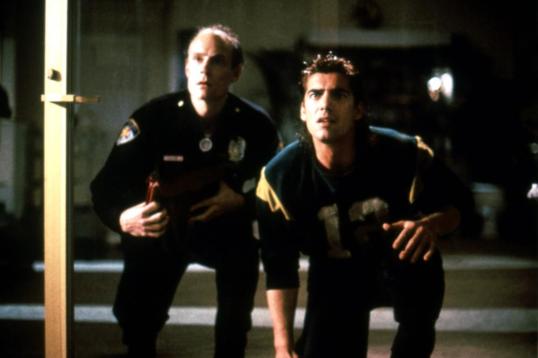
After a toxic chemical spill, Beverly Hills is evacuated.  While its citizens wait in a hotel, their mansions and valuables are guarded by the police and agents of the EPA.  Or so they think.  It turns out that the chemical spill was faked and that both the police and the government agents are in on it.  While the town’s deserted, they’re going to rob everyone blind.  The scheme’s mastermind is Bat Masterson (Robert Davi), the owner of L.A. Rams.  What Masterson doesn’t realize is that one citizen of Beverly Hills stayed behind, his own quarterback, Boomer Hayes (Ken Wahl).  Teaming up with Ed Kelvin (Matt Frewer), the last honest cop in town, Boomer sets out to protect Beverly Hills.

It’s just a dumb as it sounds.  In fact, of the many Die Hard ripoffs that came out in the late 80s and the early 90s, The Taking of Beverly Hills is probably the dumbest, which also makes it one of the most entertaining.  Boomer, who has an impressive mullet, can only speak in football analogies, constantly assuring Ed that it’s only the first down and that they can turn things around after halftime.  When Boomer gets serious, he says, “It’s time to play offense.”  One of the stranger things about The Taking of Beverly Hills is that, unlike working class hero John McClane, Boomer is not an outsider.  He’s in Beverly Hills because he’s rich.  The Taking of Beverly Hills is basically about one rich guy trying to keep another rich guy from robbing a bunch of other rich people.  It’s Die Hard if Hart Bochner had been the hero instead of Bruce Willis.

Keep an eye out for Lee Ving, lead singer of Fear, playing one of the corrupt cops and an uncredited Pamela Anderson cast as a cheerleader.  And keep your ears open for songs like Epic by Faith No More because their presence on the soundtrack (and the associated rights issue) is the reason was this stupidly entertaining movie will probably never get a DVD/Blu-ray release in the United States.

It has been released in Germany, where it was retitled Boomer after the lead character.

It has been released in Germany, where it was retitled Boomer after the lead character.


Horror Film Review: The House On Sorority Row (dir by Mark Rosman)


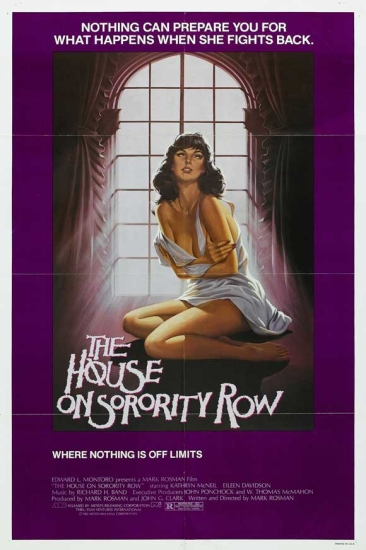
the_house_on_sorority_row_poster

The 1983 film, The House on Sorority Row, is one of the best (and sadly, one of the more underrated) slasher films to be released during the slasher boom of the early 1980s.  Yes, I know that the poster above probably makes it look a little generic.  And “Where Nothing Is Off Limits” sounds more like a tagline for a film about snowboarders than a rather engaging and occasionally even witty suspense film.

But no matter!

The House on Sorority Row is a masterpiece of the genre.  (Avoid the remake, Sorority Row.  ALWAYS AVOID THE REMAKE … except for The Maltese Falcon, the Hammer Dracula films, The Departed … you know what?  Use your own damn judgement. )

Seven sorority sisters are excited about graduating and want to throw a big party.  However, their strict and slightly insane house mother, Mrs. Slater (Lois Kelso Hunt), has a strict no party policy.  She also has a strict “everyone out of the house once the semester ends” policy and she’s not very happy when she discovers that the seven girls are planning on staying for the weekend!  She demands that they all leave.  She then proceeds to use her cane to destroy a waterbed while one girl is on it with her boyfriend.  As the hallway floods, the girls wonder what’s wrong with Mrs. Slater.

Of course, what they don’t know is that Mrs. Slater has a tragic past.  Well, actually, they kind of do know it.  At the very least, they suspect it.  They know that Slater does have a reason for always closing the house on the weekend immediately following the end of the semester.  They know but they don’t care.  Instead, they plan an elaborate hoax.  That’s right!  V for Vengeance!

How does the hoax work out?  Well, like most college hoaxes, it ends up with two laughing girls, five angry and/or worried girls, and one dead house mother floating in the pool.  OH NO!  They’ve got to both throw a party and hide a dead body!  See, this is why I never joined a sorority.  I can throw a party.  And I can hide a dead body.  But not both in one night!

At first, things go okay.  Nobody discovers the body.  The party goes off as planned.  Everyone’s having as good a time as you can while trying to cover up a future-ruining felony.  But then suddenly, the body disappears.  And then the girls start to disappear, one-by-one…

So, let’s just be honest here.  Plotwise, The House on Sorority Row is not going to win points for originality.  Though the film does include a few clever twists, it’s pretty much your standard slasher film and it has its share of scenes where the girls stupidly split up, drop knives that they really shouldn’t drop, and hide in silly places.  I always feel bad for the girl killed in the bathroom stall because seriously, that’s the last place I would want to die.  (Add to that, her head later turns up in a toilet.  BLEH!)

While the plot may be familiar, The House on Sorority Row is a triumph of style.  Director Mark Rosman may have told a familiar story but he told it well, putting more emphasis on suspense than gore.  Regardless of how silly the story may be, you still get caught up in it.  Rosman is at his best towards the end of the film when the final survivor has to fight off the murderer while under the influence of a hallucinogenic drug.

Finally, the film is far better acted than your typical slasher film.  Though the majority of the characters are definitely familiar types (there’s the bitchy girl, the slightly less bitchy girl, the best friend, the mousy girl, the smart girl, the dumb girl, etc), the actresses who play them are all sympathetic and likable.  You actually care about them.  Yes, you even care about self-centered, immature Vicki, even though she’s the one who came up with the hoax in the first place.  Vicki is played by Eileen Davidson and she gives one of the best performances in slasher film history.  It’s hard not to relate to her exasperation as it turns out to be harder to cover up a murder than she originally assumed.

That said, having watched the film, I’m glad that I never joined a sorority.  Between the waterbed and the murders, I don’t know how I ever would have ever graduated.

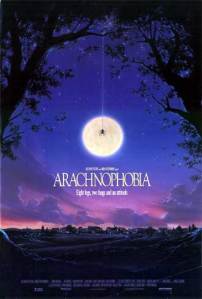
Quick Movie Review: Arachnophobia (dir. by Frank Marshall)


When I was a kid, my grandmother used to keep this clear shower curtain of a large black web, complete with a big red spider on it. It scared me so bad that I was actually more willing to brave the darkness of the basement bathroom than to have to deal with that monstrosity in the well-lit one. Between that, my brother’s EC comics and the original “The Fly” with Vincent Price, it’s how I developed Arachnophobia. It’s a fight or flight reflex that occurs when anything spider related appears. It seems fitting that as I’m writing this from a location that’s full of Black Widows, Arachnophobia is the topic for this review.

Arachnophobia marked the first directing attempt by Frank Marshall, long time producer of many of Steven Spielberg’s films. The film turned out to be a success when released, and manages to feature one the greatest Human vs. Tarantula battles ever filmed.

Although the film has some horror elements, it’s kind of hard to classify Arachnophobia as an actual horror film, despite the deaths that are in the film. There are some humorous moments (particularly from John Goodman), and the scares don’t come too often. For anyone who’s bothered by spiders, though, there are a number of jumpy moments that occur without being excessively gory. The story is a little misleading. It starts in Venezuela, South America, where a deadly tarantula manages to sneak its way on board a trip back to California. You’d think that from here, the Tarantula would end up finding another Tarantula, and thus pull a Kingdom of the Spiders with a whole town full of spiders. The writers, however, end up making a mistake in having a Tarantula mate with a common house spider, thus breeding dozens of other smaller spiders.

That’s like a Tiger trying to mate with a house cat. I’m not exactly sure if that’s even possible, but I’m getting off track. This actually ends up helping the story because now the town has to deal with all of these smaller spiders that are easy to hide around. I always considered that to be pretty effective.

Jeff Daniels character, Dr. Ross Jennings suffers from Arachnophobia in the worst way. Moving to the town of Canaima with his family, he trades the big city for a more relaxed, rural setting. Of course, it’s a happy ideal situation until various deaths start happening around town. Eventually, he and the authorities come to realize just how bad things really are. John Goodman’s character was an interesting touch as a funny exterminator, but really wasn’t used as much as he could have in this film. Then again, when he does tend to steal the scenes he’s in. Arachnophobia has a number of other supporting actors, but the film mainly belongs to Daniels, Goodman and the the spiders.

Chris Walas, who won an Oscar for his effects and make up work in The Fly helped to create some of the more mechanical spiders and close-ups when necessary. While you can tell where you’re dealing with real tarantulas and their synthetic counterparts, he did a great job in getting the fear factor out there, especially during the final standoff of the film. Without giving much away, the last 20 minutes of the movie are brilliant in that the final battle is much more than the simple “find it and squash it” scenario from Kingdom of the Spiders. It’s almost a violent chess match.

Arachnophobia is a treat. It may not be the best film about spiders in general, but if you do suffer from the condition or know someone who does, it definitely worth seeing, just to jump and squirm now and then. It’s much better than knowing there are real Black Widows to contend with.