Welcome to Retro Television Reviews, a feature where we review some of our favorite and least favorite shows of the past! On Sundays, I will be reviewing Homicide: Life On The Street, which aired from 1993 to 1999, on NBC! It can be viewed on Peacock.
This week, the search for Adeena Watson’s murderer begins.
Episode 1.2 “Ghost of a Chance”
(Dir by Martin Campbell, originally aired on February 3rd, 1993)
There’s been a murder in Baltimore. That, in itself, is not news. The pilot firmly established that murder is a fact of life in Baltimore. But, the victim of this crime is an 11 year-old girl named Adeena Watson, who left her home to go to the library and who never returned. The press is covering every detail. The police brass want an arrest and they want an arrest quickly. And the primary detective on the case is rookie Tim Bayliss, who has never even worked a murder case on his own before. Giardello refuses to replace Bayliss but he also makes it clear that he needs Bayliss to bring him something.
As for Bayliss, he spends most of this episode struggling. Not only does he not have the respect of his fellow detective but he also, as a rookie, doesn’t even have a desk until Giardello, in a fit of anger, knocks everything off an unoccupied desk and awards it to Bayliss. (So, was that desk just sitting there the whole time? I thought they didn’t have any available desks.) Because this crime is what is known as a “red ball,” (i.e., a murder that has attracted the attention of the media and the public), every detective is looking for Adeena’s murderer. While Bayliss obsesses on who Adeena was before she was killed, the rest of the squad does the practical things, like talking to neighbors and bringing in all of the city’s sex offenders for interrogation.
My heart broke for Bayliss while watching this episode. Kyle Secor did a good job of capturing both Bayliss’s outrage over the crime and his fear of failing to solve his first case as a primary. While Bayliss stared at Adeena’s body in the alley, Munch, Lewis, and Crosetti debated sports. And while their attitude may have seemed callous, this episode established that disconnecting is the only way to handle working Homicide. Bayliss, having not learned how to disconnect, grows more and more obsessed with Adeena. I cheered a little when Bayliss finally stood up for himself and even won the grudging respect of Frank Pembleton. That said, the change in Bayliss happened almost too quickly to be credible. Apparently, all it took was for Giardello to give him a desk for Bayliss to go from being meek and overwhelmed to being a confident and take-charge detective.
While Bayliss searched for Adeena’s killer, Much and Bolander dealt with a murder that happened in a wealthy neighborhood. The killer (Gwen Verdon) was a wife who snapped after 60 years of marriage. As she explained to Bolander and Munch, she and her husband had earlier promised each other that they wouldn’t get a divorce until the children died. Bolander has a crush on the coroner, Dr. Blythe (Wendy Hughes), but he’s worried about getting back in the dating game after his own divorce. When Munch asks Bolander how old he is, Bolander replies, “48.” Ned Beatty was a great actor and I’ve never seen a bad Ned Beatty performance. That said, it’s also hard for me to think of any film where he looked a day under 50.
Meanwhile, Kay tries to get a confession from a guy who is about to go on trial for murder. Felton laughs when Kay says that she was visited by the ghost of the guy’s victim. However, Felton makes up for being a jerk by helping Kay find the murder weapon. This whole subplot was odd to me, largely because Kay really doesn’t come across as the type to believe in ghosts. But whatever works, I guess! Melissa Leo and Daniel Baldwin did a good job in this episode, selling a storyline that had the potential to be a little bit too cute for its own good.
As the episode ended, the killer of Adeena Watson had yet to be captured. While the other detective drank at a wharf bar, Bayliss went to Adeena’s memorial service and stared at her coffin, haunted. It was a powerful moment but one that left the viewer worried about Bayliss’s sanity. Earlier in this episode, Pembleton said that a murder that goes 72 hours without being solved will never be solved. Bayliss is running out of time.
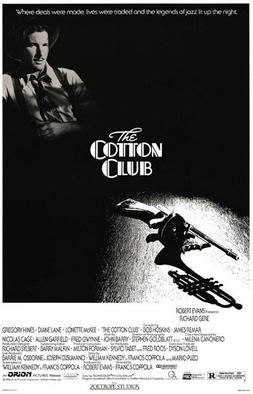 The time is the 1930s and the place is New York City. Everyone wants to get into the Cotton Club. Owned by British gangster Owney Madden (Bob Hoskins), the Cotton Club is a place where the stage is exclusively reserved for black performers and the audience is exclusively rich and white. Everyone from gangsters to film stars comes to the Cotton Club.
 Through the Shattered Lens