The Winners At Cannes And What It Means For This Year’s Oscar Race


poster_tn_sicario

Well, that shows you how much I know.

The 68th Annual Cannes Film Festival came to a close earlier today.  If you’ve been following news from the festival over the past two weeks then you’ve heard that Gus Van Sant’s Sea of Trees is no longer considered to be an Oscar contender.  (That’s putting it gently.)  You’ve heard a lot of acclaim given to Todd Haynes’s Carol.  You have also seen Denis Villeneuve’s Sicario and the Hungarian film Son of Saul emerge as a potential Oscar contenders.  Michael Caine’s performance in Youth was acclaimed, as was the work of Tim Roth in Chronic and Marion Cotillard in MacBeth.

One film that you probably did not hear about was Jacques Audiard’s Dheepan.  As far as coverage of Cannes over here in the states is concerned, Dheepan was ignored.  And yet — once again proving that nobody can predict Cannes — Dheepan is the film that ended up winning the Palme d’Or.  The acting prizes also went to actors who have been under the radar, with the possible exception of Rooney Mara.

(Some day, I will be able to forgive Rooney Mara for playing Lisbeth Salander is David Fincher’s insulting interpretation of Girl With The Dragon Tattoo.  But not today…)

As far as what the past two weeks have meant for the upcoming Oscar race: Well, I think it’s safe to say that we can forget about Sea of Trees.  As for my insistence that Sea of Trees would be nominated … well, we’ll all have a good laugh about it someday.  Carol appears to have emerged as an early front-runner and I think that Sicario could come on strong as well, especially if one of the nominal front runners — like Bridge of Spies, for instance — doesn’t live up to expectations.  It wouldn’t surprise me to see Caine and Cotillard nominated as well.  Everyone loves Michael Caine and, as he gets older, we are more and more aware that a day is going to come that he won’t be around to appear in any more movies.  As for Cotillard, she is everything that Meryl Streep is supposed to be and more.

Anyway, here are the winners!

68th Cannes Film Festival top awards:

Palme D’Or: Dheepan

Grand Prix: Son of Saul

Jury Prize: The Lobster

Best Director: Hou Hsiao-hsien for The Assassin

Best Actor: Vincent Lindon for The Measure of a Man

Best Actress: Rooney Mara for Carol and Emmanuelle Bercot for My King

Best Screenplay: Michel Franco (Chronic)

Camera d’Or (Best first feature): La Tierra Y la Sombra
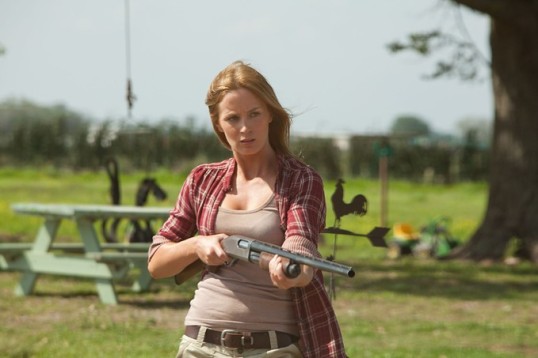
Emily Blunt in Sicario

Emily Blunt in Sicario (No, actually, that is Emily Blunt in Looper.  My mistake…)
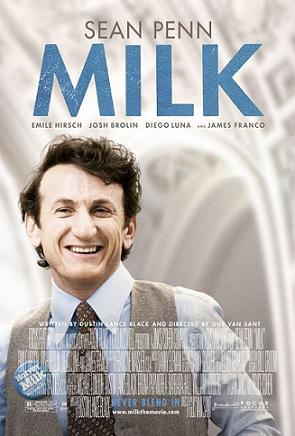
Shattered Politics #83: Milk (dir by Gus Van Sant)


Milkposter08

For the past three weeks, I have been in the process of reviewing, in chronological order, 94 films about politics and politicians.  It’s a little something that we call Shattered Politics.

And while I’ve had a lot of fun doing it, it does worry me a bit that I may have made the Shattered Lens into a far more cynical site to visit.  That’s largely because I don’t trust politicians or the government in general and, despite the fact that we started off with Abraham Lincoln and Mr. Smith Goes To Washington, the majority of the films that I’ve reviewed have reflected that fact.

So, in order to combat that cynicism, I’m going to recommend a film from 2008 that, despite being a biopic about a politician, is actually rather inspiring.  I am, of course, talking about the 2008 best picture nominee, Milk.

Milk tells the story of Harvey Milk who, in 1977, became the first openly gay man to be elected to a major public office.  Now, just consider that.  Up until 38 years ago, nobody who was openly gay had been elected to public office.  Nowadays, the idea of an out gay man or a lesbian running for public office is only shocking to a dwindling minority of homophobes.  Even down here Texas, which everyone up north always smugly assumes to be so intolerant, nobody is surprised when a gay or a lesbian not only runs for office but wins as well.  Sheriff Lupe Valdez has served as sheriff of Dallas Country for over ten years and, though she’s been controversial, none of that controversy has concerned her sexuality.  Meanwhile, Annise Parker has served three-terms as mayor of Houston, making Houston the biggest city in America to have an openly gay mayor.

However, before Lupe Valdez could be sheriff or Annise Parker could be mayor, Harvey Milk had to serve on the San Francisco Board of Supervisors.

Milk follows Harvey (Sean Penn, who won an Oscar for his performance) and his much younger boyfriend, Scott (James Franco) from the moment they first meet in New York to when they moved to San Francisco in 1970.  We see how Harvey first found fame as a neighborhood activist and how he challenged both the political and gay establishment of San Francisco in his campaigns for political office.  When he finally wins a seat on the Board of Supervisors, he does so at the cost of his relationship with Scott.  He enters into another relationship with the self-destructive Jack (Diego Luna), which ends tragically.

By winning office, Harvey becomes a spokesman for gays everywhere.  When a sinister state senator (Denis O’Hare) attempts to pass a bill that would forbid gays from teaching school, Harvey leads to opposition.  And, while Harvey’s career continues to rise, the career of another supervisor — Dan White (Josh Brolin) — plummets.

Elected at the same time as Harvey, Dan is an uptight former cop.  Though he and Harvey originally strike a somewhat awkward friendship (Harvey is the only supervisor to come to the christening of Dan’s child), Dan soon comes to resent Harvey.  (At one point, Harvey suggests that Dan might be closeted and Brolin’s tightly coiled performance certainly implies that Dan is repressing something.)  Eventually, Dan shoots and kills both the mayor (Victor Garber) and Harvey.

Though the film ends in violence and anger, it also ends with hope.  Though Harvey may be dead, the activists that he inspired are there to carry on.

Because the film was directed by a gay man, written by a gay man, and tells the story of a gay man, Milk is often dismissed, even by critics who liked it, as just being a gay film.  But, actually, it is a film that should inspire anyone who has ever felt like they’ve been pushed into the margins of our national culture.  By the film’s end, Harvey Milk has emerged as not just a gay hero but as a hero to anyone who has ever been told that their voice does not matter.  When Harvey says, repeatedly, “You’ve got to give them hope,” it’s hope for all of us.

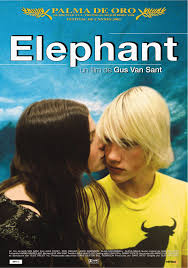
Back to School #62: Elephant (dir by Gus Van Sant)


http://www.youtube.com/watch?v=SC8ogZ4Jsuw

Gus Van Sant’s dream-like 2003 film Elephant is not an easy film to review.  Working with a non-professional cast and avoiding any easy answers or traditional narrative tricks (and indeed, the film ends with the fates of most of the characters still unknown), Elephant is ultimately a disturbing and nightmarish film.  It’s also an important film, one that examines the violence that runs through our current culture.

I’m one of the lucky ones.  I managed to get through all 12 years of my public education without ever getting shot at.  There’s quite a few people my age who can’t make the same claim.  I’d be lying if I said that I spent a lot of time in school obsessing over whether or not someone was going to start shooting but now, when I look back, I sometimes wonder how close I may have come.  One of the scarier things about the typical profile of school shooter is that we’ve all known somebody who fits it.  Sometimes, I can’t help but wonder if I just got lucky.  Maybe the guy who was planning on shooting up my school couldn’t get his hands on a gun.  Maybe, at the last moment, he changed his mind and decided to leave his gun in his locker instead of taking it out before the start of second period.  We come into contact with thousands of people over the course of our lives and we can never for sure what any of them are truly thinking or planning.

According to Wikipedia, there were a dozen school shootings in the U.S. during the time I was in high school.  Thankfully, none of them happened at my high school but, as I looked over the list, I couldn’t help but wonder why my classmates and I were spared the trauma of random violence while the students at Rocori High School in Cold Springs, Missouri were not.  Were we somehow better or more deserving than the students at Rocori?  Had they done something wrong or had we done something right?  Why were they forced to deal with violence while I was spared?  It all just seems so random.

And that’s the terrifying thing about random violence — it is, in the end, all so random.  We always tend to look for explanations afterward.  We try to assign blame and we try to come up with a reason because we know that, if we can explain random violence, then we can do something about it.  But, far too often, there are no reasons.

Elephant perfectly captures this randomness.  The film’s ensemble of characters spend what for many of them will be their final hours randomly wandering through their high school and their lives. Three mean girls eat lunch and then duck into toilet stalls where all three of them proceed to throw up.  John (John Robinson) searches for his drunk father (Timothy Bottoms) who may be wandering around the campus.  Awkward Michelle (Kristen Hicks) goes from her gym class to the library, little aware that she will soon be the first to be confronted by the gunmen.  Once the shooting starts, silent jock Bennie (Bennie Dixon) walks through the body-strewn halls, a potential hero until he is randomly shot.  The film is full of flash forwards and flashbacks, in which we see Alex (Alex Frost) and Eric (Eric Duelen) planning their rampage and we’re given clues as to their motives but we’re not given any answers.

Perhaps most memorable of all, at least to me, is the character of Eli (Elias McConnell), an aspiring photographer who gets one picture of Alex and Eric as they enter the library.  Up until that moment, the entire film has pretty much centered on Eli.  We’ve gotten to know him.  We’ve come to like him.  And yet, when Eli is shot, it happens almost as an afterthought.  One minute, he’s standing in the background and the next moment, he’s gone.  And we’re left to wonder if he survived or if it was even him who got shot.  Ultimately, what we realize is that, in that one split second, Eli ceased to be.  Even if he does survive being shot, he’ll never be the same person we saw earlier.  Even if he wasn’t shot, he’ll always be one of the students who went to that school.  In the end, we may have cared about Eli but none of that could stop the random violence.

Elephant is not an easy film to watch but then again, it shouldn’t be.  (If you want to read a bunch of comments from some people who just don’t get it, you can go read the simple-minded comments that some of them have posted over on the movie’s page at the imdb.) Elephant is a dark and troubling film, one that gave me nightmares after I saw it.  It’s a film so effective and powerful that one viewing is more than enough.

(Incidentally, one of Elephant‘s credited producers was JT Leroy, the pen name of Laura Albert whose books inspired a similarly difficult but powerful film, Asia Argento’s The Heart is Deceitful Above All Else.)

images

In Memory of Robin Williams #4: Good Will Hunting (dir by Gus Van Sant)


Good-Will-Hunting-still-three

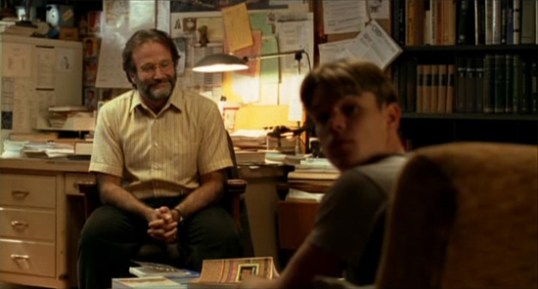
After being nominated three times, Robin Williams finally won an Oscar for his performance as Dr. Sean McGuire in 1997’s Good Will Hunting.  The first time I ever watched Good Will Hunting, I was 16 years old and I loved it.  12 years later, I rewatched it for this review and, oddly enough, I did not love it.  In fact, I barely even liked it.  However, one thing that I did better appreciate the second time around was the performance of Robin Williams.

Good Will Hunting was, of course, written by its two stars, Matt Damon and Ben Affleck.  It tells the story of Will Hunting (Matt Damon), a self-taught math genius who, as a result of being abused as a child, is full of anger and refuses to allow anyone to get close to him.  His only true friend is Chuckie Sullivan (Ben Affleck), a construction worker.  Will works as a janitor at MIT and, when he’s caught secretly solving a complex math problem, he’s taken under the wing of Prof. Gerard Lambeau (Stellan Skarsgard).  While Will pursues a volatile romance with a med student named Skylar (Minnie Driver, who is good in an underwritten role), Lambeau arranges for Will to become a patient of psychologist Sean McGuire (Robin Williams).  The recently widowed Sean helps Will to come to terms with his abusive childhood and deal with his anger issues.  When Skylar tells Will that she’s moving to California, Will is forced to decide whether to follow her or to just push her away like he does with everyone else.

I can still remember that the first time I ever saw Good Will Hunting, I had such a crush on Will Hunting.  After all, he looked like Matt Damon.  He was smart but he could still stand up for himself.  He was a jerk but that was just because he needed the right girl in his life.  When he finally talked about being abused by his foster father, my heart broke for him and I just wanted to be there for him while he cried.  When he drove off to see Skylar in that beat-up car of his, I thought it was such a romantic moment.  Like, seriously — Oh.  My.  God.

That was the first time I saw the movie.

However, when I recently rewatched the film for this review, I had a totally different reaction to Will Hunting.  Maybe it’s because I’m older now and I’ve had to do deal with real-life versions of the character but this time, I actually found myself very much not charmed by Will Hunting and his condescending verbosity.  Whereas originally it seemed like he pushed the away the world as a defensive mechanism, it now seemed like Will was basically just a sociopath.  People in both the audience and the movie assumed that, because he was so smart, there had to be something more to Will than just bitter negativity but actually, there was less.  And even Will’s intelligence seemed to be more the result of the fact that director Gus Van Sant and screenwriters Damon and Affleck were kind enough to surround Will with less-than-articulate characters to humiliate.  It’s easy to be the smartest person in the room when you’re surrounded by strawmen.  I got the feeling that we were supposed to impressed because Will cites Howard Zinn at one point but, really, Howard Zinn is pretty much the historian of choice for phony intellectuals everywhere.

(In the interest of fairness, I guess I should admit that I may be biased because I once dated a phony intellectual who was always citing Howard Zinn, despite having not read anything that Zinn had ever written.  Don’t get me wrong.  He owned a copy of A People’s History of the United States and he always made sure it was sitting somewhere where visitors could see it but he had never actually opened it.  I imagine he has since moved on to Thomas Piketty.)

Instead, I found myself reacting far more positively to the character of Chuckie Sullivan.  Chuckie may not have been a genius but at least he was capable of holding down a job, actually cared about his friends, and was capable of communicating with people without trying to destroy their self-esteem.  If I had been Skylar, I would have dumped Will and spent my last few months in Boston enjoying the working class pleasures of Chuckie Sullivan.

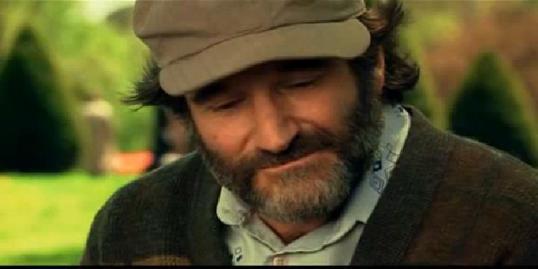
But here’s the thing — the main reason that we believe, despite all evidence to the contrary, that there is good inside of Will Hunting is because Sean Maguire tells us that there is.  As I rewatched Good Will Hunting, I was surprised by just how good Robin Williams’s performance really was.  The compassionate psychologist has become such a stock character that there’s something truly enjoyable about watching an actor manage to find nuance and individuality in the familiar role.   Sean is such a kind and likable character (and Robin Williams gives such an empathetic performance) that we’re willing to give Will the benefit of the doubt as long as he is.  In Good Will Hunting, Robin Williams once again had the beard that gave him gravitas in Awakenings.  But he also had the saddest eyes.  It’s the eyes that you remember as you watch the film because it’s those eyes that tell us that Sean has had to overcome the type of pain that Will Hunting will never be capable of understanding.

It’s those eyes, more than anything, that convince us that there might be some good in Will Hunting.

good-will-hunting