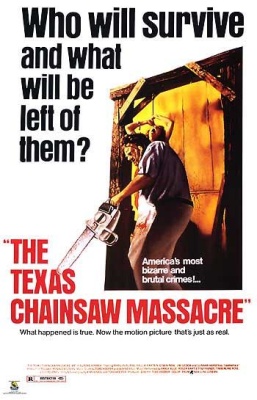
Originally released way back in 1974, The Texas Chainsaw Massacre continues to be one of the most iconic and influential horror films of all time.
Not only did the film terrify generations of filmgoers, it also undoubtedly inspired many people who lived up north to swear that they would never visit Texas. (Speaking as a Texan, I appreciate it!) So powerful was the impact of The Texas Chainsaw Massacre that it is regularly cited as being one of the first “gore” films, despite the fact that barely a drop of blood is seen throughout the entire film. Instead, what is seen is Sally (played by Marilyn Burns) screaming while running and Leatherface (Gunnar Hansen) dancing with that chainsaw.
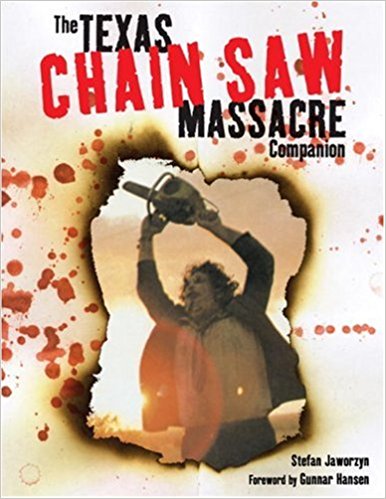
So, how did a group of hippies in Austin come to make one of the most famous movies of all time? That is the question that is answered in the 2004 book, The Texas Chainsaw Massacre Companion. Written by Stefan Jaworzyn and featuring a foreword by Gunnar Hansen, this breezy and entertaining book contains almost everything you could possibly want to know about this film. The book is largely an oral history, featuring lengthy quotes from the film’s cast and crew. (For the most part, Jaworzyn allows the interviews speak for themselves and only occasionally interjects any editorial commentary.) Along with detailing the film’s infamously difficult production (with Marilyn Burns nearly being driven to the point of an actual breakdown and Hansen, an otherwise sensitive poet, coming close to being possessed by his murderous character at one point), the companion also deals with crimes of Ed Gein and Tobe Hooper’s career both before and after his best known film.
Most interesting, to me, were the sections that dealt with how the head of the Texas Film Commission helped to secure The Texas Chainsaw Massacre a national distribution deal. Considering that The Texas Chainsaw Massacre basically portrayed Texas as being a place where you could get killed if you made a wrong turn, the involvement of the Texas Film Commission may seem strange at first. Some of the interviews in the book seem to suggest that the head of the Commission had a crush on Marilyn Burns.
It’s an entertaining book, even if I don’t agree with everything that Jaworzyn says. (He calls Psycho overrated at one point.) With the recent deaths of Marilyn Burns, Gunnar Hansen, and Tobe Hooper, The Texas Chainsaw Massacre Companion now serves as something of a tribute to these three artists and the film that, to the surprise of everyone, changed cinema forever.
The first time I watched THE TEXAS CHAINSAW MASSACRE was at a drive-in around 1975. I remember laughing hysterically at the film; of course, I was tripping my brains out on mescaline at the time and laughed at anything! I’ve since viewed the film several times without chemical enhancement and I’m no longer laughing. I like it a lot, it’s a scary little exploitation shocker for sure, but one thing that really irks me is a certain segment of critics who treat it as some kind of metaphor with deep meaning.
Don’t get me wrong, there’s a lot to like here. The tension is gripping, the horror relentless, and Tobe Hooper did a terrific job working with a miniscule budget. It’s just that over the years, critics have overanalyzed the thing to death, expounding on the political and cultural ramifications of it’s themes and blah, blah, blah. Whether or not all this blathering about…
Hi there! Well, as of my birthday yesterday, I am now officially an adult. What does that mean for this site? Well, for the most part, it means that I’m going to be even more aggressive about giving my opinion. After all, I’m an adult now. Whatever I say matters, no matter how weird or random it may be! In fact, I’m such an adult that I’m not even going to worry about proofreading these posts anymore. Adults don’t have to worry abut makin typos.
So, what is Lisa’s editorial corner? Well, it’s a new weekly feature where I talk about whatever caught my eye during the previous week. Basically, it’s a way for me to embrace my inner know-it-all. Fear not, I’m going to keep it entertainment-related. You don’t have to worry about me using this feature to try to convince you to vote for Gary Johnson in 2016. (At least not yet…)
For instance, I might use this feature to talk about Gunnar Hansen…
On Gunnar Hansen and Andrew Bryniarski
On November 7th, Gunnar Hansen passed away from pancreatic cancer. He was 68 years old. When I first heard the news, I was out with my friends in the SBS (and I’ll explain what that stands for at a more appropriate time) and we were celebrating my upcoming birthday. I spent the day after that with my family and then it was Monday and it actually was my birthday and … well, long story short: I’ve only now gotten a chance to write about his passing on this site. And I feel really guilty about that because Gunnar Hansen was an iconic figure in film history.
Who was Gunnar Hansen? Well, you probably already know. He was Leatherface in the original Texas Chainsaw Massacre. Beyond that, he was also a teacher, a writer, an acclaimed poet, and reportedly one of the nicest guys that you could ever hope to meet. I never met Gunnar but every story that I’ve ever heard about him — whether it was from someone who met him at a convention or someone who knew him outside of the world of horror fandom — has been a positive one. As well, I’ve read many interviews with Hansen about the making of Texas Chainsaw and he always came across as being a very intelligent and well-spoken individual.
And it’s often overlooked just how good a performance that Hansen gives in Texas Chainsaw Massacre. Hansen may have been cast because of his large frame and he may have had to perform underneath a mask but he still turned Leatherface into a genuine character. It’s often overlooked that, out of the entire cannibal family, Leatherface is the only one who has any real responsibilities. He’s just trying to prepare everyone’s dinner and he keeps getting interrupted! No wonder he eventually ends up sitting down and slumping in frustration.
Now, upon until a few hours ago, I had absolutely no idea who Andrew Bryniarski was. Do you know who he is? Here’s a picture of him, with Gunnar Hansen:
Gunnar is on the right.
Why are Andrew and Gunnar posing together? Because Andrew played Leatherface in 2003 remake of Texas Chainsaw and in 2006’s Texas Chainsaw Massacre: The Beginning.
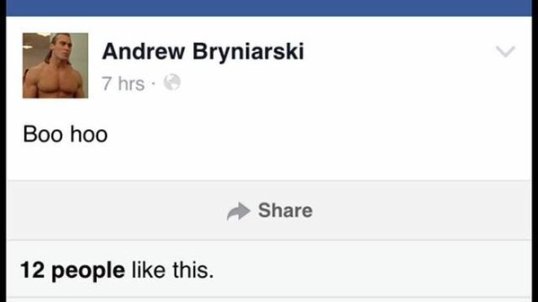
And here is what Andrew said on Facebook after several people tagged him in posts about Gunnar’s death:
Seriously, Mr. Bryniarski? Now, before you think that he “misspoke” or any of that, he went on to double down on his comments. When someone pointed out that, if not for Gunnar, Bryniarski would have never played Leatherface, Bryniarski wrote back, “I played the role twice without him.” Bryniraski then told another FB user to “suck Gunnar’s dead nutz.”
Seriously — what the Hell!?
For what it’s worth, Bryniarski has an official response to everyone who is upset with him. You can check it out here. As far as I can tell, it appears that he feels that, while promoting Texas Chainsaw 3D, Gunnar criticized the way that he played Leatherface.
There’s probably more to it than that but … well, it really doesn’t matter. If you’re going to speak ill of the dead, you better have a hell of a better reason that professional jealousy. End of story. Bryniarski’s comments and the outrage that greeted them only serve to remind us that Gunnar Hansen was a class act.
Gunnar Hansen, R.I.P.
On Jack The Ripper
Over 4 years ago, when I reviewed Murder By Decree, I wrote about my fascination with the unsolved case of Jack the Ripper. Well, after all this time, I’m still fascinated. So, needless to say, when I read that an Australian professor named Richard Patterson was convinced that he had figured out the identity of Jack the Ripper, I was intrigued.
Then I found out that Patterson thought that poet Francis Thompson was the murderer and I promptly yawned.
Poor Francis Thompson.
Seriously, most evidence (as opposed to the speculation of people who have seen From Hell) indicates that Saucy Jack was probably some psycho who lived on the margins of society. He got away with his murders because he committed them in 1888, a time when just taking fingerprints was considered to be advanced forensic science. He was never caught, he died in obscurity, and no one knows his name.
However, that’s no fun! Why spend so much time researching Jack the Ripper if the final solution is just going to be some creep that nobody’s ever heard of!? That’s why it seems the almost every Victorian of any sort of renown has, at some point, been accused of being the Ripper. Oscar Wilde, Lewis Carroll, Francis Thompson, and the painter Walter Sickert — all of them have been accused and, amazingly, all of them have had their creative work cited as evidence of their guilt.
You have to wonder if, 100 years from now, amateur criminologists will insist that Stephen King was responsible for every unsolved murder in New England…
Speaking of Walter Sickert…
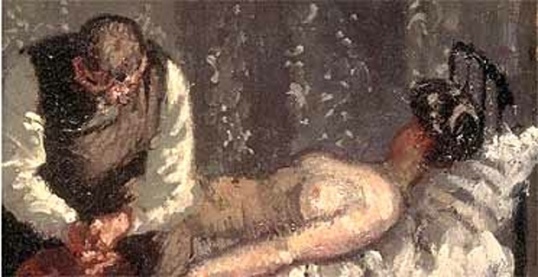
Here’s one of the infamous painting that’s always cited by people who are convinced that he was Jack The Ripper:
Why not listen to a little music before you leave?
Hey — did you know that I have a daily music blog? Check it out: Lisa Marie’s Song of the Day! This is the song that I shared on my birthday because a lot of people have told me that it might as well be about me:
You know what you should do now?
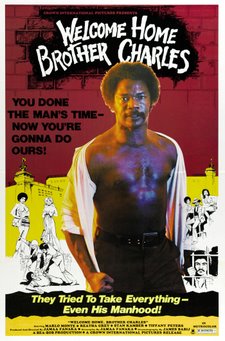
Since it’s the day after my birthday and all, why not go read the first review that I ever wrote for this site? Check out my thoughts on a strange little film called Welcome Home, Brother Charles.
Occasionally, I get asked why I am always making mean-spirited jokes about Vermont. Well, believe it or not, there is a reason! Would you believe that it all goes back to The Texas Chainsaw Massacre?
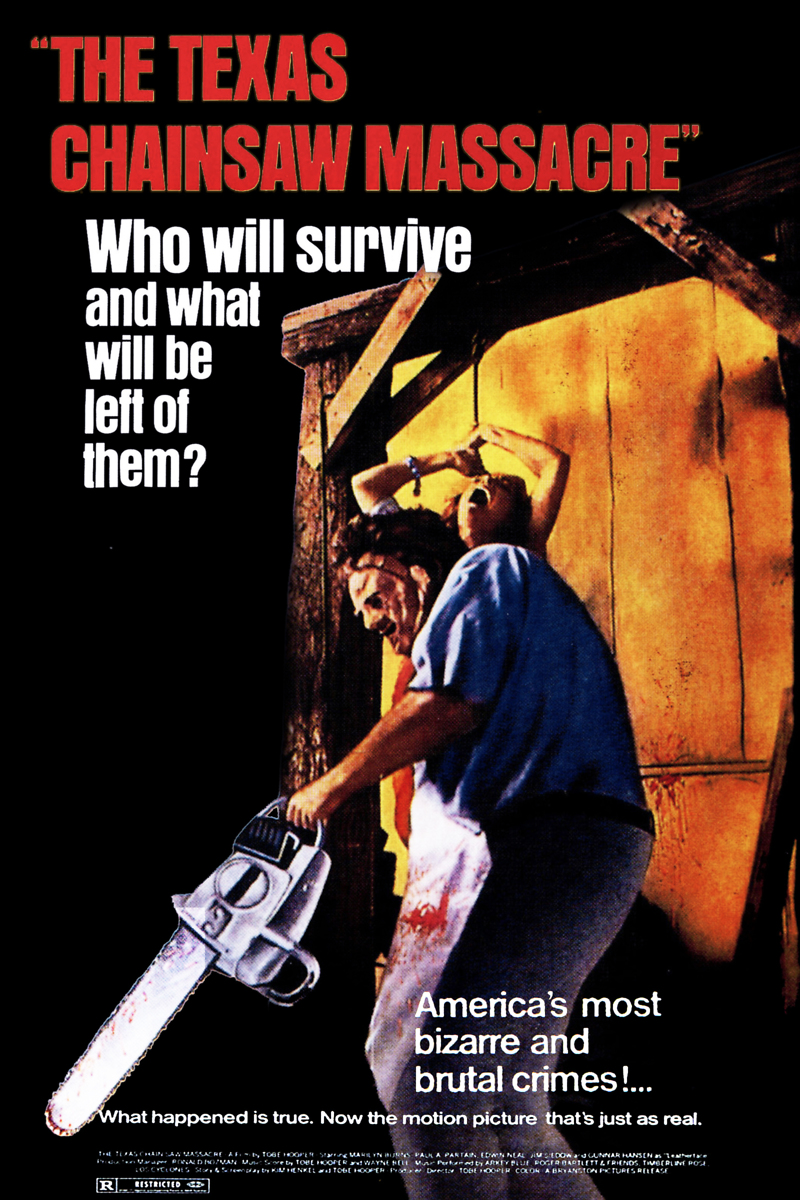
In an editorial that was posted on this very site, I argued that one reason why, ever since it was initially released in 1974, The Texas Chainsaw Massacre has remained an iconic horror film is because the title specifically alerts you that the film takes place in Texas. For whatever reason, people across America are terrified of my home state. Despite the fact that we’re all pretty friendly down here, people are scared to death. They think we’re all walking around with guns or that something’s bad is going to happen if you make a wrong turn. (And, of course, folks from up north can’t handle the fact that the temperature occasionally gets above 85. “OH MY GOD, IT’S GLOBAL WARMING!” the tourists shout. No, morons — it’s just summer in Texas.) In order to prove my point, I pointed out that no one would want to see a movie called The Vermont Chainsaw Massacre.
For good measure, I may have then added, “Fuck Vermont.” Because — well, why not?*
Within hours of posting that editorial, I heard from someone in Vermont and OH MY GOD, she was so offended! Seriously, she seemed to be really upset that I was suggesting that nobody would be scared of getting horribly murdered while driving through Vermont!
So, to the people of Vermont, accept my apologies. Y’all are just as capable of killing people with a chainsaw as we are, okay?
Seriously, though, The Texas Chainsaw Massacre would never work if it was set in Vermont. That’s not just because Vermont su …. uhmm, is a lovely state. That’s because The Texas Chainsaw Massacre is a uniquely Texan film. One reason why this film is so successful is because it was made by Texans and it starred Texans (no inauthentic accents here!) and it was filmed in Texas during the summer. From the minute we see that van driving down the road, we feel the isolation of the characters. Every frame of the film is filled with Texas heat and humidity and, as such, the audience can almost literally feel how uncomfortable it is inside the van, so much so that you really can’t blame everyone for wanting to get out and walk around for a while. Ultimately, the burning sun is as important a character in this film as Sally (Marilyn Burns), her obnoxious wheelchair-bound brother Franklin (Paul A, Partain), or Leatherface (Gunnar Hansen), the hulking cannibal who chases after them with a chainsaw.
Actually, it’s a little bit difficult to know what to say about The Texas Chainsaw Massacre. It’s such a famous film that even people who haven’t seen it feel as if they had. And every review always points out the reasons why it works: the film is shot in an almost documentary style, Marilyn Burns was one of the great scream queens, Leatherface’s final dance with his chainsaw is pure nightmare fuel, and, despite the fearsome title, next to no blood is actually seen on screen. This is one of those films where we imagine we see a lot more than we actually do. Despite being advertised as being a “chainsaw massacre,” only one person actually falls victim to a chainsaw and he’s so obnoxious that you’re kind of happy that he finally stopped talking.
They may not be much blood on the screen but this is still one of the most stomach-churning films ever made. When Sally finds herself trapped in the house with Leatherface and his family, that house is so filthy and disgusting that you can literally smell the rotting flesh coming off the screen. This may be a case of my own OCD speaking but the squalor of that house tends to disturb me even more than some of the murders.
Speaking of the murders, the death of Jerry (Allan Danziger) always freaks me out. Jerry is looking for his other dead friends when Leatherface appears out of nowhere and hits him with a sledgehammer. Up until that point, Jerry seemed like the smartest of the five people to find themselves wandering around that desolated part of South Texas. Certainly, if I had been there, I probably would have wanted to stay with Jerry. Perhaps that’s why Jerry’s high-pitched scream before getting killed always disturbs me. If you’ve seen enough slasher movies, you know that the men in these movies — no matter what is happening to them — hardly ever scream. When Jerry does so, it makes the movie feel real in a way that most film influenced by Texas Chainsaw do not.
Listen, Vermont … I’m sorry you can’t have a chainsaw massacre of your very own. But The Texas Chainsaw Massacre is a part of our history and, despite the negative implications of the name, we do take a certain amount of pride in it. It is truly one of the great horror films. Ignore the remakes, which were made by non-Texans and are all so excessively stylized that you have to wonder if the filmmakers even saw the original.
One final note: The Texas Chainsaw Massacre also has one of the truly great trailers. Check it out below!
——
* I should mention that I can usually trust someone around here to ask me if I really want to say something like “Fuck Vermont” before I hit publish. But that weekend, Arleigh was on vacation and this was before I had recruited my sister to come work here so there really wasn’t anyone else around the TSL offices who was used to dealing with me and my impulsive nature. I tried to show the post to Leonard to get his opinion about the F Vemont line but he was busy watching hockey…
I like to use 2010’s Nightmare on Elm Street as the basis for horror remakes I’m not fond of. So when Texas Chainsaw 3D was announced, I automatically wrote it off as being something you could put on the shelf right next to this one. I have to admit I was actually surprised. Yeah, it’s a bad movie, but I didn’t find myself scoffing nearly as much as I did Nightmare, which really didn’t work for me at all. I just don’t see myself running back to see this one. I believe part of this has to do with the way the film opens.
Having gone into the film blind, I expected a remake of the remake. Essentially the same story we had with The Texas Chainsaw Massacre: The Beginning. The shock was that the film starts with the events of the original Tobe Hooper film, rendered in 3D (which was very cool, I might add). It then moves to the afternoon after the last victim ran away. This gives anyone who may be unfamiliar with the original a bit of a bridge, and personally having never liked any of the original sequels, I liked the aftermath that takes place.
Essentially, Texas Chainsaw 3d is the story of Heather Miller (played by Percy Jackson’s Alexandra Daddario), who receives word from her lawyer that she’s inherited a home in Dallas, Texas. What she doesn’t realize is that this inheritance comes with a few problems. She decides to hop in a van and head down there, accompanied by her friend Nikki (Tania Raymonde), Nikki’s date Kenny (Keram Malicki-Sanchez), and her boyfriend (Tremaine “Trey Songz” Neverson, who the girls in my audience gave the same whoops and catcalls normally reserved for Pattinson/Lautner in a Twilight Showing).
Basically, the movie becomes the cliché “draw this person into isolation and Bam!” that every horror film has, but I’ll admit that I watched a lot of those scenes with my eyes averted, so in that aspect, it got the job done. The visual makeup effects were done by Robert Kurtzman, the “K” in the KNB Effects group (The Walking Dead’s Gregory Nictotero and Howard Berger are the others), and there’s no shortage of blood in this film. While it’s not quite on the level on what the upcoming Evil Dead looks like – that appears to be on the epic Dead Alive levels – Chainsaw does have limbs lost, blood spurting and Leatherface’s signature weapon used to fullest extent. Those moments of isolation come of as very intense, and the direction isn’t bad.
The 3D in the film was nice, though used sparingly. To be honest, the best use of the effects was in what it added to the pieces of the original film that were used. I really enjoyed the outcome there and there are a few key “weapon in the camera” shots that may make you flinch.
Horror films have their eye candy. Sex sells, let’s face it. In Chainsaw, both Raymonde and Daddario had the guys captivated, and Scott Eastwood (Clint’s Son) works for the ladies. While there’s no nudity in the film, good considering how many kids were at my showing, there’s enough skin to appreciate.
What I didn’t like about the film was that in this day and age where you have smart heroes in horror stories – one need only look at Cabin in the Woods here – Chainsaw resorts to the classic “two step, drop” method, meaning that characters meaning to escape will only make it a few steps before stumbling over their feet. I don’t know if that works anymore for audiences. The times that it happened at my showing brought about more laughter than it did horror. Granted, I can’t say I’d be the best of runners with someone wielding a noisy chainsaw behind me, but you’d be damn sure I’d be up or kicking from the floor if I had to. Additionally, the heroes make a few stupid mistakes, which they have to I suppose. Still, I would have liked a few more smart moves. One other thing is that Leatherface himself, while menacing, doesn’t have the same effect that the Brynarski one in Marcus Nispel’s film with Jessica Biel. The Leatherface in that film was a hulking behemoth of a dude that ran with football player like speeds. Chainsaw 3D’s Leatherface is more like your grandpa that caught you stomping around his rose garden and chased after you with garden shears. It’s the equivalent of seeing Dawn of the Dead running zombies and going back to shuffling walkers.
Overall, Texas Chainsaw 3D isn’t anything fantastic and new. You can wait for it on 3D Blu-Ray. If you are an absolute fan of the series, it’s worth a look for both the connections to the original and a cool Gunnar Hansen cameo. Or you can watch it just for Daddario. Just make sure someone else buys you the ticket.





 Through the Shattered Lens