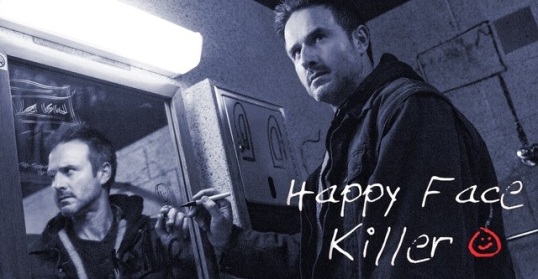
October True Crime: Happy Face Killer (dir by Rick Bota)


2014’s Happy Face Killer is loosely-based on the real-life crimes of Keith Hunter Jesperson.

Jesperson was a truck driver who, in the early 90s, murdered at least eight women in six different states.  (Jesperson later claimed that he murdered over 160 but no one knows if that’s true or not.  For his part, Jesperson has a habit of retracting his confessions shortly after giving them.)  The product of an abusive childhood, Jesperson’s trademark was drawing a smiley face on either the bodies of his victim or on the locations where he dumped them.  A good deal of Jesperson’s crime spree was inspired by anger that someone else had falsely confessed to one of his murders.  Jesperson left graffiti in truck stops all over Oregon, letting people know that the “Happy Face Killer” was still out there.

In The Happy Face Killer, Jesperson is played by David Arquette.  The film makes good use of Arquette’s naturally goofy screen persona, showing how a serial killer like Jesperson could convince someone to climb into his truck in the first place.  Arquette plays Jesperson as someone who comes across as being maybe a little bit nerdy and little but off-center but who still manages to present himself as being a likable guy.  It’s only once he has his victim alone in his truck that Jesperson allows the mask to slip and reveals his true self.  Whether making overly glib videos in which he brags about being a murderer or considering whether he should let one potential victim live because she has a baby, Arquette portrays Jesperson as being an all-too plausible and familiar monster.  The film’s best moments are the ones where Jesperson is struggling to hold up his façade of normality.  It’s those scenes that make the viewers realize that we’ve all probably known a Keith Jesperson or two.  Indeed, I think one reason why serial killers have such a hold on the culture right now is because it’s totally possible that anyone of us might know one.  Who knows what their neighbors or their co-workers are really doing behind closed doors?

Where the film falters is in its portrayal of the investigation that led to Jesperson’s eventual capture.  In real life, Jesperson panicked after the police questioned him about reports that he had been seen with some of the Happy Face Killer’s victims.  Afraid that he was going to be arrested, Jesperson twice attempted (and failed) to commit suicide before eventually turning himself in and confessing to the crimes in hopes of getting a lenient sentence.  In the film, the investigation is headed up by a tough-as-nails FBI agent (played by Gloria Ruben), who is haunted by the murder of her sister and who spends a lot of time apologizing to dead bodies and fighting the forces of the patriarchy.  The scenes with Ruben feel a bit too derivative of every other serial killer film that has ever been made and Ruben’s flat performance fails to bring much depth to her one-note character.  The scenes of Ruben snapping at the condescending men who think that a woman can’t catch a serial killer feel less like empowerment and more like pandering.

The Happy Face Killer is at its most effective when it focuses on the loneliness of the late night truck stop and the danger hiding behind the smiling face of the seemingly friendly man offering you a ride.  David Arquette gives a frightening performance as the soulless Jespersen.  In real life, Keith Jespersen is currently serving four life sentences and will hopefully never see the outside of a prison again.

Film Review: Lincoln (dir. by Steven Spielberg)


I am a history nerd.

If you’ve read my previous reviews here on the Shattered Lens, that’s not necessarily a major revelation.  Still, before I talk about Steven Spielberg’s latest film, the sure-to-be Oscar nominated Lincoln, you should know where I’m coming from as a reviewer.  Cinema may be my number one love but history, and especially political history, runs a close second.  To me, there is nothing more fascinating than learning how those in the past both viewed and dealt with the issues that we still face in the present.  Whereas some people take pride in being able to name every player that’s ever played for the Dallas Cowboys, I take pride in the fact that I can not only name every President and Vice President in order but I can also tell you exactly who they had to defeat in order to serve in those offices.

I love history and therefore, it was hard for me not to feel as if Lincoln was a film that was made specifically for me.  Covering the final four months of the life of the 16th president, this film tells the story of Lincoln’s struggle to pass the 13th Amendment and to bring an end to the U.S. Civil War.  The film also documents Lincoln’s troubled marriage to the unstable Mary and his son’s decision to enlist in the Union Army.  Even though Spielberg and screenwriter Tony Kushner don’t include any vampires*, there’s still a lot going on in Lincoln and it is to their credit that the film remains compelling despite the fact that everyone already knows how the story is going to end.

Daniel Day-Lewis is getting a lot of critical acclaim for his performance in the title role and, for once, I actually have to agree with the critics.  Abraham Lincoln is one of the most iconic figures in American history.  He is such an icon that, at times, it’s hard to believe that this larger-than-life figure, with his stove-pipe hat and his homely face, was an actual human being who lived and breathed and died like any other human being.  It’s easier to think of him in the same way that Jesus Christ used to be represented in films like Ben-Hur, as an inspiring character who is always standing just a little bit off-camera.  The brilliance of Day-Lewis’s performance is that he makes us believe that this legendary figure could actually exist with all the rest of history’s mortals.  For lack of a better term, Day-Lewis humanizes Lincoln.  His performance contains all the bits of the Lincoln legend: the fatalistic melancholy, the steely resolve, the quick humor, and occasional flashes of self-doubt.  The genius of the performance is the way that it takes all the legendary pieces and arranges them to create a portrait of a very believable man.

Though the film is dominated by Day-Lewis’s lead performance, the film’s supporting cast does a good job at bringing to life the people around Lincoln.  Whenever one film can manage to find roles for Hal Holbrook, David Strathairn, Jared Harris, James Spader, John Hawkes, and Jackie Earle Haley, you’ve got good reason to be optimistic about what you’re about to see.  Probably the film’s showiest supporting role goes to Tommy Lee Jones, who plays the firebrand abolitionist Thaddeus Stevens.  Admittedly, Tommy Lee Jones gives a standard Tommy Lee Jones performance here but, especially when paired with Day-Lewis’s more internal acting style, the end result is still fun to watch.  Also giving a good performance is Sally Field, who plays Lincoln’s mentally unstable wife.  Historians have rarely been kind (or fair) to Mary Lincoln but Field makes her into a difficult but sympathetic figure.  Finally, even though the role of Lincoln’s son is not a challenging one, I’m always happy whenever Joseph Gordon-Levitt shows up onscreen.

Ultimately, however, Lincoln is a Steven Spielberg film.  Spielberg is a very good director but he’s also a very safe one.  The same can be said of Lincoln as a film.  The film’s cinematography, art design, and costume design are all brilliantly done and award-worthy but it’s still hard not to occasionally wish that Spielberg would have enough faith in his audience that he wouldn’t feel the need to have John Williams provide constant musical cues to let us know what we are supposed to be feeling about what we’re experiencing.  If you’re looking for hints of moral ambiguity, an unflinching examination of the rivers of blood that flowed on the Civil War battlefield, or for an in-depth portrait of Lincoln’s personal demons (and most historians agree that he had a few), you might want to look elsewhere.  This is not Martin Scorsese’s Lincoln.  This is Steven Spielberg’s Lincoln.  This is a film that is meant to be inspiring (as opposed to thought-provoking) and, for the most part, it succeeds.

I have to admit that I went into Lincoln expecting to be disappointed.  Ever since the film first went into production in 2011, websites like Awards Daily have been hyping this film to death.  Before many of them had even seen the completed film, online critics were announcing that both the film and Daniel Day-Lewis were the clear front-runners for the Oscars in 2013.  As anyone who has read my previous reviews on this site knows, nothing turns me off more than the bandwagon mentality of the critical establishment.  Often times, when a film is embraced as vehemently and as early as Lincoln has been, I feel almost honor-bound to be a hundred times more critical of it than I would be of a film like Step Up Revolution.

However, Lincoln is a rarity.  It’s a film that, for the most part, actually lives up to all the hype.

—-

*I imagine that little joke will cause a lot of confusion to anyone who, ten years in the future, happens to stumble across this review.  To you, future reader who has forgotten all about Abraham Lincoln: Vampire Hunter, I can only apologize.