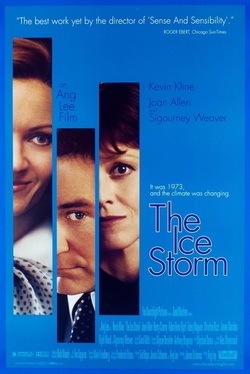
The 1997 film The Ice Storm is kind of a schizophrenic film, which makes sense since it’s set in 1973 and, just from what I’ve seen in the movies, it appears that the early 70s were kind of a schizophrenic time.
It’s a film that deals with two sets of people who all live in an upper class Connecticut community. One part of the film deals with parents who are freaking out about suddenly being adults. The other part of the film deals with the children, most of whom seem destined to make the same mistakes as their parents. It’s a film that is occasionally bracingly realistic and relatable, one that reminds us that being directionless in the 70s isn’t necessarily that different from being directionless in 2016. At other times, the film feels a bit too studied for its own good. This is one of those films that features a Tobey Maguire voice-over and, as good an actor as Maguire has always been, he’s always at his worse when reciting a pseudo-profound voice over. And then there are other times when the film feels a bit too cartoonish for its own good. Elijah Wood’s a stoner. Sigourney Weaver walks around with a bullwhip. David Krumholtz shows up as a character named Francis Davenport.
Fortunately, the film is directed by Ang Lee and Ang Lee is probably one of the few filmmakers who can overcome tonal inconsistency. Lee is so good with actors and is such a good storyteller that even his lesser films are usually worth watching. The Ice Storm would just be another silly sin-in-the-suburbs film if it had been made by any director other than Ang Lee.
The main adult in the film is Ben Hood (Kevin Kline). Ben is married to Elena (Joan Allen) but he’s having an affair with his neighbor, Janey (Sigourney Weaver). Elena may be upset when she finds out about the affair but she’s still willing to accompany her husband to a key party. A key party was a 70s ritual in which husbands would throw their car keys into a big punch bowl and then the wives would randomly pick a key and have sex with the owner. Basically, anytime a TV show or a movie takes place in the suburbs during the 70s, there has to be at least one key party.
And The Ice Storm‘s key party is kind of fun to watch. Kevin Kline and Joan Allen both give really good performances and Ben is such a loser that it’s fun to watch him freak out when Janey gets a key other than this own. Elena, meanwhile, ends up going off with Janey’s husband (Jamey Sheridan, pretty much looking the same in this 1997 film as he did in Spotlight and Sully) and they share a really good scene together, one that reveals that none of the film’s adults are really as mature or liberated as they claim to be.
While the adults attempt to play, their children attempt to find some sort of meaning to their empty existence. Ben and Elena’s daughter, Wendy (Christina Ricci), wears a Richard Nixon mask and enjoys sexually teasing her classmates, especially Janey’s youngest son, Sandy (Adam Hann-Byrd). Ben and Elena’s oldest son, Paul (Tobey Maguire) is in New York, hoping to lose his virginity to Libbits (Katie Holmes) despite the fact that Libbets is far more interested in his boarding school roommate, Francis Davenport (David Krumholtz). Paul also compares his family to the Fantastic Four so, assuming Paul survived both the 70s and 80s, he’s probably still living in Connecticut and telling everyone who disappointed he was with last year’s film.
And, of course, there’s Mickey (Elijah Wood). Mickey is Janey’s oldest son and he’s permanently spaced out. When the ice storm of the title occurs, Mickey is the one who decides to wander around outside and appreciate the beauty of nature’s remorseless wrath.
Needless to say, the ice storm is also a really obvious metaphor for the way all of these very unhappy (but very prosperous) characters tend to view and treat each other. Despite all the attempts to pretend otherwise, everyone has a frozen soul. Nobody’s capable of maintaining any sort of real emotional connection. Of course, someone dies and everyone’s forced to take a look at the sad reality of their lives and the film ends with a sudden and spontaneous display of actual human emotion. It’s one of those ideas that probably works better as a literary conceit than a cinematic one.
That said, The Ice Storm is flawed but very watchable. I enjoyed it, even if it did occasionally seem to be trying way too hard. It’s well-acted and, if nothing else, I enjoyed getting to see all of the amazingly tacky clothes and the interiors of all those big houses. These people love their wide lapels and their shag carpeting. The Ice Storm is not Ang Lee’s best but it’s still good enough.
 Through the Shattered Lens