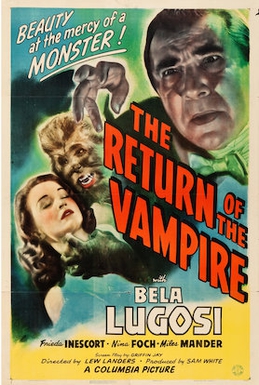
Horror Film Review: The Return of the Vampire (dir by Lew Landers)


1943’s The Return of the Vampire opens in 1918.

Lady Jane Ainsley (Frieda Inescort) and her colleague, Dr. Walter Saunders (Gilbert Emery), suspect that there might be a vampire active in London.  After reading a book on vampirism that was written by Dr. Armand Tesla, they manage to find the vampire’s coffin.  As the vampire’s servant — a werewolf named Andreas (Matt Willis) — watches, Lady Jane and Dr. Saunders drove a metal stake through the vampire’s heart.  It turns out that the vampire was none other than Armand Tesla himself!  Andreas turns back into a normal person and becomes Lady Jane’s assistant.

Jump forward to the 1940s.  During an attack by the Germans, a bomb explodes over Tesla’s grave and exposes not just his coffin but also the metal pole in the middle of his skeleton.  Two workmen assume that the pole is just bomb debris and they remove it.  Tesla (Bela Lugosi) promptly comes back to life and Andreas turn back into a werewolf.  Tesla sets out to get revenge on Lady Jane and the daughter of Dr. Saunders, Nicki (Nina Foch).

The Return of the Vampire is an interesting film.  Since the film was not made by Universal Pictures, it could not use the name “Dracula” for its vampire but it’s obvious from the start that Armand Tesla is meant to be Dracula.  Tesla wears his Dracula costume, speaks in his Dracula voice, and gives his Dracula performance.  To his credit, Lugosi actually gives a very strong performance in The Return of the Vampire.  His anger towards the people who staked him feels very real and there’s nothing of the intentional campiness that marred some of Lugosi’s later performances.  Lugosi leaves little doubt that Tesla is not only evil but he’s someone who truly enjoys being evil.  He can’t leave England until he gets his revenge on the people who previously defeated him.  For all the talk of stakes, sunlight, and crosses, the vampire’s true weakness is its own vanity and its inability to let go of a grudge.

As a history nerd, I found myself fascinated with how the film worked the then-current Blitz into its story.  The main villain may have been played by Bela Lugosi but the Germans definitely played their role as well, launching the bombing raids that distracted the authorities from the vampire in their midst.  Indeed, it’s probably not coincidence that it was a German pilot who brought Tesla back to life in the first place.  The German pilot is shot down but not before he drops a bomb on Tesla’s crypt.  The film says to be aware of the outside threat but to also be aware that threats can come from the inside as well.  While the Germany terrify the citizens of London, the vampire coolly moves through the night.

Clocking in at a fast-paced 69 minutes, The Return of the Vampire also features a stiff upper lip Scotland Yard inspector (Miles Mander) who, of course, is skeptical of the existence of vampires.  At the end of the film, he asks his subordinates if they believe in vampires.  They reply that they do.  He then looks at the camera and asks us, “And do you, people?”

Well, do you?
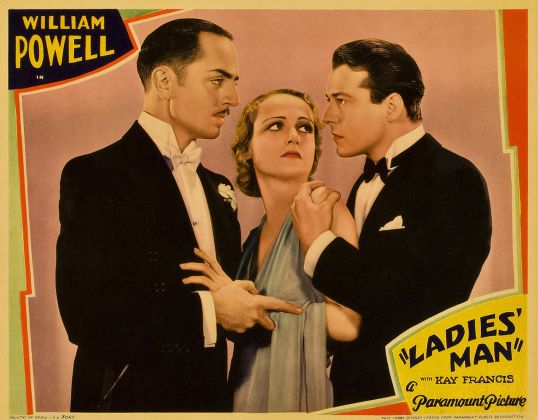
Love On The Shattered Lens: Ladies’ Man (dir by Lothar Mendes)


In the 1931 film Ladies’ Man, the always suave William Powell plays Jamie Darricott.

Jaimie may be suave but, when we first meet him, he’s faking it.  He lives in a tiny broom closet in a grand hotel and he only has two suits to his name.  The only thing that Jamie has going for him is that he’s charming and he’s handsome, in the way that only William Powell could be.  He’s like a much sleazier and far less likable version of Nick Charles.  Unfortunately, Jamie doesn’t have Nora Charles or Asta in his life.  He just has one valet and a lot of ambition.  It’s strange to see Powell play a bitter man but that’s what he does here.

Jamie starts spending time with the wealthy Mrs. Fendley (Olive Tell), despite the fact that she’s married to wealthy businessman Horace Fendley (Gilbert Emery).  Jamie starts to move up in the world.  He gets a much better room.  He gets a few more suits of clothes.  Soon, Jamie is also spending time with Mrs. Fendley’s daughter, the wild Rachel (Carole Lombard).  Rachel doesn’t care if prohibition is the law of the land.  She’s going to get as drunk as she wants every night.  And Rachel doesn’t care if society judges her for sleeping over in another man’s room despite not being married to him.  Rachel does what she wants!  And I have to admit that, at first, I liked Rachel.  She was a rebel and she made no apologies for her behavior and good for her!  (It helped she was also played by Carole Lombard, who was just starting her career but already had a lively screen presence.)  What’s interesting is that both Mrs. Fendley and Rachel seem to know that the other is seeing Jamie and they’re both pretty much okay with that.  And since Jamie is getting paid by both of them, he’s okay with it too.

This might sound a bit racy for a 1931 film and I suppose it is.  However, this is also a pre-code film.  Before the Production Code was instituted, films always portrayed New York society as being filled with gigolos and people who got drunk at nightclubs.  Pre-code films had the advantage of not only knowing what people wanted to see but also the freedom to give it to them.  Ladies’ Man is pretty open, if not particularly explicit, in detailing how Jamie makes his money.  And the message seems to be that no one can blame him.  There’s a depression going on!  Jamie has to do something to survive!  At least he’s not killing people Jimmy Cagney or Paul Muni!

However, when Jamie meets and falls for the kindly Norma Page (Kay Francis), he starts to reconsider his lifestyle.  And when Rachel finds out that Jamie is actually falling in love with Norma, she lets her father know about what’s going on.  It all leads to a rather sudden and surprisingly dark ending.  The film may have been pre-code but it was still a film from the era of DeMille and hence, all sinners had to be punished.

Seen today, Ladies’ Man is definitely a relic of a previous time.  It was made early enough in the sound era that it’s obvious that some members of the cast were still learning how to act with sound.  For a film with a 70-minute run time, it has a surprisingly large numbers of slow spots.  This is not the film to use if you want to introduce someone to the wonders of the pre-code era.  That said, I love William Powell and I love Carole Lombard.  This film was made before their brief marriage and it’s nowhere near as fun as their later collaboration, My Man Godfrey.  But it’s still enjoyable to see them together, bringing some much needed life to this scandalous tale.

Lisa Reviews An Oscar Winner: The Life of Emile Zola (dir by William Dieterle)


The Life of Emile Zola, the winner of the 1936 Oscar for Best Picture of the Year, opens with two French artists living in a drafty apartment.

Emile Zola (Paul Muni) is destined to become one of France’s most popular and important writers.  Paul Cezanne (Vladimir Sokoloff) will eventually become one of the most important artists of the post-impressionist movement.  But for now, they’re just two struggling artists who have sworn that they will never sell out their principles.  They are poor but they’re happy.  That changes for Zola after he meets a prostitute named Nana (Erin O’Brien-Moore) and he uses her life story as the inspiration for a novel.  The book is controversial and its frank content scandalizes France.  The public censor comes close to banning it.  But it also becomes a best seller.  It’s the book everyone secretly owns but claims to have never read.

Zola writes several more books, all about the conditions of the working class in France.  Eventually, he becomes what he claimed he would never be, a wealthy man living in a mansion and having little contact with the poor and oppressed.  Cezanne sees Zola one last time, calling him out for having sold his talent for money.  Cezanne explains that, on general principle, he can no longer be Zola’s friend.

Meanwhile, a quiet and rather meek family man named Captain Alfred Dreyfus (Joseph Schildkraut) has been arrested and accused of being a spy for Germany.  There’s little evidence that Dreyfus is a spy.  Indeed, most of the evidence seems to point to a Major Walsin-Esterhazy (Robert Barrat).  But, because Dreyfus is considered to be an outsider, he is convicted in a show trial and exiled to Devil’s Island.

(In real life, it’s generally agreed that Dreyfus was a victim of anti-Semitism.  As the only Jewish member of the army’s General Staff, Dreyfus was viewed with suspicion by his colleagues even before anyone knew that there was a German spy.  The Life of Emile Zola doesn’t specifically state that Dreyfus was a victim of anti-Semitism, with the exception of a brief moment when one of his accusers looks at his personnel file and says, “He’s not one of us,” while pointing at the word “Jew.”  Otherwise, the fact that Dreyfuss was Jewish is never mentioned in the film.  It’s as if the film is going out of its way to avoid offending the very people that the movie is criticizing.)

After speaking to Dreyfus’s wife (played by Gale Sondergaard, who would later become the victim of a show trial herself when she was blacklisted as a suspected communist), Zola decides to take up Dreyfus’s case.  He publishes an open letter — J’Accuse — in which he states that Dreyfus was not given a fair trial and that Dreyfus is innocent of the charges against him.  Zola finds himself in court, accused of libel.  Zola uses his trial to give Dreyfus the hearing that he never received.  While the army boos his every utterance, the people of France rally to his side.

The Life of Emile Zola is an early example of the type of prestige production that today is often referred to as being an “Oscar picture.”  It tells a true story.  As a film that condemns the treatment of Alfred Dreyfus but avoids stating the obvious reason why Dreyfus was targeted in the first place, it’s political without being radical.  And it features a performance from the most acclaimed actor of the era, Paul Muni.  Muni gives a powerful performance as Zola, holding the viewer’s attention even during the lengthy trial scenes that take up most the second half of the film.  That said, the true star of the film is Joseph Schildkraut, who plays Dreyfus as being a kind and trusting soul who finds himself caught up in a Kafkaesque nightmare.  At one point, Dreyfus is given a gun and told that there’s one way that he can avoid being put on trial for treason.  Schildkraut played the scene so well that I wanted to cheer when he refused to surrender.

The Life of Emile Zola is a big and, at times, self-consciously important production.  It was clearly designed to win a bunch of Oscars and it certainly managed to do that.  Compared to some of the other films nominated that year — The Awful Truth, Dead End, A Star is Born, Lost Horizon, Stage Door, In Old Chicago — The Life of Emile Zola can seem a bit stodgy.  However,  the performances of Muni and Schildkraut continue to make the film worth watching.

Film Review: The Loves of Edgar Allan Poe (dir by Harry Lachman)


I have to admit that the 1942 film, The Loves of Edgar Allan Poe, turned out to be far different from what I was expecting.

Just based on the title, I was expecting it would be a highly fictionalized, borderline silly film about Edgar Allan Poe defeating his romantic rivals and winning the hand of the woman he loved while still finding time to write The Raven.  I figured that there would be at least a few gentlemanly fisticuffs, with Poe portrayed as a combination of Rhett Butler and Cary Grant.  Looking at the title, it was easy for me to imagine the film closing with Poe kissing his future wife and then looking straight at the camera.  “Quoth the Raven!” he would say and wink while romantic music swelled in the background…

But no.  The Loves of Edgar Allan Poe is actually a very conventional biopic.  With a running time of only 67 minutes, the movie often feels rather rushed but it still manages to include most of the better known details of Edgar Allan Poe’s short but eventful life.  (An ever-present narrator is always ready to fill us in on every thing that happens off-screen.)  The film doesn’t spend much time on what initially inspired Poe’s macabre imagination.  There’s a scene of Poe, as a child, standing on a desolate hill and looking at a raven perched in a dead tree.  With the exception of an extended section that deals with Annabel Lee, that’s about as deep as the movie is willing to get as far as Poe’s art is concerned.

When Poe grows up, he’s played by actor Sheppard Strudwick, who has a good mustache but never exactly comes across as being the type of tortured genius who would eventually end up both revolutionizing literature and drinking himself to death.  The majority of the film deals with Poe’s advocacy for copyright reform, which is an important issue but not exactly the most cinematic of concerns.  Poe survives college.  Poe tries to sell The Raven for $25.  Eventually, Poe marries Virginia Clemm (Linda Darnell) and her subsequent sickness and death leads to not only Poe’s greatest work but also his own tragic end.

Along the way, Poe meets both Thomas Jefferson and Charles Dickens.  Jefferson shows up long enough to tell a young Poe that he’s a good writer and that he needs to stop gambling.  Dickens meets Poe and encourages him to continue to advocate for better copyright laws.

It is known that Poe and Dickens actually did meet but did Poe also meet Thomas Jefferson?  Legend says that he did but no one knows for sure.   Here’s what we do know:

Poe attended the University of Virginia in 1826.  The University’s founder, former President Thomas Jefferson, was still alive in 1826 and would often invite promising students to Monticello.  Whether Jefferson was still doing that when Poe enrolled at the University of Virginia is questionable.  Jefferson died five months after Poe started his studies.

As for Dickens, Charles Dickens and Edgar Allan Poe admired each other’s writing and they met in Philadelphia during Dickens’s 1842 tour of North America.  No record has been kept of what they discussed, though some think that Dickens told Poe about his pet raven and perhaps inspired Poe’s best-remembered poem.  In the movie, they discuss copyright laws, which is nowhere near as much fun.

(When it comes to Poe’s meetings with both Jefferson and Dickens, it is perhaps best to remember the lesson of The Man Who Shot Liberty Valance and print the legend.)

The Loves of Edgar Allan Poe is a very short film and an obviously low-budget one as well.  When the presence of that somewhat pedantic narrator, The Loves of Edgar Allan Poe feels more like an educational special than a real movie.  It’s an okay introduction to Poe’s life but, ultimately, the best way to get to know Edgar Allan Poe is to sit down and start reading.

Horror Film Review: Dracula’s Daughter (dir by Lambert Hillyer)


draculas_doughter_original_poster_1936

Did you know that Dracula had a daughter!?

Well, Bram Stoker might disagree but, according to Universal Studios, he did.  Her name was Countess Marya Zaleska and, as played by Gloria Holden, she is the title character in 1936’s Dracula’s Daughter!  Like her father, the Countess was also a vampire.  The film never gets into just how she became a vampire.  Was she born a vampire or, far more disturbingly, was she once a mortal who turned into a vampire by her own father?  The film doesn’t tell us but it does establish early on that she hates being one of the undead.  Unlike her father, she struggles with her urge to drink blood.  When she discovers that Dracula has been staked, she and her servant, Sandor (Irving Pichel), steal the body from the morgue and burn it.  The Countess thinks that this will cure her of her urges.

Sadly, it does no such thing.

So, what’s a reluctant, 20th century vampire to do?  Well, she can always go to a psychiatrist and hope that science can somehow break the curse.  She ends up as a patient of Dr. Jeffrey Garth (Otto Kruger).  By coincidence, Dr. Garth has another famous patient — Dr. Edward Von Helsing.  (That’s right, they changed the “van” to a “von” in Dracula’s Daughter.  Despite the name change, Edward van Sloan returns to play the veteran vampire hunter.)

Von Helsing in on trial, accused of murdering Dracula in the previous film.  Oddly enough, nobody mentions Renfield who, seeing as how we’re told Dracula’s Daughter starts exactly where Dracula left off, would have been found dead in the crypt as well.  Even stranger, no one steps forward to defend Von Helsing.  Dr. Seward, Mina, Johnathan Harker?  Forget about them.  Not a single one is to be found while Von Helsing is accused of murder.

Bastards.

Fortunately, Von Helsing has a defense!  Since Dracula was already dead and had been for 500 years, Von Helsing could not have killed him.  Helping him out with this defense is Dr. Garth…

Meanwhile, the Countess tries to resist the urge to attack every woman that she sees.  She pours her frustrations out into painting.  One night, Sandor brings the Countess a new model, a beautiful young woman named Lil (Nan Grey).  The Countess orders Lil to undress and then, after staring at her, gives into her urges and attacks…

If you’re thinking that there’s a subtext here, that’s because there is.  (In fact, Universal’s tagline for the film was, “Save the women of London from Dracula’s Daughter!”)  Perhaps even more so than in Dracula, Dracula’s Daughter uses vampirism as a metaphor for forbidden sex.  When the Countess stares at Lil and, later, when she prepares to bite the neck of Dr. Garth’s fiancée, she is embodying the hysterical fears of a puritanical society.  When she unsuccessfully seeks a cure for her vampirism, we’re reminded that, in the 1930s, psychiatry classified homosexuality as being a mental illness.  When the Countess struggles with her urge to drink blood, she is a stand-in for everyone who has struggled with their sexuality.

Gloria Holden plays the Countess as being as much a victim as a victimizer.  Whereas Bela Lugosi turned Dracula into the epitome of evil, Gloria Holden gives a performance that is full of ambiguity.  In fact, she at times seems to be so tortured by her vampiric state that, when she finally fully embraces the fact that she’s a vampire, you have to cheer a little.  At least she’s finally being honest with herself!  At least she’s no longer making apologies or allowing society to punish her for being who she is.  Was Countess Zaleska the first reluctant vampire in film history?  I’m not sure but Holden’s performance undoubtedly set the bar by which all other self-loathing vampires should be judged.

Dracula’s Daughter holds up surprisingly well.  It’s definitely one to look for during this Halloween season.

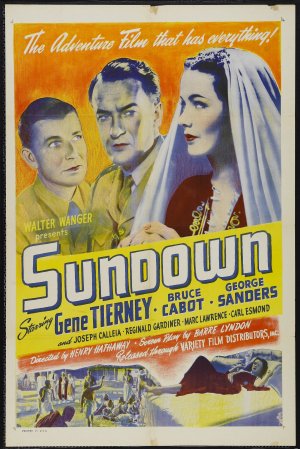
The Fabulous Forties #27: Sundown (dir by Henry Hathaway)


40s

You may remember how, back in April, I started on a mission to review all 50 of the films included in Mill Creek’s Fabulous Forties box set.  I actually got off to a pretty good start and, by the end of the month, I was about halfway through.  Yay me!

However, then the month of May began.  And May turned out to be a very, very busy month.  As I sit here writing this, it’s been 27 days since I last posted a Fabulous Forties review.  That review was …. well, I can’t even remember what it was.  After I post this, I’ll click on this link to find out.

However, things have calmed down a bit and now I can go ahead and finish up the Fabulous Forties box set.  And that’s a good thing because, between me and you, I am more than ready to move on to the Nifty Fifties box set!

Anyway, without further ado, let’s consider the 27th film in Mill Creek’s Fabulous Forties, 1941’s Sundown!

Poster_of_the_movie_Sundown

Sundown was released by United Artists in 1941.  It’s a propaganda film, telling the story of British soldiers in North Africa and their attempts to both maintain the peace among the natives and to keep the Axis powers from arming the local rebels.  Bruce Cabot is the experienced soldier who knows how things work in Africa.  George Sanders is the new commander who is a bit more by-the-book.  At first, you think that the film is going to be dominated by the rivalry between Sanders and Cabot but actually it’s not much of a rivalry.  For the most part, they get along just fine and I guess that’s to be expected considering that the film was made at a time when the emphasis was on everyone remaining unified against the Nazis.

Speaking of the Axis powers, they’re always in hovering in the shadows of the film but it’s rare that we actually see any enemy soldiers.  Perhaps this is because the film was made at a time when the United States was technically neutral.  Joseph Calleia plays a prisoner of war who has rejected fascism and instead just wants to sing opera and cook for Sanders and Cabot.  Calleia’s character is specifically identified as being an Italian.  If not for that (and the fact that the film was made in 1941), it would be just as easy to assume that Sanders and Cabot were fighting the French or maybe the Russians.

There’s an enemy agent in one of the tribes and it’s up to Sanders and Cabot to figure out who.  Helping them out is the local big game hunter, played by Harry Carey.  And, on top of that, there’s also a mysterious native woman played by Gene Tierney.  Gene Tierney is totally miscast but that adds to this film’s odd charm.

And, for modern viewers, it definitely is an odd charm.  I watched Sundown twice and I’m still not sure exactly what happened in the film.  Sundown is one of those films that doesn’t so much have a plot as it just has a lot of scenes that kind of tell a story, assuming that you have the patience and concentration to figure out how they all link together.  Between Cabot’s roguish smile, Sanders’s stiff upper lip performance, Calleia’s enjoyable overacting, and Gene Tierney’s otherworldly beauty, Sundown is unexpectedly dream-like.  The film even features a sudden sermon in which a clergyman (Sir Cedric Hardwicke) exhorts everyone to fight.  The clergyman is never seen again.

Sundown was a strange movie, one that I often found myself struggling to follow.  It was also apparently a box office bomb, though it did receive 3 Oscar nominations.  One of those nominations was for Charles Lang’s cinematography and it was definitely deserved.  Even the version I saw (which suffered from a typically poor Mill Creek transfer) was still impressive to look at.

Lisa Reviews An Oscar Nominee: A Farewell to Arms (dir by Frank Borzage)


220px-Poster_-_A_Farewell_to_Arms_(1932)_01

Reportedly, Ernest Hemingway hated the 1932 film adaptation of his great novel, A Farewell To Arms.  The novel, of course, tells the story of ambulance driver Frederic Henry (played in the film by Gary Cooper), his service in World War I, and his doomed love affair with an English nurse named Catherine (played by the very American Helen Hayes).  The novel was acclaimed for being tough and unsentimental.  The film is the exact opposite, revealing itself to be more typical of the work of director Frank Borzage than Ernest Hemingway.

How romantic was Borzage’s adaptation of A Farewell to Arms?  It was so romantic that it even changed the novel’s famous ending.  The novel ended with Catherine dying and Frederic Henry walking away, alone and in the rain.  The film, however, ended with Catherine miraculously recovering.  Never mind, of course, that having Catherine survive pretty much defeated the entire purpose of the story.  What was important was to give American audiences a happy ending!

However, European audiences got a more downbeat ending.  In the European version, Catherine does die.  After she dies, Frederic picks up her body and looks up into heaven, which is certainly far more dramatic (and, in its way, sentimentally spiritual) than anything to be found in Hemingway’s novel.  If, like me, you see A Farewell To Arms on TCM, you’ll see the European ending.

So, yes, I can understand why Hemingway would have hated this film.  But I have to admit that I rather enjoyed it.  The film adaptation makes for terrible Hemingway but it’s great Borzage.  Borzage specialized in making grand, lyrical, and sweeping romantic melodramas and that’s what his version of A Farewell To Arms truly is.  Helen Hayes may not be convincingly English and Gary Cooper may be a bit overly earnest for a Hemingway hero but they both look good together and they have great chemistry.  (Plus, Adolphe Menjou gives a good supporting performance as Frederic’s best friend.)  As a director, Borzage keeps the story moving at a steady pace and plays up the romance in every single scene.  There’s a great sequence that’s filmed entirely from the wounded Frederic’s point-of-view as he’s brought into a hospital and looked over by a series of officious nurses.  We see everything through Frederic’s eyes until Catherine finally enters the room and kisses him.  Only then do we see Frederic and Catherine together, leaving us with no doubt that these two belong together.  A Farewell To Arms may not be a great literary adaptation but it is a great cinematic romance.

A Farewell To Arms was nominated for best picture but it won to a largely forgotten film called Cavalcade.