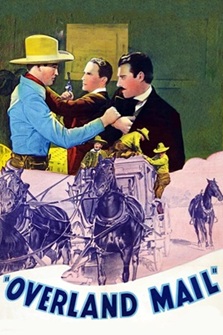
Overland Mail (1939, directed by Robert F. Hill)


Jack Mason (Jack Randall) has the most important job on the frontier.  He delivers the mail.  After he’s chased by the members of the local Indian tribe, he learns that an uprising is imminent because a young brave has been murdered and the tribe blames the citizens of a nearby town.  Of course, the murder was actually committed by a gang of counterfeiters led by saloon owner Pollini (Tristram Coffin).  Pollini is not only a counterfeiter but he also lies to sweet Mary Martin (Jean Joyce), telling her that he’s hiring her to be a waitress when he’s actually looking for a dance hall girl.  Jack has to bring Pollini to justice before a full scale war breaks out.

This is not a bad B-western.  It’s short and quick but the story is slightly better than the average Monogram oater and Jack Randall and co-star Dennis Moore are both believable as cowboys and gunslingers.  Fans of the genre will be happy to see Glenn Strange as the sheriff and Iron Eyes Cody as the chief of the tribe.  I’ve always liked westerns where the heroes were just trying to keep the peace so that they could deliver the mail.  We take mail for granted nowadays but in the 1800s, delivering mail was almost as dangerous as delivering money.  If you’re not into westerns, Overland Mail won’t change your mind but, if you’re already a fan of the genre, Overland Mail makes for an entertaining 50 minutes.


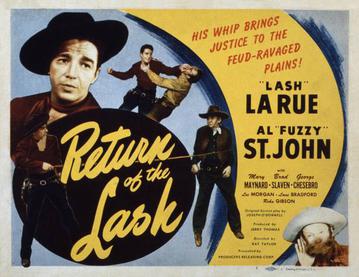
Return of the Lash (1947, directed by Ray Taylor)


There’s another range war brewing on the frontier.  Big Jim Kirby (George Chesebro) knows there’s plans for a new railroad so he wants to steal the land from the ranchers so he can make a fortune off a selling it.  Kirby calls in everyone’s mortgage, knowing they’ll never be able to pay.  Rancher Tom Grant (Buster Slaven) reaches out to Cheyenne Davis (Lash LaRue, a look alike for Humphrey Bogart)) and Fuzzy Q. Jones (Al St. John) for help.  Cheyenne raises the money but then he makes the mistake of trusting Fuzzy to deliver it.  Fuzzy takes a knock to the noggin and now, he’s got amnesia.  Where’s the money?

This is a standard B-western and you know the drill.  Big Jim’s henchmen don’t want that money to get paid.  Cheyenne is on the side of the angels.  Fuzzy provides comic relief.  Lash LaRue appeared in several B-westerns.  He never became as big a star as some of his contemporaries but he did have a gimmick that made him memorable.  Most westerns stars used guns.  LaRue had a bullwhip.  When LaRue was first offered the role of Cheyenne, he lied and said he could crack a whip.  After he struggled to teach himself, tiny production company PRC hired a professional trainer.  That was a huge expense for a poverty row studio but it paid off because LaRue became proficient with the whip and he had a surprisingly long career.  He was born Alfred LaRue.  The studio came up with the Lash nickname.  Many western stars, like Johnny Mack Brown, played characters who shared their name.  Lash almost always played Cheyenne Davis.

Lash LaRue’s movies were cheap and never that memorable.  In this one, Lash barely appears and most of the action is carried out by Al St. John as Fuzzy.  But Lash LaRue did play an important part in Hollywood history when he briefly came out of retirement to teach Harrison Ford how to crack a whip for a little film called Raiders of the Lost Ark.

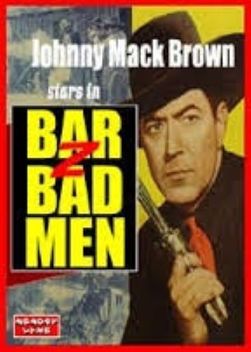
Bar-Z Bad Men (1937, directed by Sam Newfield)


After getting kicked out of town for shooting the place up during a night of friendly fun, cowboy Jim Waters (Johnny Mack Brown) drops in on his old friend, rancher Ed Parks (Jack Rothwell).  Ed has got a strange problem.  There are cattle rustlers about but instead of stealing Ed’s cattle, they’re adding cattle to Ed’s herd.  It’s an obvious scheme to try to create a feud between Ed and his neighbor, rancher Hamp Harvey (Frank LaRue).  Before Jim and Ed can solve the problem, Ed is gunned down.  Harvey is the number one suspect but Jim figures out the truth, that Harvey has been betrayed by one of his own employees and that all of this is a part of a scheme by Sig Bostell (Tom London) to take control of both ranches.

Bar-Z Bad Man is a B-western with a notably twisty plot as Bostell plays both sides against each other for his own benefit.  As usual, Johnny Mack Brown makes for a good and convincing western hero.  Whether he’s chasing someone on his horse or drawing his guns, Brown is always a convincing cowboy.  What makes this film interesting is that it opens with Johnny Mack Brown engaging in the type of behavior that most B-western heroes would never think of doing.  Shooting up the town and then getting exiled for his actions adds an element of redemption to Jim’s efforts to get to the bottom of Bostell’s schemes.  Or it would if Jim ever really seemed to feel bad about shooting the town up.  His excuse is that he was just having a good time.  Try to get away with that in the real old west, Jim!

Bar-Z Bad Men is a good B-western for those who like the genre.  The story is solid and Johnny Mack Brown is as convincing saving the west as he was shooting it up.


Roaring Rangers (1946, directed by Ray Nazarro)


Another frontier town is in trouble.

Sherriff Jeff Conner (Jack Rockwell) is having trouble ridding his town of outlaws so his son, Larry, (Mickey Kuhn) writes a letter to his hero to ask for help.  He addresses the letter to “Durango Kid, Texas.”  That’s all it takes for Steve Randall (Charles Starrett) and his sidekick, Smiley Burnette, to show up in town.

Steve and Smiley apply to be deputies but Sheriff Conner explains that someone is circulating a petition to get him fired.  Steve dresses up as the Durango Kid and pressures the citizens to give the Sheriff another chance.  Realizing that the Durango Kid is making them look bad, the outlaws decide to dress up one of their own as Durango and make the Kid look bad.  With the town turning on Durango, will Durango and Smiley be able to save Sheriff Conner from an assassination attempt?

This Durango Kid film is different from the rest of the series in that, for once, Steve is hired to be a deputy instead of a sheriff.  This really is Sheriff Conner’s story, as he tries to win the respect of the town and keep its citizens safe, even while his own brother (Ed Cassidy) is working with the outlaws.  There are all the usual horse chase and shootouts but this time, Durango and Smiley are mostly around to provide support to a man who is trying to do the right thing.  B-western fans will enjoy it.

Smiley sings a few songs, as always.  This time, musical accompaniment is provided by Merle Travis and his Bronco Busters.