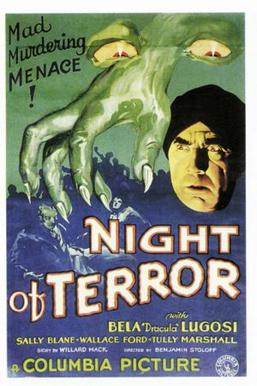
1933’s Night of Terror opens with a character known simple as The Maniac (Edwin Maxwell) attacking random people with a knife. The Maniac is on a murder spree. He leaves taunting newspaper articles on the bodies. (Don’t look at me, I didn’t write the script,) Wisecracking newspaper reporter Tom Hartley (Wallace Ford ) would love to track the Maniac down.
Meanwhile, the richest man in town has been murdered. Was he killed by the Maniac? No one is sure. What is known is that he divided his large fortune amongst not only his heirs but also his servants. Of course, if an heir or a servant should die, that just means more money for everyone else! Meanwhile, the man’s nephew — scientist Arthur Hornsby (George Meeker) — is busy trying to talk his family into burying him alive so that he can test his new suspended animation serum. Arthur swears that he’s figured out a way for people to live without oxygen for a period of time!
Okay, Arthur, that’s great. Anyway….
This sixty-one minute horror film features Bela Lugosi as Degar, the butler. Degar and his wife, Sika (Mary Frey), are regularly referred to as being “heathens” by some of the other members of the family. And yet, when the family needs someone to hold a seance so that they can figure out who is trying to kill all of them, who do they ask to conduct it? Degar’s not happy about it but Sika agrees to do so. Needless to say, things don’t go well.
It’s a bit of silly film and the final twist doesn’t make much sense. One gets the feeling that the script was written over the course of one night and no one really spent that much time worrying about whether or not it all came together to tell a coherent story. Moments of humor are mixed in with moments of would-be terror. The family chauffeur is easily scared. The members of the family all toss out insults at each other. When the police show up, they speak in the rat-a-tat fashion of 1930s police officers. No one in the film yells, “Scram!” and yet it seems like they should have. It’s that type of movie. My favorite scene featured a handcuffed Lugosi offering a police officer a cigarette from “Asia.” Needless to say, the cigarette caused the cop to pass out. Its 1930s stoner humor.
Bela Lugosi got top-billing but his role is actually pretty small. Still, Lugosi gives a good performance and delivers his lines with a straight face. He gets the honor of explaining the mystery to all of the police officers and family members. That said, the film is stolen by Edwin Maxwell as the Maniac. Maxwell gets to break the fourth wall at the end of the film and he probably sent many young audience members home with nightmares. The Maniac tells the audience not to reveal how the film ended, lest they want to be haunted by him. Hitchcock would have been proud.
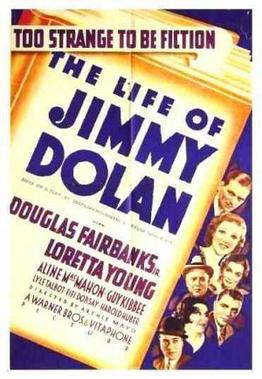
Jimmy Dolan (Douglas Fairbanks Jr.), the light heavyweight champion of the world, goes out of his way to present himself as being a wholesome boxer who loves his mom and is as saintly outside the ring as he’s fearsome inside. Instead, in private, Jimmy is a hard-drinking cynic with a corrupt manager (Lyle Talbot) and a wild girlfriend (Shirley Grey). When a reporter (George Meeker) threatens to reveal the truth, Jimmy’s manager punches him and accidentally kill him. The manager frames Jimmy for the crime and then flees with Jimmy’s girlfriend, just to suffer a fiery end in a car accident.
Everyone except for weary Inspector Phalanxer (Guy Kibbee) thinks that Jimmy is dead. Jimmy goes on the run, hitching rides on freight trains and nearly starving to death before he stumbles over a home for orphans. Peggy (Loretta Young) takes Jimmy in and gives him food and a place to live. Jimmy helps with the kids (including Mickey Rooney). When Jimmy learns that the orphanage might be shut down, he agrees to fight in a charity boxing match against the fearsome King Cobra (Sammy Stein). King Cobra is so tough that even John Wayne (playing a boxer named Smith) is scared to get in the ring with him. Jimmy risks his life and his freedom for the orphanage.
This is a good pre-code melodrama. Because this was a pre-code film, it doesn’t have to shy away from portraying Jimmy’s decadent lifestyle outside of the ring. Douglas Fairbanks, Jr. was a likable actor and easy to root for. He was athletic enough to be convincing as someone who could handle himself in a fight. When he finds himself down-and-out, he’s standing in for everyone who was struggling during the Depression. The great character actor Guy Kibbee also has some great moments as the inspector, especially towards the end of the film. Fans of John Wayne won’t see much of him here but it’s still interesting to see Wayne play a character who is frightened of something.
All in all, The Life of Jimmy Dolan is a good, pre-code boxing movie.
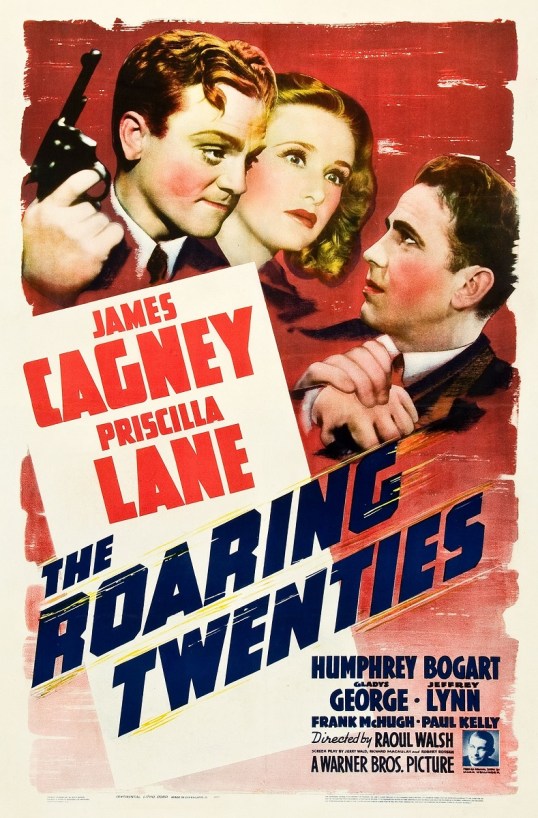
The 1939 gangster epic, The Roaring Twenties opens with newsreel footage of men like Franklin D. Roosevelt, Winston Churchill, and Adolf Hitler. We watch as they give speeches and as armed soldiers march across Europe. For those of us watching in the present, these are figures from the past. For audiences in 1939, though, these were the men who were shaping both their present and their future.
A narrator informs us that the world has changed much over the past few years and that it’s on the verge of changing again. The world is preparing for war and who knows what society is going to look like afterwards. (Interestingly enough, at the time that The Roaring Twenties was released, the U.S. was officially neutral when it came to the war in Europe, with many politicians arguing that the U.S. should pursue an isolationist foreign policy. Though the film seems to be speaking to a nation that was already committed to war but that was actually not the case.) The narrator goes on to say that it’s easy to forget what America was like just 20 years ago. World War I was ending. Soldiers were returning home. Prohibition has just become the law of the land and, as a result, there was now a whole new way to make illicit cash. It was a different era, the narrator tells us, one that is running the risk of being forgotten.
With that narration, it’s made obvious that The Roaring Twenties is designed to be more than just a gangster film. It’s also a history lesson. With Americans aware that another war might be coming, perhaps they needed to be reminded of what happened during and after the previous one. By that same token, with people across the world already dying in the fight for freedom, perhaps Americans needed to be reminded of what happened the last time they allowed the government to take those freedoms away.
The Roaring Twenties tells the story of three men who first met in 1918, while they were all hiding out in a foxhole while a bloody and violent war rages all around them. (The narrator somewhat archly notes that the three men — like all the men who fought and died in World War I — had been told that they were making “the world safe for democracy.”) The three of them become friend while under fire and they remain friends when they return home to a war-weary nation that refuses to take care of its veterans. Unfortunately, that friendship doesn’t survive the roaring 20s.
George Holly (Humphrey Bogart) is a former saloon keeper who becomes a major bootlegger after the passage of prohibition. George is the type who takes pleasure in gunning down a 15 year-old during World War I. (“He’ll never make 16,” George says after pulling the trigger.) He doesn’t improve once he returns home but he does find a lot of success as a bootlegger. Soon, he’s got a mansion. He’s got bodyguards. He goes to the best clubs and owns the best clothes. Prohibition may have been meant to put George Holly out-of-business but instead it’s made him a rich and influential man.
Lloyd Hart (Jeffrey Lynn) is a college-educated idealist, one who becomes a lawyer once he returns home. Even the most successful of bootleggers needs a good lawyer but Lloyd refuses to compromise his belief in the law, even when it comes to helping out his friends. Lloyd will eventually end up working out of the district attorney’s office, where he builds cases against men like George Holly.
And finally, there’s Eddie Bartlett (James Cagney). Eddie is the film’s main character. He’s a criminal but, unlike George, he’s not totally corrupt. In many ways, he’s an idealist but he’s never as self-righteous as Lloyd. While his friends worry about their place and their role in society, Eddie is just trying to survive. Before he went off to war, Eddie was a mechanic but, once he returns, he discovers that his job has been filled. With no other work available, Eddie is finally hired to drive a cab. What is those cabs could be used to smuggle alcohol? Eddie finds himself working with Panama Smith (Gladys George) while, at the same time, going to war with Nick Brown (Paul Kelly). In between making and losing a fortune (due to both the end of prohibition and the 1929 stock market crash), Eddie falls in love with singer Jean Sherman (Priscilla Lane). Because Eddie can’t leave the rackets, Jean ends up married to Lloyd instead.
The film follows these characters, from 1918 to 1933. Along the way, it also provides a critique of prohibition. Prohibition is presented as being a bad law, one that led to men like George Holly getting rich and which destroyed the lives of countless people. By making liquor illegal, the film argues, it also made it appealing to people who would have otherwise never had a drink. There’s a definite appeal to the forbidden. Interestingly enough, Eddie never takes a drink while he’s getting rich smuggling the stuff. It’s only after prohibition is repealed and Eddie finds himself once again reduced to driving a cab for a living that he becomes a drunk. Rich George and educated Lloyd might survive the end of prohibition by Eddie — who was as much a foot soldier during prohibition as he was during World War I — against finds himself cast out by a society that wants to forget about the national trauma that it’s just gone through. Eddie, however, isn’t going to go down without a fight. He’s played by James Cagney, after all.
The Roaring Twenties is a true classic. It works as a gangster movie, a historical epic, and a portrait of the side effects of out-of-control regulation. It tells the story about what happens when society becomes more interested in governing people than in helping them. Indeed, the film asks, what were men like Eddie Bartlett supposed to do when, after risking their lives for their country, they returned home to discover that their jobs were gone, rent had gone up, and the government wouldn’t even allow them to commiserate their sorrows over a cold beer? Who can blame America for rebelling? Who can blame the Eddie Barletts of the world for doing what they had to do to survive?
Finally, not only does The Roaring Twenties feature brilliant performances from genre veterans like Bogart and Cagney (in fact, this is a probably Cagney’s best gangster performance) but it also recreates the 20s with such skill that you can’t help but wish that you could have been a part of it. It all ends with a brilliant final scene on the steps of a church. “He used to be a big shot!” Yes, he was.
So, today, I got off work so that I could vote in Texas’s Super Tuesday primary. After I cast my vote (and don’t ask me who I voted for because it’s a secret ballot for a reason!), I came home and I turned on the TV and I discovered that, as a result of spending February recording countless films off of Lifetime and TCM, I only had 9 hours of space left on my DVR. As a result, the DVR was threatening to erase my recordings of Bend It Like Beckham, Jesus Christ Superstar, American Anthem, an episode of The Bachelor from 2011, and the entire series of Saved By The Bell: The College Years.
“Acgk!” I exclaimed in terror.
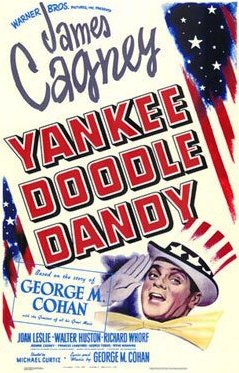
So, I immediately sat down and started the process of cleaning out the DVR. I started things out by watching Yankee Doodle Dandy, a film from 1942.
Yankee Doodle Dandy is a biopic of a songwriter, signer, and dancer named George M. Cohan. I have to admit, that when the film started, I had absolutely no idea who George M. Cohan was. Imagine my surprise as I watched the film and I discovered that Cohan had written all of the old-fashioned patriotic songs that are played by the Richardson Symphony Orchestra whenever I go to see the 4th of July fireworks show at Breckenridge Park. He wrote You’re A Grand Old Flag, The Yankee Doodle Boy, and Over There. Though I may not have heard of him, Cohan was an American institution during the first half of the 20th Century. Even if I hadn’t read that on Wikipedia, I would have been able to guess from watching Yankee Doodle Dandy, which, at times, seems to be making a case for sainthood.
And that’s not meant to be a complaint! 74 years after it was originally released, Yankee Doodle Dandy is still a terrifically entertaining film. It opens with George (played by James Cagney) accepting a Congressional Gold Medal from President Franklin D. Roosevelt. (We only see Roosevelt from behind and needless to say, the President did not play himself. Instead, Captain Jack Young sat in a chair while FDR’s voice was provided by impressionist Art Gilmore.) Cohan proceeds to tell Roosevelt his life story, starting with his birth on the 4th of July. Cohan tells how he was born into a showbiz family and a major theme of the film is how Cohan took care of his family even after becoming famous.
The other major theme is patriotism. As portrayed in this biopic, Cohan is perhaps the most patriotic man who ever lived. That may sound corny but Cagney pulls it off. When we see him sitting at the piano and coming up with the lyrics for another song extolling the greatness of America, we never doubt his sincerity. In fact, he’s so sincere that he makes us believe as well. Watching Yankee Doodle Dandy, I found myself regretting that I have to live in such an overwhelmingly cynical time. If George M. Cohan was alive today, he’d punch out anyone who called this country “Murica.”
Yankee Doodle Dandy is an amazingly positive film. There are a few scenes where Cohan has to deal with a few Broadway types who are jealous of his talent and his confidence but, otherwise, it’s pretty much one triumph after another for Cohan. Normally, of course, there’s nothing more annoying than listening to someone talk about how great his life is but fortunately, Cohan is played by James Cagney and Cagney gives one of the best performance of all time in the role.
Cagney, of course, is best remembered for playing gangsters but he got his start as a dancer. In Yankee Doodle Dandy, Cagney is so energetic and so happy and such a complete and totally showman that you can’t help but get caught up in his story. When he says that, as a result of his success, things have never been better, you don’t resent him for it. Instead, you’re happy for him because he’s amazingly talented and deserve the best!
Seriously, watch him below:
James Cagney won the Oscar for Best Actor for his performance here. Yankee Doodle Dandy was also nominated for best picture but lost to Mrs. Miniver.
I’m really glad that I watched Yankee Doodle Dandy today. In this time of overwhelming negativity, it was just what I needed!
Do you know what time of year it is!? Well, yes — it is August and soon it will be September. But even more importantly, it’s back to school time! Summer is over and, all across the country, children and teenagers alike are getting ready to return to school. Some schools in America have already opened. In my part of Texas, school is officially starting on August 25th. So, what better time than now for the Shattered Lens to go back to school? Over the next 8 days, we’ll be taking a chronological look at 76 films about teenagers and high school.
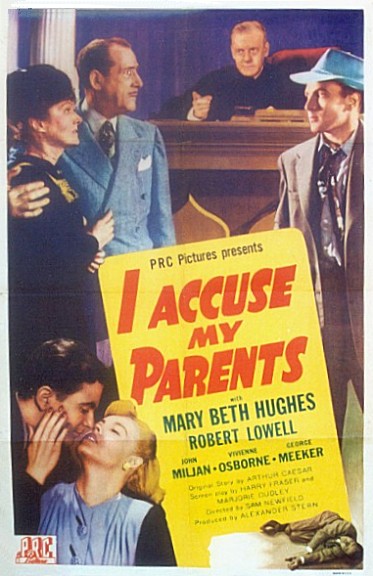
And what better film to start with than the low-budget 1944 look at juvenile delinquency, I Accuse My Parents? Well, technically, there’s probably a lot of better films that I could start with but, to be honest, I just love this film’s title. I Accuse My Parents. It’s just so melodramatic and over the top, much like this film itself. And yet, the title also carries a hint of the truth. After all, who hasn’t accused their parents at one point in their life?
I Accuse My Parents opens with Jimmy Wilson (Robert Lowell) standing in a courtroom and being addressed by a stern-sounding judge. Despite the fact that Jimmy appears to be in his early 30s, the film continually assures us that he’s a teenager. He’s been accused of manslaughter and, as the judge tells us, he has apparently failed to provide any help to his defense lawyers. Does Jimmy have anything to say in his defense? Jimmy looks down at the floor, obviously deep in thought. Finally, he looks up and says, “I accuse my parents.”
“OH MY GOD!” everyone in the courtroom says in unison. Or, at least, they would have if this film hadn’t been made in 1944. Instead, they simply gasp in shock.
It’s flashback time! We see that before Jimmy became a murderous criminal, he was just your normal 30 year-old high school student. He even won an award for writing an essay about how wonderful his parents were. Little did his fellow students suspect that Jimmy’s mom was actually a drunk and his father was more concerned with business than with raising his son. When Jimmy’s mom showed up at the school drunk, all of Jimmy’s friends saw her and laughed. Jimmy’s essay of lies had been exposed!
Even worse, when Jimmy got an after-school job as a shoe salesman, he met and fell in love singer Kitty Reed (Mary Beth Hughes). Little did Jimmy suspect that Kitty was also the mistress of gangster Charles Blake (George Meeker). Blake recruited Jimmy to start delivering stolen goods. Unfortunately, award-winning essay aside, Jimmy was a bit of an idiot and never realized, until it was too late, that he was being drawn into a life of crime. Even worse, his father was too busy working and his mother was too busy drinking to see what their son was getting involved with.
I have a soft spot in my heart for films like I Accuse My Parents. These films take place in a world where the worst thing that can happen will always happen. Being neglected by his parents doesn’t just leave Jimmy feeling angry or resentful. Instead, it leads to him meeting a gangster and becoming a criminal. And while most of the on-screen evidence would suggest that Jimmy’s main problem is that he’s a little bit stupid (and that would certainly explain why, despite clearly being in his 30s, Jimmy is still a senior in high school), the film wants to make it very clear that all of this could have been avoided if only he had better parents.
Add to that, it’s interesting to see that, even in the 1940s, it wasn’t easy being a teenager!
Finally, it should be noted that the film ends with a note letting us know that the producers had shipped copies of the film off to our fighting forces in Europe, which I think was sweet of them. (Though I have a feeling that the soldiers might have preferred something featuring Lana Turner…)
 Through the Shattered Lens