Bonus Horror On The Lens: I Was A Teenage Frankenstein (dir by Herbert L. Strock)


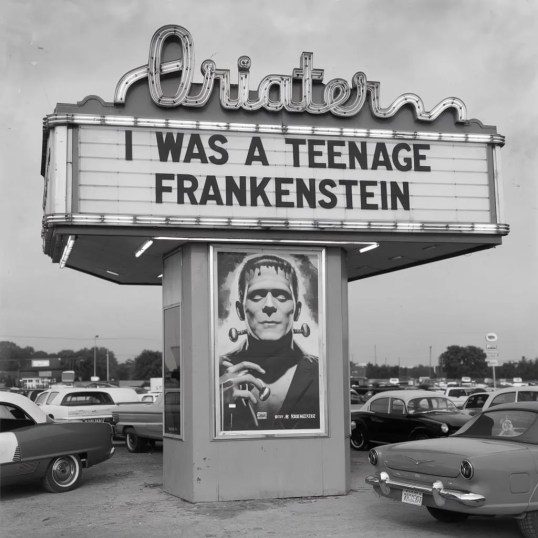
From 1957, it’s I Was A Teenage Frankenstein!

This film was produced as a direct result of the box office success of I Was A Teenage Werewolf.  Just as in Teenage Werewolf, Whit Bissell plays a mad scientist who makes the mistake of trying to play God.  (He also makes the mistake of keeping an alligator in his lab but that’s another story.)  The end result …. Teenage Frankenstein!

The makeup on the Teenage Frankenstein is probably the best thing about this film.  If nothing else, this film features a monster who actually looks like he was stitched together in a lab.

Enjoy and please be sure to read my full review!

Bonus Horror On The Lens: I Was A Teenage Frankenstein (dir by Herbert L. Strock)


From 1957, it’s I Was A Teenage Frankenstein!

This film was produced as a direct result of the box office success of I Was A Teenage Werewolf.  Just as in Teenage Werewolf, Whit Bissell plays a mad scientist who makes the mistake of trying to play God.  (He also makes the mistake of keeping an alligator in his lab but that’s another story.)  The end result …. Teenage Frankenstein!

The makeup on the Teenage Frankenstein is probably the best thing about this film.  If nothing else, this film features a monster who actually looks like he was stitched together in a lab.

Enjoy and please be sure to read my review of this film at Horror Critic!

Horror Film Review: House of Frankenstein (dir by Erle C. Kenton)


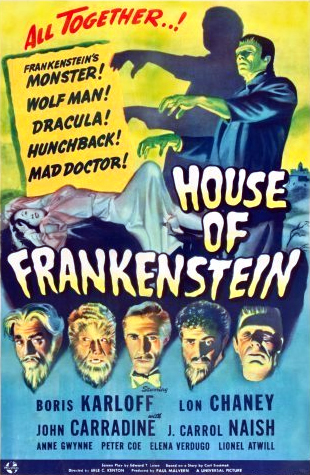
House of Frankenstein opens in a prison.  Dr. Gustav Neimann (Boris Karloff), the bother of one of Baron Frankenstein’s assistants, has been convicted of robbing graves and attempting to carry on the Baron’s work.  Dr. Neimann’s faithful assistant is the hunchback, Daniel (J. Carroll Naish).  Daniel is loyal to Neimann because Neimann has promised to someday place Daniel’s brain in a stronger body.

When a sudden earthquake allows Neimann and Daniel to escape, they waste no time in getting revenge on Neimann’s enemies.  First, they murder a traveling showman named Prof. Lampini (George Zucco) and steal both his identity and his mobile horror exhibit.  Included in the exhibit is a coffin that Lampini claimed held the skeleton of Dracula.  (There’s even a stake sticking out of the skeleton’s chest.)  When Neimann returns to his original hometown, he removes the stake from the skeleton so that he might use it on the Burgomaster, Hussman (Sig Ruman).  The skeleton transforms into Dracula (John Carradine).  Because he is relieved to have been brought back to life, Dracula does not attack Neimann but instead agrees to help Neimann get revenge on Hussman in return for Neimann looking after his coffin.  Dracula soon learns that he should have thought twice before trusting either Neimann or Daniel.

Neimann moves on, stopping off at Frankenstein’s village and recovering the bodies of both Frankenstein’s Monster (Glenn Strange) and Larry Talbot (Lon Chaney, Jr.) from the frozen chamber in which they were trapped at the end of Frankenstein Meets The Wolf Man.  Revived from suspended animation, Larry immediately starts whining about how much his life sucks.  (I love The Wolf Man but subsequent films turned Larry into the whiniest of the Universal monsters.)  Neimann promises to put Larry’s brain in a new body if he helps to revive the Monster.  Larry agrees.  Meanwhile, Daniel falls in love with a gypsy girl named Ilonka (Elena Verdugo) while Ilonka falls in love with Larry.  Daniel wants Neimann to put his brain in Larry’s body, Larry won’t stop whining about the approaching full moon, and the villagers are getting suspicious!

House of Frankenstein has never been a favorite of critics or horror historians and the film does have its share of flaws.  For instance, though it would have been fun to see Bela Lugosi return to his signature role, John Carradine seems like ideal casting for Dracula.  Unfortunately, Dracula is only in the film for about ten minutes and he comes to an end that really doesn’t feel worthy of a character of his stature.  The film reduces Larry Talbot to just being a dumb lug who won’t stop feeling sorry for himself.  Finally, Glenn Strange has the right physique for the Monster but, much as with John Carradine, he is underused.

That said, I still enjoyed House of Frankenstein.  A lot of that is because of Boris Karloff, who brings a lot of sly humor to his performance as the mad scientist.  (That said, Karloff himself later said that he did the role solely for the money and was bored with the whole thing.)  J. Carroll Naish turns Daniel into a rather sympathetic henchman, one who is so desperate to be “normal” that he’s willfully blinded himself to the fact that Neiman really doesn’t care about anyone other than himself.  (In many ways, he’s the equivalent of the hapless characters that Michael Ripper later played for Hammer Films.)  Finally, Elena Verdugo brings a lot of life to the stock role of the dancing gypsy girl who falls in love with Larry Talbot despite the fact that Larry is kind of a dumb lug.

For a modern viewer, the main appeal of House of Frankenstein is that it is one of the original Universal horror films, even if it came out long after the first Dracula and Frankenstein films.  As such, it has all the things that we associate with and love about those films.  There’s a ruined castle.  There’s angry villagers.  The cast is full of Universal horror mainstays, including Lionel Atwell and Anne Gwynne.  And, yes, the film features a mob descending on the castle with torches.  Flaws and all, House of Frankenstein is an enjoyable time capsule.  It’s a horror film from a far more innocent age and it’s one that remains a fun watch.

Previous Universal Horror Reviews:

  1. Dracula (1931)
  2. Dracula (Spanish Language Version) (1931)
  3. Frankenstein (1931)
  4. Island of Lost Souls (1932)
  5. The Mummy (1932)
  6. The Invisible Man (1933)
  7. The Bride of Frankenstein (1935)
  8. Dracula’s Daughter (1936)
  9. Son of Frankenstein (1939)
  10. The Wolf Man (1941)
  11. Ghost of Frankenstein (1942)
  12. Frankenstein Meets The Wolf Man (1943)
  13. Son of Dracula (1943)
  14. Creature From The Black Lagoon (1954)

Horror On The Lens: I Was A Teenage Frankenstein (dir by Herbert L. Strock)


From 1957, it’s I Was A Teenage Frankenstein!

This film was produced as a direct result of the box office success of I Was A Teenage Werewolf.  Just as in Teenage Werewolf, Whit Bissell plays a mad scientist who makes the mistake of trying to play God.  (He also makes the mistake of keeping an alligator in his lap but that’s another story.)  The end result …. Teenage Frankenstein!

The makeup on the Teenage Frankenstein is probably the best thing about this film.  If nothing else, this film features a monster who actually looks like he was stitched together in a lab.

Enjoy and please be sure to read my review of this film at Horror Critic!

Cleaning Out The DVR: Let Us Live! (dir by John Brahm)


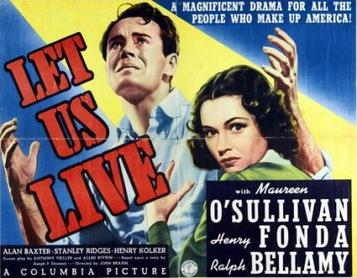
In the 1939 film, Let Us Live!, Henry Fonda plays Brick Tennant.  Brick is a poor but honest taxi driver who has always lived a law-abiding life and who is looking forward to marrying waitress named Mary Roberts (Maureen O’Sullivan).  However, when a taxi is used as a getaway car in a violent robbery that leaves a policeman dead, Brick finds that he’s a suspect.

At first, Brick isn’t too worried.  It turns out that every taxi driver in Boston is apparently being considered a suspect.  Brick is just 1 out of 120.  However, when the police bring Brick in to take part in a lineup, one of the witnesses insists that Brick and his friend, Joe Linden (Alan Baxter), were involved in the robbery.  Despite the fact that Brick and Mary were at a church, planning their wedding, during the robbery, Brick and Joe are arrested and put on trial for murder.  Despite Brick’s initial faith in the system, he and Joe are convicted and sentenced to die.

On death row, Brick faces the inhumane reality of American justice.  He watches as other prisoners slowly lose their mind as a result of neglect and abuse.  He watches as another prisoner drops dead in front of him, to the indifference of the guards.  Even when Mary tells him that she’s still looking for evidence that will exonerate him, Brick says that he no longer cares.  The state of Massachusetts is determined to kill him and he doesn’t believe that there’s any way stop them.  As Mary puts it, Brick is now dead inside.

Still, Mary continued to investigate.  Helping her is a police detective named Everett (Ralph Bellamy).  Everett comes to realize that two innocent men are sitting on Death Row but will he and Mary be able to find the real culprits before the state executes Brick and Joe?

While watching Let Us Live, I found it impossible not to compare the film to The Wrong Man, another film in which Henry Fonda played an innocent man being railroaded by the system.  Both The Wrong Man and Let Us Live were based on a true stories, though Let Us Live takes considerably more liberty with its source material than The Wong Man does.  Whereas The Wrong Man is a docudrama that’s full of moody atmosphere courtesy of director Alfred Hitchcock, Let Us Live is much more of a fast-paced, melodramatic B-move.

That said, Let Us Live! is still a definitely effective look at how an innocent man can be railroaded by a system that’s often more concerned with getting a quick conviction than actually searching for the truth.  Sadly, the issues that Let Us Live deals with are just as relevant today as they were in 1939.  The film’s power comes from Henry Fonda’s performance as Brick.  It’s truly heart-breaking to watch Brick go from being a cheerful optimist to a man who has been so broken down by American justice that he can’t even bring himself to celebrate the news that he might be released.  The film ends on a grim note, a reminder that some damage cannot be undone.

Let Us Live! is another good but obscure film that I discovered through TCM.  Keep an eye out for it!

Horror On The Lens: I Was A Teenage Frankenstein (dir by Herbert L. Strock)


From 1957, it’s I Was A Teenage Frankenstein!

This film was produced as a direct result of the box office success of I Was A Teenage Werewolf.  Just as in Teenage Werewolf, Whit Bissell plays a mad scientist who makes the mistake of trying to play God.  (He also makes the mistake of keeping an alligator in his lap but that’s another story.)  The end result …. Teenage Frankenstein!

The makeup on the Teenage Frankenstein is probably the best thing about this film.  If nothing else, this film features a monster who actually looks like he was stitched together in a lab.

Enjoy and please be sure to read my review of this film at Horror Critic!


Shattered Politics #12: The Boss (dir by Byron Haskin)


The Boss

After you’ve watched The Phenix City Story, why not go over to Netflix and watch another obscure but hard-hitting B-movie, The Boss?

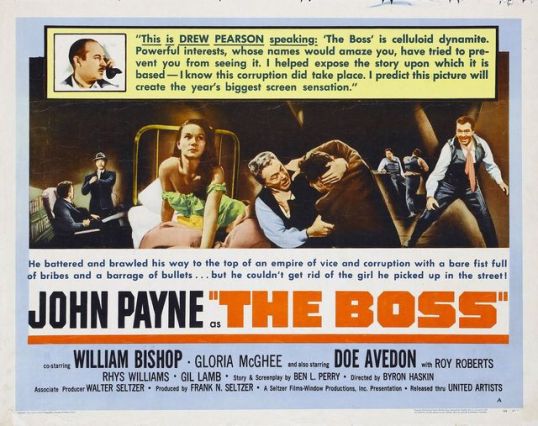
First released in 1956, The Boss came out a year after The Phenix City Story but they both serve as good companion pieces to each other.  Whereas The Phenix City Story shows what it’s like to live in a city dominated by corruption and crime, The Boss shows how a city could get that way in the first place.

The Boss opens in 1919, in an unanmed midwestern city.  (A title card informs us that the city is a “middle class city.”)  World War I has ended and the returning soldiers are marching in a parade throughout the city.  Leading the march is Capt. Matt Brady (John Payne), a humorless war hero.  Marching behind him are a group of soldiers who all seem to hate his guts, even after Bob Herrick (William Bishop) attempts to defend him.  It appears that Matt was a strict officer during the war and Bob was the only one of his men who didn’t hate him.  Of course, a lot of that is because Bob was a childhood friend of Matt’s.  They both grew up in the city together.  To be exact, their home was in the third ward.  As Bob explains, the Brady family rules the third ward.

Matt’s older brother, Tim (Roy Roberts), is the 3rd ward’s alderman.  After the parade ends, Tim explains that he expects Matt to follow in the family business.  However, Matt doesn’t want anything to do with politics.  Instead, he just wants to marry Elsie (Doe Avedon) and live a normal life.  In fact, Matt says, he’s got a date with Elsie that night.

However, before Matt can go on that date, he ends up getting attacked and beaten up by some of the soldiers from the parade.  He’s late for his date and when Elsie refuses to forgive him, Matt ends up going out and getting drunk.  After getting into a few more fights, he meets an insecure woman named Lorry (Gloria McGhee) and announces that they’re getting married whether she wants to or not.

The next morning, Matt wakes up to discover that he now has a wife, Elsie never wants to see him again, and that Tim has dropped dead of a heart attack.  Bruised and hungover, Matt suddenly finds himself forced to take over the family business.

The film jumps forward a few years.  Matt is now the most powerful man in the city.  He decides who get elected to which office and, with the help of the Mafia, he’s made a lot of money for himself.  Bob, meanwhile, has married Elsie and is now Matt’s attorney and unofficial second-in-command.  Meanwhile, Lorry lives in a huge mansion that she never leaves.

It took me a while to get into The Boss.  In fact, I nearly stopped watching after the first twenty minutes because it didn’t ever seem like there would be a moment when Matt would be anything other than surly, drunk, and bruised.  But then, once Tim drops dead, the movie becomes a bit more interesting.  If you remember John Payne for anything, it’s probably for being the nice but kind of boring lawyer from the original Miracle on 34th Street.  So, it’s interesting to see him here, playing a crude and perpetually angry man who always seems to be on the verge of punching someone out.  He gives a good performance and occasionally you even feel a little sorry for Matt.  For everything he does wrong, he’s still essentially the same guy who wanted to marry a school teacher and live out in the suburbs.

Of course, I’m a history nerd so my favorite scenes in The Boss were the ones that dealt with real moments from history, like the scene where Matt panics when he hears about the 1929 Stock Market crash.  Even better, though, is a brief sequence that takes place at a political convention.  Though no names are uttered and the party is never specifically identified, it’s obvious that Matt is meant to be at the 1932 Democratic Convention and the candidate that is asking for Matt’s support is obviously meant to Franklin Roosevelt.  When Roosevelt is nominated without Matt’s support, Matt can only bitterly observe that he wishes he was from Chicago because then he could own a President.

Would a movie made today have the guts to say such a thing about FDR?  I doubt it.

The Boss is currently available on Netflix.  If you’re into politics and history (and maybe even political history), be sure to watch it before it goes away.