Horror Film Review: Trilogy of Terror (dir by Dan Curtis)


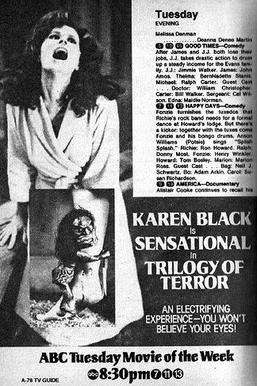
1975’s Trilogy of Terror is a true classic, a rare made-for-television horror film that could have just as easily and effectively been released in theaters.

As one can surmise from the title, it features three stories.  Each story is directed by Dan Curtis and written by Richard Matheson.  Each story also features Karen Black in the lead role, giving Black a chance to play not just one but four very different characters over the course of one film.  One of the things that makes this film work so well is Karen Black’s totally committed performance.  Sadly, Karen Black later expressed some regret about having appeared in the film because it led to her being typecast as a horror actress, which she definitely hadn’t been before.  (One need only watch Karen Black in Five Easy Pieces, Nashville, or Family Plot to see what a good actress she was.  Even in something like Easy Rider, where she had only a small role and very few lines, her talent is obvious.)  As a result, Black was no longer considered for the big studio films that she had appeared in previously and instead, she spent the remained of her career appearing in low-budget horror films.  That’s a shame because Trilogy of Terror really does show what a strong actress Black was.

The first segment features Black as Julie, a seemingly uptight teacher who somewhat surprisingly agrees to go out on a date with Chad (Robert Burton), a sleazy college student.  Chad drugs Julie’s drink during their date and later undresses her and takes pictures which he then uses in an attempt to blackmail Julie into basically being his sex slave.  Julie, however, turns out to have a big secret of her own and Chad discovers too late that he was the one who was being manipulated.  This segment was the least interesting of the three stories but the ending was very satisfying.  Anyone who has ever dated a “nice guy” who turned out to actually be a jerk will enjoy Julie’s revenge.

The second segment is enjoyably sordid, an over-the-top soap opera that I can’t talk too much about without spoiling the plot.  Black plays Millicent, a repressed brunette, who is hatefully obsessed with her twin sister, blonde Theresa (Black again).  Millicent fears that Therese is planning to corrupt and destroy her boyfriend, Thomas (John Karlen).  Millicent explains to her therapist (George Gaynes) all of the terrible things that Therese has done.  Of course, the truth turns out to be much more complicated.  This story was entertaining and featured a surprisingly effective twist.

The third segment is the one that everyone remembers.  Amelia (Karen Black) lives alone in a high-rise apartment and has recently purchased, as a present for her anthropologist boyfriend, a wooden fetish doll in the form of a misshapen aboriginal warrior with pointed teeth and a spear.  The doll comes with a scroll that explains that the doll is inhabited by the spirit of a Zuni hunter and that the only thing keeping the doll from coming to life is the gold chain adorning the doll.  Of course, the chain eventually falls off and Amelia finds herself being pursued through her apartment by a viscous doll that is obsessed with killing her.  This is the simplest and the scariest of the Trilogy of Terror’s three stories.  It’s easy to say that it’s just a doll until it pops out of nowhere and stabs Amelia in the ankle.  This story ends on a properly dark note and that final image of Karen Black is haunting.

For a fifty year-old film, Trilogy of Terror holds up remarkably well.  Watch it and witness just how good an actress Karen Black truly was.
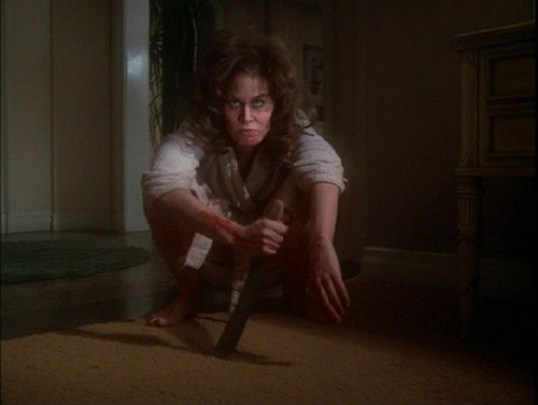
Trilogy of Terror (1975, dir by Dan Curtis. DP: Paul Lohmann)
Horror on the Lens: Trilogy of Terror (dir by Dan Curtis)


For today’s horror on the Lens we have a made-for-TV movie that was produced and directed by Dan Curtis.

Trilogy of Terror, which aired in 1975, is an anthology film, featuring three segments that were each based on a short story from Richard Matheson.  What makes this particular film special is that each segment features Karen Black playing a radically different character from the previous segment.  The film really is a showcase for this underrated actress, though Black herself later said that the film ruined her career because it typecast her as a horror actress.

The third segment is the one that gets all the attention.  That’s the one with the killer doll.  I like all of the segments, though.  The first one is often considered to be the weakest but anyone who has ever been through a similar situation will appreciate it as tale of revenge.  The second segment has a playful vibe that I liked.  And yes, the third segment is genuinely frightening.

From 1975, here is Trilogy of Terror:

The Fantastic Four (1994, directed by Oley Sassone)


It’s not that bad.

Produced by Roger Corman and made for a budget of only a million dollars, the very first film version of The Fantastic Four is best known for having never been released.  Stan Lee always claimed that the film was never meant to be released and that it was only made so that German producer Bernd Eichinger could hold onto the rights for the characters.  Eichinger has always said that he wanted to release the flm and it was Avi Arad, the future founder of Marvel Studios, who asked him not to because he felt a low-budget B-movie would damage the Marvel brand.  Arad has said that Eichinger is telling the truth and considering the reception that Albert Pyun’s Captain America received, I can understand why Arad was concerned.

Though the film was never officially released, bootleg copies are out there.  I’ve seen the movie a few times and I watched it again last night.  Watching it, I was reminded that The Fantastic Four is not as bad as people say.

It’s an origin story.  Reed Richards (Alex Hyde-White) flies into space with his girlfriend Sue (Rebecca Staab), her annoying kid brother Johnny (Jay Underwood), and Reed’s best friend Ben (Michael Bailey Smith).  Cosmic comet rays lead to them developing super powers.  Reed can stretch.  Johnny can burst into flame.  Sue can turn invisible.  Ben turns into a creature with orange, rocky skin.  On Earth, they battle both the evil Doctor Doom (Joseph Culp) and the Jeweler (Ian Trigger) for possession of a powerful diamond.

The low budget is obvious and the script isn’t great, with the Jeweler being a truly unimpressive villain.  (Unlike Doctor Doom, the Jeweler was created specifically for this movie.)  But the movie still has more genuine heart than the future big-budget Fantastic Four films. Alex Hyde-White plays Reed as being brilliant but self-absorbed.  Sue is a thankless role but Rebecca Staab does her best.  Jay Underwood is annoying as Johnny but Johnny was annoying in the comic books as well.  This version of The Fantastic Four is the only movie, so far, to capture and stay true to the spirit of the characters.

This is especially true when it comes Michael Bailey Smith’s performance as Ben Grimm.  More than either Jamie Bell or Michael Chiklis, Smith realistically portrays Ben’s bitterness over knowing that he will never be able to return to his former life.  Of all the film versions of the Fantastic Four, this is the only one that adequately captures both the look and the personality of The Thing.  He become a real person and not just an actor in a rubber suit.  This movie is also the only one, so far, to really do a decent job of portraying Dr. Doom’s megalomania.  It’s interesting that the film that Marvel didn’t want released is the one that stays true to the original comic book.

The Fantastic Four will be joining the MCU in 2025.  Ironically, considering that Marvel Comics started with the Fantastic Four, they’ll be among the last of the major characters to get an MCU film.  There’s hope that the new Fantastic Four will reverse the MCU’s declining fortunes.  I’ve been skeptical ever since I heard the Silver Surfer was going to be played by Julia Garner but hopefully, I’ll be wrong.  Galactus is one of the great Marvel villains and I hope the new Fantastic Four will do him justice.  When people are watching the massively hyped, big budget, CGI-heavy version of The Fantastic Four, I hope at least some will remember the low-budget version that could barely afford a single special effect and I hope they’ll remember that it wasn’t that bad.

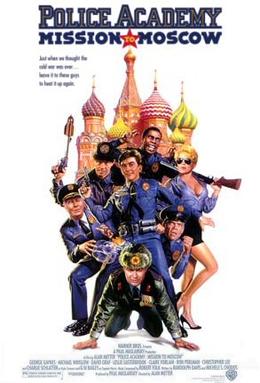
Police Academy 7: Mission to Moscow (1994, directed by Alan Metter)


Russia has a problem.  Mob boss Konstantine Konali (Ron Perlman, slumming) has created a video game so addictive that the people playing it don’t even realize that it’s actually a sophisticated computer virus that allows Konali to take control of almost any security system.  As a result, Moscow has been hit by a string of robberies.  The Moscow police commandant, Nikolaivich Rakov (Christopher Lee, slumming even more than Perlman) knows that he doesn’t have the resources to stop Konali so, as so many have done before him, he decides to contact Commandant Eric Lassard (George Gaynes) and asks for help.

In others words: Police Academy Goes To Russia!

Well, some of the Police Academy graduates get to go.  After the box office failure of City Under Siege, there was a five year hiatus between that movie and the latest (and last) installment in the Police Academy film saga.  During that time, the juvenile boys who made up the franchise’s target audience all grew up and became too cool to admit that they had ever seen a Police Academy film.  By the time Mission to Moscow went into production, most of the stars of Police Academy had also either moved on or desperately wanted to create the impression that they had something better to do than go to Russia to take part in the final stand of an aging franchise.

As a result, Lassard only takes Tacklberry (David Graf), Sound Effects Machine (Michael Winslow), Callahan (Leslie Easterbrook), Harris (G.W. Bailey), and Cadet Connors (Charlie Schlatter) with him to the Russia.  Cadet Connors is a computer expert and he is obviously meant to be the new Steve Guttenberg/Matt McCoy style wiseass.  He ends up falling for a pretty Russian translator (Claire Forlani).  Cadet Connors tries his best but he’s no Carey Mahoney.

Give Mission to Moscow some credit for predicting both the rise of the Russian Mafia and the danger of computer viruses.  Otherwise, Mission to Moscow ends the Police Academy franchise in a desultory manner.  The cast looks old and even the usually reliable Sound Effects Machine doesn’t bring much energy to his shtickPolice Academy: Mission to Moscow was one of the first American movies to be filmed in Moscow after the collapse of the Soviet Union and it even features an actor standing in for Boris Yeltsin.  In the tradition of a family sitcom doing a special episode of Epcot Center, there’s plenty of footage of the cast standing in front of all of the landmarks but otherwise, Mission to Moscow doesn’t do much with its setting.  It’s interesting as historical trivia but forgettable as a movie.

10 years after the series began, Mission to Moscow brought the Police Academy films to a close, not with a bang but with a very exhausted whimper.  There was a syndicated tv series featuring the Sound Effects Machine that aired in 1997 but I never saw an episode and I was surprised to lean that it even existed.  It’s on YouTube so, someday, I’ll try to watch it.  Not today, though.


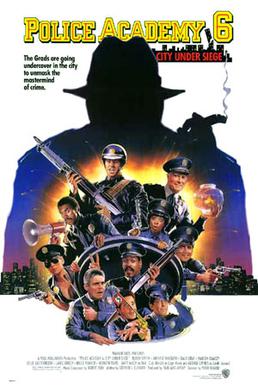
Police Academy 6: City Under Siege (1989, directed by Peter Bonerz)


The sixth Police Academy film opens with another crime wave.  Considering that the Police Academy Class of 1984 was supposedly the best to ever graduate, they don’t seem to have done much to clean up the city.  This time, a series of robberies are being committed in the Wilson Heights neighborhood.  Since Captain Harris (G.W. Bailey) and Lt. Proctor (Lance Kinsey) don’t seem to be capable of upholding the law in their precinct, the Mayor (Kenneth Mars) orders Harris to work with Commandant Lassard (George Gaynes) and the usual gang of Police Academy graduates.

Carey Mahoney is still missing in action but Nick Lassard (Matt McCoy) has transferred up from Miami and has taken Mahoney’s place as the resident smartass.  Also returning are Sound Effects Man (Michael Winslow), Hightower (Bubba Smith), Hooks (Marion Ramsey), Callahan (Leslie Easterbrook), Tackleberry (David Graf), and, after having been absent for the previous two films, Sgt. Fackler (Bruce Mahler)!

I cannot believe I’m saying this but Police Academy 6 turned out to be better than I remembered.  It’s just as stupid as all of the other Police Academy films but everyone seems to be having a good time and Matt McCoy no longer feels out of place as Mahoney’s replacement.  Bruce Mahler’s return as Fackler also means a return to the physical comedy that he excelled at in the first two films and the total incompetence of Harris and Proctor is handled better here than it was in the previous few films.  A welcome addition to the cast is Gerrit Graham, as the childish head of the robbers.  (Whereas the previous few films at least tried to pretend like the criminals were a potentially serious threat, City Under Siege presents them as being as clownish as everyone else in the film.  It’s a better approach because it’s not as if anyone watches a Police Academy film expecting to see something like The French Connection or Fort Apache, The Bronx.Police Academy 6 is a stupid, stupid movie and the jokes are as juvenile as ever but, along with Part 3, it’s still one of the better sequels.

Police Academy 6 was the first Police Academy film to not be a box office hit.  It would be followed by one final sequel, Mission to Moscow, which I’ll take a look at on Saturday.

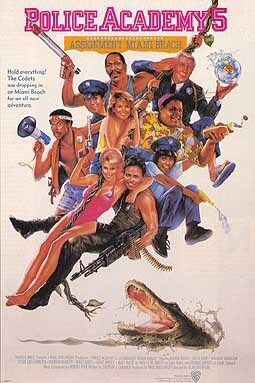
Police Academy 5: Assignment Miami Beach (1988, directed by Alan Myerson)


Police Academy 5 starts as so many Police Academy films have started.  Commandant Lassard (George Gaynes) is getting progressively more loopy and Captain Harris (G.W. Bailey) is plotting to take over the Academy.  This time, Harris thinks that he has come up with the perfect plan when he discovers that Lassard has reached the mandatory retirement age.

With retirement looming, Lassard attends one final law enforcement convention in Miami.  At the convention, Lassard is to be honored as “Police Officer of the Decade” because it was apparently a very slow decade.  Lassard decides to bring along his favorite academy graduates so that they can celebrate with him and meet his nephew, Sgt. Nick Lassard (Matt McCoy, who you may recognize as Seinfeld’s Lloyd Braun or maybe as the spokesman for Hartford Insurance).   The commandant invites Sound Effects Guy (Michael Winslow), Tackleberry (David Graf), Hightower (Bubba Smith), Hooks (Marion Ramsey), Callhan (Leslie Easterbrook), and House (Tab Thacker).  Notice who isn’t there?  This was the first Police Academy film without Steve Guttenberg’s Carey Mahoney and Commandant Lassard celebrating his career without inviting his most loyal graduate doesn’t seem right.

Once what is left of the old gang arrives in Miami, they get caught up in the usual Police Academy shenanigans.  Rene Auberjonois plays a jewel thief who accidentally switches bags with the Commandant and who has 24 hours to retrieve the stolen diamonds.  It’s Florida so there are women in bikinis and an Everglades boat chase.  Harris gets humiliated in every way possible.  The jokes are even more juvenile than usual.  Nick Lassard uses sunscreen to permanently label Harris as being a “dork” so everyone on the beach calls Harris a “dork.”  That’s as sophisticated as things get.

Unfortunately, there’s a Steve Guttenberg-shaped hole at the center of Police Academy 5 and not even as formidable a thespian as Matt McCoy can fill it.  Even though Guttenberg always seemed like he was miscast as both a cop and a former juvenile delinquent, Police Academy 5 shows how important he really was to the franchise.  Mahoney was the closest thing that the Police Academy films had to a fully developed character and, without him around, it’s even more obvious how thinly drawn all of the other characters were.  (Guttenberg was filming Three Man And A Baby while Police Academy 5 was in production though, in an A.V. Club interview a few years ago, Guttenberg said the real reason he wasn’t invited to Miami Beach was because the producers couldn’t afford to pay his salary.  “You’ve got to get paid!” Guttenberg explained.)

I will, however, give Police Academy 5 some credit.  Rene Auberjonois does what he can with his bumbling jewel thief and the scene where Tackleberry pulls a gun on a shark made me laugh.  Otherwise, Police Academy 5 is no Police Academy 3.

Tomorrow, it’s time for … you guessed it! …. Police Academy 6!

Police Academy 4: Citizens on Patrol (1987, directed by Jim Drake)


Long before the end credits of 22 Jump Street imagined Jonah Hill and Channing Tatum going to culinary school, the flight academy, and into outer space, the Police Academy films bravely tested just how far one already thin premise could already be stretched.

In Police Academy 4, Commandant Eric Lassard (George Gaynes) comes up with another plan to make the city safer.  (Since Lassard has been coming up with plans for three years without any success, it may be time to let the old man retire peacefully.)  This time, he wants to institute Citizens on Patrol, which would mean training citizens to act like cops.  It sounds like the type of terrible idea that could get a city sued into bankruptcy but considering that this is a city where a human sound effects machine and the former head of the 16 precinct’s biggest gang can become decorated police officers, I guess it’s as good an idea as any.

As usual, Carey Mahoney (Steve Guttenberg) and the gang are ready to help Lassard.  Bruce Mahler’s Fackler is no longer a part of the ensemble but Bubba Smith, Bobcat Goldthwait, Michael Winslow, David Graf, Tim Kazurinsky, Marion Ramsey, and Brian Toschi are all back.  Also returning, after skipping out on the first two sequels, is Capt. Harris (G.W. Bailey).  Harris wants to see Lassard fail so that he can take over the police academy.  It’s the same thing as the first three films.  As in previous Police Academy films, there’s a visit to the Blue Oyster leather bar and a last minute crime wave to give the Citizens on Patrol a chance to prove they belong in the program.  The Citizens on Patrol include Billie Bird, Brian Backer, David Spade, wrestler Tab Thacker, and Corrine Bohrer as a love interest for Bobcat Goldthwait.  Sharon Stone also makes an appearance, playing a journalist and improbably falling for Steve Guttenberg.  Watching the film, it is obvious that the idea was that, in future Police Academy films, the Citizens on Patrol could replace any of the regular cast members who wanted too much money to return.  As a result, almost every veteran of the cast has a doppelganger in the Citizens on Patrol.  Brian Backer could replace Steve Guttenberg.  Tab Thacker is there to put Bubba Smith on notice that no one is irreplaceable.  Is Bobcat Goldthwait being difficult?  Just remind him that David Spade can play a crazy eccentric too.

Police Academy 4 is the most crowded of the Police Academy films and, even by the franchise’s undemanding standards, most of the jokes fall flat.  Jim Drake took over as director after the director of the previous two films, Jerry Paris, died of a brain tumor and Drake struggles to balance low comedy with police action.  Guttenberg and company don’t have the same energy in this installment as they had in the previous three and the new cast members all feel as if they’re out place sharing scenes with the veterans, like a group of underclassmen who have been invited on the senior trip.

This would be the final Police Academy film for Steve Guttenberg.  Would the franchise be able to survive without him?  Check here tomorrow to find out with my review of Police Academy 5!

Police Academy 3: Back in Training (1986, directed by Jerry Paris)


Police Academy 3 opens with a state in the middle of a fiscal crisis.  Money has to be saved somewhere and the governor (Ed Nelson) has decided that it’s not necessary for the state to have two police academies.  I am not sure why the governor would be the one to make that determination since the previous two Police Academy films established that the academies are run by the city but I guess I should remember that I’m watching a Police Academy film and not ask too many questions.

Which academy is going to be closed down?  Will it be the academy run by Commandant Lassard (George Gaynes) or the one run by Commandant Mauser (Art Metrano, returning from the second film)?  Mauser is willing to use any dirty, under-handed trick to keep his academy open.  Meanwhile, Lassard has his most recent graduating class returning to instruct his latest batch of recruits.  Can Mahoney (Steve Guttenberg) and Michael Winslow’s human sound effects machine save the academy?

When I watched Police Academy 3 this weekend, I was surprised to discover that it wasn’t as bad as I remembered.  Maybe it’s because I watched it immediately after the first two films and my senses were dulled but Police Academy 3 turned out to be an amiable and enjoyably stupid comedy. It helped that two of the new recruits were played by Tim Kazurinsky and Bobcat Goldthwait.  Returning to the roles that they first played in the second movie, Kazurinsky and Goldthwait make for a good comedic team.  As for the rest of the Police Academy regulars, they all do their usual comedy bits like pros and without any fuss.  It’s predictable and sometimes, funny.

Police Academy 3 was the first Police Academy film to have a PG-rating and, as a result, the jokes were still as juvenile and crude as the first two movies but, at the same time, Police Academy 3 seems to have made peace with the fact that it’s target audience was a bunch of adolescent boys dropped off at the theater by their mothers.  Mauser is still regularly humiliated but no one gets a blow job while standing in front of a podium.  This is a Police Academy for the entire family, assuming that your family is easily amused and not too demanding.

Police Academy 3 is a dumb movie and the recurring joke about policemen accidentally entering the Blue Oyster Bar is even less funny the third time that it’s used.  There’s also a Japanese recruit who only seems to be included because, back in the 80s, American films were obsessed with making fun of Japan.  Despite all that, Police Academy 3 is still not as bad as the usual Police Academy sequel.

But what about Police Academy 4?  Check in tomorrow to find out if it’s also better than I initially remembered.

(It’s not.)

Police Academy 2: Their First Assignment (1985, directed by Jerry Paris)


In an unnamed city that is probably meant to be Los Angeles but which looks like Toronto, a criminal gang known as the Scullions have taken over the 16th precinct.  Led by the loud, marble-mouthed Zed (Bobcat Goldthwait), the Scullions are terrorizing the citizens and harassing one shop owner, Carl Sweetchuck (Tim Kazurinsky), in particular.  The captain of the 16th precinct, Pete Lassard (Howard Hesseman), calls his brother, Eric Lassard (George Gaynes), and asks for the best cadets to have recently graduated from the police academy.

Carey Mahoney (Steve Guttenberg) and a few other of the cadets from the first Police Academy movie end up in the 16th.  Tackleberry (David Graf) is there and so is accident-prone Douglas Fackler (Bruce Mahler).  Bubba Smith is back as Hightower and so is Michael Winslow, the human sound effects machine.  They’re determined to help Lassard’s brother but it’s not going to be easy because they have to work with Lt. Mauser (Art Metrano) who is basically a dick who wants to be captain.  Mauser is exactly like Harris from the first film, except his name is Mauser and, instead of getting his head stuck up a horse’s ass, he gets his hands super-glued to his head.

Police Academy 2 is less raunchy than the first film but still not quite as family friendly as the films that would follow.  There’s still one f-bomb dropped and a few adult jokes, as if the film wasn’t fully ready to admit that it was destined to become associated with juvenile viewers who would laugh at almost anything involving a bodily function.  There is one funny moment where Steve Guttenberg goes undercover to join Zed’s gang, mostly because he’s Steve Guttenberg and he’s even less believable as a gang member than he was as a cop.  The closest thing that movie has to a highlight is Bobcat Goldthwait’s manic turn as Zed and Tim Kazurinsky’s desperation as he watches his store get repeatedly destroyed.  Tackleberry also gets an amusing romantic subplot, where he meets a police woman (Colleen Camp) who loves guns almost as much he does.  Unfortunately, Tackleberry’s romance gets pushed to the side by all of the gang activity.

Police Academy 2 is stupid but, depending on how much tolerance you have for Bobcat Goldthwait, sometimes funny.  It’s not as “good” as the first film but it’s still better than most of what would follow.  Speaking of which, tomorrow, I will be reviewing the first Police Academy film to get a PG-rating, Police Academy 3: Back in Training.

Police Academy (1984, directed by Hugh Wilson)


God help us, it has come to this.  After a month and a half being locked down, Lisa and I watched the first two Police Academy movies last night.

The first Police Academy takes place in an unnamed city that appears to be in California.  Due to a shortage of officers, the mayor has announced that the police academy will now accept anyone who wants to apply, regardless of their physical or mental condition.  Naturally, this leads to a collection of misfits applying.  Martinet Lt. Harris (G.W. Bailey) is determined to force all of them to drop out of the academy and he has a point because I wouldn’t trust Michael Winslow’s human sound effects guy to investigate any crimes that were committed in my neighborhood.  What’s he going to do?  Make silly noises while I’m trying to figure out who stole my car?

The leader of the recruits is Carey Mahoney (Steve Guttenberg).  Mahoney is being forced to attend the academy because otherwise, he’ll have to go to jail for disturbing the peace.  Police Academy is a film that asks you to believe that a character played by Steve Guttenberg has not only frequently been in trouble with the law but would also make a good cop. Guttenberg doesn’t really do a bad job as Mahoney.  He’s a likable actor, even if his filmography has more duds than hits.  But he’s still miscast in a role that demands someone like Bill Murray, who could be both tough and funny.

The other recruits include Bubba Smith as Hightower and David Graf as the insane gun nut, Tackleberry.  Kim Cattrall is the rich girl who wants to be a cop and who falls in love with Mahoney.  George Gaynes is Commandant Lassard, who is out-of-it but not as out-of-it as he would be in the sequels.

You have to wonder how many parents, in the late 80s and early 90s, allowed their children to rent the R-rated Police Academy from the local video store without realizing the the first Police Academy is considerably more raunchy than the later sequels.  How did mom and dad react when they walked into the room and discovered their children watching Georgina Spelvin giving George Gaynes a blow job from underneath a podium?  Or how about the scene where recruit George Martin (Andrew Rubin) is spied having a threesome in the girl’s dorm?  The first Police Academy film is definitely made from the same mold as Animal House, Caddyshack, and Stripes.  It’s just not as funny as any of those films.

However, it is funnier than every Police Academy film that followed it.  There’s enough solid laughs to make the first Police Academy fun in a stupid way.  For instance, just about every scene involving accident-prone Cadet Fackler (Bruce Mahler) was funny.  Bubba Smith gets a lot of laughs just by being Bubba Smith in a stupid movie.  It’s also hard not to love it when Cadet Hooks (Marion Ramsey) yelled, “Don’t move, Dirtbag!”  Hell, I even laughed at the sound effects guy once or twice.

All of the Police Academy films are now on Netflix.  Tomorrow, we’ll take a look at Police Academy 2: Their First Assignment.