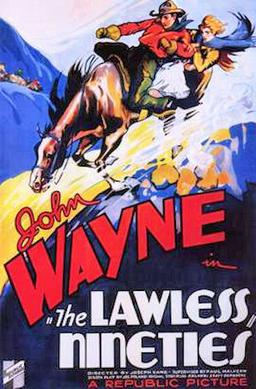
The Lawless Nineties (1936, directed by Joseph Kane)


The year is 1890 and Wyoming is on the verge of voting for statehood.  Newspaperman Major Carter (George “Gabby” Hayes) believes that it’s time for Wyoming to become a state and most of the locals agree with him.  Businessman Charles Plummer (Harry Woods) does not want Wyoming to become a state and he’s willing to send out his main henchman, Steele (Al Bridge), to intimidate the voters and to silence Carter.  Plummer has a profitable racket going and the last thing he wants is for the U.S. government to get involved in his activities.  It falls to two federal agents, John Tipton (John Wayne) and Bridger (Lane Chandler), to supervise the voting and protect the citizen.  When Major Carter is shot by a drunk anti-statehood activist, the mission to make Wyoming a part of the Union becomes personal.

The Lawless Nineties is typical of the B-movies that John Wayne made for Republic Pictures before John Ford resurrected his struggling career by casting him as The Ringo Kid in Stagecoach.  There are plenty of gunfights and horse chases and explosions as the bad guys try to keep the townspeople from voting and the federal agents set up their own sting operation to expose Plummer’s gang.  Wayne seems more relaxed here than he did in some of his other B-movies.  He was obviously getting more comfortable with being on camera and playing the hero.  Probably the most interesting thing about this film is that Gabby Hayes (credited as George Hayes, without his famous nickname) plays the renowned and intelligent Major Carter.  Hayes was just a year away from establishing himself as a perennial B-movie sidekick and supplier comedy relief.  He would soon be best-known for playing characters who had little in common with the intelligent and well-spoken Major Carter.  In The Lawless Nineties, Hayes gets a chance to play something other than the comedic relief and turns out to be petty good at it.

This is another one of those westerns that will be enjoyed by fans of the genre.  It’s nothing special but it does allow Wayne to show hints of his future stardom and it also gives Gabby Hayes a chance to show what he was actually capable of.

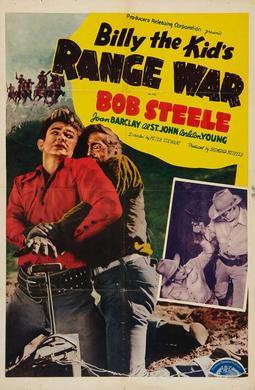
Billy The Kid’s Range War (1941, directed by Sam Newfield)


Billy the Kid was a big damn hero.

At least that’s the claim of Billy The Kid’s Range War, in which Billy (played by middle-aged Bob Steele) is a do-gooder with a comedic sidekick named Fuzzy (Al St. John) and a hankering to help Ellen Gorman (Joan Barclay) bring a new stagecoach line to town.  Williams (Karl Hackett) does want to the Gorman family to success so he hires Buck (Rex Lease) to dress up like Billy the Kid and ride a horse that looks like Billy the Kid’s and commit crimes, like killing Ellen’s father.  Framed for all those crimes that he didn’t commit and with his best friend (Carleton Young) ordered to arrest him, Billy decides to go under cover so that he can clear his good name.  Someone pretending to be Billy the Kid got him into this mess.  Now, Billy’s going to get out of it by pretending to be someone else.

The action is pretty standard for a B-western.  Mostly, it’s interesting to see a movie where Billy the Kid is actually a nice guy who gets framed.  No wonder a whole generation grew up with no idea about true history of the American frontier.  Sam Newfield directed a handful of Billy the Kid films and the capable Bob Steele starred in most of them but this is the only one that I’ve sat down and watched and it actually left me missing the production values of the Johnny Mack Brown films.  For fans of these type of westerns, there’s the promise of seeing familiar actors like George Cheseboro and Ted Adams doing there thing.  Even the outstanding character actor Milton Kibbee makes an appearance.  For those who do not like westerns, this film is not going to change their minds.

Despite the promise of the title, there is no range war in this movie.  There’s just Billy the Kid, trying to clear his good name.

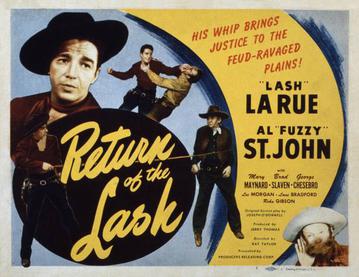
Return of the Lash (1947, directed by Ray Taylor)


There’s another range war brewing on the frontier.  Big Jim Kirby (George Chesebro) knows there’s plans for a new railroad so he wants to steal the land from the ranchers so he can make a fortune off a selling it.  Kirby calls in everyone’s mortgage, knowing they’ll never be able to pay.  Rancher Tom Grant (Buster Slaven) reaches out to Cheyenne Davis (Lash LaRue, a look alike for Humphrey Bogart)) and Fuzzy Q. Jones (Al St. John) for help.  Cheyenne raises the money but then he makes the mistake of trusting Fuzzy to deliver it.  Fuzzy takes a knock to the noggin and now, he’s got amnesia.  Where’s the money?

This is a standard B-western and you know the drill.  Big Jim’s henchmen don’t want that money to get paid.  Cheyenne is on the side of the angels.  Fuzzy provides comic relief.  Lash LaRue appeared in several B-westerns.  He never became as big a star as some of his contemporaries but he did have a gimmick that made him memorable.  Most westerns stars used guns.  LaRue had a bullwhip.  When LaRue was first offered the role of Cheyenne, he lied and said he could crack a whip.  After he struggled to teach himself, tiny production company PRC hired a professional trainer.  That was a huge expense for a poverty row studio but it paid off because LaRue became proficient with the whip and he had a surprisingly long career.  He was born Alfred LaRue.  The studio came up with the Lash nickname.  Many western stars, like Johnny Mack Brown, played characters who shared their name.  Lash almost always played Cheyenne Davis.

Lash LaRue’s movies were cheap and never that memorable.  In this one, Lash barely appears and most of the action is carried out by Al St. John as Fuzzy.  But Lash LaRue did play an important part in Hollywood history when he briefly came out of retirement to teach Harrison Ford how to crack a whip for a little film called Raiders of the Lost Ark.

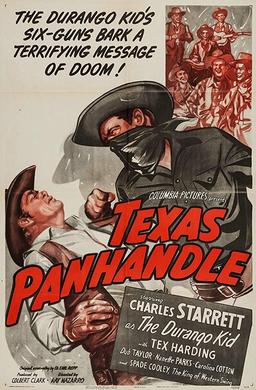
Texas Panhandle (1945, directed by Ray Nazarro)


Secret Service agent Steve Buckner (Charles Starrett) is told by his boss that his activities as the Durango Kid have led some in the Agency to suspect that Steve is himself an outlaw.  Even after Steve explains that he only takes on the Durango Kid identity when he needs to step outside of the law to protect innocent people, Steve is still suspended pending an investigation.

With nothing better to do, Steve rides off to the Texas panhandle, where he learns that outlaws have been robbing settlers and stealing government gold.  Working as the Durango Kid, Steve discovers that it’s not just outlaws that are targeting the new arrivals but it’s also the corrupt head of the local land office, Ace Gatlin (Forest Taylor).  Helping out Steve are settler Tex Harding and Cannonball (Dub Taylor), who works at the saloon and sings a few songs.

This is a standard Durango Kid film.  It has all the usual gunfights and horse chases but it doesn’t have Smiley Burnette.  Dub Taylor takes Smiley’s place as the comedic sidekick and, while Taylor isn’t bad, he’s still no Smiley Burnette.  Dub Taylor’s characters were usually more buffoonish than the clever helpers played by Smiley Burnette and, as a result, the Durango Kid movies with Taylor feel more juvenile than the ones with Smiley.  That’s the case here.

This installment is interesting because it reveals that Steve’s superiors knew about his Durango Kid side hustle and were as a confused about why he needed it as everyone else was.  Steve reveals he would rather lose his job than give up being Durango.  Luckily, at the end of the movie, he gets a telegram telling him that the investigation is over and he’s been reinstated with the Secret Service.  All’s well that ends well.

Challenge of the Range (1949, directed by Ray Nazarro)


On the frontier, someone is raiding the homes of ranchers like Jim (Henry Hall) and Judy Barton (Paula Raymond).  The Homeowners Association summons Steve Roper (Charles Starrett) to bring a stop to the raids.  Everyone suspects that Cal Matson (Steve Darrell) and his son, Rob (Billy Halop), are behind  the raids but Steve, as the Durango Kid, discovers that a third party is trying to set everyone at war with each other for his own benefit.

The entry in the Durango Kid series was Charles Starrett’s 103rd western.  It’s not a particularly distinguished entry, relying heavily on stock footage.  I did find the idea of the film’s bad guy trying to manipulate the Bartons and the Matsons into destroying each other to be interesting but the movie doesn’t do much with it and the identity of main villain will be obvious to anyone who watches the film.  There is one good scene where Steve disarms three bad guys and then makes them walk all the way back to town without their boots on.  Steve doesn’t mess around.

Smiley Burnette provides the comic relief and a few songs.  This time, Smiley’s a dime store writer researching his next book.  Musically, he is accompanied by The Sunshine Boys.  103 movies in and Smiley still hasn’t figure out that Steve and Durango are one of a kind.

Landrush (1946, directed by Vernon Keays)


Steve Harmon (Charles Starrett) rides again!  This time, he’s investigating the murder of a Pony Express rider.  The murderer is outlaw leader Claw Hawkins (Bud Geary), who is working with rancher Kirby Garvey (Steve Barclay) to cheat the local homesteaders out of their land.

When local newspaper editor Jake Parker (Emmett Lynn) is attacked for trying to expose Claw Hawkins, Steve puts on a mask and dark clothing and, as the Durango Kid, he moves Jake to the carpentry shop owned by Durango’s old friend, Smiley Burnette.  While Jake continues to spread the word to the homesteaders, Durango works to prevent Claw and Kirby from taking all of the land for themselves.

This is a typical Durango Kid film.  This is not the first time that I’ve seen the Durango Kid protect the rights of homesteaders and, as usual, the main villain is not the outlaw that everyone fears but the respectable citizen who is controlling him.  Along with the usual gunfights and horse chases, Landrush has an exciting sequence where Durango and the homesteaders have to deal with a series of fires that have been set by Claw to keep the homesteaders from reaching their land.  Charles Starrett is as authentic a cowboy as ever.  Unfortunately, Bud Geary and Steve Barclay aren’t very interesting as the villains.  People who have watched several Durango Kid films will regret that series regulars Frank Fenton and Jock Mahoney weren’t cast in the roles.

As usual, Smiley Burnette provides comedy relief and sings two songs.  This time, he’s accompanied by Ozie Waters and His Colorado Rangers.

Lawless Empire (1945, directed by Vernon Keays)


For years, outlaws have controlled the frontier town of Dusty Gulch but now their power is threatened by the homesteaders who are moving into the area.  Led by the crusading Rev. Tex Harding, the homesteaders are being progress and reform to the frontier.

Duke (Ethan Laidlaw) and his gang have launched a campaign of intimidation against the new arrivals.  Luckily, the Durango Kid (Charles Starrett) rides into town to protect the homesteaders.  Duke’s boss, businessman Blaze Howard (John Calvert), decides that the town needs a sheriff to go after the Kid.  Blaze offers the job to newcomer Steve Ranson, not realizing that Steve is not only the Durango Kid but also the brother of the former sheriff, who was murdered by Blaze’s men.

Lawless Empire is one of the few Durango Kid films not to feature Smiley Burnette as Durango’s sidekick.  Instead, Durango rides into town with Bob Wills and his Texas Playboys and, while Willis does perform a song or two, there’s still considerable less singing than in the films that featured Burnette.  The role of comic relief is provided by Dub Taylor in the role of Cannonball.  Cannonball gets a job sweeping up Blaze’s saloon and he feeds whatever information he learns back to Durango.  When Blaze figures out what’s going on, he deliberately supplies Cannonball with bad information but it doesn’t make any difference.  The Durango Kid is always one step ahead of the bad guys.

Lawless Empire is a little more serious than the other Durango Kid films.  Steve is not only trying to clean up the town but he’s also seeking to avenge his brother so there’s not as much room for as much comedy as usual.  Lawless Empire does have all of the usual gunfights and horse chases and the film gets off to an exciting start with Durango making his first appearance with his gun already drawn so that he can disarm Duke and his men.  Even without Smiley around to help him out, Durango brings law to a lawless empire.


Six-Gun Law (1948, directed by Ray Nazarro)


Steve Norris (Charles Starrett) has moved to a new frontier town and is making a good living as a cattle rancher.  The sheriff (Ethan Laidlaw) takes a dislike to Steve and even accuses him of being a cattle rustler.  Steve is so angered that he plays right into the hands of Decker (Hugh Prosser), a corrupt businessman who secretly puts blanks into Steve’s gun and then tricks Steve into thinking that he has shot and killed the sheriff.

Decker appoints Steve as the new sheriff but demands that Steve do exactly what Decker orders him to do.  If Steve actually enforced the law, Decker will turn him in as the first sheriff’s murderer.  Steve may not be able to do anything about Decker’s crimes but his alter ego, The Durango Kid, can!  As always, working with Steve is his loyal sidekick, Smiley Burnette.

The stand-out set piece of this Durango Kid film is an exciting stagecoach chase, which features the Durango Kid (in the form of legendary stuntman Jock Mahoney) making some thrilling moves.  The scene was so exciting and popular that it was used in a dozen other Durango Kid films.  These movies were never shy about reusing good scenes, effective stunts, and plot twists.  (It’s easy to lose track of how many times Steve has been appointed as sheriff of a town.)  This was also neither the first nor the last time that Hugh Prosser and Robert Wilke would play bad guys in a Durango Kid movie.  However, this is the only Durango Kid film to feature the Rodeo Rangers providing musical accompaniment  to Smiley Burnette’s songs.

Six-Gun Law will be best appreciated by fans of the western genre.  Charles Starrett is as tough and authentic a cowboy as always and the storyline has some nice twists and turns.  For once, with Steve being blackmailed by Decker, it makes sense that Steve would put on his disguise and solve his problems as the Durango Kid.

Gunning For Vengeance (1946, directed by Ray Nazarro)


Steve Landry (Charles Starrett) rides into another town and is once again named the new sheriff.  Luckily, Steve’s old friend Smiley Burnette is working as the town’s blacksmith.  Steve makes Smiley his deputy and then sets about trying to break up a gang of cattle rustlers.  When Steve learns that his jurisdiction does not extend beyond the city limits, he dons the disguise of his alter ego, The Durango Kid, to go after the outlaws.

Has Steve met his match in Belle (Phyllis Adair), the saloon owner who is the secret leader of the outlaws?  She notices that The Durango Kid’s boot tracks are the same as Steve’s boot tracks.  I’m surprised that no one has ever noticed that before.  Steve went through a lot of trouble to disguise himself as Durango but he never bothered to change his boots.

This entry in the Durango Kid series features a lot of Smiley Burnette so your enjoyment on the film will depend on how much tolerance you have for Smiley’s songs and his style of humor.  Each film featured Smiley being followed around by a different group of musicians.  In this one, Smiley is accompanied by The Trailsman.  When Smiley accidentally locks himself in a jail cell, the Trailsman stand on the other side of the bars and sing a song about how Smiley can’t get out of the cell.  Smiley does eventually get out but, later on, he’s knocked out cold during an attempted jail break.  Smiley’s not much of a help in this one.

This has all of the typical Durango Kid elements, including the stock footage of the stampeding cattle that appeared in nearly all of his films.  There’s another saloon fight and a gunfight towards the end.  Durango rides out of town alone, leaving Smiley behind, but we know they’ll soon be reunited in another adventure.

Trail to Laredo (1948, directed by Ray Nazarro)


On the frontier, everyone has gold fever.  People are trying to find gold and steal gold and it falls to brave Treasury agents like Steve Ellison (Charles Starrett) and Smiley Burnette (played by Smiley Burnette) to keep things safe.  When Steve needs to find out who is trying steal gold, he puts on his mask and assumes the identity of The Durango Kid.

Near Laredo, a shipment of government gold has been stolen.  Dan Parks (Jim Bannon) is arrested after the gold is found in his wagon but Steve knows that the Durango Kid earlier warned Dan about traveling with gold.  Durango and Smiley set out to prove that Dan was set up by his business partner, Fenton (Hugh Prosser).

This yet another Durango Kid movie where Steve gets a job working for the bad guy while Durango works to thwart his plans.  (Remarkably, no one ever puts two and two together and notices that Steve, Smiley, and Durango always seem to show up in town at the same time.)  Fenton is just one of a long line of corrupt businessmen and land barons that Durango has had to deal with.  Fenton is not above threatening Dan’s young son (Tommy Ivo) to get Dan to do what he wants.  Given that Dan is just trying to make a good life for his family in a rough world, it’s satisfying when Fenton gets his comeuppance.

Almost every Durango Kid film featured at least one good fight scene.  In Trail to Laredo, the big fight takes place in a saloon and it’s pretty exciting.  Not only does the saloon get trashed but there’s a moment where one of the bad guys actually seem to fly through the air.  Even Virginia Maxey, playing Classy the saloon singer, gets in on it.

Both Virginia Maxey and Smiley Burnette get to sing a few songs.  As always, there enough gunfights and horse chases to keep fans of the genre happy.  Charles Starrett was a great cowboy.