Though the Academy of Motion Picture Arts and Sciences claim that the Oscars honor the best of the year, we all know that there are always worthy films and performances that end up getting overlooked. Sometimes, it’s because the competition too fierce. Sometimes, it’s because the film itself was too controversial. Often, it’s just a case of a film’s quality not being fully recognized until years after its initial released. This series of reviews takes a look at the films and performances that should have been nominated but were, for whatever reason, overlooked. These are the Unnominated.
Oh, how this movie made me cry!
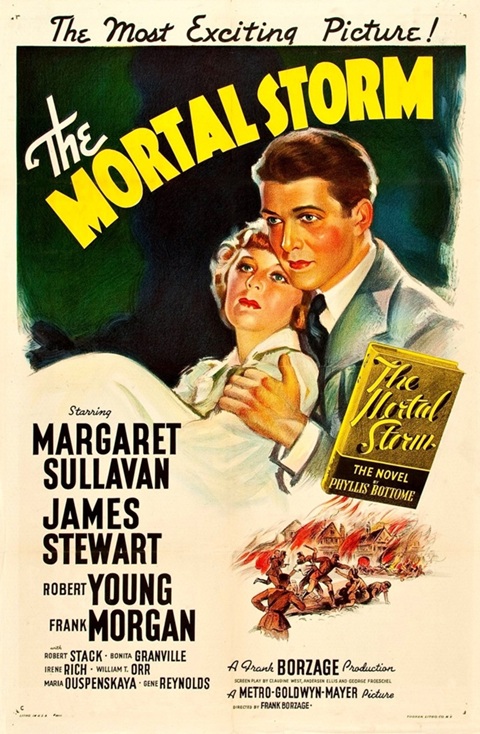
Released in 1940, at a time when war was spreading across Europe, Asia, and Africa but the United States was still officially neutral, The Mortal Storm opens on January 30th, 1933. In the mountains of Germany, near the Austrian border, Professor Viktor Roth (Frank Morgan) is celebrating his 60th birthday. He starts the day being applauded by his students at the local college. In the evening, he returns home for a celebration with his family, including wife (Irene Rich), his daughter Freya (Margaret Sullivan), his son Rudi (Gene Reynolds), and his two stepsons, Otto (Robert Stack) and Erich von Rohn (William T. Orr). Also present are Freya’s fiancé, Fritz (Robert Young) and one of Roth’s students, a pacifist named Martin Breitner (James Stewart). It’s a joyous occasion and the film takes its time introducing us to Prof. Roth and his extended family. At first, everyone seems very kind. They seem like people who most viewers would want to spend time with or live next to….
But then, the family’s maid excitedly enters the room and announces that it’s just been announced that Adolf Hitler is the new chancellor of Germany. Otto and Erich are overjoyed and head out to celebrate with the other members of the Nazi Youth Leage. Martin is less happy and excuses himself to return home. Roth and his wife worry about what this means for people who do not agree with Hitler’s beliefs. Freya says that they shouldn’t talk politics. It is jokingly mentioned that Hitler has taken away Roth’s special day but Roth’s young son Rudi says that he’s learned in school that the needs of the individual will never be more important than the needs of the state. If Hitler wants to take away your day, it’s your duty to give it up or face the consequences.
Based on a 1937 novel, The Mortal Storm was not the first Hollywood production to take a stand against Hitler and the Nazis but it was one of the best. I say this despite the fact that the film only hints at the fact that Prof. Roth is Jewish, something that was made very clear in the book. (In the movie, Roth and his wife worry what will happen to “Non-Aryans” and “freethinkers.”) That said, the film perfectly captures how quickly and insidiously the authoritarian impulse can spread. The town, which once seemed so friendly, becomes a very dark place as the students at the university put on their swastika armbands and start to hunt down anyone who dissents from the party line. When Roth says that, as a scientist, he does not believe one race can be genetically superior to another, his students walk out on him. A local teacher is beaten when he fails to return to the Nazi salute. When Martin refuses to join the Party, Otto and Erich turn against him despite being lifelong friends. When Martina and Freya flee for the border, Fritz pursues them. And even after Prof. Roth is sent to a concentration camp, Otto and Erich continue to follow the orders of Hull (Dan Dailey), the sinister Youth Party Leader.
It’s a powerful film, one that remains just as relevant today as it was when it was first released. Hull and Erich’s fanaticism would, today, find a welcome home on social media. The scenes in which the townspeople eagerly threaten to report their former friends and neighbors for failing to salute or show proper enthusiasm for the government have far too many modern day equivalents for me to even begin to list them all. This film was also the last the James Stewart made with frequent co-star Margaret Sullivan and they both give great performances. (All-American Jimmy Stewart might seem a strange choice to play a German farmer but he is never less that convincing as Martin, one of the few people in the town not to surrender his principles and beliefs to the crowd.) The film’s final moments, with the camera panning around the empty Roth home, brought very real tears to my eyes.
Despite being a powerful film, The Mortal Storm was not nominated for a single Oscar. (Jimmy Stewart did win his only Oscar that year but it was for The Philadelphia Story.) It’s temping to assume that, at a time when America was still divided about how to react to the war in Europe and when many Americans still remembered the trauma of the first World War, The Mortal Storm was too explicitly political and anti-Nazi to get a nomination but, the same year, The Great Dictator was nominated for Best Picture. It seems more likely that, in those days when the studios ruled supreme, MGM decided to puts it weight behind The Philadelphia Story rather than The Mortal Storm.
That said, The Mortal Storm was definitely worthy of being nominated, for Picture, Director, Screenplay, Actress (Margaret Sullivan), Actor (Stewart), Supporting Actor (Frank Morgan and Robert Stack), and Supporting Actress (Irene Rich and, in the role of Stewart’s mother, Maria Ouspenskaya). The film may not have been nominated but it remains a powerful and important work of art.
Previous entries in The Unnominated:
 Through the Shattered Lens