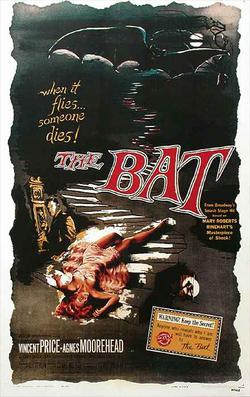
Today’s Horror on the Lens is 1959’s The Bat. A simple case of bank embezzlement leads to a murder that may or may not be connected to a series of other murders that are apparently being committed by a mysterious killer known as “The Bat.” The Bat is said to have no face and steel claws and, needless to say, everyone in town is worried about becoming the next victim.
Who is the Bat? Is Dr. Malcolm Wells (Vincent Price), the shady scientist whose work has led to him doing experiments on bats? Is it Victor Bailey (Mike Steele), the bank clerk who is a prime suspect in the embezzlement case? Is it the butler (John Sutton) with a secret past? Could it even be one of the cops (Gavin Gordon and Robert B. Williams) who has been tasked with capturing The Bat? Can mystery novelist Cornelia van Gorder (Agnes Moorehead) solve the mystery before becoming The Bat’s next victim!?
The Bat is based on a play and it’s definitely a bit stagey but when you’ve got performers like Agnes Moorehead and Vincent Price onscreen, it really doesn’t matter. The Bat is an entertaining and atmospheric mystery, featuring a Vincent Price playing another one of his charmingly sinister cads.
1935‘s The Bride of Frankenstein is usually described as being a sequel to Frankenstein, but I think it would be better to call it a continuation. In much the same way that all modern YA adaptations seem to be split into two parts, Universal split Mary Shelley’s Frankenstein into two separate films. The bare basics of The Bride of Frankenstein‘s plot — the monster learns to talk and demands that his creator build him a mate — can all be found in the original novel.
(Of course, in the original novel, the monster somehow learns how to speaks like an Oxford grad and Dr. Frankenstein destroys the female monster before bringing her to life. The monster responds by killing Elizabeth. Seriously, Frankenstein is a dark book.)
Bride of Frankenstein features one of my favorite openings of all time. Lord Byron (Gavin Gordon) and Percy Bysshe Shelley (Douglas Walton) are praising Mary Shelley (Elsa Lanchester) and the story that she’s told about how a dedicated scientist played God and created life. Mary informs them that she’s not finished and then proceeds to tell them the rest of the story. It’s a great opening because it lets us know that the rest of what we’re seeing is taking place directly inside of Mary’s mind. It frees the film from the constraints of realism and allows director James Whale to fully indulge his every whim, no matter how bizarre. When you’re inside someone else’s imagination, anything can happen and that’s certainly the feeling that you get as you watch The Bride of Frankenstein.
The Bride of Frankenstein opens with that burning windmill and a wounded Henry Frankenstein (Colin Clive) being carried back to his wife, Elizabeth (Valerie Hobson, replacing Mae Clarke). Gone is the original film’s coda, in which Elizabeth announces that she’s pregnant. And why shouldn’t it be gone? It felt awkward in the first movie and, like any good writer, Mary Shelley is fixing her story as she goes along.
While Henry is recovering, he is approached by a former mentor, Dr. Pretorious (Ernest Thesiger). Dr. Pretorious is undoubtedly an eccentric and definitely a little bit crazy but he believes in Frankenstein’s work. In fact, Dr. Pretorious has even created life on his own! He’s created a bunch of tiny people that he keeps in several glass jars. They’re impressive but, sadly, they’ll never conquer the world. Pretorious wants Frankenstein to, once again, work with him to create life. As Pretorious explains it, it’s time to usher in a new age of “God and monsters!”
(Interestingly enough, one of Pretorious’s henchmen is played by Dwight Frye, who previously played Frankenstein’s henchman, Fritz, in the first film. Frye dies in both films. Reportedly, Universal bestowed upon him the nickname, “The Man of a Thousand Deaths.” It can perhaps be argued that Dwight Frye was both the Steve Buscemi and the Giovanni Lombardo Radice of Universal horror.)
Meanwhile, the monster (Boris Karloff, credited with just his last name because, just four years after Frankenstein and the Mummy, he was already an icon) has survived the burning windmill. He’s lonely, he’s afraid, and he actually kills more people in The Bride of Frankenstein than he did in Frankenstein. And yet, he’s still the film’s most sympathetic character. With everyone constantly trying to kill him, you can understand why the monster is quick to attack every human being that he sees. He’s almost like a dog who, after years of abuse, automatically growls and bears his teeth at anyone that he sees.
And yet, the monster does eventually find a friend. A blind hermit (O.P. Heggie) invites the monster into his own home. (Of course, the hermit does not know who the monster is. He just assumes that monster is a normal man who does not know how to speak.) As time passes, the hermit teaches the monster how to say a few words and also tells the monster that there is nothing worse than being lonely. The monster learns that “Friend good.” The monster even learns how to smoke a cigar and Heggie and Karloff play these roles with such warmth (Bride of Frankenstein is not only the film where the Monster learns to talk, it’s also the one where he learns to smile) that you really start to dread the inevitable scene where everything goes wrong.
And that scene does arrive. Two hunters stop by the hermit’s shack and immediately attack the Monster. The Monster flees. The shack burns down. The hermit is led away from his only friend, apparently destined to be lonely once again.
Eventually, of course, the Monster does get his bride. The Bride is such an iconic character that it’s easy to forget that she only appears in the final ten minutes of the film. Elsa Lanchester plays both Mary and the Bride. She screams when she sees the Monster. “We belong dead,” the Monster replies and my heart breaks a little every time.
So, which is better? Frankenstein or The Bride of Frankenstein? I don’t think it’s necessary to choose one or the other. To use a metaphor that might be appreciated by Henry and Dr. Petorious, Frankenstein is the brain while The Bride of Frankenstein is the heart. They’re two good films that, when watched together, form one great film.
First off, a warning. The following review of the 1941 best picture nominee Suspicion will include spoilers. So, if you haven’t seen the film and you’re obsessive about avoiding major spoilers, then don’t read the review. Simple, no?
Two years ago, I was having lunch with some of my fellow administrative assistants. One of them was talking about how she had watched an “old movie” the previous night. From listening to the vague details that she offered up, I was able to figure out that she had apparently stumbled across TCM for the first time in her life. From listening to her talk, I would not be surprised if she was literally describing the first time she had ever actually seen a black-and-white movie. Needless to say, my first instinct was to correct everything she was saying but I resisted. (For some reason, at that time, I was feeling self-conscious about being perceived as being a know-it-all.) But, as she kept talking, I found it harder and harder to keep quiet. Listening to her talk about old movies was like attending an art history lecture given by someone who had flunked out of a finger painting class. Finally, when the conversation had moved on to someone who we all knew was sleeping with her much older boss, our self-proclaimed old film expert announced that age didn’t matter. “I’d go out with Cary Grant,” she said, “and he’s old.”
Before I could stop myself, I added, “He’s also dead.”
Oh my God, the look of shock on her face! I actually felt really guilty because I could tell that she had apparently taken a lot of happiness from the idea that suave, witty, and handsome Cary Grant was still out there. And can you blame her? In a career that spanned three decades and included several classic dramas and comedies, Cary Grant epitomized charm. Some of his movies may seem dated now but Grant was such a charismatic and natural actor that it’s impossible not to get swept up in his performances.
(Who would be the contemporary Cary Grant? I’ve heard some people compare George Clooney to Grant. And it’s true that Clooney has Grant’s charm but, whereas Grant always came across as very natural, you’re always very aware that George Clooney is giving a performance.)
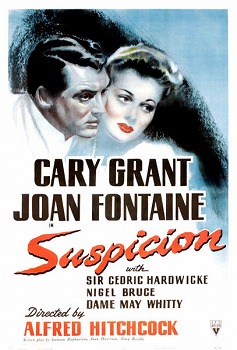
It was Grant’s charm that made him the perfect choice for the male lead in Suspicion but it was that same charm that made the film so controversial. In Suspicion, Grant plays Johnnie. Johnnie meets, charms, and — after the proverbial whirlwind courtship — marries Lina (Joan Fontaine), a sheltered heiress. It’s only after Lina marries Johnnie that she discovers that he’s broke, unemployed, and addicted to gambling. With everyone from her family to her friends telling her that Johnnie is only interested in her money, Lina starts to worry that Johnnie is plotting to kill her. Lina starts to view all of Johnnie’s actions with suspicion, wondering if there’s an innocent explanation for his occasionally odd behavior or if it’s all more evidence that he’s planning to kill her. When he brings her a glass of milk, Lina has to decide whether or not to risk drinking it…
Suspicion was based on a novel in which Johnnie was a murderer and which ended with Lina voluntarily drinking that poisoned milk. In the film, however, Johnnie is not a murderer. Apparently, it was felt that Grant was so charming and so likable that audiences would never accept him as a murderer. Instead, he’s an embezzler and all of his strange behavior is due to him being ashamed of his past and feeling that he’s not worthy of Lina. Once Lina realizes that Johnnie isn’t trying to kill her, she promises him that she’ll stay with him.
And a lot of people (including director Alfred Hitchcock, who claimed it was forced on him by the film’s producers) have criticized that ending but you know what?
It works. If I had to choose between Joan Fontaine essentially committing suicide or Joan Fontaine promising to love Cary Grant even if Grant goes to prison, I’m going to go with the second choice. Ultimately, Suspicion works because you can imagine being swept off your feet by Grant’s character. But what makes Suspicion enjoyable, to me, is that Johnnie ultimately turns out to be exactly who we were hoping he would be.
Needless to say, Suspicion works as a great double feature with Rebecca. Watch one after the other and have a great night of menace and romance.

 Through the Shattered Lens