Behind the Camera: The Unauthorized Story of ‘Diff’rent Strokes’ (2006, dir by Robert Iscove)


Norman Lear has television superstar Conrad Bain under contract and Fred Silverman wants to build a show around Bain and a talented black child actor named Gary Coleman.  Entitled Diff’rent Strokes and featuring Todd Bridges and Dana Plato as Coleman’s brother and stepsister, the show is a hit.  The three young actors briefly become superstars, much like the amazing Conrad Bain.  And then, when the show is finally canceled after ten years, it all goes downhill as Todd Bridges and Dana Plato run into trouble with drugs and the law and Gary Coleman, once one of the highest paid stars on television, discovers that he’s now flat broke.  All three of them learn how quickly the world can turn on you when you’re no longer considered to be a success.

Behind the Camera: The Unauthorized Story of ‘Diff’rent Strokes’ was another one NBC’s cheap movies about the behind-the-scenes drama of a popular sitcom.  (They also did Three’s Company and Mork & Mindy).  Like all of NBC’s Behind the Camera movies, it makes the mistake of thinking that everyone is as interested in the habits of network executives as the people who work for them are.  (This time, it’s Saul Rubinek who gets to play Fred Silverman.)  The actors who plays Bridges, Coleman, and Plato are convincing enough but the storytelling is shallow, featuring the same information that you would expect to find in an episode of the E! True Hollywood Story.  I was disappointed that we didn’t get any scenes of Alan Thicke recording the theme song.

Todd Bridges and the late Gary Coleman both appear as themselves, talking about their experiences with the show and the difficulties of navigating life after Diff’rent Strokes was canceled.  Bridges is down-to-Earth while Coleman rambles like someone who was still trying to figure out how his life had led up to this moment.  The ending, in which Bridges and Coleman stand at Dana Plato’s grave and Coleman delivers a nearly incoherent monologue, is the one time that the film really captures any feeling of emotional honesty.  It is obvious that both Bridges and Coleman are still haunted by what happened to Plato after the show ended.  Knowing that Coleman himself would die just four years after the airing of this movie makes the scene more poignant when viewed today.


The Films of 2024: Gary (dir by Robin Dashwood)


Wow, what a depressing documentary!

I’m taking about Gary, which is currently streaming on Peacock.  Gary tells the story of former child actor-turned-security guard Gary Coleman, who went from being one of the top stars in television to eventually struggling to pay the bills.  The documentary tells the story of Coleman’s life, from his start as a cute kid with a mischievous smile to his stardom, his health struggles, and the controversy over why all the money that he made as a child eventually disappeared.  Gary blamed his parents.  His parents blamed Gary’s managers.  The woman who eventually married Gary blamed everyone.  Gary, himself, ended up as tabloid fodder, in which he was treated as not only being the poster child for the problems that young stars encounter but in which he was also regularly ridiculed for having those exact same problems.  Watching the documentary, one gets the feeling that the world took an odd joy in Gary Coleman’s downfall.  Coleman himself died under mysterious circumstances and the documentary, though even-handed, leaves one feeling that there’s definitely a lot about his death that could stand to be examined.

Gary Coleman’s stardom was a bit before my time, though I have seen a few episodes of Diff’rent Strokes online.  The show, to be honest, always seems a bit cringey to me but, still, it’s obvious that Coleman was a capable actor even when he was having to repeat the catch phrases that he came to hate.  Unfortunately, his kidney problem stunted his growth and, as he got older, the acting opportunities dried up.  He was reduced to parodying his former stardom, appearing on talk shows and sitcoms and repeating, “What you talkin’ about” to anyone who asked.  The documentary was painfully sad to watch.  Gary Coleman definitely comes across as being a bit of an eccentric but it’s hard not to feel that he never allowed to grow up and that the people who should have been looking out for him, like his parents and his manager and his wife, were only looking out for themselves.

The film features interviews with the people who failed Coleman.  None of them really take any sort of responsibility for their actions.  At first, his wife comes across like she really cared about him but, as the documentary progresses, we hear too many stories about her abusing and manipulating him to take anything she says at face value.  When she sells a picture of Coleman on his death bed to a tabloid, that’s pretty much last straw as far as any sympathy for her is concerned.  Coleman’s business manager also initially comes across as being genuine and sincere but, again, there are just too many stories of misusing Coleman’s money.  If he doesn’t seem to be as ruthlessly mercenary as Coleman’s wife, it’s still obvious that he shouldn’t have been managing Coleman’s career.  As for Coleman’s parents, the less said about them the better.  Everyone that is interviewed is very good at blaming someone else for what happened after Coleman’s stardom ended.

Again, this was depressing documentary.  Watching this, I really felt bad about Gary Coleman.  It’s hard to know what to do about child stars.  On the one hand, there are child stars who grow up to lead what appear to be perfectly normal and stable lives.  But, there’s also a lot like Gary Coleman, whose lives are pretty much destroyed by their early success.  No kid should be supporting their family.  And no family should be paying their bills exclusively with their kid’s salary.  To me, it all comes down to the parents.  You can’t depend on an industry to raise your child for you.  In the end, though, Coleman was let down by a lot of people.  There’s more than enough blame to go around.

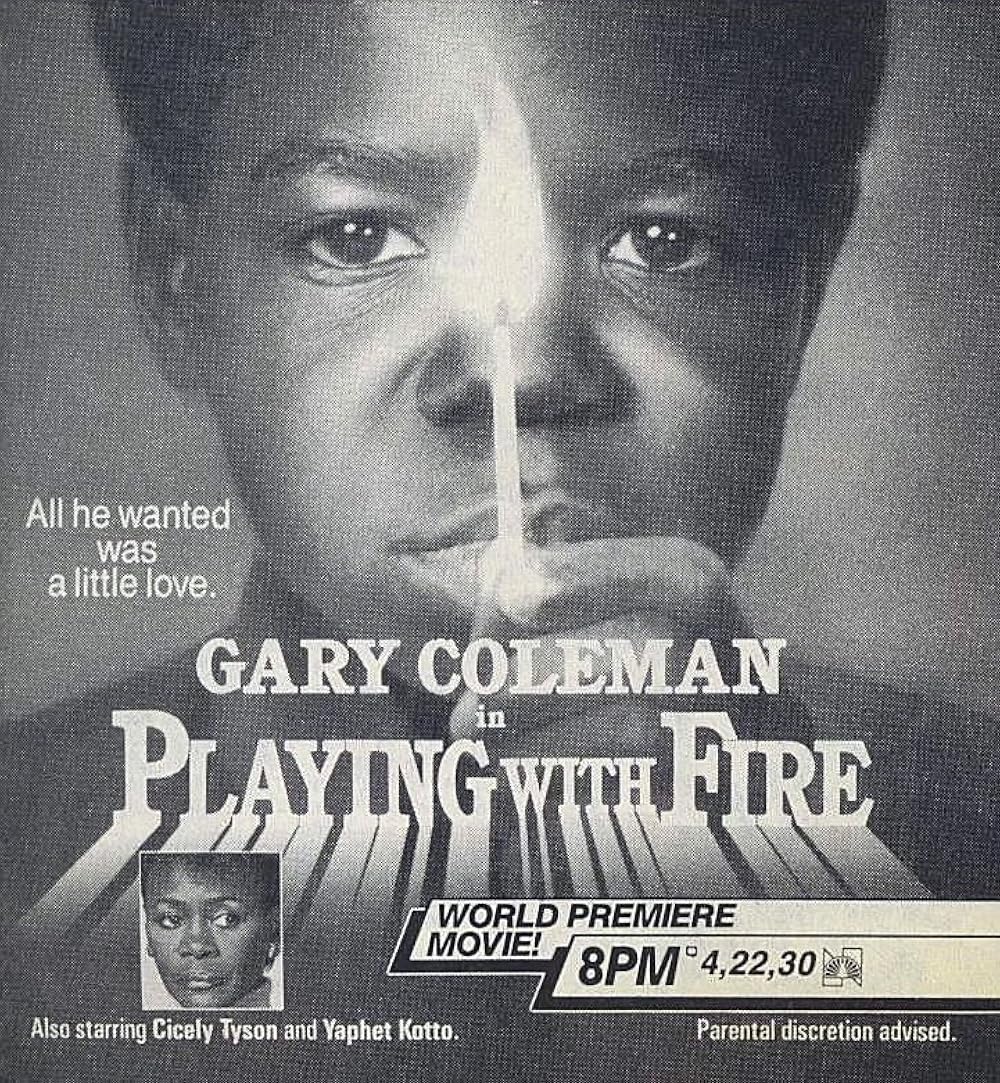
Playing With Fire (1985, directed by Ivan Nagy)


David Phillips (Gary Coleman) is a teenager who sets fires when he gets upset.  He has many reasons to be upset.  His parents (Ron O’Neal and Cicely Tyson) are getting divorced and are constantly fighting.  His teachers at school are always getting on his back.  He has to take care of his younger siblings and his dog.  He can’t even get the bigger kids in school to let him play basketball with them.  At first, David just plays with his lighter but, after he accidentally sets his mother’s coat on fire, David discovers that he likes to watch things burn.  David and his mother both claim it’s just coincidence that David is always nearby whenever a fire breaks out but Fire Chief Walker (Yaphet Kotto) knows what’s really going on.  After David nearly burns down his house, Walker tries to reach him before it’s too late.

This isn’t really meant to be a horror film  but it’s shot like one, with plenty of scenes of Gary Coleman staring at a burning fire with a possessed-look in his eyes.  The movie tries to make David sympathetic but the scene where he threatens his own dog with a lighter suggests that David has more problems than just his parents splitting up.  This was Gary Coleman’s first dramatic role.  I think it may have also been his only dramatic role.  It’s not that he’s not convincing as a really angry kid.  It’s just that he’s Gary Coleman so, no matter how much the movie tries, it still comes across as being a special episode of Diff’rent Strokes where Arnold becomes a pyromaniac.  Coleman tries to play up the drama of the situation but it’s hard not to laugh whenever he looks shocked at one of the fires that he has just started.  Every scene seems like it should end with Conrad Bain showing up with the cops.

For years, this movie was next to impossible to find but finally, someone found an old VHS tape in their garage and uploaded the movie to both YouTube and the Internet Archive, ensuring the world will never forget the time that Gary Coleman played with fire.

One final note: the director is better known for eventually becoming business partners with notorious Hollywood madam, Heidi Fleiss.