Lisa Reviews An Oscar Winner: The Life of Emile Zola (dir by William Dieterle)


The Life of Emile Zola, the winner of the 1936 Oscar for Best Picture of the Year, opens with two French artists living in a drafty apartment.

Emile Zola (Paul Muni) is destined to become one of France’s most popular and important writers.  Paul Cezanne (Vladimir Sokoloff) will eventually become one of the most important artists of the post-impressionist movement.  But for now, they’re just two struggling artists who have sworn that they will never sell out their principles.  They are poor but they’re happy.  That changes for Zola after he meets a prostitute named Nana (Erin O’Brien-Moore) and he uses her life story as the inspiration for a novel.  The book is controversial and its frank content scandalizes France.  The public censor comes close to banning it.  But it also becomes a best seller.  It’s the book everyone secretly owns but claims to have never read.

Zola writes several more books, all about the conditions of the working class in France.  Eventually, he becomes what he claimed he would never be, a wealthy man living in a mansion and having little contact with the poor and oppressed.  Cezanne sees Zola one last time, calling him out for having sold his talent for money.  Cezanne explains that, on general principle, he can no longer be Zola’s friend.

Meanwhile, a quiet and rather meek family man named Captain Alfred Dreyfus (Joseph Schildkraut) has been arrested and accused of being a spy for Germany.  There’s little evidence that Dreyfus is a spy.  Indeed, most of the evidence seems to point to a Major Walsin-Esterhazy (Robert Barrat).  But, because Dreyfus is considered to be an outsider, he is convicted in a show trial and exiled to Devil’s Island.

(In real life, it’s generally agreed that Dreyfus was a victim of anti-Semitism.  As the only Jewish member of the army’s General Staff, Dreyfus was viewed with suspicion by his colleagues even before anyone knew that there was a German spy.  The Life of Emile Zola doesn’t specifically state that Dreyfus was a victim of anti-Semitism, with the exception of a brief moment when one of his accusers looks at his personnel file and says, “He’s not one of us,” while pointing at the word “Jew.”  Otherwise, the fact that Dreyfuss was Jewish is never mentioned in the film.  It’s as if the film is going out of its way to avoid offending the very people that the movie is criticizing.)

After speaking to Dreyfus’s wife (played by Gale Sondergaard, who would later become the victim of a show trial herself when she was blacklisted as a suspected communist), Zola decides to take up Dreyfus’s case.  He publishes an open letter — J’Accuse — in which he states that Dreyfus was not given a fair trial and that Dreyfus is innocent of the charges against him.  Zola finds himself in court, accused of libel.  Zola uses his trial to give Dreyfus the hearing that he never received.  While the army boos his every utterance, the people of France rally to his side.

The Life of Emile Zola is an early example of the type of prestige production that today is often referred to as being an “Oscar picture.”  It tells a true story.  As a film that condemns the treatment of Alfred Dreyfus but avoids stating the obvious reason why Dreyfus was targeted in the first place, it’s political without being radical.  And it features a performance from the most acclaimed actor of the era, Paul Muni.  Muni gives a powerful performance as Zola, holding the viewer’s attention even during the lengthy trial scenes that take up most the second half of the film.  That said, the true star of the film is Joseph Schildkraut, who plays Dreyfus as being a kind and trusting soul who finds himself caught up in a Kafkaesque nightmare.  At one point, Dreyfus is given a gun and told that there’s one way that he can avoid being put on trial for treason.  Schildkraut played the scene so well that I wanted to cheer when he refused to surrender.

The Life of Emile Zola is a big and, at times, self-consciously important production.  It was clearly designed to win a bunch of Oscars and it certainly managed to do that.  Compared to some of the other films nominated that year — The Awful Truth, Dead End, A Star is Born, Lost Horizon, Stage Door, In Old Chicago — The Life of Emile Zola can seem a bit stodgy.  However,  the performances of Muni and Schildkraut continue to make the film worth watching.
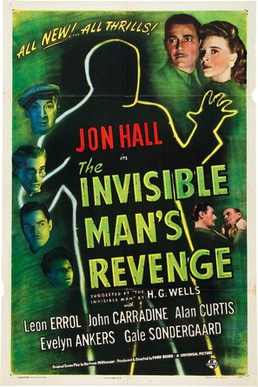
Horror Film Review: The Invisible Man’s Revenge (dir by Ford Beebe)


1944’s The Invisible Man’s Revenge opens with Robert Griffin (Jon Hall) arriving in England.

Despite his last name and the fact that he’s played by the star of Invisible Agent, this Robert Griffin would not appear to be in any way related to the previous invisible men.  Instead, he is someone who has just escaped from a mental institution in South Africa.  He has already murdered two orderlies and now, he’s come to England to take vengeance on Sir Jasper Herrick (Lester Matthews) and his wife, Lady Irene (Gale Sondergaard), two old friends who the paranoid Robert thinks tried to kill him in Africa so that they could steal his money.  When Robert sees Sir Jasper and Lady Irene, he informs them that they can either give him half of their fortune or they can allow him to marry their daughter, Julie (Evelyn Ankers).  Lady Irene responds by drugging Robert and having him kicked out of the house.

Dejected, Robert eventually comes across the cottage of Dr. Peter Drury (John Carradine, giving a surprisingly low-key performance in the mad scientist role).  Dr. Drury reveals to Robert that he has developed a serum that can turn living things invisible.  Drury goes on to “show” Robert all of the invisible pets that he has hanging out around the cottage, from an invisible dog to an invisible parrot.  When Robert asks how long the invisibility lasts, Drury says that it will last until the invisible person dies.  That sounds pretty good to Robert so he volunteers to be Drury’s latest test subject.

Soon, Robert is invisible and going out of his way to haunt that Herrick family.  Some of Robert’s antics are merely playful.  He helps a cobbler (Leon Errol) win a game of darts and later turns the man into his personal servant.  Robert’s other actions are a bit more destructive.  Robert, after all, was a murderer to begin with and using a serum that cause additional insanity is definitely not helping him with his temper.  When Robert decides that he wants to be visible again, he discovers that there’s only one temporary way to do it and it involves a lot of blood.

After being portrayed as being a hero in Invisible Agent, The Invisible Man is once again a villain in The Invisible Man’s Revenge and it just feels right.  There’s just something inherently sinister about the idea of someone being invisible.  Jon Hall, who was so boring in Invisible Agent, is far more compelling here, playing Robert as a paranoid megalomaniac who has so convinced himself of his own cleverness that he can’t even understand that he’s writing the script for his own downfall.  This is a good, solid Universal horror movie.  The true hero of the movie is Drury’s dog, played by a talented canine actor named Grey Shadow.  It takes more than invisibility to fool that dog!

Previous Universal Horror Reviews:

  1. Dracula (1931)
  2. Dracula (Spanish Language Version) (1931)
  3. Frankenstein (1931)
  4. Island of Lost Souls (1932)
  5. The Mummy (1932)
  6. The Invisible Man (1933)
  7. The Bride of Frankenstein (1935)
  8. Dracula’s Daughter (1936)
  9. Son of Frankenstein (1939)
  10. The Invisible Man Returns (1940)
  11. The Wolf Man (1941)
  12. Ghost of Frankenstein (1942)
  13. Invisible Agent (1942)
  14. Frankenstein Meets The Wolf Man (1943)
  15. Son of Dracula (1943)
  16. House of Frankenstein (1944)
  17. House of Dracula (1945) 
  18. Creature From The Black Lagoon (1954)

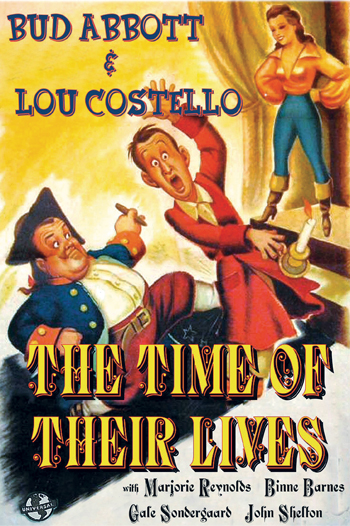
Happy Patriots Day: Abbott & Costello in THE TIME OF THEIR LIVES (Universal 1946)


gary loggins's avatarcracked rear viewer

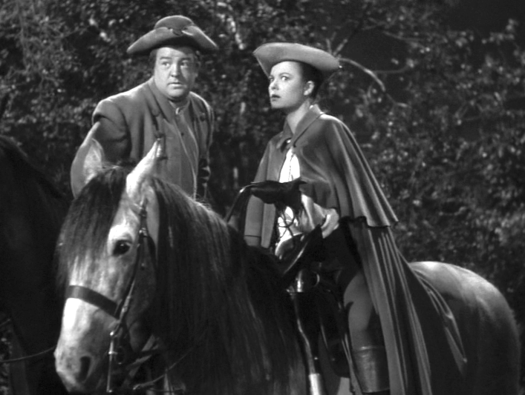
Good morning! While most of you in America are fretting over Tax Day, here in Massachusetts we’re celebrating Patriots Day, commemorating the 1775 Battles of Lexington and Concord that kicked off the American Revolution. It’s a state holiday, and the Boston Marathon is held every year on this date, with the Red Sox playing their traditional 11:00am game. It’s been a tradition on this blog (well, since last year, anyway ) to feature Revolutionary War-themed films, and today we’ll take a look at THE TIME OF THEIR LIVES, an Abbott & Costello comedy that’s one of the duo’s best.

THE TIME OF THEIR LIVES differs from the usual A&C formula, with Bud and Lou playing separate characters rather than working as a team. The film begins in 1780, as Costello’s Horatio Prim, tinker by trade and true patriot, rides to visit his lady-love Nora. In his possession is a letter…

View original post 502 more words

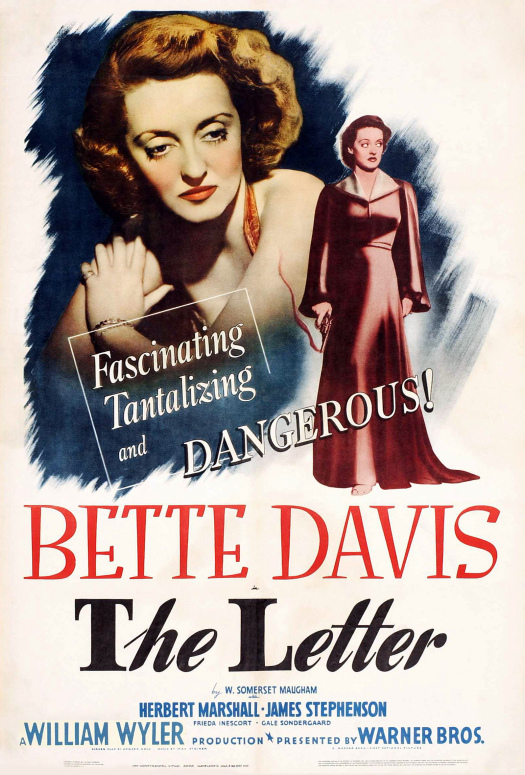
Happy Birthday Bette Davis: THE LETTER (Warner Brothers 1940)


gary loggins's avatarcracked rear viewer

Film noir buffs usually point to 1940’s STRANGER ON THE THIRD FLOOR as the first of the genre. Others cite 1941’s THE MALTESE FALCON as the film that launched the movement. But a case could certainly be made for William Wyler’s THE LETTER, released three months after STRANGER, but containing all the elements of what would be come to called film noir by future movie buffs. THE LETTER also features a bravura performance by Miss Bette Davis , who was born on this date in 1905, as one hell of a femme fatale.

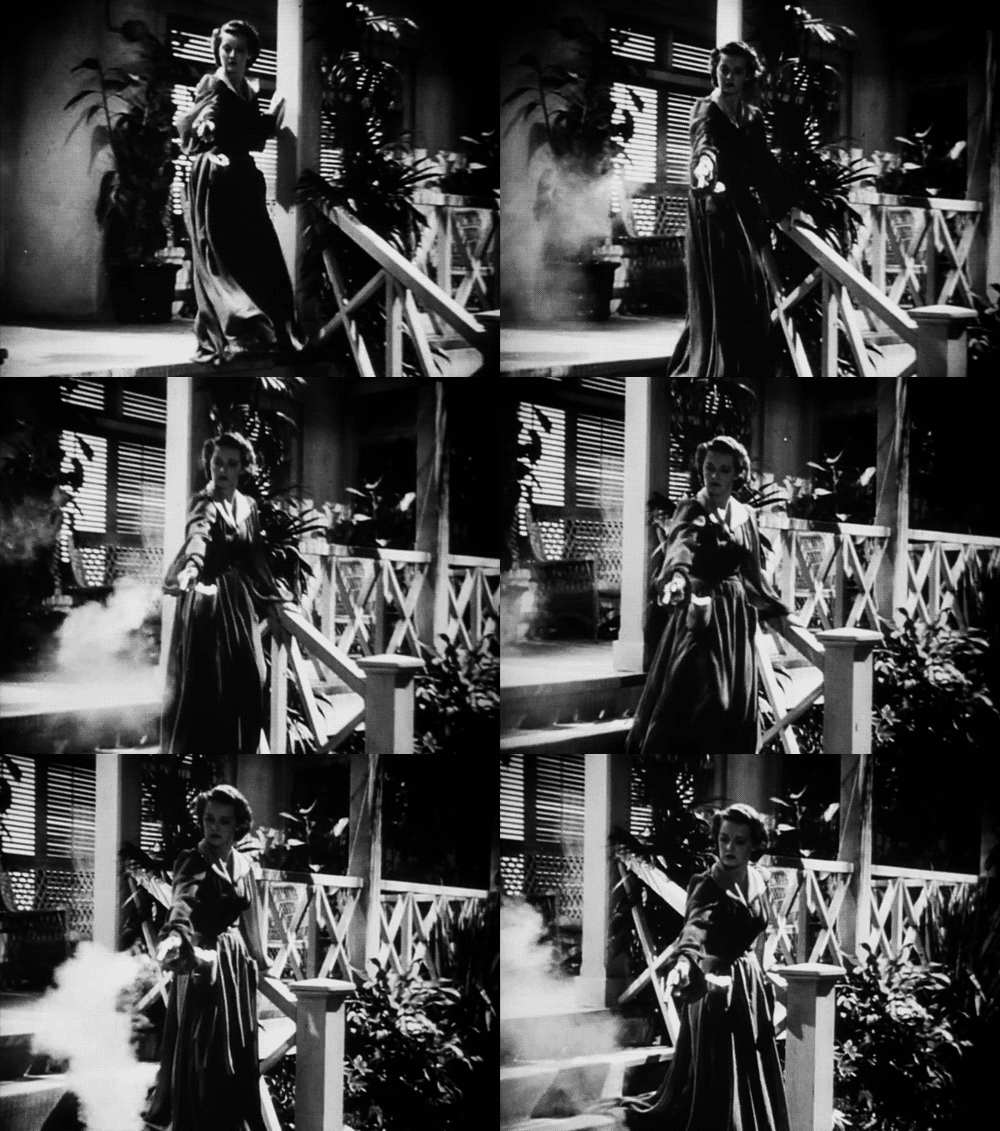
The movie starts off with a bang (literally) as Bette’s character Leslie Crosbie emerges from her Malaysian plantation home pumping six slugs into Geoff Hammond under a moonlit night sky. The native workers are sent to fetch Leslie’s husband, rubber plantation supervisor Robert, from the fields. He brings along their attorney Howard Joyce, and it’s a…

View original post 607 more words

Halloween Havoc!: THE INVISIBLE MAN’S REVENGE (Universal 1944)


gary loggins's avatarcracked rear viewer

Jon Hall is back as The Invisible Man, but not the same one he played in INVISIBLE AGENT . Like all the Invisible Man movies, THE INVISIBLE MAN’S REVENGE features a new protagonist, as Hall plays Robert Griffin, an escaped mental hospital patient who comes to London seeking his share of a diamond mine after being left for dead in the African jungle by partners Sir Jasper and Irene Herrick. Griffin has returned to get what’s coming to him, and he does… Irene dopes him, and the couple throw the rascal out. Disoriented, Griffin stumbles into a nearby river, where he’s saved from drowning by shady Cockney Herbert Higgins.

Higgins and his disreputable attorney pal try to shake down Jasper, but are confronted by the local chief constable. Griffin’s left to fend for himself, when he stumbles upon the home of Dr. Drury, a scientist experimenting with invisibility on animals…

View original post 403 more words

Cleaning Out The DVR #14: The Letter (dir by William Wyler)


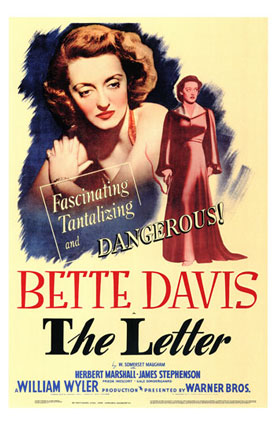
The_Letter_poster

After watching Break-Up Nightmare, I watched one more film that was sitting on my DVR.  That film was 1940’s The Letter.  I had recorded it off of TCM and, up until last night, I had never seen it before.  I’m happy to say that I’ve seen it now because it’s a great movie, featuring a fascinating mystery, feverish atmosphere, excellent supporting performances, and a ferociously brilliant performance from the great Bette Davis.

Filmed in a dream-like noir style by William Wyler, The Letter opens on a rubber plantation in Malaysia.  It’s night and the camera pans over the native workers all trying to sleep through the hot night.  Eventually, the camera reaches the big house, where the plantation’s wealthy and, of course, white manager lives.  (The contrast between the wealthy Europeans interlopers and the natives who work for them is a reoccurring theme throughout The Letter.)  A gunshot rings out.  A man stumbles out of the house.  Following after him is Leslie Crosbie (Bette Davis).  She is carrying a gun and, as we watch, she shoots the man a few more times.  She shoots him until she’s sure that he’s dead.

Leslie is the wife of Robert Crosbie (Herbert Marshall, who also played Davis’s husband in The Little Foxes) and the man that she just killed is Geoff Hammond, a respected member of Malaysia’s European community.  When the police arrive, Leslie explains that Hammond “tried to make love to me” and that she was forced to kill him in self-defense.  Leslie is arrested for the crime and will have to face trial but everyone knows that she will be acquitted.  After all, Leslie and her husband are members are well-connected members of the upper, European class.

However, Leslie’s lawyer, Herbert Joyce (James Stephenson), has doubts about Leslie’s story.  He points out that she sounds just a little too rehearsed.  His suspicions are confirmed when his clerk, Ong Chi Seng (Sen Yung), tells him about the existence of a letter that Leslie wrote on the day that Hammond was killed.  In the letter, Leslie orders Hammond to come see her and threatens to reveal the details of their relationship if he doesn’t.  Ong explains that he only has a copy of the letter.  The original is in the hands of Hammond’s widow (Gale Sondergaard) and she’s willing to sell the letter for a substantial price.

Not surprisingly The Letter is dominated by Bette Davis but, for me, the most memorable character is the outwardly obsequies but inwardly calculating Ong Chi Seng.  Sen Yung plays him with such a polite manner and a gentle voice that it’s actually incredibly shocking when he reveals his true nature.  And yet, even after he’s been exposed as a potential blackmailer, his manner never changes.  Meanwhile, Gale Sondergaard only appears in a handful of scenes but she steals every one of them with her steely glare.

In order to get the letter away from Ong and Mrs. Hammond, Leslie and Joyce have to convince Robert to give them the money without allowing him to learn the letter’s content.  But, what neither one of them realizes, is that Mrs. Hammond has plans that go beyond mere blackmail.

The Letter is an atmospheric melodrama that plays out almost like a fever dream and it also features one of Davis’s best performances.  It was nominated for best picture but it lost to another atmospheric melodrama, Alfred Hitchcock’s Rebecca.

Cleaning Out The DVR: Anthony Adverse (dir by Mervyn LeRoy)


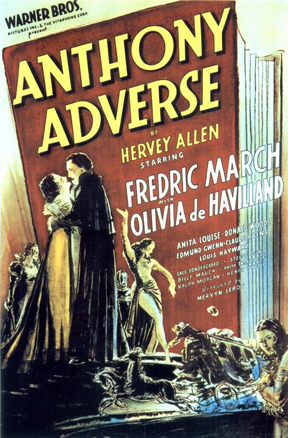
AnthonyAdverse

Late last night, I continued to clean out my DVR by watching the 1936 film, Anthony Adverse.

I recorded Anthony Adverse off of TCM, where it was being shown as a part of that channel’s 31 Days of Oscars.  Anthony Adverse was aired because it was nominated for Best Picture of 1936.  That’s significant because, if not for that nomination, I doubt that anyone would ever have a reason to watch Anthony Adverse.  It’s certainly one of the more obscure best picture nominees.  Despite a prestigious cast and being directed by the respectable Mervyn LeRoy, Anthony Adverse only has a handful of reviews over at the imdb.  And most of those reviews were written by Oscar fanatics like me.

Anthony Adverse is an epic historical film, one that tells the story of Anthony Adverse (Frederic March).  Anthony is the illegitimate son of Denis Moore (Louis Hayward) and Maria (Anita Louise), the wife of evil Spanish nobleman, Don Luis (Claude Rains, convincing as a nobleman but not as someone from Spain).  Luis murdered Denis and Maria died giving birth so Luis abandons the baby at an Italian convent.  Anthony is raised by nuns and priests and then, 10 years later, is apprenticed to an English merchant named John Bonnyfeather (Edmund Gwenn).  Bonnyfeather just happens to be Anthony’s grandfather!  Though Luis told him that Anthony died as soon as he was born, Bonnyfeather quickly figures out that Anthony is his grandson.  However, Bonnyfeather doesn’t share that information with Anthony and instead, he gives Anthony the surname “Adverse.”

Bonnyfeather raises Anthony as his own son.  Anthony grows up to be Frederic March and ends up falling in love with and marrying the beautiful Angela (Olivia De Havilland).  However, Anthony is suddenly called away on business to Havana, Cuba.  He doesn’t even have a chance to tell Angela that he’s leaving.  He does leave her a note but it blows away.  Assuming that she’s been abandoned, Angela goes to France, becomes an opera singer, and is soon the mistress of Napoleon.

Meanwhile, in Cuba, Anthony becomes convinced that Angela has intentionally abandoned him.  Consumed by grief, he ends up running a slave trading post in Africa.  He takes one of the slaves, Neleta (Steffi Duna), as his mistress and becomes known for his cruelty.  However, he eventually meets Brother Francois (Pedro de Cordoba) and starts to reconsider his ways.

(The film’s treatment of the slave trade is …. well, it’s awkward to watch.  The film is undoubtedly critical of slavery but, at the same time, it’s hard not to notice that the only slave with a prominent part in the film is played by a Hungarian actress.  Anthony may eventually reject cruelty but it’s left ambiguous as to whether or not he rejects the slave trade as a business.  If Anthony Adverse were made today, one imagines that this section of the film would be handled much differently.)

Meanwhile, back in Europe, Bonnyfeather is dying and his housekeeper, Faith (Gale Sondergaard, who won the first ever Oscar awarded for Best Supporting Actress for her performance here), plots to claim his fortune.

After I watched the movie but before I started this review, I did some research and I discovered that Anthony Adverse was based on a 1,222-page best seller that came out in 1933.  I’m going to guess that the film’s long and ponderous story may have worked better on the page than it does on the screen.  As a film, Anthony Adverse clocks in at 141 minute and it feels even longer.  Despite the impressive cast, the film just never clicks.  It’s never that interesting.

At the same time, I can understand why it was nominated for best picture.  It’s a big movie, full of characters and extravagant sets and ornate costumes.  You can tell it was an expensive movie to make and there’s enough philosophical dialogue that you can pretend there’s something going on underneath the surface.  In the 1936, Anthony Adverse may have been quite impressive but seen today, it’s forgettable.

Anthony Adverse lost best picture to another overproduced extravaganza, The Great Ziegfield.  Personally, I would have given the award to the unnominated My Man Godfrey.

http://www.youtube.com/watch?v=c_OyZlSCpo4