What to say about the original Children of the Corn?
First released in 1984, this film was based on one of Stephen King’s least interesting short stories. It’s a pretty dumb and poorly-paced movie, featuring villainous puritan children who are more annoying than menacing. The heroes aren’t particularly likable, even if one of them is played by Linda Hamilton. And yet, somehow, Children of the Corn spawned an 11-entry film franchise. (The 11th Children of the Corn film was released in 2020, 36 years after the original.) The original film was remade in 2009 and it continues to be a familiar reference point on the pop cultural landscape. I’ve lost track of the number of Children of the Corn parodies that I’ve seen.
The plot is pretty simple. One day, all of the children in a small rural town get together and kill all the adults. They worship a mysterious entity called He Who Walks Behind The Rows and they sacrifice any adult who is stupid enough to wander into town. The leader of the children is shrill-voiced little twerp named Isaac (John Franklin) and his second-in-command and chief enforcer is the sullen Malachai (played by Courtney Gaies). The children all dress like 1880s settlers and they spend a lot of time staring at each other. Eventually, Malachai overthrows Isaac and ties him to a cross, which leads to a seemingly endless scene of Isaac screeching, “Malachai!” over and over again.
Meanwhile, two adults have accidentally driven into town, Burt (Peter Horton) and his girlfriend, Vicky (Linda Hamilton). They end up running over a child who was trying to flee the cult. They put the body in the trunk of their car and then they kind of forget about it. In their defense, they’ve got a lot to deal with. The children want to sacrifice Vicky and Burt wants to lecture all of the children about how their backwards ways are ruining America. I’m not kidding. This film about children wearing old timey clothes and talking about He Who Walks Behind The Rows tries to convince the viewers that it has a sincere message.
Children of the Corn was not the first movie about killer children but it’s certainly one of the most influential. You have to wonder why because the film itself simply isn’t very good. Beyond the bad acting and the heavy-handed sermonizing, the film’s pacing is all off. A simple story shouldn’t have this many slow spots. Director Fritz Kiersch falls so in love with shots of that haunted cornfield that he forget to use them to tell a compelling story.
And yet, it can’t be denied that there is an audience for this film and the many sequels that followed. I imagine some of it has to do with the fact that people are just fascinated by the idea of evil children. We’re expected to like and forgive the behavior of children, regardless of how obnoxious they may be. Movies like Children of the Corn exploit a real fear that many people have, that children will figure out that they can get away with murder and therefore, they will. It’s a simple and not particularly well-executed idea but it’s one that led to an 11-film franchise so I guess one should never discount the value of keeping it simple.
That town is named Lakeview, despite the fact that there is no lake nearby. There aren’t many buildings in the town. There’s a service station. There’s a diner. There’s a sheriff’s office. There’s a general store. There are a few houses. Lakeview is a place that people rarely visit and which no one can escape.
There is a sheriff. His name is Cole (Eric Pierpoint) and he spends most of his days in an alcoholic stupor. He’s been depressed ever since his girlfriend, Bridget, was murdered. Now, Bridget’s younger sister, Gordet (Robin Lyn Heath), is living like a feral animal while the local shopkeeper, Sally (Ginger Lynn Allen), is determined to have Cole for herself. Cole’s deputy (Ash Adams) is in love with Sally and wants Cole’s job for his own. That’s a lot of drama for a small town.
Of course, the real drama in Lakeview comes from the fact that the town is run by a group of bikers! The head biker is named Angel (Andrew Divoff). By terrorizing the citizens, Angel and his gang make their own wishes come true without ever asking anyone else if that’s something they would be interested in. Cole is too drunk and depressed to stand up to them. The other townspeople are …. well, I don’t know what their problem is. One assumes that they have to be tough, as they’re living in a harsh and inhospitable desert. But none of them them are willing to stand up for themselves. Maybe they’ve recently moved to Arizona from California and they’re not used to the idea of self-defense. But, for whatever reason, Angel controls Lakeview.
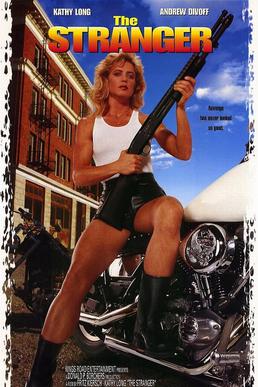
But then the Stranger (Kathy Long) rides up on her motorcycle. Dressed in black leather and wearing a corset that looks like it would actually be really uncomfortable in the desert heat, The Stranger has no name but she does know how to kick ass. She has come to kill all the members of Angel’s gang. Unfortunately, the majority of the gang is out-of-town when The Stranger arrives. So, the Stranger waits in Lakeview and kills who she can. The townspeople, led by Sally, want her to leave before things get too violent. Meanwhile, Cole comes out of his drunken stupor just long enough to notice that the Stranger looks a lot like his dead girlfriend….
1995’s The Stranger was an attempt to a modern-day spaghetti western, with a woman playing the type of mysterious figure who would traditionally have been played by Clint Eastwood or Charles Bronson. That, in itself, is a pretty good idea. Unfortunately, The Stranger itself is abysmally paced and the filmmakers seem to have overlooked that, in the best spaghetti westerns, the silent, nameless heroes were usually paired with a more talkative (and often much more amusing) partner. The Good, The Bad, and the Ugly had Eli Wallach. Once Upon A Time In The West had Jason Robards. In The Stranger, there’s not really anyone around to fill that role. (Cole is too full of self-pity to be amusing. Gordet spends most of the movie running from one abandoned car to another.) As such, The Stranger becomes fairly grim and slow. Things are only livened up when The Stranger beats people up. Kathy Long was a kickboxing champion and she’s strong enough in the action scenes that it makes up for the fact that she doesn’t have a particularly compelling screen presence. She and Eric Pierpoint also have next to no romantic chemistry, making the whole question of whether or not she’s Bridget’s ghost seem a bit moot.
The best reason to see the film is to watch Andrew Divoff play Angel. Divoff is always a good villain and he’s memorably unhinged in The Stranger. Unfortunately, he’s not in the film as much as the viewer might hope. Watching the film, I half expected the Wishmaster to ask if I wanted Andrew Divoff’s role to be larger. I would have said no while thinking yes. You know how that Wishmaster is.
4 Shots From 4 Films is just what it says it is, 4 shots from 4 of our favorite films. As opposed to the reviews and recaps that we usually post, 4 Shots From 4 Films lets the visuals do the talking!
This October, we’re using 4 Shots From 4 Films to look at some of the best years that horror has to offer!
4 Shots From 4 1984 Horror Films
Children of the Corn (1984, dir by Fritz Kiersch)
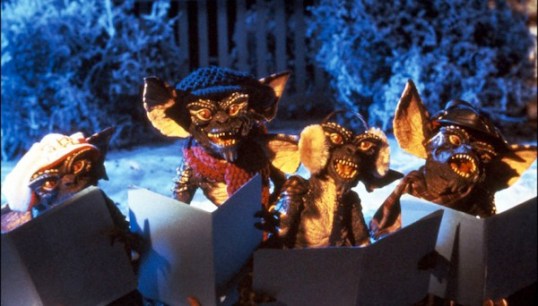
Gremlins (1984, dir by Joe Dante)
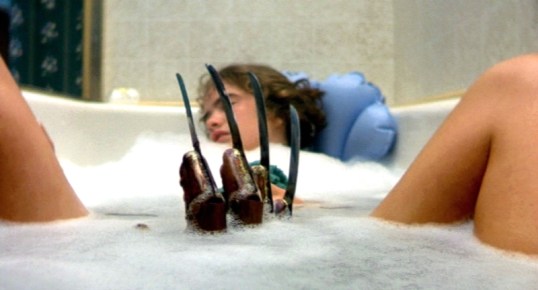
A Nightmare on Elm Street (1984, dir. by Wes Craven)
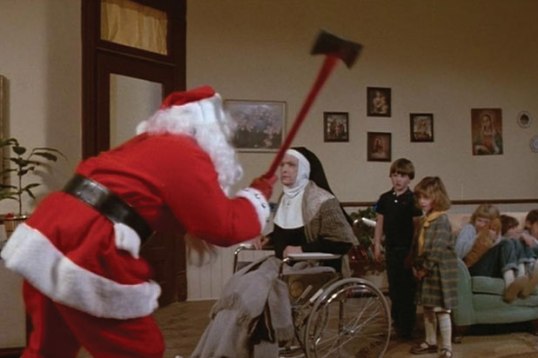
Silent Night, Deadly Night (1984, dir by Charles E. Sellier, Jr.)
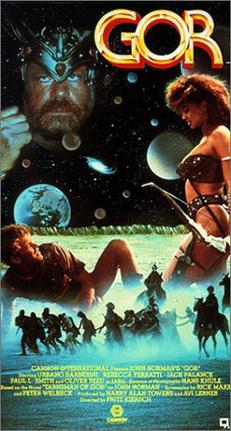
The 1987 film Gor opens with a nerdy college professor (played by Urbano Barberini, of Demons and Opera fame) giving perhaps the worst lecture in the history of underwhelming lectures. The professor explains that there is a counter-earth, a place that he claims is known as Gor. Gor shares the same orbit as Earth but it’s linearly opposed to Earth, which apparently makes it impossible to see. However, the professor says that his father gave him a ring which can transport the user to Gor. The only problem is that the professor has not figured out how to use the ring.
The students all look incredibly bored with the lecture and I don’t blame them. Not only does the professor seem to be rambling but he doesn’t even offer up any visual aides. He could have at least utilized a powerpoint presentation or something. Instead, his only teaching aide is a whiteboard on which he’s written “counter-earth.” I have to wonder what their final exam is going to look like. “True or false. Your professor is a freaking loon.”
(I found myself wondering what university would possibly grant tenure to some guy who thinks he owns a magic ring but then I remembered Evergreen College.)
The professor’s name is Tarl Cabot and I think that’s a good deal of his problem right there. When you give a child a name like Tarl Cabot, you’re pretty much guaranteeing that he’s going to grow up believing that he has a magic ring that’ll transport him to another planet.
Of course, in Tarl’s case, it turns out that the ring does just that. After his teaching assistant dumps him so that she can go on a date with another professor, Tarl crashes his car and when he wakes up, he finds himself on Gor. Apparently, the ring only works if you crash your car or something.
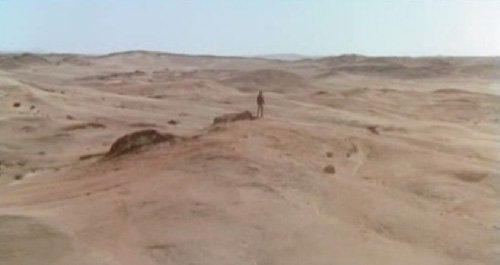
As for Gor itself, it turns out to be kind of a dump. It’s a huge desert. Seriously, check out this counter-earth:
If Tarl wanted to see a desert, he could have just driven around Southern California and saved himself a lot of trouble.
Yes, there is trouble in Gor. No sooner has Tarl arrived then he’s being attacked by a bunch of barbarians on horseback. The barbarians are led by the evil Sarm (played by Oliver Reed). Much as with the case of Tarl Cabot, I think that once you name a child Sarm, you’ve pretty much guaranteed the way that his life is going to turn out. Anyway, Tarl somehow survives being attacked by the barbarians. He even manages to kill Sarm’s son, which leads to Sarm declaring that he wants Tarl dead.
Fortunately, Tarl is eventually rescued by another group of barbarians. This group is led by Talena (Rebecca Ferratti) and she wants Tarl to help her rescue her father from Sarm’s fortress. But how can Tarl help when he’s literally useless? Don’t worry! The good barbarians are willing to train Tarl. One montage later, Tarl is now a master swordsman. Now, all Tarl has to do is dress like a barbarian and then track down a little person who can serve as a guide to Sarm’s fortress!
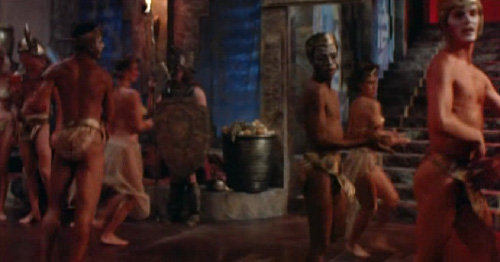
And what a fortress it is! Sarm may be evil but he likes to make sure that both his guests and his slaves have a good time. Sarm welcomes Tarl to the fortress and even tries to recruit him over to his side. (So apparently, Sarm’s over that whole “you killed my son” thing.) Sarm understands that the best way to recruit Tarl is with a dance number! As Sarm laughs lustfully, the slaves put on a show. It’s somewhat out-of-place but at least it distracts from the rest of the film.
Anyway, there’s a lot of problems with Gor but the main one is that the place itself just doesn’t seem like it’s worth all the trouble. After spending years trying to figure out how to get to the planet, Tarl arrives and discovers that it’s basically the same desert that was used in almost every post-apocalyptic film made in the 80s and 90s. (In fact, judging from John Carter, it’s still being used today.) What I always wonder about this type of movie is 1) why is the other planet always full of humans who speak perfect English and 2) why do all of these planets feature a society that resembles that ancient Roman Empire? Apparently, swords and arrows are literally universal weapons because they’re used on every planet in the universe.
When I first saw that this film starred Urbano Barberini, I assumed that it was going to turn out to be an Italian production. (In the late 80s, there were several Italian films that featured barbarians fighting in post-apocalyptic landscapes.) However, it turns out that Gor was a South African production, co-produced by the legendary Harry Alan Towers and directed by an American named Firtz Kiersch. (Kiersch also directed the first film version of Children of the Corn.) That said, the film itself is so ineptly dubbed and the production values are so low-budget that it would still be easy to mistake Gor for a film directed by Bruno Mattei or Claudio Fragasso.
Because he’s so badly dubbed, it’s difficult to really judge Barberini’s performance as Tarl Cabot. At the very least, he looks good with a sword in his hand and he’s cute — if never quite believable — when he plays Tarl as a neurotic physicist. However, Barberini can’t really compete with Oliver Reed, who devours every inch of scenery that he can find. Reed bellows and laughs and appears to be drunk in almost every scene in which he appears but at least he seems to be having a good time. Reed is also required to wear a silly helmet in most of his scenes and I sincerely hope that he got to take it home with him.
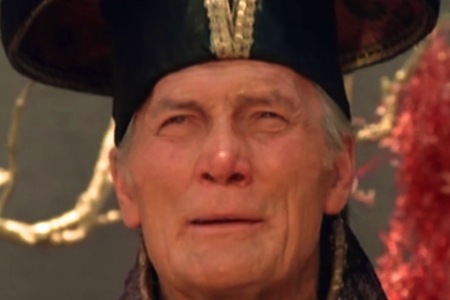
Oliver Reed isn’t the only familiar face to pop up in Gor. There’s also Jack Palance. Palance only shows up for about two minutes and he looks rather confused as he discusses his plan to conquer the world. (Apparently, Palance returned in Gor‘s sequel.) For two minutes of screen time, Palance managed to score himself third billing in the opening credits of Gor, above even Oliver Reed! Way to go, Jack!
Anyway, Gor is a pretty stupid movie. I appreciated the random dance number but otherwise, it’s fairly dull and only occasionally enlivened by Oliver Reed’s refusal to go gently into that dark night. I’m going to guess that films like this were popular with filmgoers who saw themselves as real-life Tarl Cabots and who spent their spare time thinking, “Nobody will laugh at me once they see me with a sword!” I caught the film yesterday on Comet TV, which is quickly becoming one of my favorite channels for watching bad movies.
And I will admit — the kids are creepy. Especially that little Isaac guy with the shrill voice. Whenever Isaac starts screaming, “MALACHI!!!!,” — well, it’s like nails on a chalkboard, to be honest.
Anyway, in case you’d forgotten, this is the movie where all the little kids hang out in a cornfield and kill adults. It attempts to say something about religion but I’m not sure what it’s trying to say. It’s all kind of silly but, as I said, some people seem to like it.
(Personally, I prefer that old episode of South Park where they keep declaring shenanigans on the carnival, all the cows jump off a cliff, and the visiting yankee tourists end up getting devoured by rats in jail.)
In order to help you decide for yourself whether or not this is a decent film, here is Stephen King’s Children of the Corn! Enjoy it while you can because you just know that YouTube is going to eventually yank it down for copyright reasons.


 Through the Shattered Lens