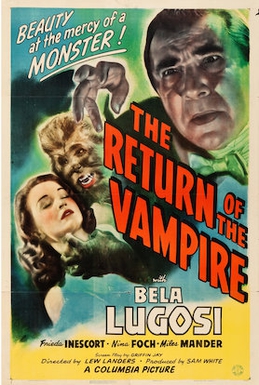
Horror Film Review: The Return of the Vampire (dir by Lew Landers)


1943’s The Return of the Vampire opens in 1918.

Lady Jane Ainsley (Frieda Inescort) and her colleague, Dr. Walter Saunders (Gilbert Emery), suspect that there might be a vampire active in London.  After reading a book on vampirism that was written by Dr. Armand Tesla, they manage to find the vampire’s coffin.  As the vampire’s servant — a werewolf named Andreas (Matt Willis) — watches, Lady Jane and Dr. Saunders drove a metal stake through the vampire’s heart.  It turns out that the vampire was none other than Armand Tesla himself!  Andreas turns back into a normal person and becomes Lady Jane’s assistant.

Jump forward to the 1940s.  During an attack by the Germans, a bomb explodes over Tesla’s grave and exposes not just his coffin but also the metal pole in the middle of his skeleton.  Two workmen assume that the pole is just bomb debris and they remove it.  Tesla (Bela Lugosi) promptly comes back to life and Andreas turn back into a werewolf.  Tesla sets out to get revenge on Lady Jane and the daughter of Dr. Saunders, Nicki (Nina Foch).

The Return of the Vampire is an interesting film.  Since the film was not made by Universal Pictures, it could not use the name “Dracula” for its vampire but it’s obvious from the start that Armand Tesla is meant to be Dracula.  Tesla wears his Dracula costume, speaks in his Dracula voice, and gives his Dracula performance.  To his credit, Lugosi actually gives a very strong performance in The Return of the Vampire.  His anger towards the people who staked him feels very real and there’s nothing of the intentional campiness that marred some of Lugosi’s later performances.  Lugosi leaves little doubt that Tesla is not only evil but he’s someone who truly enjoys being evil.  He can’t leave England until he gets his revenge on the people who previously defeated him.  For all the talk of stakes, sunlight, and crosses, the vampire’s true weakness is its own vanity and its inability to let go of a grudge.

As a history nerd, I found myself fascinated with how the film worked the then-current Blitz into its story.  The main villain may have been played by Bela Lugosi but the Germans definitely played their role as well, launching the bombing raids that distracted the authorities from the vampire in their midst.  Indeed, it’s probably not coincidence that it was a German pilot who brought Tesla back to life in the first place.  The German pilot is shot down but not before he drops a bomb on Tesla’s crypt.  The film says to be aware of the outside threat but to also be aware that threats can come from the inside as well.  While the Germany terrify the citizens of London, the vampire coolly moves through the night.

Clocking in at a fast-paced 69 minutes, The Return of the Vampire also features a stiff upper lip Scotland Yard inspector (Miles Mander) who, of course, is skeptical of the existence of vampires.  At the end of the film, he asks his subordinates if they believe in vampires.  They reply that they do.  He then looks at the camera and asks us, “And do you, people?”

Well, do you?
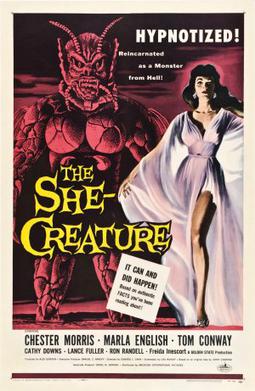
Horror Film Review: The She-Creature (dir by Edward L. Cahn)


In the 1956 film, The She-Creature, bodies are being discovered on the beach.  The murderer appears to be a bizarre, humanoid creature with gills and scaly skin.  It commits its dastardly crimes and then it disappears back into the ocean!  What could it be?  Is it a genuine monster?  Is it a psycho diver in a rubber suit?  Is it just some random murderer that hides in the shadows and stalks the night like a cat searching for mouse?

While bodies are showing up on the beach, Dr. Carlo Lombardi (Chester Morris), is trying to convince the world that his theories about reincarnation and the occult are correct.  Usually clad in a tuxedo and accompanied by his assistant, Andrea (Marla English), Dr. Lombardi swears that everyone has lived a past life and that, when under hypnosis, people are capable of reliving all of their past lives.  Dr. Lombardi theorizes that reincarnation has been going on since the beginning of time and, as a result, a hypnotized person could even relive their past life as a cave dweller or, presumably, a single-celled creature floating around in a lake.  Actually, under Lomradi’s theory, I guess it’s possible that someone could have been a dinosaur in a past life.

(It’s probably best not to give that too much thought because most people would probably be disappointed to discover that they weren’t one of the cool dinosaurs but instead, they were one of those goofy green lizards that was always running out of the way of the cool dinosaurs.  No matter how many times someone bangs a gong, not everyone can be a T-rex, sorry.  Everyone wants to be the dinosaur that eats but no one wants to be the one that got eaten.)

The scientific community scoffs at Dr. Lombardi but when he puts Andrea under hypnosis, it’s enough for Timothy Chappell (Tom Conway) to want to go into business with him.  The scientific community may scoff at Lombardi and his theories but Chappell sees him as the key to a fortune.  Who cares if his powers are real or not?  Well, Lombardi cares and he’s discovered that he can use hypnosis to cause Andrea to turn into a prehistoric monster who will kill his enemies!

(Actually, Dr. Lombardi is such a good hpynotist that he’s even able to convince a dog to kill his owner.  Then again, maybe he just offered the dog a treat for being a good boy.  Who knows how the canine mind works?)

An entertaining B-movie, The She-Creature benefits from the committed performance of veteran tough guy Chester Morris, the other-worldly beauty of Marla English (who was cast because it was correctly felt she resembled Elizabeth Taylor), and the noir-influence direction of Edward L. Cahn.  The plot makes no sense but it hold your interest and the monster is a genuinely impressive creation.

On a personal note, I’ve never bought into reincarnation but if I was anyone in a past life, I was probably either Edie Sedgwick or Alice Roosevelt.


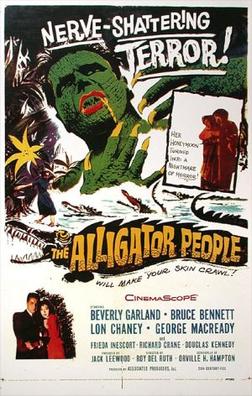
Horror Film Review: The Alligator People (dir by Roy Del Ruth)


You know what the worst bayou is?

Bayouself.

Thank you!  I’ll be here all night and don’t forget to tip your server!

Anyway, the 1959 film, The Alligator People, largely takes place in the bayous of Louisiana.  Nurse Jane Marvin (Beverly Garland) is suffering from amnesia so she allows two psychiatrist to give her a dose of truth serum and then, when she’s in a hypnotized state, she proceeds to remember her former life as Joyce Webster.

Joyce married a handsome and seemingly perfect man named Paul Webster (Richard Crane) but, right when they were about to go on their honeymoon, he received a telegram that disturbed him.  After he made a phone call, he vanished from Joyce’s life.  Joyce did some research of her own and discovered that Paul’s former home was the Cypresses Plantation in the small town of Bayou Landing, Louisiana.

When Joyce travels down to Bayou Landing, she discovers that there’s really not much there, other than a bunch of hungry alligators.  She meets the owner of the plantation, Lavinia Hawthorne (Frieda Inescort).  She also meets the handyman, Manon (Lon Chaney, Jr.), a one-handed brute who spends most of his day shooting at alligators.  And, eventually, Joyce comes across her husband but Paul is no longer the man that she remembers.

Paul’s skin is scaly and he only comes out at night.  It turns out that Paul was, long ago, injected with a serum that would allow him to grow back a missing limb.  The serum worked as far as the limb was concerned but an unfortunate side effect is that Paul is now turning into an alligator!  Dr. Mark Sinclair (George Macready), the man who came up with the serum in the first place, is hopeful that he can reverse the process but, to do so, he’s going to need a lot of radioactive material.

Complicating things is that Manon has decided that he wants Joyce for himself and he’s certainly not going to compete with some alligator man for her attention.  Of course, Joyce despises Manon from the first moment she sees him but Manon’s not that smart.  Can Paul be cured before Manon destroys everything?

The Alligator People is one of those 1950s B-movies that is probably better-known for its name than anything else.  That said, when taken on its own terms, it’s an entertaining watch.  It was one of the final films to be directed by Roy Del Ruth, who had previously been one of Hollywood’s top directors of musicals and comedies.  There’s not much music or deliberate comedy to be found in The Alligator People but Del Ruth does manage to capture the humid stillness of the bayous.  As always, Beverly Garland gives a strong performance as a determined woman who isn’t going to be told what to do and Richard Crane is about as convincing as one can be while turning into an alligator.

As for Lon Chaney, Jr, he plays Manon as being a total monster and he gives a convincing performance, even if it is hard not to mourn the loss of the shadings that he brought to his monster roles while he was with Universal.  Manon is a rough and determinedly unintelligent character, one who exists only to destroy.  Significantly, he’s not one of the Alligator People.  Instead, he’s just a man who doesn’t care about anyone but himself.

The Alligator People is an effective B-movie, full of a bayou atmosphere.

Film Review: Pride and Prejudice (dir by Robert Z. Leonard)


On this date, in 1813, Jane Austen’s Pride and Prejudice was first published.  The book was published Thomas Egerton, who bought the rights for £110.  Apparently, Austen didn’t expect the book to become the success that it did.  As a result, she ultimately only made  £140 off of the book.  (Egerton made considerably more.)  When the book was originally published, Austen’s name was nowhere to be found on the manuscript.  Instead, it was credited to “the author of Sense and Sensibility.”

(When Sense and Sensibility was originally released, it was simply credited to “A Lady.”)

The rest, of course, is history.  205 years after it was first published, Pride and Prejudice remains one of the most popular and influential novels ever written.  Every year, new readers discover and fall in love with the story of outspoken Elizabeth Bennet, the proud Mr. Darcy, the pompous Mr. Collins, and the rather sleazy George Wickham.  There have been countless film and television adaptations.  My personal favorite is Joe Wright’s 2005 version, with Keira Knightley as Elizabeth.  My least favorite would have to be Pride and Prejudice and Zombies.

The very first film adaptation of Pride and Prejudice was released in 1940.  Originally, the movie was envisioned as being a George Cukor film that would star Norma Shearer and Clark Gable.  However, the film’s production was put on hold after the death of Shearer’s husband, the legendary Irving Thalberg.  When the film finally resumed pre-production in 1939, Gable was now busy with Gone With The Wind.  Cast in his place was Robert Donat (who, interestingly enough, would have played Rhett Butler if Gable had refused the role).  With the film originally meant to be filmed in Europe, the outbreak of World War II led to yet another delay.  By the time production resumed, Cukor had been replaced by Robert Z. Leonard and Norma Shearer had also left the project.  With Gone With The Wind breaking box office records, MGM came up with the idea of once again casting Vivien Leigh opposite of Clark Gable.  However, Gable eventually left the film and Laurence Olivier, looking for a chance to act opposite Leigh, agreed to play Darcy.  However, the studio worried that casting Olivier and Leigh opposite each other would lead to negative stories about the two of them having an affair despite both being married to other people.  So, Leigh was removed from the project and Greer Garson was cast.  Olivier was so annoyed with the decision that, after Pride and Prejudice, it would be eleven years before he would work with another American studio.

Despite all of the drama behind-the-scenes, MGM’s version of Pride and Prejudice is a thoroughly delightful film, one full of charming performances and witty lines.  Though she was 36 when she made Pride and Prejudice, Garson is still the perfect Elizabeth, giving a lively and intelligent performance that stands in stark contrast to the somewhat staid films that she was making at the same time with Walter Pidgeon.  As for Olivier, from the first minute he appears, he simply is Darcy.  That said, my favorite performance in the film was Edmund Gwenn’s.  Cast as Mr. Bennet,  Gwenn brought the same warmth and gentle humor to the role that he would later bring to Kris Kringle in Miracle on 34th Street.  I also liked the performances of Maureen O’Sullivan as Jane and Edward Ashley as disreputable Mr. Wickham.

Pride and Prejudice is not an exact adaptation.  For one thing, the movie takes place in the early Victoria era, supposedly because MGM wanted to cut costs by reusing some of the same costumes that were previously used in Gone With The Wind.  As well, Lady Catherine (Edna May Oliver) is no longer as evil as she was in the novel.  Finally, because the production code forbid ridicule of religion, the theological career of Mr. Collins (Melville Cooper) was considerably downplayed.  Not even Jane Austen (or, more specifically, the film’s screenwriter, Aldous Huxley) could defy the Code.

Seventy-eight years after it was first released, the 1940 version of Pride and Prejudice holds up surprisingly well.  It’s an enjoyable film and one that, despite a few plot changes, remains true to the spirit of Austen.

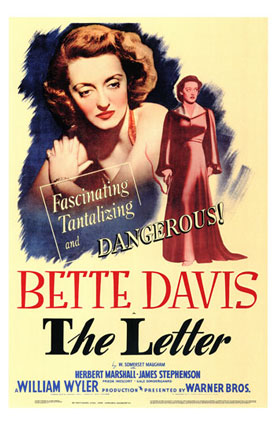
Cleaning Out The DVR #14: The Letter (dir by William Wyler)


The_Letter_poster

After watching Break-Up Nightmare, I watched one more film that was sitting on my DVR.  That film was 1940’s The Letter.  I had recorded it off of TCM and, up until last night, I had never seen it before.  I’m happy to say that I’ve seen it now because it’s a great movie, featuring a fascinating mystery, feverish atmosphere, excellent supporting performances, and a ferociously brilliant performance from the great Bette Davis.

Filmed in a dream-like noir style by William Wyler, The Letter opens on a rubber plantation in Malaysia.  It’s night and the camera pans over the native workers all trying to sleep through the hot night.  Eventually, the camera reaches the big house, where the plantation’s wealthy and, of course, white manager lives.  (The contrast between the wealthy Europeans interlopers and the natives who work for them is a reoccurring theme throughout The Letter.)  A gunshot rings out.  A man stumbles out of the house.  Following after him is Leslie Crosbie (Bette Davis).  She is carrying a gun and, as we watch, she shoots the man a few more times.  She shoots him until she’s sure that he’s dead.

Leslie is the wife of Robert Crosbie (Herbert Marshall, who also played Davis’s husband in The Little Foxes) and the man that she just killed is Geoff Hammond, a respected member of Malaysia’s European community.  When the police arrive, Leslie explains that Hammond “tried to make love to me” and that she was forced to kill him in self-defense.  Leslie is arrested for the crime and will have to face trial but everyone knows that she will be acquitted.  After all, Leslie and her husband are members are well-connected members of the upper, European class.

However, Leslie’s lawyer, Herbert Joyce (James Stephenson), has doubts about Leslie’s story.  He points out that she sounds just a little too rehearsed.  His suspicions are confirmed when his clerk, Ong Chi Seng (Sen Yung), tells him about the existence of a letter that Leslie wrote on the day that Hammond was killed.  In the letter, Leslie orders Hammond to come see her and threatens to reveal the details of their relationship if he doesn’t.  Ong explains that he only has a copy of the letter.  The original is in the hands of Hammond’s widow (Gale Sondergaard) and she’s willing to sell the letter for a substantial price.

Not surprisingly The Letter is dominated by Bette Davis but, for me, the most memorable character is the outwardly obsequies but inwardly calculating Ong Chi Seng.  Sen Yung plays him with such a polite manner and a gentle voice that it’s actually incredibly shocking when he reveals his true nature.  And yet, even after he’s been exposed as a potential blackmailer, his manner never changes.  Meanwhile, Gale Sondergaard only appears in a handful of scenes but she steals every one of them with her steely glare.

In order to get the letter away from Ong and Mrs. Hammond, Leslie and Joyce have to convince Robert to give them the money without allowing him to learn the letter’s content.  But, what neither one of them realizes, is that Mrs. Hammond has plans that go beyond mere blackmail.

The Letter is an atmospheric melodrama that plays out almost like a fever dream and it also features one of Davis’s best performances.  It was nominated for best picture but it lost to another atmospheric melodrama, Alfred Hitchcock’s Rebecca.