Clash of the Titans (1981, directed by Desmond Davis)


High atop Mt. Olympus, Zeus (Laurence Olivier) and his fellow Gods look down on Earth and jealously manipulate its citizens.  When Zeus impregnates Danae (Vida Taylor), the daughter of the King of Argos, she and her son Perseus (Harry Hamlin) are banished to sea.  Zeus responds by ordering Poseidon (Jack Gwillim) to release the Kraken.

Years later, when Callibos (Neil McCarthy), the son of the Goddess Thetis (Maggie Smith), destroys all but one of Zeus’s flying horses, Zeus transformer Callibos into a tailed monster.  Thetis tries to get her revenge by having Callibos kill Perseus but instead, Perseus chops off Callibos’s hand, comes to possess Pegasus, the last of the flying horses, and also wins the right to marry Andromeda (Judi Bowker).

At the wedding, Cassiopeia (Sian Phillips) declares Andromeda to be even more beautiful than Aphrodite (Ursula Andress).  Big mistake.  Aphrodite demands that Andromeda by sacrificed to the Kraken.  Along with Pegasus, Ammon (Burgess Meredith), Thallo (Tom Pigott-Smith), and robot owl, Perseus goes on a quest to get the snake-haired head of Medusa so he can turn the Kraken into stone.

There’s a lot that I love about Clash of the Titans, from the Ray Harryhausen’s stop-motion special effects to the blind witches who pass one eyepiece among them to Burgess Meredith’s performance as Ammon.  I even like the robot owl.  But the thing that has always made the biggest impression on me is that Mt. Olympus is portrayed as having a shelf that holds a figurine for every human in the world.  The Gods casually move the pieces around and transform them on whims.  Of all the films that have been based on Greek mythology, Clash of the Titans is one of the few that really captures the idea of the Gods essentially being a bunch of petty and jealous libertines who view humans are just being their playthings.

Let’s not overthink Clash of the Titans, though.  The main appeal of Clash of the Titans is that it’s just a good, old-fashioned adventure movie.  In this age of CGI and humorless heroes, it’s hard not love the film’s mix of old-fashion stop-motion animation, strong characters, and occasional moments of humor.  (I like the owl and I won’t apologize for it.)  Also, Medusa has appeared in a lot of movie but she’s never been scarier than in this movie.  Who can forget the yellow glow of her eyes, followed by men turning to stone?  Who can forget the hiss of her tail or the moment when Perseus waits to strike while trying not to look into her eyes?  Beyond Medusa, who can forget the Kraken rising from the sea or the blood of Callibos giving birth to giant scorpions?  Without CGI, Clash of the Titans still captures the feel of living in a different time and a different land.  Clash of the Titans brings mythology to life in a way that few other films have been able to,

I loved the original Clash of Titans when I was a kid.  I rewatched it last month and I happy to say that I love it still.

Lisa Reviews An Oscar Nominee: Great Expectations (dir by David Lean)


“My Christian name was Philip Pirrip, which I pronounced Pip….”

SHUT UP, PIP!

Seriously, there’s a lot of good things that can be said about Charles Dickens’s Great Expectations but most readers simply can’t get past the fact that the narrator insists on being called Pip.  I don’t necessarily blame them, as Pip might be a good nickname for a child but, by the time you’re 16, you should be demanding that everyone call you Phil.  That said, I’ve always liked Great Expectations.  Despite the fact that Charles Dickens could be a terribly pedantic writer, the plot of Great Expectations is genuinely interesting and the book is full of interesting characters, the majority of whom don’t demand to be known by their childhood nicknames.  Plus, I’ve always related to Estella.

The 1946 film adaptation of Great Expectations was at least the third movie to be made from the novel and it would be followed by many more.  (In 1998, there was a modernized version where Pip was wisely renamed Finn.)  Still, the 1946 adaptation is the best.  As directed by David Lean (and based on a stage version that was put together by none other than Alec Guinness), Great Expectations remains true to the source material while, at the same time, cutting away a lot of extraneous material.  As a result, Lean’s film version of the story maintains a clear narrative momentum, which is something that eluded Dickens in his sprawling original.

John Mills plays Pip, an orphan who is being raised by his wicked aunt and her husband, the simple but kind-hearted blacksmith, Joe Gargery (Bernard Miles).  One night, Pip helps out an escaped convict named Magwitch (Finlay Currie) and, though Magwitch is eventually recaptured, that one act of kindness will determine the rest of Pip’s life.

Pip is invited to visit the mansion of a recluse named Miss Havisham (Martita Hunt) and it’s there that he first meets and falls in love with the beautiful but rather cold-hearted Estella (Jean Simmons and then, after Estella grows up, Valerie Hobson).  Of course, what Pip doesn’t realize is that Miss Havisham has specifically raised Estella to destroy the hopes and dreams of every man that she meets.

Eventually, Pip grows up and discovers that he has a mysterious benefactor who feels that Pip should be transformed into a gentlemen so that he might be able to meet the “great expectations” that the benefactor has for him.  Pip, of course, assumes that it’s Miss Havisham but even those who haven’t read the book will probably suspect that there’s more to it than just that.  Pip moves to London, where he stays with Herbert Pocket (Alec Guinness), a pale young man (for that’s how Dickens described him) who teaches Pip that a gentleman does not use his knife as a fork.  Herbert was always my favorite character in the book and he’s my favorite character in the film, largely because he’s played by the totally charming Alec Guinness.

Anyway, Pip becomes a bit of a snob but eventually, he discovers the truth about his benefactor and the last few years of his life.  It causes him to not only rip down a lot of curtains but also to reconsider what it truly means to be a a gentleman.

It’s all very well-done, largely because David Lean doesn’t allow the fact that he’s making a film out of a great novel get in the way of telling a good story.  The film is well-acted by a wonderful cast of British thespians, all of whom manage to make even the most artificial of scenes and lines seem naturalistic and believable.  Even though Pip is a bit of a jerk, John Mills manage to turn him into a sympathetic character.  (Mills plays Pip as if he himself cannot stand the fact that he’s turned into such a snob.)  Both Jean Simmons and Valerie Hobson do a wonderful job of bringing the potentially problematic character of Estella to life and Bernard Miles is wonderfully empathetic in the role of the Joe Gargery.  The scene where a nervous Gargery first meets Pip after Pip has become a gentleman is a true example of great acting.

Not surprisingly, Lean also does a great job of bringing 19th century England to life.  Watching this film is a bit like stepping into a time machine and going back to the Dickensian era.  As filmed by Lean, London is as bright and vibrant as Pip’s childhood home is dark and constraining.  When Pip finds Magwitch on the beach, Lean directs the scene as if it were from a film noir.  When Pip enters the darkened home of Miss Havisham and meets the beautiful but destructive Estella, the film flirts with becoming a Rebecca-style gothic romance.  And when it’s just Pip and Herbert Pocket talking, it becomes a comedy of manners.  Not surprisingly, Great Expectations won Oscars for both its art design and its gorgeous black-and-white cinematography.

Great Expectations was also nominated for Best Picture.  However, it lost to Gentleman’s Agreement.

Cleaning Out The DVR #20: Tom Jones (dir by Tony Richardson)


(For those following at home, Lisa is attempting to clean out her DVR by watching and reviewing 38 films by this Friday.  Will she make it?  Keep following the site to find out!)

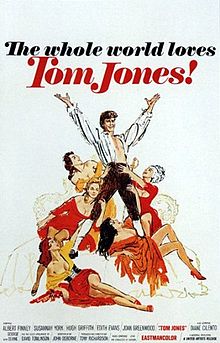
220px-Poster_-_Tom_Jones_01

Oh, how I wanted to love Tom Jones!

http://www.youtube.com/watch?v=NjEE_1U0-8s

No!  Not that Tom Jones.

I’m talking about Tom Jones, the British film from 1963.  Based on a novel by Henry Fielding, Tom Jones was a huge box office success and it was one of the few comedies to ever win the Oscar for best picture.  Whenever you watch a documentary about the British invasion of the early 60s, chances are that you’ll see at least a clip or two from Tom Jones.  The film (or perhaps I should say the film’s box office success) is a part of 60s pop history, right up there with The Beatles on The Ed Sullivan Show and Sean Connery shooting that guy in cold blood in Dr. No.

Up until last night, I had heard about Tom Jones but I had never seen it.

And I really wanted to love it.

The film takes place in 18th century England and it tells the story of young Tom Jones (Albert Finney).  It starts with a lengthy sequence that plays out like a silent film, complete with title cards.  Upright Squire Allworthy (George Devine) comes home and discovers that a baby has been left in his bed.  He assumes that the child was born to two of his servants and declares that he will raise Tom Jones to be a good and worthy man.

Two decades later, Tom Jones has grown up and now he’s being played by Albert Finney (who, it must be said, was quite a handsome man when he was young).  Because Tom is good-looking and kind-hearted, every woman in England lusts after him.  But Tom is in love with innocent Sophie Western (Susannah York).  However, Sophie is a member of the upper class and Tom is a “bastard,” at a time when that actually means something.

Indeed, Sophie’s aunt and uncle (played by Edith Evans and Hugh Griffith) demand that Sophie have nothing to do with Tom Jones.  They decide that she will marry Blifil (David Warner, young but already typecast as a villain).  Through clever lies and manipulations, Blifil convinces Squire Allworthy that Tom has turned bad and must therefore be exiled from his home.  Does Blifil want to get rid of Tom just so he can marry Sophie or is it possible that there’s more to Blifil’s scheming?

Before we get the answer to that question, we spend a while following the exiled Tom as he wanders around England and attempts to prove himself worthy of Sophie.  Along the way, Tom serves briefly in the army, gets into numerous fights, and has several affairs.  One of those affairs is with Mrs. Walters (Joyce Redman), who he briefly thinks might be his mother.  Eventually, Tom ends up as the lover to the decadent Lady Bellaston (Joan Greenwood).  Through Blifil’s scheming, he also ends up framed for attempted murder and facing the gallows…

And, as melodramatic as that may all sound, Tom Jones is definitely a comedy.  It doesn’t take itself seriously and there’s hardly a single scene that isn’t played for laughs.  Director Tony Richardson goes out of his way to make sure that you never forget that you’re watching a movie.  There are freeze frames.  There’s plenty of characters around to supply sarcastic commentary.  There’s even a few cases of fourth wall breaking.

As I watched Tom Jones, it was hard for me not to compare it to Stanley Kubrick’s Barry Lyndon.  After all, both films take place during the same period of time and both deal with a young man making his way through European society.  I would even argue that, in its way, Barry Lyndon is far more satirical than Tom Jones.  The main difference between the two films is that Barry Lyndon is all about subtext whereas everything that happens in Tom Jones happens right on the surface.

As I said, I really wanted to like Tom Jones but, seen today, the entire film seems to be trying a little bit too hard.  Tony Richardson’s direction is so manic that it gets a bit exhausting after a while.  That said, I can understand why the film was such a success when it was first released.  I’m sure in 1963 — after having to deal with decades of pompous costume dramas — viewers probably found Tom Jones to be a breath of fresh air.  Not only was it a British film released at a time when all things British were in style but it was also a film that, by the standards of 1963, dealt frankly with sex.  In short, Tom Jones is definitely a film of its time.  If it doesn’t hold up as well today, that’s because it wasn’t made for 2016.  It was made for 1963.

And obviously, if the judgment of the Academy is to be trusted, Tom Jones was the perfect film for 1963.  That said, I would have given best picture to another British film, From Russia With Love.

Horror Film Review: The Brides of Dracula (dir by Terence Fisher)


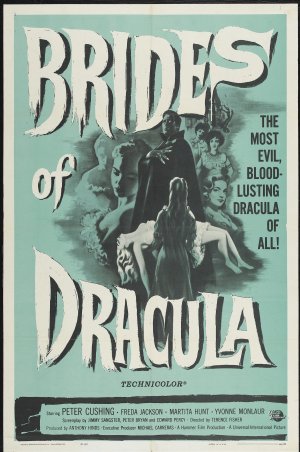
The-Brides-of-Dracula-posterSo, imagine this.  Two years have passed since your film company released a low-budget film called Horror of Dracula.  To the surprise of many, the film became an international hit that not only revived interest in the character of Dracula but also made a star out of an imposing and opinionated actor named Christopher Lee.  Naturally, being a smart film mogul, you want to make a sequel to Horror of Dracula.  Both director Terrence Fisher and screenwriter Jimmy Sangster have agreed to return to make a second part of the franchise.  Now, all you have to do is recruit your star…

…and Christopher Lee doesn’t want to do the film!

There are conflicting reports on just how much Christopher Lee disliked the Hammer Dracula films.  Lee, himself, has been inconsistent on the subject, occasionally claiming that he hated all of them and then other times saying that he only disliked the sequels.  One thing that does remain consistent is that Lee reportedly feared being typecast as Dracula and, as a result, he initially declined to be a part of any sequel.

Nowadays, they’d probably just recast the role with Nicolas Cage.  But this was the late 50s/early 60s and, instead of recasting, Hammer just made a Dracula film without Dracula.  Yes, the film may have been called The Brides of Dracula but, beyond being mentioned in the film’s prologue, Dracula never makes an appearance.  For that matter, there really aren’t any brides of Dracula either.  There are three female vampires but none of them are turned into vampires by Dracula.  Instead, the vampire in question is Baron Meinster (David Peel, who does a pretty good job in the role but who, needless to say, is no Christopher Lee).

Dracula does not return for The Brides of Dracula but his nemesis Prof. Van Helsing (Peter Cushing) does.  Cushing was so well-cast as Van Helsing and brought such a sense of righteous fury to the role that his presence goes a long way towards making up for the absence of Christopher Lee.  When you look at and listen to Cushing’s Van Helsing, you’re left with little doubt that this is a man who has dedicated his life to destroying vampires and that he’s quite good at it.

And it’s a good thing that Van Helsing shows up because, regardless of whether Dracula is directly involved or not, Transylvania has some issues.  The Brides of Dracula opens with a French school teacher named Marianne (Yvonne Monlaur) finding herself stranded at an old castle.  The owner of the castle — Baroness Meinster (Martita Hunt) — allows Marianne to spend the night but asks her to please refrain from releasing her son, Baron Meinster, from the chains that hold him prisoner.  Naturally, Marianne does exactly the opposite.  She steals a key and sets the Baron free.

Of course, the Baron is a vampire and soon he’s feeding on the inhabitants of a nearby village.  The Baron has also decided that Marianne should be his bride.  Will Prof. Van Helsing be able to save Marianne’s soul and defeat a second vampire?  You’ll have to watch the movie to find out!

And you certainly should.  Once you get over the fact that Brides of Dracula does not feature Lee’s iconic Dracula, the film itself is surprisingly entertaining, filled with all of the gothic touches, creepy scenery, evil villains, bloody throats, and heaving cleavage that you would expect from a Hammer film.  Peel, Hunt, and Monlaur are all well-cast and best of all, Peter Cushing is Dr. Van Helsing!

In short, it’s not bad for a Dracula film that doesn’t actually feature Dracula.

http://www.youtube.com/watch?v=4bNmNniIDsk