Cleaning Out The DVR #16: Johnny Belinda (dir by Jean Negulesco)


X-johnnybelindalenda48-jjp

Continuing my effort to watch 38 films in 10 days (and, as of today, I only have 6 days left!), I spent part of last night watching the 1948 film Johnny Belinda.

Johnny Belinda takes place in Canada, on Cape Breton Island.  The residents of the island are a hearty, no-nonsense group of people.  They work hard, they don’t play hard because they never play, they farm, and they don’t have much use for outsiders.  When a new doctor, Robert Richardson (Lew Ayres), arrives on the island, he has to work hard to earn their trust.

Dr. Richardson is fascinated by Belinda McDonald (Jane Wyman), a young woman who is deaf and mute.  Belinda lives on a farm with her father (Charles Bickford) and her aunt (Agnes Moorehead).  Everyone in the community assumes that Belinda is a simple-minded and, because her mother died giving birth to her, she is resented by her father.  Only Dr. Richardson believes that Belinda is in any way intelligent and, over her father’s objections, he teaches Belinda sign language.

Dr. Richardson’s secretary, Stella (Jan Sterling), falls in love with him and grows angry when it becomes apparent that he’s more interested in taking care of Belinda than pursuing an adulterous romance with Stella.  Meanwhile, Stella’s husband, a viscous alcoholic named Locky (Stephen McNally), gets drunk and rapes Belinda.  9 months later, when Belinda gives birth to a boy that she names Johnny, everyone assumes that Dr. Richardson is the father.  Soon, both Richardson and the McDonald family are being shunned by the judgmental community.

Locky, meanwhile, is determined to keep anyone from finding out about his crime, to the extent that he’s willing to commit murder.  Both Locky and Stella are determined to take Johnny away from Belinda and it all eventually leads to further tragedy and, somewhat inevitably, a dramatic murder trial.

Much like Random Harvest, Johnny Belinda is another film that I could imagine being remade for Lifetime.  It’s a well-made melodrama that appeals to all of the emotions and features a cast of talented actors doing good work playing characters that are probably just a bit too familiar.  In fact, there’s really not a single moment of Johnny Belinda that will take you by surprise but, despite that, the film still works.  Jane Wyman does such a good job playing the silent Belinda that it makes the entire movie worth watching.  (It’s interesting to contrast Wyman’s innocent, vulnerable, and sympathetic performance here with her far more severe work in The Yearling.)  Reportedly, Wyman devoted so much time and effort to her performance that it was cited as a reason for her divorce from future President Ronald Reagan.  For Johnny Belinda, Wyman lost the chance to be first lady but she did win an Oscar.

(And, for the record, Wyman voted for Reagan in 1980 and 1984, saying that it wasn’t often that you got to vote for your ex-husband.)

Johnny Belinda was nominated for best picture of the year and, with 10 nominations, it was the most nominated film of 1947.  Though it won an Osar for Wyman, it lost best picture to Laurence Olivier’s Hamlet.

Embracing the Melodrama Part II #19: Sunset Boulevard (dir by Billy Wilder)


Sunset Boulevard

“All right, Mr. De Mille, I’m ready for my close-up!”

— Norma Desmond (Gloria Swanson) in Sunset Boulevard (1950)

First released in 1950 and nominated for Best Picture, Billy Wilder’s Sunset Boulevard is one of the greatest and most influential films of all time.  It’s also something of a difficult film to review because, in order for one to truly understand its greatness, it needs to be seen.  A description simply will not do.  You have to experience, first hand, the performances of Gloria Swanson, William Holden, and Eric Von Stroheim.  You have to see, with your own eyes, the way that Billy Wilder perfectly balances drama, satire, and horror.  I can tell you about how cinematographer John F. Seitz perfectly contrasts the empty glossiness of Hollywood with the dark shadows that fill the ruined mansion of Norma Desmond but, again, it’s something that you owe it to yourself to see.  You need to hear the perfectly quotable dialogue with your own ears.  You need to experience Sunset Boulevard for yourself.

And, while you’re watching it, think about how easily one bad decision could have screwed up the entire film.  Sunset Boulevard is famous for being narrated by a dead man, a screenwriter named Joe (William Holden).  When we first see Joe, he’s floating in a pool.  Originally, however, the film was to open with the dead Joe sitting up in the morgue and telling us his story.  Reportedly, preview audiences laughed at the scene and it was cut out of the film.  And Wilder made the right decision to remove that scene.  Sunset Boulevard may be famous for being a strange film but, when you actually watch it, you realize just how controlled and disciplined Wilder’s direction actually is.  Sunset Boulevard may be weird but it’s never less than plausible.

Joe Gillis is a former newspaper reporter-turned-screenwriter.  He may have started out as an idealist but, as the film begins, he’s now just another Hollywood opportunist.  While trying to hide from a man looking to repossess his car, Joe stumbles upon a dilapidated old mansion.  The owner of the mansion is none other than Norma Desmond (Gloria Swanson), a silent film star who has sent been forgotten but who still dreams of making a comeback.  (When Joe tells her that she used to be big, Norma famously responds that she’s still big and it’s the pictures that have gotten small.)  Norma has written a script and the opportunistic Joe convinces her to hire him as a script doctor.

Joe moves into the mansion and discovers a world that has never moved past the 1920s.  Norma’s butler and former director, Max (played by Gloria Swanson’s former director Erich Von Stroheim) writes letters that he claims were sent by Norma’s fans.  Norma spends her time watching her old movies.  Occasionally, other forgotten silent screen stars (including Buster Keaton) drop by to play cards.

Encouraged by Joe’s vapid flattery and a mysterious phone call from a Paramount exec, Norma has Max drive her down to the studio.  Greeted by the older employees and ignored by the younger, Norma visits with director Cecil B. DeMille (who plays himself).  In a rather sweet scene, she and DeMille remember their shared past.  DeMille obviously understands that she’s unstable but he treats her with real respect, in contrast to the manipulative Joe.

As for Joe, he’s fallen for a script reader named Betty (Nancy Olson) and wants to escape from being dependent on Norma.  However, Norma has invested too much in her “comeback” to just allow Joe to leave…

Sunset Boulevard is a wonderful mix of film noir and Hollywood satire.  And, though the film may be narrated by Joe and told from his point of view, it’s firmly on Norma’s side.  As easy as it is to be dismissive of Norma’s delusions, she’s right in the end.  It is the pictures that have gotten small and, as she proves towards the end of the film, she is still as capable of making a grand entrance as she ever was.

Joe may have been too stupid to realize it but Norma Desmond never stopped being a star.

http://www.youtube.com/watch?v=Y3P0Zpe-2og

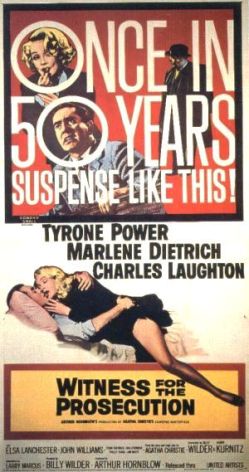
Lisa Watches an Oscar Nominee: Witness for the Prosecution (dir by Billy Wilder)


Movie_poster_for_-Witness_for_the_Prosecution-

Earlier today, I DVRed the 1957 best picture nominee, Witness for the Prosecution, off of TCM.  I watched the film as soon as I finished dinner and, having now seen Witness for the Prosecution, I am prepared to give you my professional and erudite review.

Okay, are you ready for it?  Here we go:

🙂 Oh my God, I freaking love this movie!!!!!!!!! 🙂

Witness for the Prosecution is many things.  It’s a courtroom drama.  It’s a domestic comedy.  It’s a twisty murder mystery.  It’s a showcase for three great performers.  It’s crowd pleaser that will make you think and, even if it does involve people killing each other, it will probably make you smile as well.  Don’t let that 1957 date fool you.  Witness For the Prosecution is a lot of fun.

Leonard Vole (Tyrone Power) is a somewhat sleazy man who has two claims to fame.  One is that he claims to be responsible for inventing the egg beater.  The other is that he’s been accused of murdering Mrs. French (Norma Varden), a wealthy widow who had recently named Leonard as the beneficiary of her will.  Everyone assumes that Leonard must have been having an affair with Mrs. French but Leonard claims that he’s innocent.

Suspecting that he is soon going to be arrested, Leonard hires Sir Wilfred Robarts (Charles Laughton) to serve as his attorney.  Though Sir Wilfred is recovering from a heart attack and has been ordered to not take on any more stressful criminal cases, he agrees to defend Leonard.  He proceeds to do just that, under the watchful eye of his nurse, the protective Mrs. Plimsoll (Elsa Lanchester).

(The testy relationship between Sir Wilfred and Mrs. Plimsoll provides the film with its comedic relief.  Laughton and Lanchester were married in real life and, watching the film, you can tell that they had a lot of fun acting opposite each other.)

Sir Wilfred is convinced that he can win acquittal for Leonard, especially since Leonard’s German wife, Christine (Marlene Dietrich), is willing to provide an alibi for him.  (In one of the film’s best moments, Sir Wilfred talks about how distraught Christine will be to discover that Leonard has been arrested just to then have the very calm and self-possessed Christine step into the room.)  However, to everyone’s shock, Christine is called as a witness for the prosecution.  She testifies that Leonard confessed the murder to her and that she only provided an alibi out of fear and love.

Things aren’t looking good for Leonard but then, a mysterious woman with a cockney accent contacts Sir Wilfred and reveals that Christine may have had reasons of her own for not giving Leonard an alibi…

Witness For The Prosecution ends with a voice over that says, “The management of this theater suggests that for the greater entertainment of your friends who have not yet seen the picture, you will not divulge, to anyone, the secret of the ending of Witness for the Prosecution.”  And I have to say that, when I heard that, it just made me love the film even more.  I had enjoyed the film so much and had so much fun following all the twists and the turns of the mystery that I found myself nodding in agreement.

“Sure, 58 year-old voice over,” I said, “I will not divulge the secret ending of Witness For The Prosecution.”

And I’m not going to!  Though, to be honest, you’ll probably guess the secret before it’s revealed.  It’s a plot twist that has been imitated by so many other courtroom dramas that it’s probably not as much of a mind-blower today as it may have been back in 1957.

But no matter!  Witness For The Prosecution is still a lot of fun.  Even if you figure out the mystery early, you can still watch the film and enjoy Laughton’s wonderfully theatrical performance.

Witness for the Prosecution was nominated for best picture and, interestingly enough, another theatrical courtroom drama — 12 Angry Men — was also nominated that year.  It’s interesting to compare the low-key drama of 12 Angry Men to the cheerful flamboyance of Witness For The Prosecution.  They are both great films about the law but each is told from a very different perspective.

Of course, in the end, both of these great films ended up losing to The Bridge On The River Kwai.