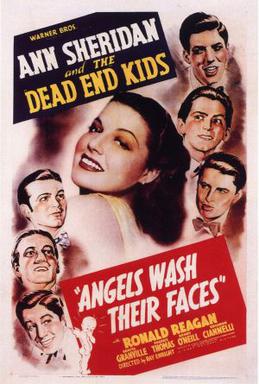
Angels Wash Their Faces (1939, directed by Ray Enright)


Gangster William Kroner (Bernard Nedell) and his henchman Martino (Eduardo Ciannelli) frame teenager Gabe Ryan (Frankie Thomas) for setting several buildings on fire.  Because Gabe has just gotten out of reform school and is a member of a local neighborhood gang, they know that no one will believe him or his sister, Joy (Ann Sheridan).

What Kroner and Martino did not count on were the Dead End Kids (Billy Halop, Bobby Jordan, Leo Gorcey, Gabriel Dell, Huntz Hall, and Benard Punsley).  They’re not going to sit by while the adults send their friend to jail.  Plus, one of their friends was killed in one of the fires.  The kids are out for revenge and sympathetic district attorney Pat Remsen (Ronald Reagan) is on their side.

As a publicity stunt, the city is holding an election for “Kid Mayor.”  The Kid Mayor gets to run the city for a week.  What could go wrong?  Billy Halop decides to run for Kid Mayor so that he can order the arrest of Kroner and then beat a confession out of him.

Angels Wash Their Faces was one of the last of the studio-made Dead End Kid films.  After this one, they would be sent down to Poverty Row and their films would be more obviously comedic.  Angels Wash Their Faces starts out as a juvenile delinquent drama, with Gabe struggling to rebuild his life and keep on the right track.  Then it becomes a goofy comedy, with Billy Halop running for mayor and unleashing vigilante justice on the bad guys.  I’m not sure that any city would actually give the “kid mayor” the power to lock people up.  Whoever came up with the idea of a kid mayor should be run out of politics.

On the positive side, Ann Sheridan is beautiful.  Future president Reagan is his usual friendly self.  On the negative side, the movie, overall, lacks the edge that made the first few Dead End Kids films memorable and the Dead End Kids themselves seem to be pretty much interchangeable.  Huntz Hall would have made a better mayor.
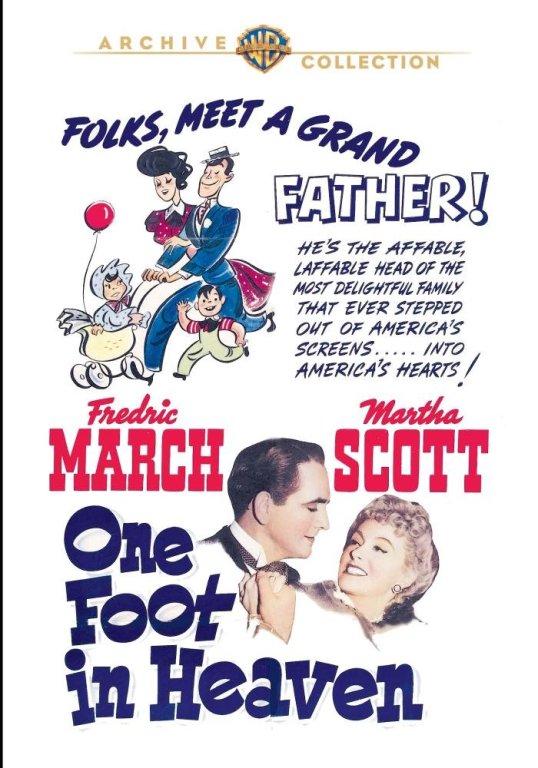
 

Lisa Reviews An Oscar Nominee: One Foot In Heaven (dir by Irving Rapper)


I have to admit that One Foot In Heaven is a film that I probably never would have watched if not for the fact that it received an Oscar nomination for Best Picture.

This film from 1941 tells what I presume to be a true — or, at the very least, a true-ish — story.  Fredric March plays William Spence.  The film opens in 1904 with Spence explaining to his future in-laws that he’s spontaneously decided to drop out of medical school because he feels that he’s been called to become a Methodist minister.  Though no one is happy or particularly encouraging about William’s decision to abandon the financial security of medicine to work as a minister, William feels that it’s what he was meant to do.

We follow William and his wife, Hope (Martha Scott), as they move from town to town, living in dingy parsonages and barely paying the bills by doing weddings.  Though Hope is frustrated by the constant moving and the less-than-ideal living conditions, she remains supportive of William.  They start a family and William goes from being a stern and somewhat judgmental man to becoming an inspiring minister.  He even changes his opinion about the sinfulness of going to the movies.  (All things considered, that’s probably for the best.)  Eventually, William, Hope, and the family end up ministering to a congregation in Colorado.  Determined to finally give his wife the home that she deserves, William tries to rebuild both the church and the parsonage.  It turns out to be more difficult than he was expecting.

That’s pretty much the film.  There’s not really much conflict to be found, until the final 30 minutes or so when William struggles to convince a bunch of snobs to help him achieve his dream of building a new church.  The film opens with a title card thanking the Methodists for their help in the production of the film, which should tell you everything you need to know about the film’s attitude towards Protestantism.  William does debate an agnostic at one point but it’s not much of a debate.  William, after all, is played by the authoritative Fredric March while the agnostic’s name isn’t even listed in the credits.  It’s a well-made film, in that sturdy way that many 1941 studio productions were, but — unless you’re just crazy about the history of Methodism — it’s not particularly interesting.

On the plus side, Fredric March gives a good performance as William Spence.  March was one of the best actors of Hollywood’s Golden Age and he gives a sympathetic performance as a stern but well-meaning man who respects tradition but who is still willing to admit that he has much to learn.  Probably the film’s most effective scene is when William reluctantly watches a movie with his son.  March captures William’s transformation from being a disapproving father to an entertained filmgoer.  It’s one of the few moments when the film really feels alive.

So, how did One Foot In Heaven receive a Best Picture nomination in the same year that saw nominations for films like Citizen Kane, The Little Foxes, Suspicion, and The Maltese Falcon?  One Foot In Heaven is well-made and totally uncontroversial.  It’s the type of film that, if it were made today, it would probably be directed by Ron Howard and it would star someone like James Marsden or Garrett Hedlund.  One Foot In Heaven is not particularly memorable but there’s nothing particularly terrible about it either and it probably felt like a “safe’ film to nominate.  Still, it’s probably significant that One Foot In Heaven didn’t receive any nominations other than one for Best Picture.  It lost that Oscar to another film about family, How Green Was My Valley.

Horror On TV: Suspense 2.5 “Dr. Violet” (dir by Robert Stevens)


I think it’s fairly safe to say that wax museums are inherently creepy.

I mean, don’t get me wrong.  If I see a wax museum off of the side of the road, I’m definitely going to visit it, if just so I can find the Hall of Presidents and give the finger to FDR.  (It’s a long story.)  But that said, wax museums are definitely not some place where you would want to get accidentally locked in.

Well, in tonight’s episode of Suspense, that’s exactly what happens to one unfortunate college student.  AGCK!

This episode originally aired on October 4th, 1949 and it has a very impressive cast that will be familiar to anyone who has ever spent a few hours watching TCM: Anne Francis, Hume Cronyn, Ray Waltson, Evelyn Varden, and Mike Kellin are all featured.

Enjoy!

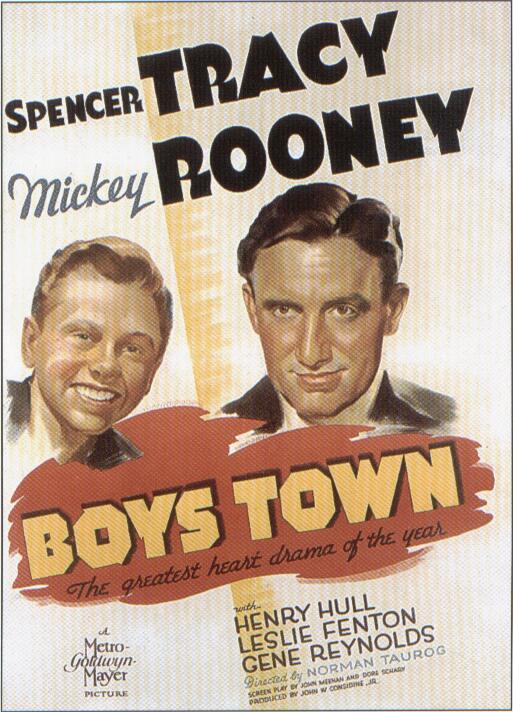
Lisa Reviews An Oscar Nominee: Boys Town (dir by Norman Taurog)


boys_town

Before writing about the 1938 film Boys Town, I want to share a story that might be false but it’s still a nice little story.  Call this an Oscar Urban Legend:

Boys Town is about a real-life community in Nebraska, a home for orphaned and homeless boys that was started by Father Edward Flanagan.  In the film, which was made while Father Flanagan was still very much alive, he was played by Spencer Tracy.  Boys Town was a huge box office success that led to the real Boys Town receiving a lot of favorable publicity.  When Tracy won his Oscar for Boys Town, his entire acceptance speech was devoted to Father Flanagan.

However, a problem arose when an overeager PR person at MGM announced that Spencer Tracy would be donating his Oscar to Boys Town.  Tracy didn’t want to give away his Oscar.  He felt that he had earned it through his acting and that he should be able to keep it.  Tracy, the legend continues, was eventually persuaded to donate his Oscar on the condition that he would get a replacement.

However, when the replacement arrived, the engraving on the award read, “Best Actor — Dick Tracy.”

That’s a fun little story, one that is at least partially true.  (Tracy’s Oscar — or at least one of them — does currently reside at the Boys Town national headquarters.)  It’s also a story that, in many ways, is more interesting than the film itself.

Don’t get me wrong.  Boys Town is not a bad movie.  For me, it was kind of nice to see a movie where a priest was portrayed positively as opposed to being accused of being a pederast.  In a way, Boys Town serves as a nice counterbalance to Spotlight.  But, with all that said, there’s not a surprising moment to be found in Boys Town.  It’s pretty much a standard 1930s juvenile delinquency melodrama.

The movie opens when Father Flanagan giving last rites to a man who is about to be executed.  (Boys Town takes a firm stand against the death penalty, which is one of the more consistent and laudable stands of the modern Church.)  The man says the he never had a chance.  From the time he was a young boy, he was thrown into the reform school system.  Instead of being reformed, he just learned how to be a better criminal.  Father Flanagan is so moved by the doomed man’s words that he starts Boys Town, under the assumption that “there’s no such thing as a bad boy.”

Father Flanagan’s techniques are put to the test when Whitey Marsh (Mickey Rooney ) arrives.  Whitey is angry.  He’s rebellious.  He tries to run away every chance that he gets and, during one such escape attempt, he even gets caught up in a bank robbery.  Can Father Flanagan reach Whitey and prove that there’s no such thing as a bad boy?

Well, you already know the answer to that.  As I said, there’s really nothing surprising to be found in the plot of Boys Town.  It’s just not a very interesting movie, though there is a great shot of a despondent Whitey walking past a several lines of former juvenile delinquents, all kneeling in prayer.  As Father Flanagan, Spencer Tracy is the ideal priest but his role is almost a supporting one.  Believe it or not, the film is dominated by Mickey Rooney, who gives a raw and edgy performance as the angry Whitey Marsh.

(That said, it’s hard to take Whitey seriously as a future gangster when he’s always wearing a bowtie.  Then again, that may have been the height of gangster style in 1938.)

Boys Town was nominated for best picture but lost to You Can’t Take It With You.