4 Shots From Horror History: Dracula, Frankenstein, Vampyr, White Zombie


This October, I’m going to be doing something a little bit different with my contribution to 4 Shots From 4 Films.  I’m going to be taking a little chronological tour of the history of horror cinema, moving from decade to decade.

Today, we take a look at the start of the 1930s.

4 Shots From 4 Films

Dracula (1931, dir by Tod Browning)

Dracula (1931, dir by Tod Browning)

Frankenstein (1931, dir by James Whale)

Frankenstein (1931, dir by James Whale)

Vampyr (1932, dir Carl Theodor Dryer)

Vampyr (1932, dir Carl Theodor Dryer)

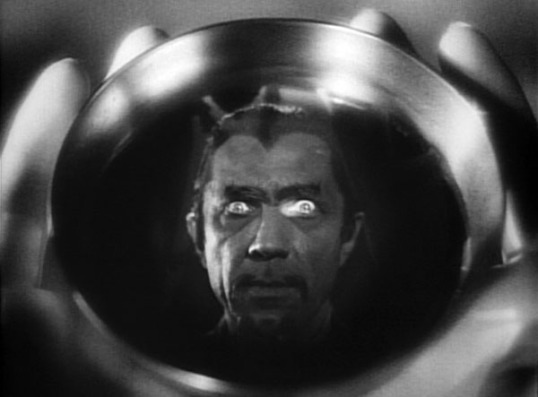
White Zombie (1932, dir by Victor Halperin)

White Zombie (1932, dir by Victor Halperin)

Horror Film Review: Frankenstein (dir by James Whale)


frankenstein_poster_1931

Pity poor Frankenstein.

No, not Victor von Frankenstein, though he certainly suffered greatly for playing God.  How much he suffered depends on which version of the story you see or read.  If you’ve read the book, you know that Victor lost his family, his love, his mentor, his best friend, and eventually his own life.  Victor is usually a bit more resilient in the films.  For instance, if you go by what we’ve seen in the Hammer films, Baron Frankenstein was pretty much indestructible.  The only thing he lost was his sanity, sacrificed as he continually insisted on making the same mistake over and over again.

And when I say “Pity poor Frankenstein,” I’m not referring to the monster either, though he certainly deserves some sympathy as well.  The monster never asked to be brought to life.  He may have destroyed castles and killed people and tossed little girls into a lake but Frankenstein’s Monster rarely seemed to mean any harm.  He was just scared, confused, and often abused.

Instead, when I say pity poor Frankenstein, I’m referring to the 1931 film.  It’s a classic horror film, one that, after 85 years, still holds up remarkably well.  It’s probably the best directed of all the Universal horror films, with James Whale bringing his own dark wit and idiosyncratic style to the film.  As was often the case with films of the era, some of the performances are better than others but no one can find fault with Boris Karloff’s definitive portrayal of Frankenstein’s monster.

And yet, for a lot of filmgoers, Frankenstein will always just be that movie where Colin Clive rants, “It’s alive!  IT’S ALIVE!”  That scene is justifiably famous but it always bothers me when it shows up as an isolated clip, devoid of context.  I’ve seen it used in documentaries.  I’ve seen it used on snarky news programs where it’s almost always used to poke fun at someone.  I’ve even seen it used in a car commercial.

You’ve seen it too.  It’s one of those scenes that everyone has seen, regardless of whether or not they’ve sat through the entire movie:

When you watch this scene without any context, it’s easy to smirk.  You might assume that the entire film is Colin Clive ranting and Dwight Frye snorting.  It’s only after you’ve seen the entire film that you appreciate Clive’s performance.  Throughout the entire first part of the film, Colin Clive plays Henry Frankenstein as being unstable but also rather withdrawn.  He’s almost vampiric, hiding inside of his laboratory all day and only coming out at night to rob graves with the hunchbacked Fritz (Dwight Frye).  He’s almost a recluse, which is why his fiancée, Elizabeth (Mae Clarke) asks his best friend, Victor (John Boles), and his mentor, Dr. Waldman (Edward Van Sloan, who also played Van Helsing in Dracula) to check in on him.

When the monster does move its hand and Clive shouts, “It’s alive!,” it’s the first sign of true emotion that Frankenstein has shown through the entire film.  He’s spent a lifetime dreaming of playing God and, now that he has, it overwhelms his mind.  Much like poor Ralph Norton in The Mummy, Clive sees something that defies all reason and he has a breakdown.

I have to admit that, for me, the first third of the film drags.  That may not have been as much of a problem in 1931, when audiences were seeing the story for the first time and didn’t already know what was going to happen.  In 1931, the slow start undoubtedly helped to build up suspense.  But, when seen today, there is a temptation to say, “Get on with it!”

(Of course, I tend to say that with all Frankenstein movies, because I’m impatient and there always seems to be an endless number of scenes people digging graves and stealing brains until we finally get to the good part.  If anything, the 1931 Frankenstein doesn’t take as long to get going as some of the later Hammer films, many of which treated the monster as almost an afterthought.)

Fortunately, Frankenstein does get on with it.  When the monster finally comes to life and Colin Clive has his moment of divine madness (“This is what it feels like to be God!”), the film shifts in tone.  If anything it becomes a bit of a dark comedy.  Henry (who is noticeably more subdued after his outburst, a bit like a drug addict who is only now starting to come down after being awake for a week) and his friends now have to not only hide the monster but try to figure out how to deal with it.  Every few minutes, it seems like another villager or Frankenstein relative is dropping by the castle.  Having created life, Henry now has no idea what to do with it.  Being God isn’t as easy as it looks.  Having created life, all Henry can now do is keep the doors locked and attempt to go back to living a relatively normal life.  In this case, that means preparing for his wedding.

It’s not until the sadistic Fritz torments the frightened monster with a torch that this horror classic truly becomes a horror film.  And it’s significant that the true monster here is not Frankenstein’s Monster but instead Fritz.  When the monster kills Fritz, he does it out of self-defense.  When he strangles Dr. Waldman, it’s because Waldman was about to cut into him with scapel.

And then there’s the little girl.  How this scene must have shocked audiences in 1931!  It’s still shocking today, because we’re not used to children dying in movies, not even horror movies.  Of course, the monster doesn’t mean to hurt the girl.  The girl is the first person to show the monster any sort of kindness.  It’s just that the monster doesn’t understand that the girl won’t float like the flowers.

The sequence where the girl’s father carries her body into the town square is perhaps one of the most devastating ever filmed.   Not only does the father’s grief contrast with the happiness of the villagers but it also contrasts with the attitude of Henry and Elizabeth who are busy preparing from their wedding, ignorant of what Henry’s creation has done.

Or, at least, they are until the monster confronts Elizabeth in her bedroom.

karloff-boris-frankenstein_11

I love that dress.

It all ends, of course, with a confrontation between Henry and his monster and a windmill being set aflame.  There’s also a happy coda that, in the best tradition of horror, feels a bit tacked on.  Fortunately, those of us who know our film history know that the story didn’t end with this film.  It continued with The Bride of Frankenstein, which I’ll be reviewing tomorrow.

As for Frankenstein, it’s a classic and it’s pretty much required viewing for any film lover.  Boris Karloff’s performance as the confused and often child-like monster is both poignant and menacing.  Watching the film, you just wish that the world had been nicer to him.

(Then again, that approach didn’t exactly work out well for the little girl with the flowers…)

Frankenstein is so much more than just Colin Clive shouting, “It’s alive!”  If you haven’t actually sat down watched the entire movie from beginning to end, you owe it to yourself to do so today.

4 Shots From Horror History: Frankenstein, Dr. Jekyll and Mr. Hyde, The Student of Prague, Eerie Tales


This October, I’m going to be doing something a little bit different with my contribution to 4 Shots From 4 Films.  I’m going to be taking a little chronological tour of the history of horror cinema, moving from decade to decade.

Today, we take a look at the 1910’s.

4 Shots From 4 Films

Frankenstein (1910, dir by J. Searle Dawley)

Frankenstein (1910, dir by J. Searle Dawley)

Dr. Jekyll and Mr. Hyde (1913, dir by Herbert Brenon)

Dr. Jekyll and Mr. Hyde (1913, dir by Herbert Brenon)

The Student of Prague (1913, dir by Stellan Rye and Paul Wegener)

The Student of Prague (1913, dir by Stellan Rye and Paul Wegener)

Eerie Tales (1919, dir by Richard Oswald)

Eerie Tales (1919, dir by Richard Oswald)

Horror Scene That I Love: The Monster and Maria from Frankenstein (1931, directed James Whale)


This scene that I love comes from the classic 1931 horror film, Frankenstein.  In this poignant scene, Frankenstein’s Monster (Boris Karloff) meets young Maria.  Maria is the first human to treat the Monster with true kindness.  Unfortunately, the Monster does not understand that, unlike flower petals, Maria does not float.

This scene features Karloff at his absolute best!

4 Shots From 4 Films: Frankenstein, Dracula, The Mummy, White Zombie


4 Shots From 4 Films is just what it says it is, 4 shots from 4 of our favorite films.  As opposed to the reviews and recaps that we usually post, 4 Shots From 4 Films is all about letting the visuals do the talking.

4 Shots From 4 Films

Frankenstein (1931, directed by James Whale)

Frankenstein (1931, directed by James Whale)

Dracula (1931, directed by Tod Browning)

Dracula (1931, directed by Tod Browning)

The Mummy (1932, directed by Karl Freund)

The Mummy (1932, directed by Karl Freund)

White Zombie (1932, directed by Vincent Halperin)

White Zombie (1932, directed by Victor Halperin)

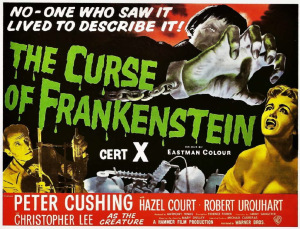
Gods of the Hammer Films: Peter Cushing, Christopher Lee, and THE CURSE OF FRANKENSTEIN (1957)


gary loggins's avatarcracked rear viewer

curse4

When Britain’s Hammer Films began in the early 1930’s they were just another movie production company. After finding some success with the 1955 sci-fi adaptation THE QUARTERMASS EXPERIMENT, they chose to make a Gothic horror based on Mary Shelley’s classic 1818 novel about a man obsessed with creating artificial life. FRANKENSTEIN had been filmed many times before, most notably Universal’s 1931 version that brought eternal fame to Boris Karloff. This time however, the producers shot in vibrant color, with blood and body parts on gory display. Tame stuff compared to today’s anything goes horrors, but in the fifties it was considered quite shocking.

Peter Cushing and Christopher Lee had appeared in two films before, Lawrence Olivier’s 1948 HAMLET and John Huston’s 1952 MOULIN ROUGE, though not as a team. Once CURSE OF FRANKENSTEIN was unleashed upon the public, they were paired another nineteen times, making Cushing and Lee terror’s all-time tandem. HORROR OF DRACULA came next, with…

View original post 613 more words

6 Madly Scientific Trailers for Halloween


It’s been way too long since we posted a new edition of Lisa Marie’s Favorite Grindhouse and Exploitation Film Trailers!  Personally, I blame the Trailer Kitties.  You know how they can be!  But, earlier today, I sent them out and I told them to come back with 6 trailer for Halloween!

This is what they returned with!

1) Frankenstein (1931)

2) Bride of Frankenstein (1935)

3) Son of Frankenstein (1939)

4) Ghost of Frankenstein (1942)

5) Curse of Frankenstein (1957)

6) Andy Warhol’s Frankenstein (1973)

What do you think, Trailer Kitty?

Halloween Trailer Kitty

Duke Tries A Halloween Marathon…Part Two.


This is part two of my attempt at partaking in a October horror marathon. The first part of which can be found here.

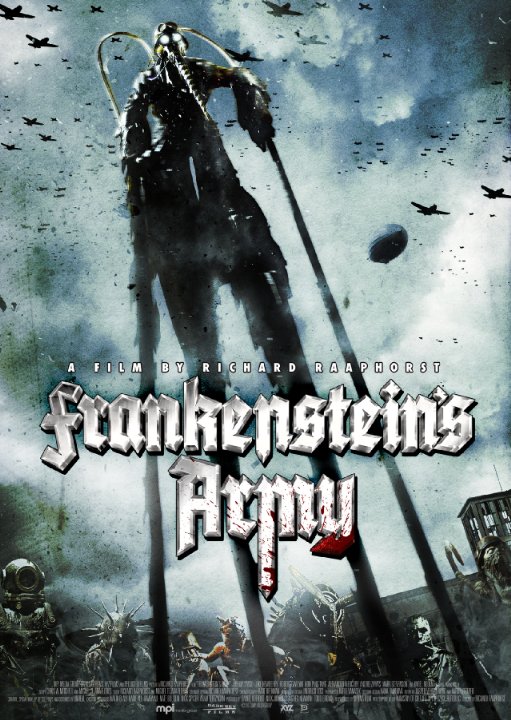
October 5th (Watched two because I didn’t have time on the 4th): ‘Frankenstein’s Army’ (dir. Richard Raaphorst)

MV5BMjA1NDE0MzcyMF5BMl5BanBnXkFtZTcwNTU2MzA3OQ@@._V1_SX640_SY720_

‘Frankenstein’s Army’ is a WWII found footage film with a weirdness and creativity that makes for one fun, goofy and clever experience…if you can get past the headache inducing sound design.

The film is about a small squad of Russian soldiers, behind enemy lines, who stumble upon an eerily abandoned church. What they find inside is a lab of a decedent of Victor Frankenstein, who has been experimenting with the bodies of soldiers (friend and foe) and turning them into mindless monsters mixed with machinery of all sorts.

The film is shot in a found footage style and it actually works. The explanation behind it is essentially they are trying to make a propaganda film. There is the usual question as to why they are still filming during certain scenes, but I actually think the film as a whole would not have worked as well had it been filmed conventionally.

The best thing about the film is easily the production, at least visually. There are some really well done long takes, often with characters in the background doing things that one might miss if they aren’t paying attention. The costume/monster designs are wonderfully weird and creative. They definitely had fun with the concept, and it shows.

The only issue I had was the sound design, which was mindbogglingly annoying. I mean really bad. So screechy, scratchy and just plain irritating. I understand that because of the nature of some of the monsters and their machine parts that it would require these sorts of sounds, but ultimately they add nothing to the experience except a headache. However, this might only be me. Others might not have the same response, so I won’t really hold it against the film – I just probably will never watch it again.

Overall this is a fun, if hollow, film worthy of at least one viewing. The performances aren’t great, and the dialogue is exactly what you’d expect from this sort of film. There is no subtext and no real scares. Still, it is so creative and so bat-shit crazy at times that it would be a shame to pass it up if given the opportunity. Especially when it is a lean 84 minutes.

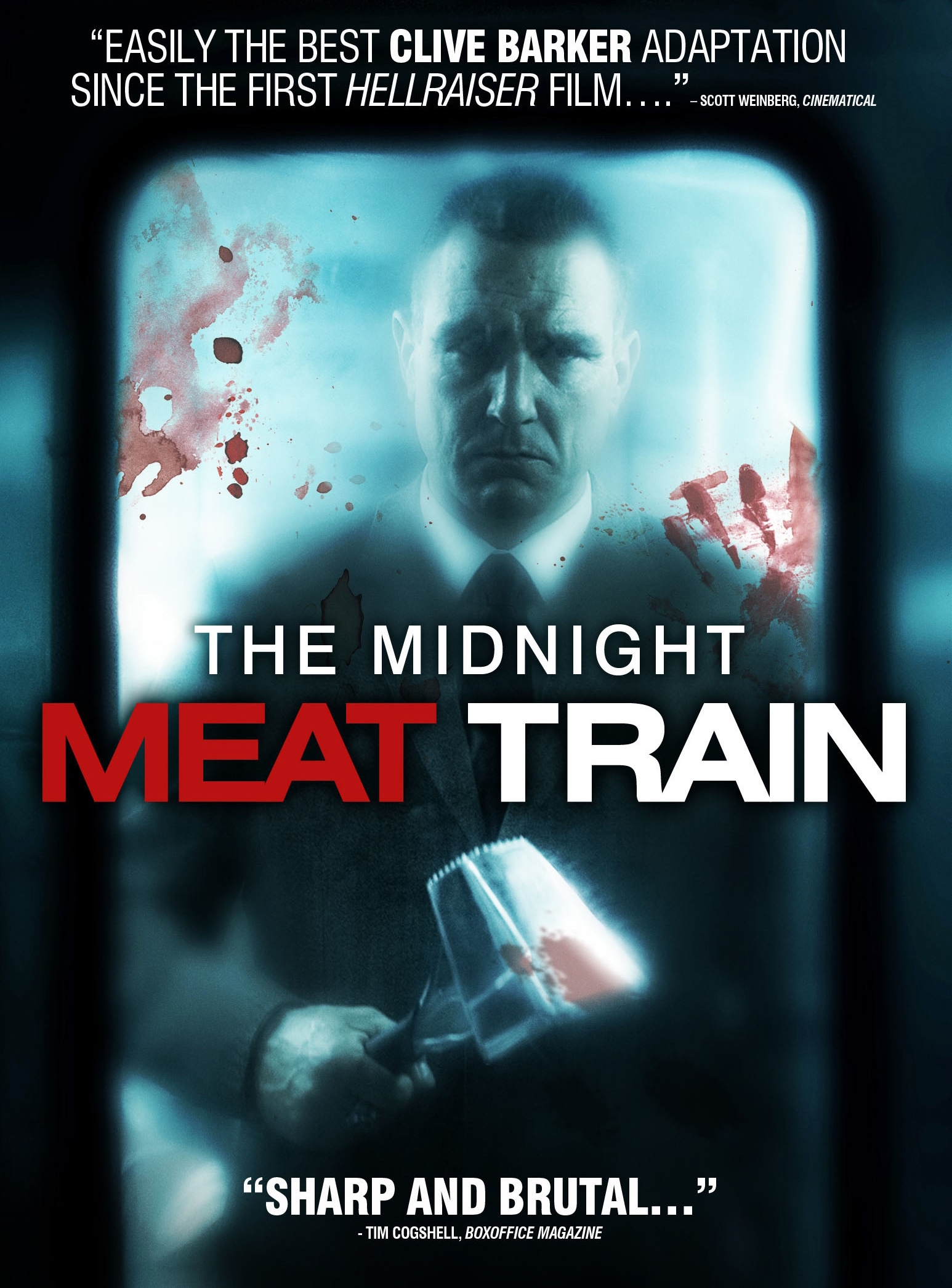
‘The Midnight Meat Train’ (dir. Ryûhei Kitamura)

midnight_meat_train_poster_01

‘The Midnight Meat Train’ is a brutal and violent horror film, that is unfortunately dragged down by some scripting and pacing issues.

The film stars Bradley Cooper as a photographer who, after being told to be a bit riskier in his search for great photos, finds himself face to face with Vinnie Jones, a butcher who is brutally murdering people on a train. Cooper begins to follow Jones in an attempt to gather evidence of the murders, all the while the darkness of the situation taking its tool emotionally on him.

The biggest issue I had was the pacing of the story as well as the characters. It is a weird situation in which I simultaneously wished it would slow down in terms of character development, while also picking up the pacing for the horror. There is such a rapid shift in the emotions of the characters that – although valid – happen way to abruptly. What is worse is that it isn’t like they don’t have enough time to draw this out. Because they do…almost too much so, to the point that I was also wishing they’d hurry up with the horror elements.

This wouldn’t have been too big of an issue if not for the fact that it made me lose interest in a lot of what was happening. I wasn’t invested in the characters or the horror because of it, and so any attempts at creating suspense were lost of me – leaving me with only the graphic and brutal kills on the train, which just aren’t my thing. I can handle gore, but find it utterly pointless – and distasteful – when there is little to no meaning behind it.

It wasn’t all bad though, with the stand out being the direction. There is some really great camerawork, especially in a scene set in an apartment. I also liked the visual contrasts between the surface and train scenes; and Vinnie Jones was cool, calm and terrifying. The ending was also great, where there is a reveal of a mythical plot line that is alluded to throughout most of the film. It is a very weird tonal shift, and goes a long way towards adding meaning to a lot of what came before it…sadly it is a case of too little too late.

Overall I didn’t hate it, but an hour in I was just ready for it to finally be over…and imagine my dismay when I realized there was another 40 minutes or so left. It is the sort of horror film in which its failings are harder for me to ignore, as I might in another film, given the content. If you are looking for just a gory horror film in which the shock value is simply the brutal violence, then this might be for you. If you are looking for something with a bit more substance, than you may want to look elsewhere.

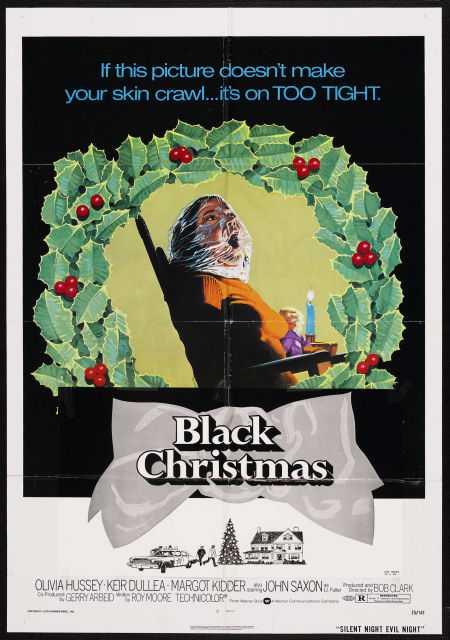
October 6th: ‘Black Christmas’ (dir. Bob Clark)

blackchristmasonesheet_1

‘Black Christmas’, considered to be one of the first ever slasher films, is an efficient, effective and highly enjoyable horror film – one I will definitely revisit often.

The film is set during Christmas at a sorority, the members of which are being harassed by someone making creepy prank calls. As many of them leave for the holiday break, one goes missing, setting off a search for her and the person calling the house. As the remaining sorority sisters try to deal with this, they begin to be killed off one by one by a killer who may potentially be someone very close to them.

The only issue I had was with a particular mannerism of the killer. The film took on a first person perspective whenever he appeared – which was effectively spooky- but there was quite a lot of moaning and weird grunts coming from him at the same time. They were meant to be eerie, and in the end worked because of the nature of his mania and the calls to the house – but it was ultimately more annoying than unsettling.

But I can easily overlook this minor issue because of just how well made the film is. There is a genuine feeling of suspense here, partly because of the whodunit nature of the murders; and also because of the closeness of the killer throughout the events of the film. You never know who it is, what will set him off, or who will be killed next – but you do know he is there, waiting.

That said, it isn’t necessarily a scary film per se, but an unsettling and bleak one. The sort that gets under your skin and sticks with you. However, with that, it has to be said that through all the bleakness, there is also a great sense of humor to the story. There is also actually a maturity and depth to the script that I wasn’t expecting. This might be set in a sorority, but it isn’t about partying and dim witted topless girls, like so many slashers that came after it. The women here are smart and mature, dealing with important family and relationship issues. This added a lot to my investment in the characters, and so made the fear of their potential demise all the more suspenseful.

The direction is great – Christmas makes for a perfect setting, at least visually. There is solid pacing and an effective slow build throughout. I was surprised how well the mystery it creates in its first few scenes holds up so well even when things slow down a bit halfway through. I think this has a lot to do with the fact that even when it might not be focused on its creepier slasher elements, it instead is focused on those previously mentioned characters – again making the suspense as the killer stalks them all the more effective. There is no real resolution to the story, but the film is less focused on the actual killer and more focused on building an atmosphere and a story that is almost mythical.

Lastly, as someone who isn’t too knowledgeable in regards to the genre, it was easy to initially think that a lot of the tropes in play were cliche…but once I took into consideration the fact that ‘Black Christmas’ came out in 1974, and was really the start of most of these, they actually added a level of admiration to my already high level of enjoyment. It might not be as good as something like ‘Halloween’, which clearly drew some influence from this, but it deserves to be considered just as much of a classic. This is easily the best film I’ve watched so far for this horror series, and one that I’d add to my list of favorite horror films of all time.

*Side note, it is absolutely hilarious that director Bob Clark also directed ‘A Christmas Story’.

A Quickie With Lisa Marie: Frankenstein (dir. by J. Searle Dawley)


There’s literally been hundreds of film adaptations of Mary Shelley’s novel Frankenstein, or the Modern Prometheus.  Everyone from James Whale to Terrence Fisher to Paul Morrissey to Kenneth Branagh to Marcus Nispel has taken a shot at interpreting the legend and the monster’s been played by everyone from Boris Karloff to Christopher Lee to Robert De Niro to Srdjan Zelenovic (who was pretty freaking hot and yummy for a creature stitched together out of random corpses in Flesh for Frankenstein).

However, the very first cinematic version of Frankenstein came out in 1910.  Produced by Thomas Edison’s film company, this 10-minute, silent film starred an actor named Charles Ogle as the monster.  Frankenstein, himself, was played by Augustus Phillips while his fiancée was played by Mary Fuller.  The film was directed by a fellow known as J. Searle Dawley.  Dawley reportedly directed over a hundred silent films and most of them are lost to history.

For about 6 decades, it was assumed that Dawley’s Frankenstein was lost as well.  However, in the mid-70s, it turned out that one remaining print of the film still existed and was apparently sitting up in someone’s attic in Wisconsin.  It also turned out that the film was still in viewable condition.

And now, thanks to a combination of YouTube and the fact that every movie made before 1922 is now in the public domain, I’ve had the opportunity to see this movie for free and even better, here’s your chance to see it for free.  Understand that when I say better, I’m speaking from the point of view of someone who is fascinated by history in general and cinematic history in specific.  In many ways, this film epitomizes everything that makes it difficult for modern audiences to appreciate the excitement once generated by silent film.  The acting is overly theatrical and watching the film makes you appreciate the eventual development of the dolly shot and the zoom lens even more.  Add to that, the music that was selected to accompany this video is way too obvious and heavy-handed.  I would suggest, before watching, that you mute the video and put your own preferred music on instead.

Still, the film does have a lot of historic interest.  I don’t think you can truly judge and appreciate the films of today unless you know something about the films of the past.  Watching a movie like the 1910 Frankenstein not only makes you realize how far films have come as an art form but also how much of the medium’s inherent earnestness has been lost with each advance in technology. 

Anyway, with all that said, here is the 1910 version of Frankenstein