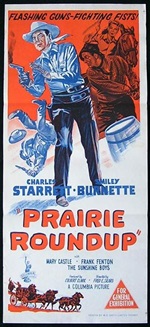
Prairie Roundup (1951, directed by Fred F. Sears)


Steve Carson (Charles Starrett) is wanted for murdering the Durango Kid!

I know that sounds confusing because Steve Carson is the Durango Kid.  The bandit that Carson shot was just disguised as the Durango Kid but actually, he was just a dim-witted outlaw who was set up by Buck Prescott (Frank Fenton), a rustler who was run out of Texas by Steve and who was trying to find a way to stop Steve from investigating his new scheme to cheat a bunch of ranchers in Santa Fe.

Steve is taken to jail but luckily, Smiley Burnette is around to help him break out.  Smiley and Steve head to Santa Fe, where they get jobs working as cowhands at the Eaton Ranch and work to expose Prescott and his gang as being responsible for a series of stampedes.  Smiley sings some songs and Steve resurrects the Durango Kid from the dead.

This was one of the later Durango Kid films.  The range war plot is one that showed up in many Durango Kid films but Prairie Roundup adds something new to the formula but having Steve framed for murdering himself.  Steve could prove his innocence by revealing that he’s actually the Durango Kid but Steve is determined to maintain his secret identity.  I’ve seen several Durango Kid films and I still don’t really understand why Steve felt he needed a secret identity in the first place.  But Prairie Roundup shows the extent to which he’ll go to keep it.

There’s plenty of fight and horse chases, more than enough to keep western fans happy.  Smiley Burnette gets to throw some punches along with singing all of his usual songs.  It’s also nice to see the lovely Mary Castle in the role of Toni Eaton, the daughter of one of the ranchers who has been targeted by Prescott.  Featuring less stock footage than usual, Prairie Roundup is a worthy entry in the Durango Kid series.

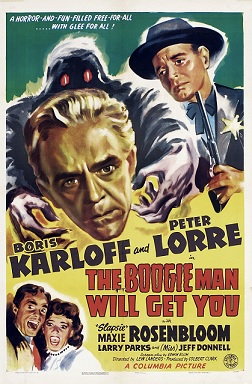
Horror on the Lens: The Boogie Man Will Get You (dir by Lew Landers)


Today’s horror on the lens is a short horror comedy from 1942.  In The Boogie Man Will Get You, Winnie Slade (Miss Jeff Donnell) buys an old house from Prof. Billings (Boris Karloff) with plans to covert it into a hotel.  However, one of the conditions of the sale is that Prof. Billings and his servants be allowed to live on the property.  What Winnie doesn’t know is that Prof. Billings had been conducting experiments on traveling salesman.  He hopes to turn them into supermen who, much like Captain America, can then be sent overseas to fight the Nazis.  However, his experiments have yet to be successful and have mostly just resulted into a lot of salesman being buried out in the rose garden.

However, things start to look up for Prof. Billings when he meets Dr. Lorencz (Peter Lorre), who is not only a doctor but also a mayor, sheriff, and dog catcher.  Seriously, Dr. Lorencz can do it all!

The Boogie Man Will Get You is a fun little time capsule of the time in which it was made.  For horror fans, it is mostly interesting because it features both Boris Karloff and Peter Lorre.  Both Karloff and Lorre appear to be having a lot of fun parodying their usual screen images.

Enjoy!

Lisa Reviews An Oscar Nominee: The Grapes of Wrath (dir by John Ford)


(With the Oscars scheduled to be awarded on March 4th, I have decided to review at least one Oscar-nominated film a day.  These films could be nominees or they could be winners.  They could be from this year’s Oscars or they could be a previous year’s nominee!  We’ll see how things play out.  Today, I take a look at the 1940 best picture nominee, The Grapes of Wrath!)

How dark can one mainstream Hollywood film from 1940 possibly be?

Watch The Grapes of Wrath to find out.

Based on the novel by John Steinbeck and directed by John Ford, The Grapes of Wrath tells the story of the Joad family and their efforts to neither get sent to prison nor starve to death during the Great Depression.  When they lose their farm in Oklahoma, they head for California.  Pa Joad (Russell Simpson) has a flyer that says someone is looking for men and women to work as pickers out west.  The 12 members of the Joad Family load all of their possessions into a dilapidated old truck and they hit the road.  It quickly becomes apparent that they’re not the only family basing all of their hopes on the vague promises offered up by that flyer.  No matter how much Pa may claim different, it’s obvious that California is not going to be the promised land and that not all the members of the family are going to survive the trip.

Tom Joad (Henry Fonda) is the oldest of the Joad sons.  He’s just been released from prison and he’s killed in the past.  Having been in prison during the start of the Great Depression, Tom doesn’t realize how bad things truly are until he arrives home and sees someone he grew up with using a tractor to knock down a house.  (It’s just business, of course.  The owners of the house can’t pay their bills so the house gets destroyed.)  The film’s story is largely told through Tom’s eyes and Henry Fonda gives a sympathetic performance, one the gets the audience to empathize with and relate to a character who is a total outsider.

As for the rest of the Joad Family, Ma (Jane Darwell) is the glue who holds them together and who refuses to allow them to surrender to despair.  (And yet even Ma is forced to make some tough choices when the starving children of one work camp ask her to share her family’s meal with them.)  Rosasharan (Dorris Bowdon) is pregnant while Grandpa (Charley Grapewin) is too sickly for the trip but doesn’t have anywhere else to go.  And then there’s Casy (John Carradine), the former preacher turned labor organizer.  Casy is not blood-related but he soon becomes a member of the family.

The Joads have a healthy distrust of the police and other authority figures and that turns out to be a good thing because there aren’t many good cops to be found between Oklahoma and California.  Instead, the police merely serve to protect the rich from the poor.  Whenever the workers talk about forming a union and demanding more than 5 cents per box for their hard work, the police are there to break heads and arrest any troublemakers on trumped up charges.  Whenever a town decides that they don’t want any “Okies” entering the town and “stealing” jobs, the police are there to block the roads.

The Grapes of Wrath provides a portrait of the rough edges of America, the places and the people who were being ignored in 1940 and who are still too often ignored today.  John Ford may not be the first director that comes to mind when you think of “film noir” but that’s exactly what The Grapes of Wrath feels like.  During the night scenes, desperate faces emerge from the darkness while menacing figures lurk in the shadows.  When the sun does rise, the black-and-white images are so harsh that you almost wish the moon would return.  The same western landscape that Ford celebrated in his westerns emerges as a wasteland in The Grapes of Wrath.  The American frontier is full of distrust, anger, greed, and ultimately starvation.  (Reportedly, the film was often shown in the Soviet Union as a portrait of the failure of America and capitalism.  However, it was discovered that Soviet citizens were amazed that, in America, even a family as poor as the Joads could still afford a car.  The Grapes of Wrath was promptly banned after that.)  John Ford is often thought of as being a sentimental director but there’s little beauty or hope to be found in the images of The Grapes of Wrath.  (Just compare the way The Grapes of Wrath treats poverty to the way Ford portrayed it in How Green Was My Valley.)  Instead, the film’s only hint of optimism comes from the unbreakable familial bond that holds the Joads together.

As dark as it may be, the film is nowhere near as pessimistic as the original novel.  The novel ends with a stillborn baby and a stranger starving to death in a barn.  The film doesn’t go quite that far and, in fact, offers up some deus ex machina in the form of a sympathetic government bureaucrat.  (Apparently, authority figures weren’t bad as long as they worked for the federal government.)  That the book is darker than the movie is not surprising.  John Steinbeck was a socialist while John Ford was a Republican with a weakness for FDR.  That said, even though the film does end on a more hopeful note than the novel, you still never quite buy that things are ever going to get better for anyone in the movie.  You want things to get better but, deep down, you know it’s not going to happen.  Tom says that he’s going to fight for a better world and Fonda’s delivers the line with such passion that you want him to succeed even if you know he probably won’t.  Ma Joad says the people will never be defeated and, again, you briefly believe her even if there’s not much evidence to back her up.

Even when viewed today, The Grapes of Wrath is still a powerful film and I can only guess what it must have been like to see the film in 1940, when the Great Depression was still going on and people like the Joads were still making the journey to California.  Not surprisingly, it was nominated for best picture of 1940, though it lost to Alfred Hitchcock’s Rebecca.

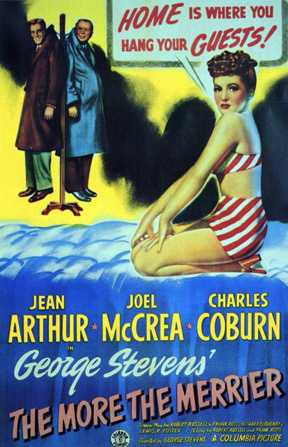
Cleaning Out The DVR #7: The More The Merrier (dir by George Stevens)


The_More_the_Merrier_-_poster

After I finished with Watch On The Rhine, I decided to watch another film from 1943.  Like Watch On The Rhine, The More The Merrier is a film about life during wartime and it takes place in Washington, D.C.  However, that’s all that they have in common.  Whereas Watch On The Rhine was a serious and somber affair, The More The Merrier is thoroughly delightful little comedy.

The More The Merrier opens with a retired millionaire named Benjamin Dingle (Charles Coburn) arriving in Washington D.C.  He’s been asked to serve as an adviser for a commission that has been tasked with solving America’s housing shortage.  (This was apparently a very real concern during World War II.)  However, as soon as Dingle arrives, he finds directly effected by the problem that he’s supposed to be solving.  His hotel room won’t be available for two days and he has no where to stay.  After a quick look through the newspaper, Ben finds an ad for a roommate.

When he arrives at the apartment, he discovers a long line of men waiting outside.  They’re all in the same situation as him and are hoping that Connie Milligan (Jean Arthur) will select him for her roommate.  However, Connie picks Ben, largely because he’s old and rich and she won’t have to worry about him hitting on her on like most guys nor does she have to worry about him borrowing her clothes or getting jealous of her, like she would have to with a female roommate.  Connie is engaged to a boring but well-paid bureaucrat named Charles Pendergrast (Richard Gaines).  She doesn’t really love Pendergrast (and he has an annoying habit of shushing her) but, after growing up poor because her mother married for love, Connie is determined to not to make the same mistake.

Ben and Connie struggle, at first, to adjust to each other’s habits.  Connie keeps to an exact schedule and claims to not have any use for frivolity.  Ben is the exact opposite.  The early scenes of them trying (and, of course, failing) to stay out of each other’s way are hilarious, with both Coburn and Arthur giving brilliant comedic performances.  (I’m jealous of how wonderfully Jean Arthur could express exasperation.)  Connie’s apartment is already small and it gets even smaller once she sublets half of it to Benjamin Dingle.

However, things are about to get even more crowded.  One day, while out exploring Washington, Ben runs into Joe Carter (Joel McCrea), a sergeant who has a few days before he’s scheduled to be shipped overseas and who has no place to stay.  Generously, Ben agrees to sublet half of his half of the apartment to Joe.  Of course, Ben does this without telling Connie.

When, after another hilarious and artfully done sequence of the three new roommates wandering around the apartment and just barely missing each other, Connie discovers what Ben has done, she orders both Ben and Joe to leave the apartment.  Ben agrees to do so, if she gives him back his security deposit.  Unfortunately, Connie already spent that money on a hat…

So, they’re stuck together.  Connie is attracted to Joe and Joe to Connie but Connie is also determined to marry Pendergrast.  (When Joe scornfully says that he bets Pendergrast combs his hair “every hour on the hour,” Connie snaps back, “Mr. Pendergrast has no hair!”)  Fortunately, Ben — being older and wiser — can see that Joe and Connie are perfect for each other and he starts doing everything he can to bring the two together.

As Ben says more than once, “Damn the torpedoes!  Full speed ahead!”

Jean Arthur is one of my favorite actresses of Hollywood’s Golden Age.  She had this perfect “no bullshit” attitude, mixed with an unexpected vulnerability.  In The More The Merrier, she’s just as credible when she’s ordering Ben and Joe to leave as when she’s breaking into tears after she catches Ben reading her diary.  In the role of Ben, Charles Coburn is warm, kind, and wonderfully eccentric.  (When Joe asks him what does for a living, Ben cheerfully replies, “I’m a well-to-do retired millionaire.  How ’bout you?”)  And then you have Joel McCrea, in the role of the “cute but dumb” Joe Carter.  He’s not really that dumb but he certainly is cute.  Wisely, McCrea never tries to be funny.  Instead, he gets most of his laughs just by reacting to all of the craziness going on around him.

Briskly directed by George Stevens, The More The Merrier features a snappy script from Frank Ross, who was married to Jean Arthur.  It’s full of hilarious lines but, at the same time, there’s an undercurrent of melancholy to it as well.  Hanging, like a shadow over all of the comedy and the romance, is the fact that Joe is soon going to be shipped overseas.  Even while you laugh, you’re very aware that there’s a chance he might not be coming back.  That reality brings an unexpected depth to the film’s otherwise cheerful love story.

The More The Merrier was nominated for best picture but it lost to Casablanca.  However, Charles Coburn did win the Oscar for best supporting actor.

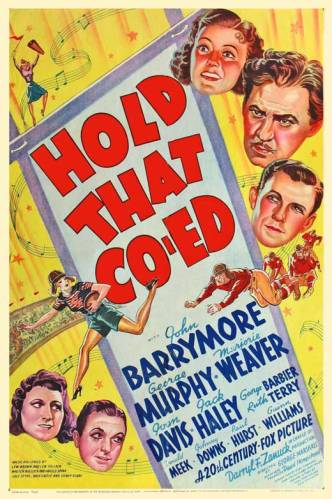
Shattered Politics #3: Hold That Co-Ed (dir by George Marshall)


hold-that-co-ed-movie-poster-1938-1020685724

“Americans will put up with bad government but they won’t stand for bad sportsmanship!” — A political consultant in Hold That Co-Ed (1938)

Rusty Stevens (George Murphy) is the new head football coach at State University.  (Which state?  We never learn for sure, though the implication is that it’s somewhere near Louisiana.)  From the minute that he arrives, Rusty discovers why State’s football program is so unheralded.  Not only are the majority of the students lazy and unmotivated but the college can’t even afford to buy the players uniforms.  The perpetually nervous Dean Thatcher (Donald Meek) is of no help when it comes to getting the university what it needs.  Even worse, the state’s Governor, Gabby Harrigan (John Barrymore), is running for the senate and he has sworn that he’s going to solve the state’s budget crisis by cutting the football program!

(Cue dramatic music.  Actually, not really.  There’s not a single dramatic moment to be found in Hold that Co-Ed.)

Well, what can Rusty be expected to do, other than lead all the students on a march down to the capitol building where they demand to see Gov. Harrigan.  However, Harrigan is busy giving an interview and he refuses to meet with the students.  Instead, he tells a fawning reporter how he is going to introduce a bill in the U.S. Senate that will guarantee all retired people, “Not one, not two, not three, but a sum of 400 dollars every month!”

After the reporter leaves, his cynical (Is there any other type?) secretary Marjorie (Marjorie Weaver) asks Harrigan how the government will ever be able to afford his plan.  Harrigan says that the government can’t but “isn’t it nice for” retired people “to have something to look forward to?”

(Gov. Harrigan sounds like he could be elected President in 2016.)

Meanwhile, the college students get rowdy in the front office and end up picking up the Governor’s aide, Wilbur (Jack Haley, who a year later would play The Tin Man in The Wizard Of Oz), and passing him around over their heads.  Naturally, this gets the attention of the press and suddenly, the fate of State’s football program is a campaign issue.

Upon discovering that most voters like football, Harrigan declares himself to be State’s biggest supporter and soon starts to play a very prominent role in the football program.  Not only does he arrange for Lizzie Olsen (Joan Davis) to become the only female to play on a college football team (When informed that Lizzie playing is against the rules, Harrigan replies, “I’ll change them!”) but he also pays players to come to State.  (When informed that paying players is against the law, Harrigan replies, “I’ll change the law!”)

It all eventually leads to Rusty romancing Marjorie and a bet between Harrigan and his opponent in the Senate race in which the outcome of the big game will determine who withdraws from the race.

Because of course it does.

First released in 1938, Hold That Co-Ed is one of those strange films that seems like it could only have come out in the 1930s.  Obviously, it’s primarily a college comedy.  Yet, at the same time, it’s also a musical which features Rusty randomly breaking out into song and dancing.  And then, on top of that, it’s a political satire.  (Reportedly, Harrigan was based on Huey Long, who also served as the basis for a far more sinister character in All The King’s Men.)

And, in its way, Hold That Co-Ed is a fun, little time capsule.  If anything, the film’s political satire feels just as relevant today as it probably did when it was first released.  As playing in grand theatrical fashion by John Barrymore, Gabby Harrigan could be any number of pompous, say-whatever-you-have-to-say demagogues.

What makes this film particularly interesting is just how much it’s on Harrigan’s side.  Whereas most political films always feel the need to at least pretend to be on the side of “good” government, Hold that Co-Ed cheerfully celebrates Harrigan’s casual corruption.  In this shrill day and age, there’s something refreshing about seeing a film that passes no judgment.

And speaking of politics, John Barrymore was never elected to political office.  However, the film’s other star, George Murphy, was.  He served in the U.S. Senate from 1965 to 1971.
HoldthatCoed

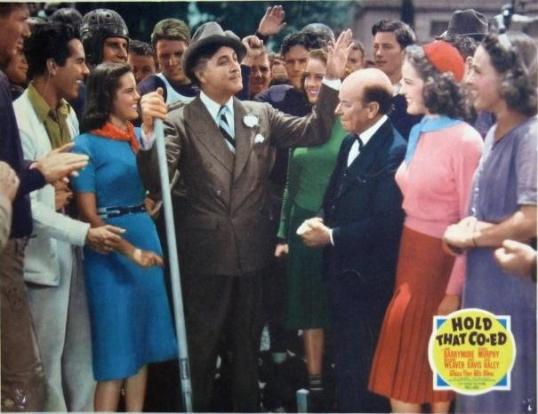
Governor Gabby Harrigan (John Barrymore) in Hold That Co-Ed
Horror on the Lens: The Boogie Man Will Get You (dir by Lew Landers)


Today’s horror on the lens is a short horror comedy from 1942.  In The Boogie Man Will Get You, Winnie Slade (Miss Jeff Donnell) buys an old house from Prof. Billings (Boris Karloff) with plans to covert it into a hotel.  However, one of the conditions of the sale is that Prof. Billings and his servants be allowed to live on the property.  What Winnie doesn’t know is that Prof. Billings had been conducting experiments on traveling salesman.  He hopes to turn them into supermen who can then be sent overseas to fight the Nazis.  (Kind of like Capt. America, when you think about it…)  However, his experiments have yet to be successful and have mostly just resulted into a lot of salesman being buried out in the rose garden…

However, things start to look up for Prof. Billings when he meets Dr. Lorencz (Peter Lorre), who is not only a doctor but also a mayor, sheriff, and dog catcher.  Seriously, Dr. Lorencz can do it all….

The Boogie Man Will Get You is a fun little time capsule of the time in which it was made.  For horror fans, it is mostly interesting because it features both Boris Karloff and Peter Lorre.  Both Karloff and Lorre appear to be having a lot of fun parodying their usual screen images.

Enjoy!

http://www.youtube.com/watch?v=MWEvKYhKc2U