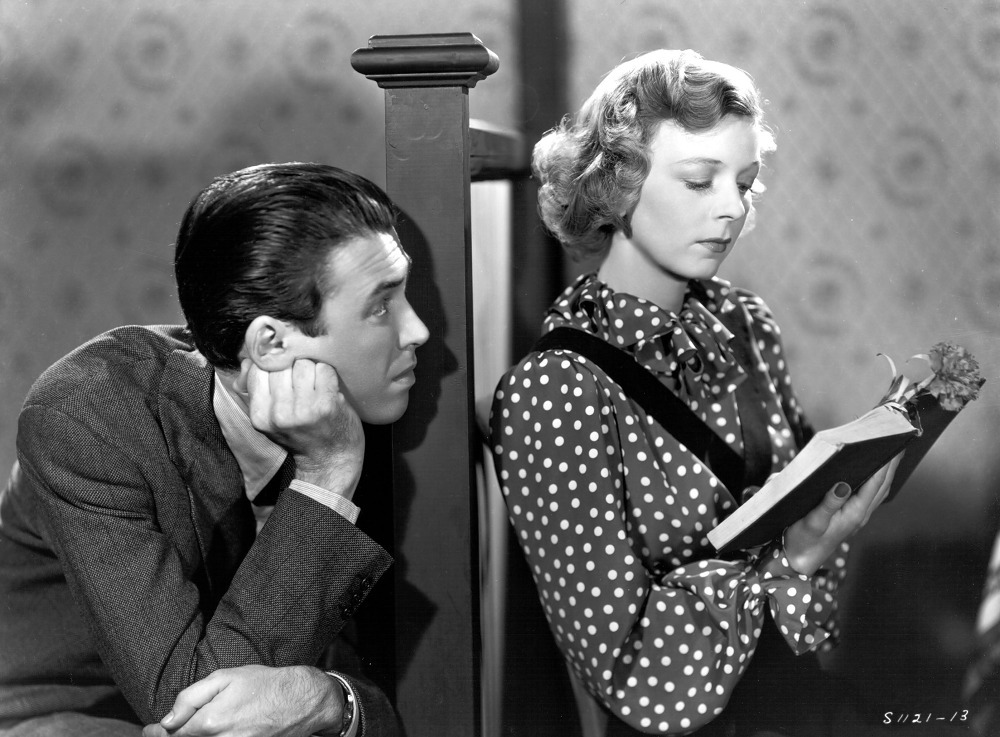
Brad reviews THE SHOP AROUND THE CORNER (1940), starring James Stewart and Margaret Sullavan!


Set in Budapest, Hungary, we meet Alfred Kralik (James Stewart), the dependable head clerk at a retail establishment named Matuschek and Company. In walks Klara Novak (Margaret Sullavan), an attractive young lady who’s desperately in need of a job, so Mr. Matuschek (Frank Morgan) hires her as a new salesgirl. Alfred and Klara immediately take a disliking to each other and give each other quite a hard time at work. As we get to know Alfred and Klara, we find out that each of them is involved in a treasured “pen-pal” relationship with a mysterious someone who truly seems to understand their heart and soul. Wouldn’t you know it, even though they get on each other’s last nerves at the shop, Alfred and Klara are each other’s secret pen-pal! While navigating unexpected drama at work, mainly involving Mr. Matuschek, his wife, and a duplicitous employee, Alfred eventually discovers that Klara is his mystery correspondent without her knowing it. As he tries to reconcile the actions of the lady he knows from work with the heart of the person who wrote those letters, Alfred decides to show Klara who he really is to see if they can fall in love in real life!

THE SHOP AROUND THE CORNER is one of my very favorite romantic comedies, and I’d guess the lead performance of James Stewart is probably the main reason. He’s just perfect in the role of Alfred Kralik… earnest, proud, awkward, vulnerable, and above all else, decent. Stewart’s ability to portray characters with believable decency separate him as one of the all-time greats and that quality is well on display here. Margaret Sullavan, as Klara Novak, matches him perfectly. Known to have a good relationship off screen as well, the chemistry between Stewart and Sullavan is off the charts and their scenes together are quite powerful. Mostly known by me for his performance as the Wizard of Oz, Frank Morgan is also incredible as Mr. Matuschek, at times jealous, volatile, and ultimately benevolent.

Director Ernst Lubitsch, known for his “Lubitsch touch,” has made a movie that has stood the test of time because of its core of emotional truth. Even though it was made well before the days of social media or online dating, THE SHOP AROUND THE CORNER understands just how differently we present ourselves when writing (or online, or on social media), compared to how we actually behave in person. Maybe it’s because THE SHOP AROUND THE CORNER was made in 1940, but I love the way its time-tested story idea is used for comedy and sweet romance, without becoming cynical. That lack of cynicism leaves room not only for comedy and romance but also a genuine compassion for its characters as they deal with the very real emotions of loneliness, pride, jealousy, and fear.

All in all, THE SHOP AROUND THE CORNER may be 85 years old, but its tender and romantic payoff set on Christmas Eve still gets me every time. As far as I’m concerned, this is about as close to perfect as a romantic comedy can get!  

(Author’s note: I’m also a fan of the 1998 remake, YOU’VE GOT MAIL, starring Tom Hanks and Meg Ryan, but I rate it below Lubitsch’s film.)
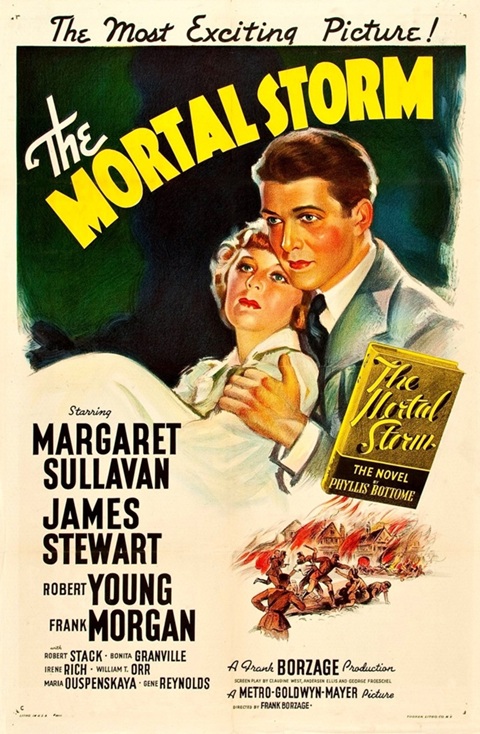
The Unnominated #16: The Mortal Storm (dir by Frank Borzage)


Though the Academy of Motion Picture Arts and Sciences claim that the Oscars honor the best of the year, we all know that there are always worthy films and performances that end up getting overlooked.  Sometimes, it’s because the competition too fierce.  Sometimes, it’s because the film itself was too controversial.  Often, it’s just a case of a film’s quality not being fully recognized until years after its initial released.  This series of reviews takes a look at the films and performances that should have been nominated but were, for whatever reason, overlooked.  These are the Unnominated.

Oh, how this movie made me cry!

Released in 1940, at a time when war was spreading across Europe, Asia, and Africa but the United States was still officially neutral, The Mortal Storm opens on January 30th, 1933.  In the mountains of Germany, near the Austrian border, Professor Viktor Roth (Frank Morgan) is celebrating his 60th birthday.  He starts the day being applauded by his students at the local college.  In the evening, he returns home for a celebration with his family, including wife (Irene Rich), his daughter Freya (Margaret Sullivan), his son Rudi (Gene Reynolds), and his two stepsons, Otto (Robert Stack) and Erich von Rohn (William T. Orr).  Also present are Freya’s fiancé, Fritz (Robert Young) and one of Roth’s students, a pacifist named Martin Breitner (James Stewart).  It’s a joyous occasion and the film takes its time introducing us to Prof. Roth and his extended family.  At first, everyone seems very kind.  They seem like people who most viewers would want to spend time with or live next to….

But then, the family’s maid excitedly enters the room and announces that it’s just been announced that Adolf Hitler is the new chancellor of Germany.  Otto and Erich are overjoyed and head out to celebrate with the other members of the Nazi Youth Leage.  Martin is less happy and excuses himself to return home.  Roth and his wife worry about what this means for people who do not agree with Hitler’s beliefs.  Freya says that they shouldn’t talk politics.  It is jokingly mentioned that Hitler has taken away Roth’s special day but Roth’s young son Rudi says that he’s learned in school that the needs of the individual will never be more important than the needs of the state.  If Hitler wants to take away your day, it’s your duty to give it up or face the consequences.

Based on a 1937 novel, The Mortal Storm was not the first Hollywood production to take a stand against Hitler and the Nazis but it was one of the best.  I say this despite the fact that the film only hints at the fact that Prof. Roth is Jewish, something that was made very clear in the book.  (In the movie, Roth and his wife worry what will happen to “Non-Aryans” and “freethinkers.”)  That said, the film perfectly captures how quickly and insidiously the authoritarian impulse can spread.  The town, which once seemed so friendly, becomes a very dark place as the students at the university put on their swastika armbands and start to hunt down anyone who dissents from the party line.  When Roth says that, as a scientist, he does not believe one race can be genetically superior to another, his students walk out on him.  A local teacher is beaten when he fails to return to the Nazi salute.  When Martin refuses to join the Party, Otto and Erich turn against him despite being lifelong friends.  When Martina and Freya flee for the border, Fritz pursues them.  And even after Prof. Roth is sent to a concentration camp, Otto and Erich continue to follow the orders of Hull (Dan Dailey), the sinister Youth Party Leader.

It’s a powerful film, one that remains just as relevant today as it was when it was first released.  Hull and Erich’s fanaticism would, today, find a welcome home on social media.  The scenes in which the townspeople eagerly threaten to report their former friends and neighbors for failing to salute or show proper enthusiasm for the government have far too many modern day equivalents for me to even begin to list them all.  This film was also the last the James Stewart made with frequent co-star Margaret Sullivan and they both give great performances.  (All-American Jimmy Stewart might seem a strange choice to play a German farmer but he is never less that convincing as Martin, one of the few people in the town not to surrender his principles and beliefs to the crowd.)  The film’s final moments, with the camera panning around the empty Roth home, brought very real tears to my eyes.

Despite being a powerful film, The Mortal Storm was not nominated for a single Oscar.  (Jimmy Stewart did win his only Oscar that year but it was for The Philadelphia Story.)  It’s temping to assume that, at a time when America was still divided about how to react to the war in Europe and when many Americans still remembered the trauma of the first World War, The Mortal Storm was too explicitly political and anti-Nazi to get a nomination but, the same year, The Great Dictator was nominated for Best Picture.  It seems more likely that, in those days when the studios ruled supreme, MGM decided to puts it weight behind The Philadelphia Story rather than The Mortal Storm.

That said, The Mortal Storm was definitely worthy of being nominated, for Picture, Director, Screenplay, Actress (Margaret Sullivan), Actor (Stewart), Supporting Actor (Frank Morgan and Robert Stack), and Supporting Actress (Irene Rich and, in the role of Stewart’s mother, Maria Ouspenskaya).  The film may not have been nominated but it remains a powerful and important work of art.

Previous entries in The Unnominated:

  1. Auto Focus 
  2. Star 80
  3. Monty Python and The Holy Grail
  4. Johnny Got His Gun
  5. Saint Jack
  6. Office Space
  7. Play Misty For Me
  8. The Long Riders
  9. Mean Streets
  10. The Long Goodbye
  11. The General
  12. Tombstone
  13. Heat
  14. Kansas City Bomber
  15. Touch of Evil

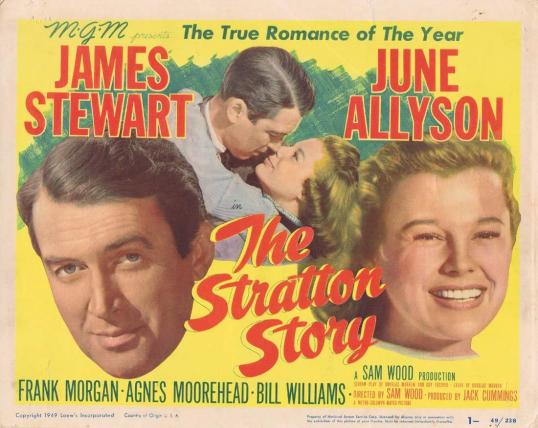
The Stratton Story (1949, dir. by Sam Wood)


Monty Stratton was one of the greats.

He was a Texas farmboy who knew how to throw a baseball.  Recruited by the Chicago White Sox, he spent five years in the majors.  From 1934 through 1938, he compiled a 36–23 record with 196 strikeouts and a 3.71 ERA in 487.1 innings.  In 1937, he won 15 games with a 2.40 ERA and five shout-outs.  The next season, he won another 15 games and completed 17 of his 22 starts.  For those of you who might not speak baseball, that all means that he was a really good right-handed pitcher.

When Stratton wasn’t playing baseball, you could find him down on his farm in Greenville, Texas.  He lived there with his wife, Ethel.  On November 27th, 1938, Monty Stratton was hunting rabbits when he accidentally shot himself in his right leg.  While Stratton survived the shooting, his leg was amputated, bringing Stratton’s major league career to an end.

No longer able to play in the majors, Monty Stratton spent the next few years as a pitching coach and helping to start a semi-pro team in Greenville.  With the help and encouragement of his wife, he continued to practice his pitching and he eventually trained himself to the point where he could transfer his weight effectively onto his artificial leg so that he could effectively throw a baseball.  In 1947, Monty Stratton made a comeback, pitching in the minors and ending the season with an 18–8 record and a 4.17 earned run average.  Stratton spent the next six years pitching in the minors before retiring from the game.  He went on to start the Greenville Little League program.  If you go to Greenville, you can still find Monty Stratton Field near Greenville High School.

The Stratton Story was made in 1949, shortly after Stratton’s comeback and while he was still playing in the minors.  James Stewart plays Monty Stratton while June Allyson plays his wife.  The movie follows Stratton from his early days on the farm through his major league career, his accident, and his eventual comeback.  Though the real Monty Stratton served as a technical advisor to the film, I don’t know how historically accurate it was.  The movie, for instance, seemed to condense the timeline so that it seemed like Stratton went straight from losing his leg to practicing for his comeback when it actually took ten years for Stratton to eventually get signed to a minor league team.  Even if it does take some liberties from the facts, The Stratton Story is still a good movie.  The baseball scenes are great and Jimmy Stewart is convincing when he’s throwing the baseball.  He’s also convincing in the scenes where Stratton sinks into a dark depression after losing his leg.  Stewart was so good in the role that, when Stratton finally started to practice his pitching again, I wanted to jump up and cheer.

I liked The Stratton Story.  It probably helps that I love baseball but it’s also a good movie about an inspiring story.

Pre Code Confidential #14: THE HALF-NAKED TRUTH (RKO 1932)


gary loggins's avatarcracked rear viewer

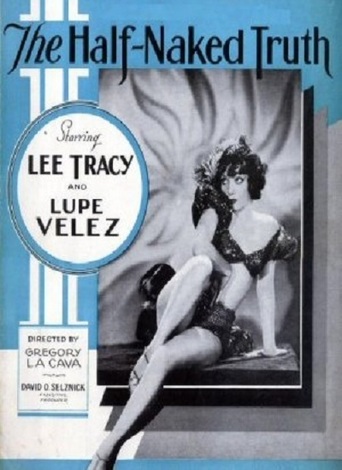
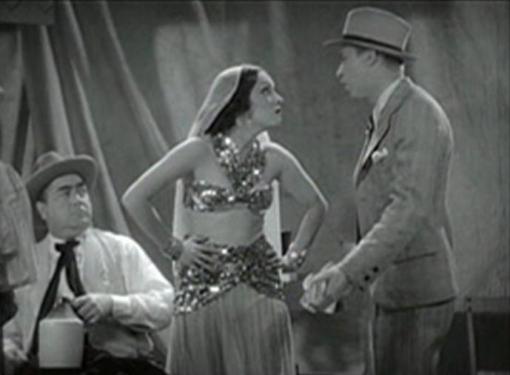
Director Gregory LaCava is remembered today mainly for a pair of bona fide classics: MY MAN GODFREY and STAGE DOOR. LaCava, who started his career in early silent animation, was also responsible for THE HALF-NAKED TRUTH, a Pre-Code screwball comedy begging to be rediscovered. It’s a crazy, innovative, pedal-to-the-metal farce headlined by fast-talking Lee Tracy and “Mexican Spitfire” Lupe Velez as a pair of carny con artists who work their way up to The Great White Way in grand comic style.

Tracy does his rapid-fire spieling schtick as a carnival barker promoting hot-tempered tamale Lupe, a hootchie dancer who spends most of the movie wearing next to nothing. Together with pal Eugene Pallette , they leave the carny life behind (with the law on their tails!) and head for Broadway, where Lee promises Lupe he’ll make her a star. The trio pawn Lupe off as Turkish Princess Exotica (with Tracy pawning off an unwitting…

View original post 388 more words

Cleaning Out The DVR, Again #12: Naughty Marietta (dir by W.S. Van Dyke)


b70-4632

Continuing the process of cleaning out my DVR, I watched the 1935 film, Naughty Marietta.  I recorded Naughty Marietta off of TCM on April 3rd.  Like many of the films that I record off of TCM, Naughty Marietta was nominated for Best Picture.  In fact, if not for that Oscar nomination long ago, Naughty Marietta would probably be totally forgotten.

Instead, it’s only partially forgotten.

Based on an operetta and containing at least one song that I’ve sung while drunk (that song, incidentally, would be Ah!  Sweet Mystery of Life), Naughty Marietta tells the story of Princess Marie (Jeanette MacDonald).  A Spanish princess, Marie is engaged (against her will) to the elderly Don Carlos (Walter Kingsford).  In order to escape a life of forced marriage, Marie pretends to be a servant girl named Marietta and stows away on a boat to New Orleans.  The boat is carrying women to the new world so that they marry French colonists.  The other women on board are shocked when Marietta announces that she plans to never marry.

However, they are even more shocked when the boat is taken over by pirates!  The pirates kill the crew and take the women prisoner.  The pirates take the women to Louisiana where, fortunately, a group of mercenaries led by Captain Richard Warrington (Nelson Eddy) show up and rescue the women.

Marie negotiates for Warrington to take the women to New Orleans and it’s obvious from the start that Marie and Warrington are attracted to each other.  However, Warrington claims that, much like Marie, he plans to never marry!  Oh my God, could it be that these two are meant to get together!?

It has all the potential for being a good musical and Jeannette MacDonald gives a good performance as Marie.  But, unfortunately, Nelson Eddy is a lot less charismatic in the role of Warrington.  Even his singing voice is a bit blah.  Oddly, Naughty Marietta was one of many romantic musicals that Jeanette MacDonald and Nelson Eddy made together.  The reason I use the term “odd,” is because — judging from this film — they didn’t appear to have much onscreen chemistry.  Whereas MacDonald is personable and relatable, Nelson Eddy seems to hold the audience at a distance.  Watching a film like this, you can’t help but regret that Jeanette MacDonald didn’t have someone like Fred Astaire for a co-star.

As for Naughty Marietta‘s best picture nomination — well, it was a big production and it was also an adaptation of a popular operetta.  At a time when 10 films were nominated every year and the studios pretty much controlled which one of their films was nominated for best picture, Naughty Marietta got a nomination.  However, the Oscar went to Mutiny on the Bounty.

Cleaning Out The DVR #30: The Great Ziegfeld (dir by Robert Z. Leonard)


(For those following at home, Lisa is attempting to clean out her DVR by watching and reviewing 38 films by the end of this Friday.  Will she make it?  Keep following the site to find out!)

Great-Ziegfeld-1936-Poster

Do you know who Florence Ziegfeld was?

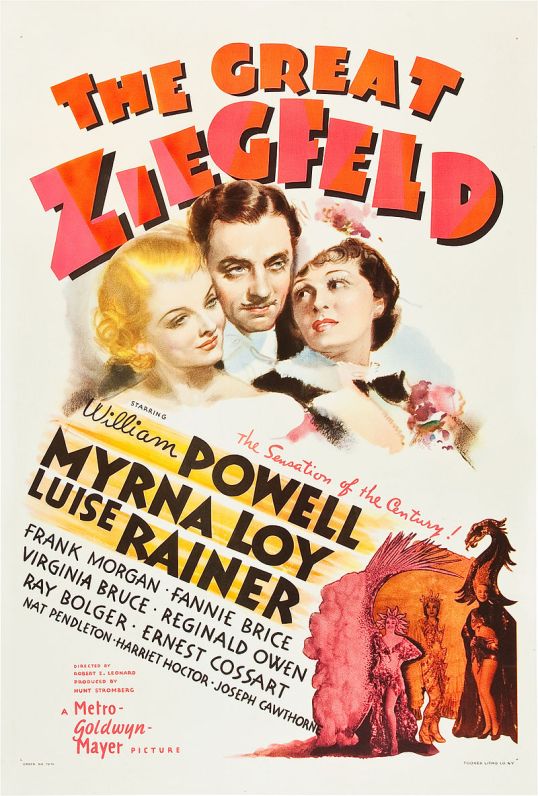
Don’t feel bad if you don’t because, until I saw the 1936 film The Great Ziegfeld, I had no idea and history is my number one obsession.  Florence Ziegfeld was a theatrical producer who, in the early days of the 20th Century, produced huge spectacles.  He was a showman who understood the importance of celebrity and gossip.  He produced a show called The Ziegfeld Follies, which was considered quite risqué at the time but which looks remarkably tame today.  Florence Ziegfeld was so famous that he even got his own Oscar-winning biopic.

The Great Ziegfeld features the always smooth William Powell as Ziegfeld.  When we first meet him, he’s promoting a strongman and a belly dancer and nobody takes him seriously.  But through hard work, good luck, and his own instinct for showmanship, he becomes famous and his shows gets bigger and bigger.  The film follows Ziegfeld as he gets married, both times to someone he is grooming to be a star.  His first wife is Anna (Luise Rainer), who loves him but divorces him when it becomes obvious that Ziegfeld’s life will always revolve around his work.  His second wife is Billie Burke and we know that she is Ziegfeld’s true love because she’s played by Myrna Loy.  Whenever you see William Powell and Myrna Loy in the same film, you know that they belong together.

The majority of The Great Ziegfeld is taken up with recreations of Ziegfeld’s stage shows.  In fact, the film almost feels more like a musical variety show than a real biopic.  (Judging from the credits, quite a few of Ziegfeld’s stars played themselves and recreated their acts on the big screen.)  I can understand why this was attractive to audiences in the 1930s.  With no end in sight to The Great Depression and Ziegfeld himself recently deceased, this movie was their only opportunity to see one of his spectacles.  The film made sure that they got their money’s worth.

However, for modern audiences, all of the acts just add to what is already an oppressive running time.  My main impression of The Great Ziegfeld was that it was really, really long.  The movie itself is well-produced and William Powell and Myrna Loy are always fun to watch but the movie just goes on and on.  As well, this biopic is so worshipful of Ziegfeld — the title is meant to be taken literally — that, as a result, he comes across as being one-dimensional.  I did appreciate the film as a historical artifact but otherwise, it didn’t do much for me.

However, it did something for the Academy.  The Great Ziegfeld was named the best picture of 1936!  Luise Rainer won best actress despite only being on-screen for a handful of scenes.  So many people were critical of Rainer’s award that, the very next year, the Academy introduced the award for best supporting actress.

As for why Ziegfeld won that Oscar — well, if you look at its competition and some of the other 1936 films that received nominations, you’re struck by the lack of truly memorable films.  It would appear that, in a weak year, the Academy decided to give the award to the biggest production they could find.

And that was The Great Ziegfeld.

(Incidentally, if Flo Ziegfeld were alive today, he would probably be a reality TV producer.)

Lisa Reviews An Oscar Nominee: The Human Comedy (dir by Clarence Brown)


The-human-comedy-1943Thanks to TCM’s 31 Days of Oscar, I now have several movies on my DVR that I need to watch over the upcoming month.  Don’t get me wrong — I’m not complaining.  I’m always happy to have any reason to discover (or perhaps even rediscover) a movie.  And, being an Oscar junkie, I especially enjoy the opportunity to watch the movies that were nominated in the past and compare them to the movies that have been nominated more recently.

For instance, tonight, I watched The Human Comedy, a film from 1943.  Along with being a considerable box office success, The Human Comedy won on Oscar (for Best Story) and was nominated for four others: picture, director (Clarence Brown), actor (Mickey Rooney), and black-and-white cinematography.  The Human Comedy was quite a success in 1943 but I imagine that, if it were released today, it would probably be dismissed as being too sentimental.  Watching The Human Comedy today is something of a strange experience because it is a film without a hint of cynicism.  It deals with serious issues but it does so in such a positive and optimistic manner that, for those of us who are used to films like The Big Short and Spotlight, a bit of an attitude adjustment is necessary before watching.

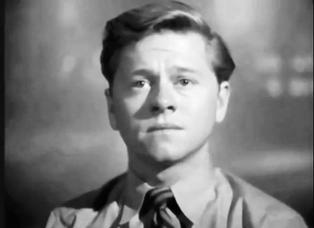
And yet that doesn’t mean that The Human Comedy is a bad film.  In fact, I quite enjoyed it.  The Human Comedy is a time capsule, a chance to look into the past.  It also features a great central performance, one that was quite rightfully nominated for an Oscar.  As I watched Mickey Rooney in this film, I started to feel guilty for some of the comments I made when I reviewed Mickey in The Manipulator last October.

2Mickey Rooney in The Human Comedy

The Human Comedy opens with an overhead shot of the small town of Ithaca, California.  The face of Mr. McCauley (Ray Collins, who you’ll recognize immediately as Boss Jim Gettys from Citizen Kane) suddenly appears in the clouds.  Mr. McCauley explains that he’s dead and he’s been dead for quite some time.  But he loves Ithaca so much that his spirit still hangs around the town and keeps an eye on his family.  Somehow, the use of dead Mr. McCauley as the film’s narrator comes across as being both creepy and silly.

Matthew-clouds-400-387x300

But no sooner has Mr. McCauley stopped extolling the virtues of small town life than we see his youngest song, 7 year-old Ulysseus (Jack Jenkins), standing beside a railroad track and watching a train as it rumbles by.  Sitting on the cars are a combination of soldiers and hobos.  Ulysseus waves at some of the soldiers but none of them wave back.  Finally, one man waves back at Ulysseus and calls out, “Going home, I’m going home!”  It’s a beautifully shot scene, one that verges on the surreal.

That opening pretty much epitomizes the experience of watching The Human Comedy.  For every overly sentimental moment, there will be an effective one that will take you by surprise.  The end result may be uneven but it’s still undeniably effective.

The majority of the film deals with Homer McCauley (Mickey Rooney).  Homer may still be in high school but, with his older brother, Marcus (Van Johnson), serving overseas and his father dead, Homer is also the man of the house.  Homer not only serves as a role model for Ulysseus but he’s also protector for his sister, Bess (Donna Reed).   (At one point in the film, she gets hit on by three soldiers on leave.  One of them is played by none other than Robert Mitchum.)  In order to bring in extra money for the household, Homer gets a job delivering telegrams.

hqdefault

In between scenes of Homer in Ithaca, we get oddly dream-like scenes of Marcus and his army buddies hanging out.  Marcus spends all of his time talking about how much he loves Ithaca and how he can’t wait for the war to be over so he can return home.  One of his fellow soldiers says, “I almost feel like Ithaca is my hometown, too.”  Marcus promises him that they’ll all visit Ithaca.  As soon as the war is over…

With World War II raging, Homer’s job largely consists of delivering death notices (and the occasional singing telegram, as well).  Telegraph operator Willie Grogan (Frank Morgan) deals with the burden of having to transcribe bad news by drinking.  Homer, meanwhile, tries to do his job with compassion and dignity but one day, he has to deliver a telegram to his own house…

The Human Comedy is an episodic film, full of vignettes of life in Ithaca and Homer growing up.  There’s quite a few subplots (along with a lot of speeches about how America is the best country in the world) but, for the most part, the film works best when it concentrates on Homer and Mickey Rooney’s surprisingly subdued lead performance.  By today’s standards, it may seem a bit predictable and overly sentimental but it’s also so achingly sincere that you can’t help but appreciate it.

The Human Comedy was nominated for best picture but it lost to a somewhat more cynical film about life during World War II, Casablanca.