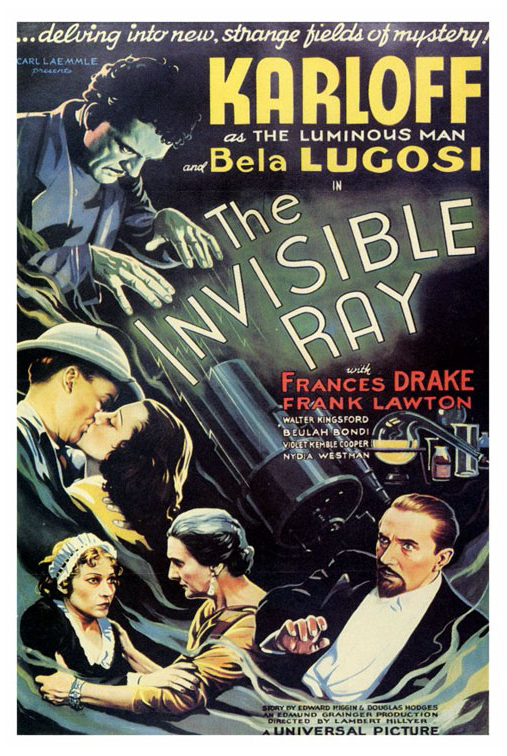
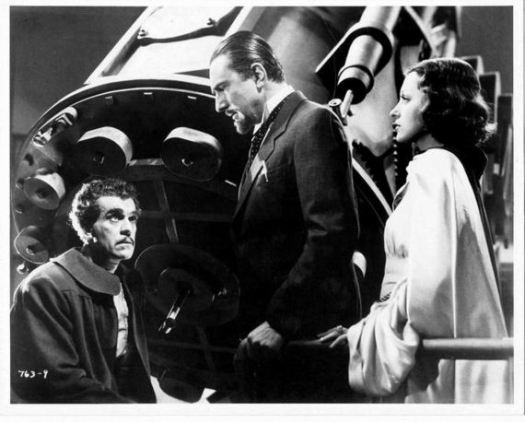
THE INVISIBLE RAY, the third Universal teaming of Boris Karloff and Bela Lugosi , is probably the least discussed of their seven films together. And I don’t quite know why, because I find it an entertaining meld of horror and science fiction that holds my interest for its 80 minute running time. The two stars are well spotlighted, with Bela as one of the good guys (for a change!) and Boris giving a hammy but well crafted performance as a scientist unhinged by his newest discovery.
A curly-haired Karloff stars as Dr. Janos Rukh, awaiting the arrival of a group of his fellow scientists for a demonstration of his Invisible Ray as a storm rages outside. Rukh’s wife Diana and blind Mother Rukh greet them: Sir Francis Stevens and his wife Lady Arabella, French astro-chemist Dr. Felix Benet, and Lady Arabella’s nephew Ronald Drake, who’s along for the ride. Rukh…
Paul Lavond (Lionel Barrymore) was just your ordinary Parisian bank owner until he was wrongly convicted of robbery and murder. Sentenced to Devil’s Island and estranged from his beloved daughter, Lorraine (Maureen O’Sullivan), Paul spends 16 years plotting how to clear his name and progressively growing more bitter and angry.
He also befriends a scientist named Marcel (Henry B. Walthall). Marcel has figured out the formula for shrinking people. He’s convinced that shrunken people will eat less, use less fossil fuels, and take up a lot less space on the planet. They’ll probably also be less likely to wage war on each other. That’s right — the secret to world peace is shrinking the population.
However, Paul has other plans for that shrinking formula! What better way to clear his name and seek revenge than by using a shrunken army of henchmen?
Uhmmm — okay, it sounds a little bit overcomplicated to me but who am I to doubt the wisdom of Lionel Barrymore?
(Yes, I know he’s Paul Lavond but, honestly, Lionel Barrymore is Lionel Barrymore regardless of who he’s playing.)
Anyway, Paul and Marcel escape from Devil’s Island but Marcel dies shortly afterward. Paul, however, forms a partnership with Marcel’s widow, Maleta (Rafaela Ottiano). Disguising himself as an elderly woman, Paul returns to Paris. Not only does he use his disguise to watch over his daughter (who doesn’t realize that the kindly old woman is actually her father) but he also starts to develop quite a reputation for selling incredibly realistic dolls…
The Devil-Doll is an odd little mix of comedy and melodrama and, to be honest, it’s a bit too uneven to really work. That said, the film is definitely worth watching just for the sight of Lionel Barrymore playing an elderly woman. (Classic film lovers will immediately notice that, when in disguise, Lionel greatly resembles his sister, Ethel.) This Christmas, when I’m watching It’s A Wonderful Life for the 100th time and Mr. Potter is cackling and plotting to put the Bailey Building and Loan out of business, I’ll have a hard time not thinking about The Devil-Doll.
The Devil-Doll was one of the final films to be directed by the legendary horror specialist, Tod Browning. I’ve read that Browning’s later films suffered because Browning plunged into depression after the death of Lon Chaney, Sr. and he never quite recovered. And, really, The Devil-Doll feels like a film that would have been perfect for Chaney’s unique talent.
But, that said, Lionel Barrymore appears to be having a lot of fun as Paul and his performance is the main reason to watch the film today.
So, I’ve been cleaning out the DVR for the past week. Fortunately, I’m going to be off work for this upcoming week, which should give me a lot of extra film-watching time. That’s a good thing because I’ve got 36 movies that I’ve recorded on the DVR since Thursday and, over the past seven days, I’ve only watched 13 of them! That’s 23 movies to go and I hope to be finished by the end of the next week.
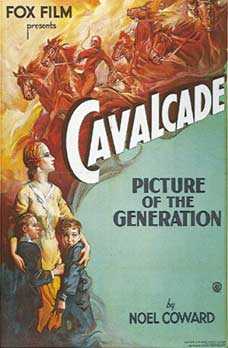
The 11th film that I found on my DVR was the 1933 film, Cavalcade. I recorded it off of FXM on April 3rd.
The main reason that I recorded Cavalcade was because it was the 6th film to win the Oscar for Best Picture. Now, I have to admit that I wasn’t expecting much from Cavalcade. It’s a film that many Oscar historians tend to list as being one of the lesser best picture winners. Cavalcade is often unfavorably compared to the films that it beat — movies like I Am A Fugitive From A Chain Gang, A Farewell To Arms, Little Women, and The Private Life of Henry VIII. Cavalcade was the first British to ever win the Best Picture and its victory is often cited as the beginning of the Academy’s love affair with British productions.
And really, Cavalcade couldn’t be more British if it tried. Based on a play by Noel Coward, Cavalcade follows two families through several decades in British history. One family is wealthy and is anchored by a patriarch who is knighted in the Boer War. The other family is lower middle class, anchored by a patriarch who starts out as a butler but who eventually manages to open up his own pub. Through the eyes of these two families, we view what, in the 1930s, was recent British history.
For modern viewers, it may be helpful to watch Cavalcade while consulting Wikipedia. For instance, the film starts with the two father figures preparing to leave to fight in the Boer War and I’m sorry to admit that I really wasn’t totally sure what that was. I had to look it up in order to discover that it was a war that the British fought in South Africa.
But you know what? That’s not really a complaint. I may not have known what the Boer War was before I started the film but that had changed by the time that I finished watching Cavalcade. Several times, I’ve mentioned on this blog how much I love history but watching Cavalcade made me realize that I still have more to learn. Even more importantly, it encouragds me to learn. That’s always a good thing.
Certain other historical events were more familiar. As soon as I saw the title card announcing that the date was 1914, I knew that I would soon be seeing a World War I montage. And, as terrible as World War I was (though, naturally, the film refers to it as being “the Great War,” and, for a few moments, I considered the fact that there was a time when nobody thought there would ever be a second world war), I was actually kind of happy for the montage because it got the characters out of the drawing room and out of the pub. Cavalcade is a very stagey film. Though there are a few attempts to open up the action, you’re always very aware that you’re essentially watching a filmed play.
Of course, the film’s best historic moment comes when a recently married couple goes on their honeymoon. We see them standing on the deck of a cruise ship, talking about how much they love each other and how wonderful life will be. They then step to the side and we see the name of the ship: RMS Titanic.
In many ways, those dismissive Oscar historians are correct about Cavalcade. It’s stagey and it’s old-fashioned and some of the performances are better than others. But, dammit, I liked Cavalcade. As the upper class couple, Diana Wynyward and Clive Brook made for a likable couple and they got to exchange some sweet-natured dialogue at the beginning and the end of the film. Add to that, it was a film about history and I love history.
Cavalcade is hardly a perfect film and it probably didn’t deserve to win best picture. But it’s still better than its reputation suggests.


 Through the Shattered Lens