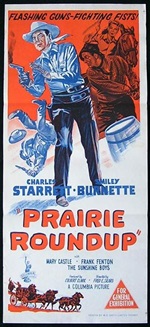
Steve Carson (Charles Starrett) is wanted for murdering the Durango Kid!
I know that sounds confusing because Steve Carson is the Durango Kid. The bandit that Carson shot was just disguised as the Durango Kid but actually, he was just a dim-witted outlaw who was set up by Buck Prescott (Frank Fenton), a rustler who was run out of Texas by Steve and who was trying to find a way to stop Steve from investigating his new scheme to cheat a bunch of ranchers in Santa Fe.
Steve is taken to jail but luckily, Smiley Burnette is around to help him break out. Smiley and Steve head to Santa Fe, where they get jobs working as cowhands at the Eaton Ranch and work to expose Prescott and his gang as being responsible for a series of stampedes. Smiley sings some songs and Steve resurrects the Durango Kid from the dead.
This was one of the later Durango Kid films. The range war plot is one that showed up in many Durango Kid films but Prairie Roundup adds something new to the formula but having Steve framed for murdering himself. Steve could prove his innocence by revealing that he’s actually the Durango Kid but Steve is determined to maintain his secret identity. I’ve seen several Durango Kid films and I still don’t really understand why Steve felt he needed a secret identity in the first place. But Prairie Roundup shows the extent to which he’ll go to keep it.
There’s plenty of fight and horse chases, more than enough to keep western fans happy. Smiley Burnette gets to throw some punches along with singing all of his usual songs. It’s also nice to see the lovely Mary Castle in the role of Toni Eaton, the daughter of one of the ranchers who has been targeted by Prescott. Featuring less stock footage than usual, Prairie Roundup is a worthy entry in the Durango Kid series.
Years ago, Bill Donner (George Cheseboro) double-crossed the other members of the Selby Gang and ran off with all of their stolen gold. Now, Donner is blind and half-crazy. When he says that he hid the gold in the ghost town of Shadeville, the Durango Kid (Charles Starrett), Smiley Burnette, and Sheriff Dodge (Stanley Andrews) ride off to find it.
Shadeville is long abandoned and, as the three men spend the night in a deserted saloon, Smiley is worried about ghosts. The Durango Kid tells the story of the first time he met the Selby Gang. The next morning, they discover that they are not the only ones who have come to Shadeville to look for the gold.
Like many of the later Durango Kid movies, Streets of Ghost Town is mostly made up of stock footage to Starrett’s earlier films. This was a cost-cutting technique on the part of Columbia Pictures but it actually works because the flashbacks were always to the horse chases and the gunfights that the audience came to see in the first place. In the days before home video and cable, those scenes were probably still new to many of the people sitting in the theater.
Starrett always made for a good hero and Smiley Burnett’s comic relief never took away from the films’s storylines. This outing features a great scene where Durango shoots a skull in the dark just to let anyone watching him know that he’s a good shot. I also enjoyed George Cheseboro’s manic performance as a man who really loves his gold. Despite all of the stock footage, Streets of Ghost Town is still an above average Durango Kid film, predictable but entertaining if you’re a fan of the genre.
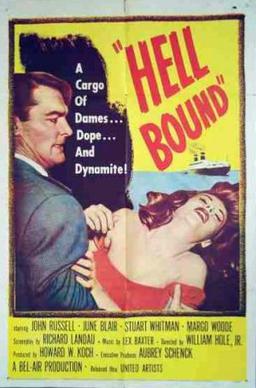
Like so many film noirs, 1957’s Hell Bound opens with a narrator. As we watch scenes of a group of thieves robbing a Naval ship of World War II narcotics, the narrator explains to us what each criminal is doing and how their plot will hopefully lead to them getting rich. Again, this is something we’ve seen in a countless number of film noirs. What makes Hell Bound unique is that the narration keeps going long after one would expect it to stop. And the expected cops and federal agents are never introduced….
That’s because we’re watching a film within a film! Jordan (John Russell) has made and produced the film himself, all to convince a gangster named Harry Quantro (Frank Fenton) to support his plan to …. well, to rob a Naval ship of narcotics. Jordan promises that the real-life theft will go just as smoothly as the theft in the movie! And, it must be said, Jordan’s movie was really well-made. He hired actors and everything. Harry agrees to give Jordan his backing on the condition that Jordan use Harry’s girlfriend, Paula (June Blair), in the operation. That, of course, means that Jordan won’t be able to use his own girlfriend, Jan (Margo Woode). That’s going to be awkward.
Anyway, Jordan starts to assemble his crew and they’re the typical film noir collection of misfits. One of the more fun things about Hell Bound is that it’s full of odd and eccentric characters, the types who would you actually expect to find trying to rob the U.S. Navy of narcotics in the 1950s. My favorite character was the blind drug dealer named Daddy (Dehl Berti). He has the perfect attitude for someone who had the luxury of not having to see the damage caused by his professions.
Of course, there’s no such thing as a perfect plan. Whenever you get a bunch of criminals together to pull off the perfect heist, there’s bound to be some betrayals and some paranoia. We’ve all seen the ending of Goodfellas and we all know what the piano coda from Layla means. Complicating matters is that a big part of the scheme requires Paula to fake being an ambulance nurse and that means that she’s going to have to work with an honest ambulance driver named Eddie Mason (Stuart Whitman). Eddie is a good, working class guy who just wants to help people and make the world a better place. How can Paula go through with her part of the plan when she’s got Eddie looking at his hands and saying that he wants to use them to be a healer!?
I really liked Hell Bound. I wasn’t expecting much from it but it turned out to be a really effective and clever 50s film noir. Clocking in at 70 minutes, it doesn’t have any time for excess padding or anything else. As soon as the film-within-a-film comes to an end, it jumps right into the action and it doesn’t let up. Add to that, you’ve got John Russell giving a tough and gritty performance as the wannabe criminal mastermind and then you’ve got Stuart Whitman managing to make his self-righteous character likable and June Blair doing a great job as the femme fatal. Hell Bound is bit of an unsung classic, a tough and gritty film noir that packs a punch.
Way back in April, I started on a series of reviews. I announced that I would be watching and reviewing all 50 of the public domain films included in Mill Creek’s Fabulous Forties box set.
At the time, I expected that it would take me maybe two weeks. At the most, two and a half. After all, I wondered, how long can I take? Well, needless to say, it took me a little longer than two weeks. In fact, it took me nearly 3 months. (In my defense, May turned out to be a very busy month for me and I wasn’t able to review a single Fabulous Forties film.) However, what’s important is that, after all this time, I am currently writing up the last of my Fabulous Forties reviews!
(And, right now, you’re reading it.)
On the whole, the Fabulous Forties has turned out to be pretty uneven box set. It contains a few classics, like My Man Godfrey, His Girl Friday, and The Last Chance. There are several good films, like The Black Book and Trapped. And then there’s quite a few mediocre and forgettable films, like The Town Went Wild and Jungle Man. (Dear God, Jungle Man…) As I started on the final film in the set, I wasn’t sure what I was about to see…
Well, no worries! The Fabulous Forties ends on a high note! The 50th film is the wonderfully entertaining 1943 comedy-musical-mystery Lady of Burlesque!
Lady of Burlesque (which was released in the UK under the title Striptease Lady) takes place in an old and somewhat decrepit New York burlesque house, the type of place where the audience is almost all male, the owners are somewhat sleazy, and the performers are a cross between cynical veterans and naive newcomers who are hoping for their first big break.
As quickly becomes apparent, the theater would fall apart if not for its main attraction, Dixie Daisy (Barbara Stanwyck). Dixie serves as a mentor for the newcomers and a confidante for the veterans. She knows how to keep the audience entertained, even when two dancers are loudly screaming at each other offstage. She knows how to deal with the sleazy owners and how to placate the owners of the Chinese restaurant next door. Dixie also knows better than to get romantically involved with any of male comics who perform at the theater but that doesn’t stop her from flirting with one of them, Biff Brannigan (Micahel O’Shea, playing his role with an almost poignant earnestness). As I watched the film, I could tell that Barbara Stanwyck was neither a natural dancer nor singer but it didn’t matter because, whether Dixie was trying to keep peace backstage or performing onstage and singing a song called, “Take It Off The E-String, Play It On The G-String,” Stanwyck totally committed herself to the role.
Plus, her outfits were to die for!
Seriously, as I watched Lady of Burlesque, I totally wanted to get a job dancing in an old timey burlesque house! If only I had a time machine…
Of course, it should be understood that the acts in Lady of Burlesque are risqué but, by today’s standards, they’re also rather innocent. The jokes may be full of double meaning but it’s all hidden in the subtext. The costumes may be sexy but they also stay on. (That probably had more to do with the production code than to do with the realities of 1940s burlesque.)
Anyway, Lady of Burlesque is technically a murder mystery but mostly, it’s just an excuse to show the performances happening onstage and a few comedic (and occasionally dramatic) vignettes of what it was like to be backstage in a burlesque house. Two dancers are murdered but the show must go on. Even as Dixie solves the murders and tries to keep everyone calm, the show must go on. In fact, that’s one of the true joys of Lady of Burlesque. Regardless of what madness might be going on backstage, the show never stops! In fact, the film often seems undecided about whether or not the backstage murders are bad because of the loss of life or the fact that they threaten to interrupt the performances onstage. Lady of Burlesque becomes a tribute to the work ethic of entertainers everywhere!
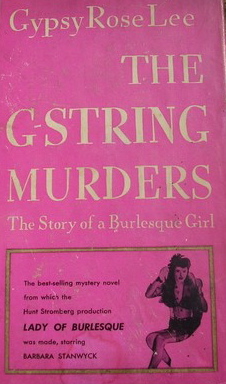
Lady of Burlesque was based on a novel by Gypsy Rose Lee. The name of that novel was The G-String Murders. Not surprisingly, that title was changed for the film version.
Well, that concludes the Fabulous Forties! In a few weeks, I’ll start in on my next Mill Creek box set, the Nifty Fifties! Until then, enjoy Lady of Burlesque!
 Steve Carson (Charles Starrett) is wanted for murdering the Durango Kid!


 Through the Shattered Lens