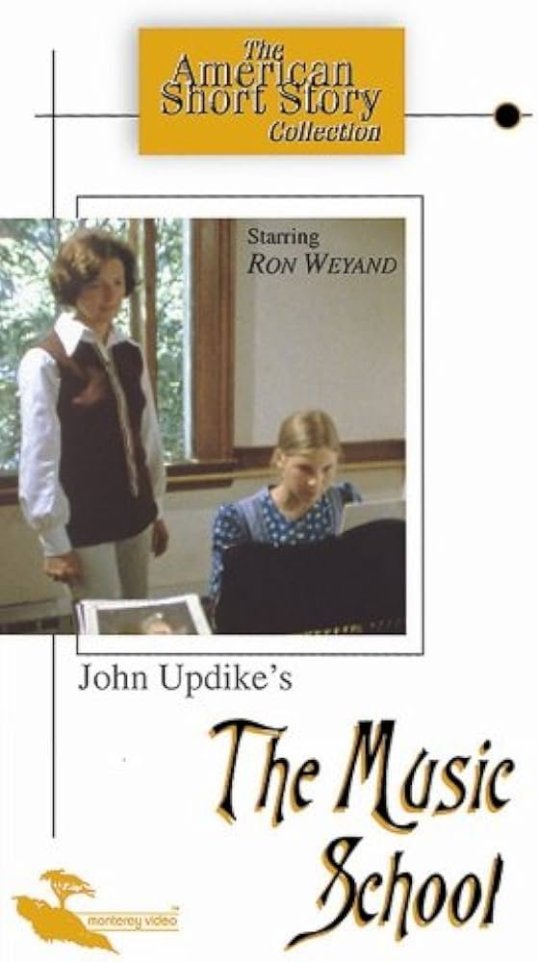
Welcome to Retro Television Reviews, a feature where we review some of our favorite and least favorite shows of the past! On Saturdays, I will be reviewing The American Short Story, which ran semi-regularly on PBS in 1974 to 1981. The entire show can be purchased on Prime and found on YouTube and Tubi.
Today, we start a new series of reviews with an adaptation of a John Updike short story!
Episode 1.1 “The Music School”
(Dir by John Korty, originally aired on January 1st, 1974)
The first episode of The American Short Story is based on a story by John Updike. Alfred Schweigen (Ron Weyand) is a writer who sits at his typewriter and who occasionally looks out the window of his office. His wife playfully sprays the window with a garden hose and the writer thinks about how she’s in therapy because of his affairs. He remembers taking his daughter to her music school and thinks about the sounds of music floating through the building like ghostly memories. He thinks about a priest who, while talking to a bunch of “Protestants and non-believers,” explained that it was now permissible to chew the Eucharist wafer instead of waiting for it to dissolve. He thinks about a friend of his, a computer programmer, who was apparently assassinated by a random sniper while his family watched. In his mind, Alfred takes the random thoughts and occurrences and builds a story around them.
It’s an interesting episode, even if it doesn’t quite work. Tasked with bringing Updike’s words to visual life, this episode far too often falls back onto cliche and Ron Weyand often looks more annoyed that sincerely perplexed by life’s mysteries. (The writer’s narration is provided by Henry Fonda, whose middle-American voice doesn’t quite match Weyand’s petulant performance.) It’s a midlife crisis type of story, one in which the writer tries to deal with his own ennui and infidelities by turning them into fiction. Unfortunately, this is a case of what was compelling on the page falling flat when it’s adapted for film. I appreciated this episode’s ambition, even if it didn’t work in the end.
Next week, the American Short Story interprets a story by Ambrose Bierce!
Katharine Hepburn was famous for both her relationship with Spencer Tracy and the films that she made with him. They were such frequent co-stars and so associated with each other that “Hepburn-Tracy” became a film genre in and of itself, one that promised a bit of comedy, a bit of drama, and some sharp-witted romance. That said, I have to admit that one of my favorite of Katharine Hepburn’s film is one that she made not with Spencer Tracy but instead with Fred MacMurray. Alice Adams is a Tracy-Hepburn film without Tracy.
First released in 1935 and based on a novel by Booth Tarkington (who was quite a big deal back in the day even if, like Arrowsmith‘s Sinclair Lewis, he’s somewhat forgotten today), Alice Adams stars Hepburn as the title character. Alice is the daughter of Virgil Adams (Fred Stone) and his wife, who is only referred to as being Mrs. Adams (Anne Shoemaker). Virgil is a sickly man who has worked as a clerk at a glue factory for several years. Despite living in a rather large house and having a maid named Malena (Hatti McDaniel), the Adams family is not wealthy. However, Mrs. Adams desperately wants the family to be rich and Alice carries herself with the airs of a wealthy woman, despite the fact that everyone in town knows that she’s not. Alice love her family and is loyal to them, even if her younger brother (Frank Albertson, who later played Sam “Hee Haw” Wainwright in It’s A Wonderful Life) appears to be addicted to gambling and her mother is constantly browbeating her father for not being more ambitious. Her family may embarrass her but we know she wouldn’t trade them for all the money in the world. That’s why we like Alice, even if she does sometimes act like a snob.
However, when Alice meets and falls for the wealthy Arthur Russell (Fred MacMurray), she lies about her social background and tries to present herself as being just as rich as him. When she invites Arthur and his parents to her house for a dinner party, she frantically tries to keep up the charade of being wealthy. Meanwhile, Virgil finds himself wrongly accused of stealing from his boss (Charley Grapewin) and, as a result, the family’s financial future is put in jeopardy.
Alice Adams is a mix of screwball comedy and social drama. On the one hand, Alice’s desperate attempts to throw the perfect party are frequently very funny. Katharine Hepburn was always at her best when she played a flighty character and the contrast between Alice’s sophisticated airs and Alice’s actual personality makes me laugh every time that I watch the film. At the same time, there’s a definite undercurrent of melancholy to the film. Alice and her mother are both so desperate to be rich that they’ve both been blinded to just how wonderful their lives really are. Alice may like Arthur and Arthur definitely likes Alice but one never forgets that a part of Alice’s attraction to Arthur is that Arthur can give her the life to which she aspires.
Alice Adams features one of Hepburn’s best performances and it’s a rare Hepburn performance to which anyone watching should be able to relate. At some point in our lives, we’ve all felt like Alice. We’ve all been Alice, even if we don’t want to admit it. Fred MacMurray’s natural likability serves him well as Arthur. He comes across like a genuinely nice guy and we definitely want him and Alice to end up together.
Alice Adams was nominated for Best Picture but it lost to a much bigger production, Mutiny on the Bounty. Bette Davis beat Katharine Hepburn for Best Actress. Davis later said that she felt Hepburn should have won.
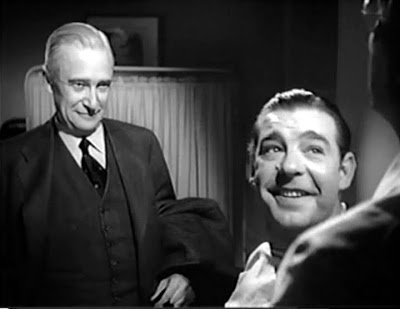
Lon Chaney Jr. made his first foray into Universal Horror with MAN MADE MONSTER, the movie that led to his studio contract and immortality with THE WOLF MAN . Both films were directed by George Waggner, who also wrote the script here under the pseudonym Joseph West. Lon’s large and in charge as the electrical monster, but top billing and acting honors go to Hollywood’s maddest of mad doctors, the great Lionel Atwill .
A bus crashes into high tension wires on a rain slicked highway, leaving all aboard dead save one. He’s Dan McCormick, a carny performer known as ‘Dynamo Dan, The Electric Man’. His seeming imperviousness to electricity piques the interest of scientist Professor Lawrence, who invites the jovial Dan to stay with him and his young niece June. Lawrence wants to run some experimental tests on Dan, but when he leaves for a medical convention his assistant…
Down here in Dallas, we have a county commissioner named John Wiley Price. Even if you don’t live in Texas, you might have heard about him. A few years ago, Price stormed out of a commissioners meeting while shouting, “All of you are white! Go the Hell!” It was a popular YouTube video for a while and attracted all of the usual type of comments that you see online. It even made the national news.
Nobody down here in Dallas was surprised by Price’s outburst. To us, that was just John Wiley being John Wiley. For that matter, nobody was particularly surprised when it was reported that he was being investigated by the FBI. Everyone always took it for granted that John Wiley Price was taking bribes and receiving kickbacks. That’s just the way that things are done down here in Dallas, by politicians both white and black. (Of course, most of the white politicians who do it don’t get publicly investigated by the FBI.)
Now, if you ask the majority of people in Dallas county what they think about John Wiley Price and they’ll probably say something negative. I’ll admit that I would probably be among them. But the thing is — John Wiley Price’s constituents love him. John Wiley Price was first elected to the commissioner’s court before I was even born and, as long as he’s on the ballot, he will be reelected. Even if Price is convicted on corruption charges, he will still be reelected.
I can still remember the night that it was announced that John Wiley Price was on the verge of being arrested by the FBI. All across his district, emergency meetings were held in churches and ministers stood behind the pulpit and, while the TV cameras rolled, they called upon everyone to pray for John Wiley Price. In Price’s district, he’s known as “our man downtown,” the idea being that John Wiley Price is standing up to the rich and white Dallas establishment and, if he makes some money for himself in the process, so be it. As long as he’s doing right for the people who elected him, who cares how he does it?
And, as much as we may want to judge the John Wiley Prices of the world, the fact that of the matter is that he’s a part of a long American political tradition. That political tradition is also the driving force behind today’s final entry in Shattered Politics.
First released in 1958 and directed by John Ford, The Last Hurrah tells the story of Frank Skeffington (Spencer Tracy), the mayor of an unnamed city in New England that’s obviously meant to be Boston. Skeffington is the flamboyant head of a large and powerful (but, as the film makes clear, aging) Irish-American political machine. He’s preparing to run for his fifth term for mayor, a campaign that he says will be his last.
Whether Frank Skeffington is a good mayor or not depends on who you ask. The poor and the disenfranchised love him. Skeffington, after all, is the son of Irish immigrants. He was born poor. His mother worked as a maid and was even fired by a member of the wealthy and influential Force family. They know that Skeffington has had to cut corners and that he’s gone out of his way to reward his cronies but they also know that Skeffington is on their side. Though the phrase is never used in the film, Skeffington is “their man downtown.”
Meanwhile, the wealthy and the upper class see Frank Skeffington as being a crook, a man who has run a corrupt administration and who uses class warfare to keep the city divided against itself and to make himself and his cronies rich. Newspaper editor Amos Force (John Carradine) has thrown his considerable influence between Skeffington’s opponent, a wealthy but dull man named Kevin McCluskey.
Reporter Adam Caulfield (Jeffrey Hunter) is in an interesting position. On the one hand, he is Skeffington’s nephew. On the other hand, as a journalist, he works for Amos Force. Skeffington invites Adam to follow and record his final campaign for posterity.
It’s interesting to compare The Last Hurrah to films like The Boss or All The King’s Men. Whereas those two films came down squarely on the sides of the reformers, The Last Hurrah is firmly on the side of Frank Skeffington. It presents Skeffington as being a sentimental figure, the type of old-fashioned, populist politician who won office by going out and meeting the people face-to-face and personally giving them a reason to vote for him. As Skeffington himself points out, he’s the type of politician that will soon be made obsolete by television and modern campaigning.
And it’s impossible not to enjoy The Last Hurrah‘s refusal to pass judgment on its lead character. It helps, of course, that Spencer Tracy plays Skeffington with a twinkle in his eye while all of his opponents are played by villainous and aristocratic character actors like John Carradine and Basil Rathbone. Yes, the film says, Skeffington may have been corrupt but at least he wasn’t boring!
Finally, I enjoyed the film because all of the “good” guys were Irish Catholic and all of the bad guys most definitely were not.
So, with that last hurrah, we conclude Shattered Politics for today. We’ll be back tomorrow, when we’ll start to get into the 1960s.



 Through the Shattered Lens