Horror Film Review: The Grapes of Death (dir by Jean Rollin)


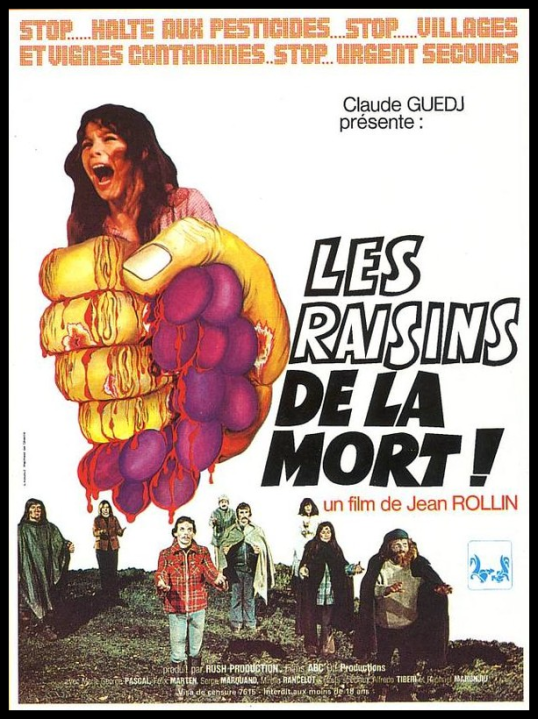
1978’s The Grapes of Death is a zombie film that moves at a relentless place, combining effective body horror with an ominous atmosphere that leaves you feeling as if anyone could be the next victim of the zombie horde.

At a vineyard, a worker complains about the new pesticides that are being used and is told, by his smug manager, not to worry so much.  Later, when that worker stumbles aboard a train, his face is pulsing with hideous ulcers.  He kills one woman and chases another, Elizabeth (Marie-Georges Pascal), off the train.  Elizabeth, who is just trying to visit her boyfriend in a nearby village, makes her way across the French countryside, meeting men and women who have been infected by something and who are now going mad.  They may not technically be the undead but, with their nonstop pursuit and their obsession with killing everyone that they come across, they are definitely zombies.

The Grapes of Death is also one of the most French films ever made.  In this film, the zombies are not the creation of a voodoo curse or outer space radiation or even there no longer being room in Hell.  (In fact, it becomes fairly obvious that The Grapes of Death takes place in a world in which there is no Heaven or Hell.)  Instead, this film features people who are transformed into zombies because they drank contaminated wine at an annual festival.  When Elizabeth does eventually meet two men who have not been turned into zombies, they are both revealed to be beer drinkers.  One could actually argue that, despite the film’s grim atmosphere and all of the violence committed and the blood shed and the philosophical discussions that occur, The Grapes of Death is ultimately a satire of French culture.  Only in France could a bad crop of wine lead to the zombie apocalypse.

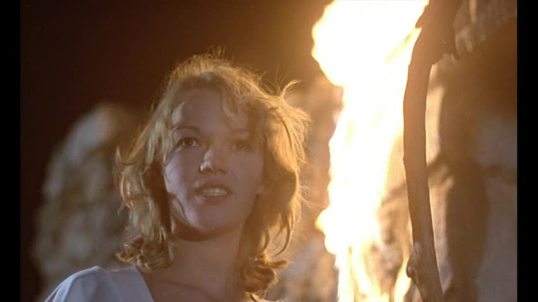
The Grapes of Death was one of the more commercially successful films to be directed by the great Jean Rollin.  Rollin is best-known for his surreal and dream-like vampire films.  In an interview, he stated that The Grapes of Death was his attempt to make a commercial horror film and that, when he was writing the script, he closely studied the structure of Night of the Living Dead.  While the film does have its similarities to Romero’s classic zombie film, The Grapes of Death is still definitely the work of Jean Rollin.  The lingering shots of the fog-shrouded French countryside and the ancient French villages, with blood staining the cobblestone streets, could have come from any of Rollin’s vampire films.  The film also uses the same serial structure that Rollin used in many of his film, with Elizabeth going from one adventure to another and almost always managing to narrowly escape danger.  Elizabeth goes from fleeing the infected man on the train to finding herself a near prisoner in an isolated house to protecting a blind girl (Mirella Rancelot) for her crazed boyfriend to being menaced by the mysterious Blonde Woman (played by frequent Rollin collaborator Brigitte Lahaie).  There’s a new cliffhanger every fifteen minutes or so.

(Rollin said that he originally envisioned contaminated tobacco as being the cause of the zombie outbreak but he ultimately went with wine instead.  Not everyone smokes but, in France, just about everyone drinks wine.)

First released as Les raisins de la mort, The Grapes of Death has been described as being “France’s first zombie film.”  I don’t know if it was the first but it’s certainly one of the best, a relentless chase through the French countryside that ends on a proper note of downbeat horror.  This film made me happy that I’m not a wine drinker.
(Be sure to read Arleigh’s thoughts here!)

International Horror Film Review: The Iron Rose (dir by Jean Rollin)


“Let’s go to the cemetery.”

That line is actually from another Jean Rollin film, Requiem for Vampire, but it also perfectly sums up the plot of his 1973 masterpiece, The Iron Rose.

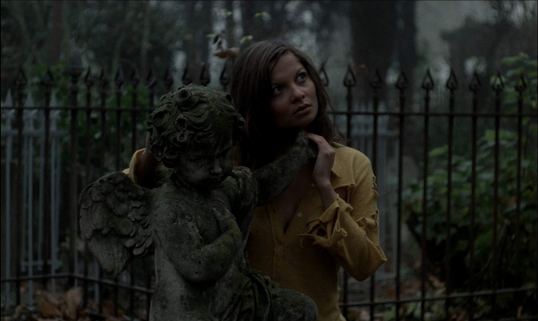
A man (Hugues Quester) meets a woman (Francoise Pascal) at a wedding party.  They agree to go on a date, one which includes a railway station, a picnic, bicycling, and finally a walk that leads to a seemingly deserted cemetery.  On what seems to be a whim, the two of them enter the cemetery.  The woman seems to be fascinated with the place.  The man is dismissive, saying that funerals are an expensive, waste of time.  The woman believes that there is something after death.  The man is cynical, saying that once you’re dead, you’re dead.  As any couple would do after having a theological conversation, the two of them enter a crypt and make love.

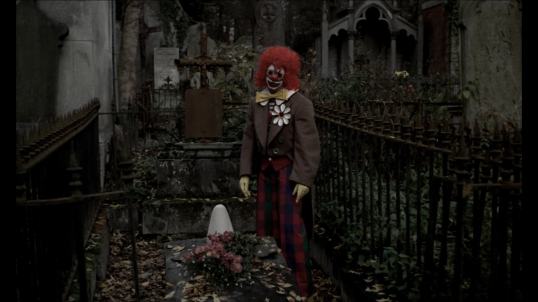
While they’re busy making love, we discover that there actually are others in the cemetery.  There’s a clown that places flowers on a grave.  There’s a mysterious man who has been watching the couple as they walk among the graves.  (In the credits the man is called “Le vampire,” though he never actually does anything in the film that would indicate that he’s a bloodsucker.)  And then there’s the old woman who, as night falls, promptly closes the cemetery gates.

When the man and the woman emerge from the crypt, they discover that they are trapped.  There’s no way to open the gate and there’s no way to get out of the cemetery.  The two of them start to walk around, searching for either an exit or, at the very least, some sort of shelter for the night.  As they walk, strange things start to happen and we’re forced to reconsider our previous assumptions about not only the man and the woman but also the cemetery itself.  Did they enter the cemetery on a whim or did one of them specifically lead in the other?  As the night progresses, the feeling of impending doom only grows.  It all leads to a rather macabre fate for one of our lovers and a dance among the tombstones for another.

The Iron Rose is one of Jean Rollin’s best films and, sadly, it’s also one of his most unjustly obscure.  Even by the standards of Rollin’s early vampire films, The Iron Rose is a surreal film, one that is far more interested in creating a haunting atmosphere than in telling a traditional story.  What is the real reason that leads to the man and the woman entering the cemetery?  The Iron Rose is full of hints but, for most part, it’s left to the audience to answer that question for themselves.  The film’s haunting final scenes force us to reconsider everything that we previously assumed by the characters and their actions.  Are they obsessed with love or are they just in love with death?  There are no easy answers.

Obviously, a 90-minute film about two people walking around a cemetery is going to have some slow spots but, in this case, those occasional moments just add to the film’s ennui-drenched atmosphere.  As filmed by Rollin, the cemetery becomes as important a character as both the man and the woman and a reminder that the present is always going to be tied to the past.  The Iron Rose is Rollin at his dream-like best.

Horror Scenes That I Love: Francoise Pascal Dances In A Cemetery in Jean Rollin’s the Iron Rose


The Iron Rose (1973, dir by Jean Rollin)

Today’s horror scene that I love comes from the 1972 French film, The Iron Rose.  In this scene, directed by the great Jean Rollin, Francoise Pascal dances in a cemetery.  Why is she dancing?  Perhaps she is celebrating the fact her lover has just suffocated inside of the crypt that she locked him in.  Perhaps she’s just happy that a clown came by earlier and lay some flowers on a grave.  One can never be sure.  This entire sequence is Rollin at his best.

This is one of Rollin’s most enigmatic films, which is saying something when you consider just how dream-like the average Rollin film is.  It was Rollin’s fifth film and his first to not involve vampires.