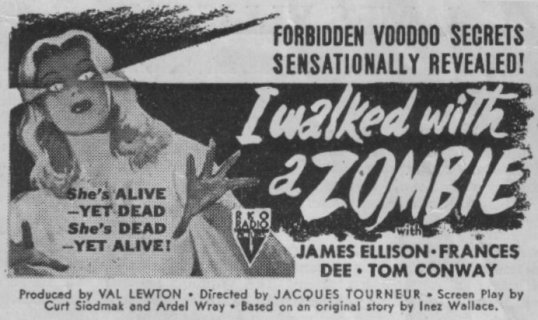
Horror Film Review: I Walked With A Zombie (dir by Jacques Tourneur)


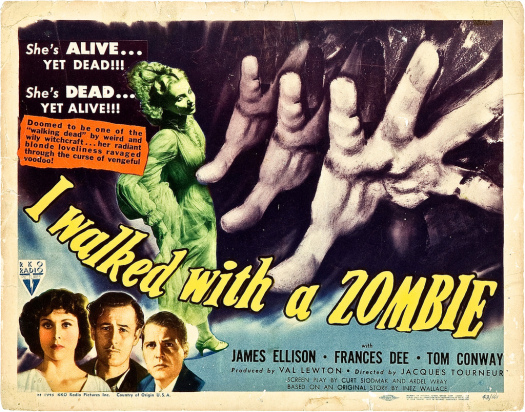
The 1943 horror film I Walked With A Zombie tells a zombie story that would probably seem strange to modern zombie fans. There’s no cannibalism. There’s no feasting on brains. There’s no talk about how the only way to stop a zombie is to shoot them in the head. In fact, the zombies in I Walked With A Zombie may be referred to as being the “living dead” but they’re not actually dead. Instead, if anything, they’ve been cursed. Maybe they’re possessed. Maybe they’ve been brainwashed. Maybe they’re lobotomized. Who can say for sure?

Instead of being the type of zombies that were made famous by George Romero’s Night of the Living Dead, the zombies in I Walked With A Zombie hew closer to the zombies of Haitian legend. These zombies suffer from a sort of mental paralysis. Unable to think for themselves, they wander about in a sort of permanent limbo, trapped between life and death and under control of the voodoo priests who transformed them.

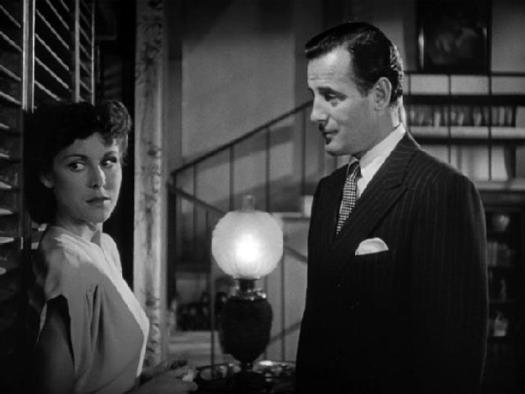
This moody and, at time, rather dream-like film deals with Besty Connell (Frances Dee), a Canadian nurse who has been hired by Paul Holland (Tom Conway), who owns a sugar plantation on a Caribbean island. Paul’s wife, Jessica (Christine Gordon) has apparently been taken ill and, as a result, is behaving strangely. Often, she wanders about with a glazed look in her eyes, almost as if she’s trapped in a sort of dream-state. Paul believes that it’s the result of the severe fever that Jessica previously suffered with. The locals, meanwhile, gossip that, right before Jessica was taken ill, she was having an affair with Paul’s alcoholic half-brother, Wesley (James Ellison). Betsy’s attempts to care for Jessica and understand her condition will lead to Betsy exploring not only the island’s voodoo culture but also …. walking with a zombie!

I Walked With A Zombie is a deliberately paced film, one that focuses more on creating and maintaining an ominous mood than on going for the type of jump scares that we’ve come to expect from most horror movies. I Walked With A Zombie is all about atmosphere and ambiguity. Indeed, it’s never determined for certain whether or not Jessica’s condition is due to a voodoo curse or if perhaps it really is just due to her earlier fever. It’s left to the audience to decide.

Directed by Jacques Tourneur and produced by Val Lewton (the same time team behind the original Cat People), I Walked With A Zombie is an effective and well-acted film, one that also features some gorgeous black-and-white cinematography and an interesting subtext about colonialism. (Upon arriving on the island, Betsy discovers that the Holland family made their fortune through the slave trade and that they still have the figurehead of an old slave ship displayed in their courtyard.) It may not be frightening by today’s standards but it is still a thought-provoking film and one that should be seen by anyone who is a serious zombie fan.
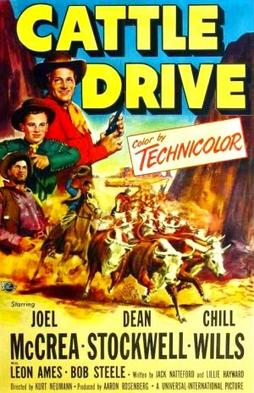
Cattle Drive (1951, directed by Kurt Neumann)


In this coming-of-age Western, Dean Stockwell plays Chester Graham, Jr., the spoiled and unruly son of a railroad owner (Leon Ames).  While riding on his father’s train and making trouble for the conductor, Chester overhears his father talking about sending him to a military school.  When the train makes as top, Chester impulsively runs away.  The train leaves without him and Chester finds himself stranded in the middle of the wilderness.  That’s when he sees cowboy Dan Matthews (Joel McCrea) trying to catch a wild stallion.

Dan is a part of a cattle drive.  Knowing that he can’t leave Chester to die in the wilderness, Dan brings him back to his camp.  The other members of the company aren’t too keen on having to look after a spoiled brat along with the cattle and Chester isn’t too happy to hear that he’ll be expected to work if he expects to get fed.  But with no choice but to work together, Chester, Dan, and the rest of the company make the journey to Santa Fe.  Chester finally drops his attitude enough to work with the company’s cook (Chill Wills) while Dan deals with a rival cowboy named Currie (Henry Brandon). Chester learns about responsibility and Dan finally finds the courage to consider settling down.

Of the many westerns that Joel McCrea made over the course of his career, he considered Cattle Drive to be his favorite and it’s easy to see why.  Cattle Drive features McCrea doing what he did best, playing a tough but good-hearted and down-to-earth cowboy who looked after an outsider.  If you were ever lost in the old west, Joel McCrea is precisely the type of cowboy that you would hope would come to your rescue.  The plot features almost every single cattle drive cliché that you could imagine but McCrea plays his role with a winning combination of grit and compassion and he and Dean Stockwell, who is also very good, make a good team.  Shot in Death Valley and Utah, Cattle Drive feels and look authentic and should be enjoyed by anyone looking for good, heartfelt western.

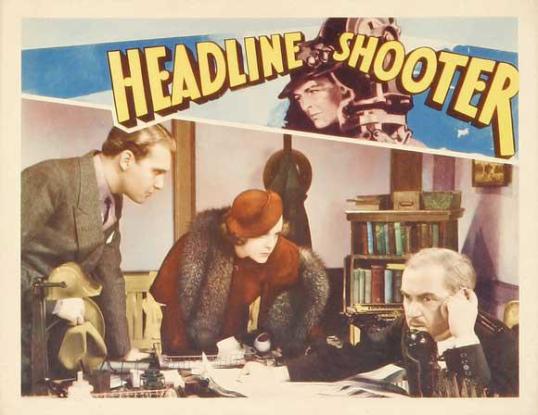
Cleaning Out The DVR: Headline Shooter (dir by Otto Brower)


Bill Allen (William Gargan) is cynical newsreel cameraman.  Everywhere he goes, he’s got a tripod and a camera ready to go.  He films the disasters that other people are too scared to go near.  When there’s an earthquake, he runs outside to film it.  When a building catches on fire, he risks life and limb to record the event.  When a dam breaks, Bill is there to not only record the devastation but also help expose the man responsible for the poorly constructed dam.  When the man later commits suicide, Bill shrugs it off.  The public, he says, had a right to know.

Jane Mallory (Frances Dee) is a reporter.  She tough and she can just as sarcastic as Bill.  When she’s held hostage by  bunch of gangster, she proceeds to not only challenge them to a game of gin rummy but she beats them too!  Jane loves pursuing a good story but she worries that she might end up as cynical and callous as some of her colleagues.  As much as Jane loves it, a part of her is desperate to get out of the news business and, instead, marry the decent but boring Hal Caldwell (Ralph Bellamy, of course).

Together, Bill and Jane …. SOLVE CRIMES!

Actually, they do.  Of course, that doesn’t happen until towards the end of this zippy 61 minute film from 1933.  Before they solve a crime and run afoul some gangsters, Bill and Jane fall in love.  Of course, it’s a cynical journalist type of love, where quips and snarky put-downs replace the traditional endearments.  But it’s love just the same.  Bill and Jane share an understanding of what it feels like to pursue a big story.  It’s something that Hal, as decent a person as Ralph Bellamy ever played in a 1930s movie, just cannot understand.

This is a pre-code film, which means that the characters are allowed to smoke and drink and the dialogue is full of double entendres.  When Bill mentions that a woman he knows has a cold, Jane replies, “Let me guess.  It kept you up all night.”  That’s the type of dialogue that, in just a few short years after the release of Headline Shooter, studio productions would no longer be allowed to get away with.

Headline Shooter is a fast-paced film, one where everyone speaks almost exclusively in the fast rat-a-tat style of 1930s New York.  Considering that it’s only an hour long, it still manages to fit in a lot of plot.  There’s also a lot of real footage of actual disasters, the majority of which is passed off as being footage that was shot by either Bill or his colleagues.  Watching the film today, it’s interesting to consider that the newsreel cameraman were essentially early versions of the paparazzi, searching the city for anything worth shooting and, for the most part, not concerning themselves with the ethical concerns of exploiting disaster.  Many of the issues raised by Headline Shooter are still pertinent today.  One could almost argue that a film like Nightcrawler is a direct descendant of Headline Shooter.

Of course, Headline Shooter in never as dark as something like Nightcrawler.  Instead, all things considered, it’s a rather cheerful melodrama.  Gargan and Dee are wonderful in the lead roles and the cast is full of wonderful 1930s character actors.  This film shows up occasionally on TCM so keep an eye out for it!

(Unless, of course, you’re a Comcast customer….)

Halloween Havoc!: I WALKED WITH A ZOMBIE (RKO 1943)


gary loggins's avatarcracked rear viewer

Val Lewton’s  I WALKED WITH A ZOMBIE is, despite the exploitative title, one of the most moody and atmospheric horror films of the 40’s. This was Lewton’s follow up to the highly successful CAT PEOPLE (1942), with Jacques Tourneur again in the director’s chair. Though screenwriters Curt Siodmak and Ardel Wray based their script on a story by Inez Wallace, producer Lewton had them add elements of Charlotte Bronte’s JANE EYRE, making this a  Gothic zombie movie!

Nurse Betsy Connell (Frances Dee) is summoned to the West Indies isle of St. Sebastian to look after Paul Holland’s (Tom Conway ) catatonic wife Jessica. The cynical Holland has an air of melancholy about him (“There’s no beauty here”, he states on the sea trip to the island, “only decay and death”). Upon arrival, Betsy meets Holland’s stepbrother Wesley Reed (James Ellison), a jovial sort until he gets in the presence of…

View original post 409 more words

Cleaning Out The DVR #26: Little Women (dir by George Cukor)


(For those following at home, Lisa is attempting to clean out her DVR by watching and reviewing 38 films by this Friday.  Will she make it?  Keep following the site to find out!)

Little_Women_1933_poster

Based on the beloved classic by Louisa May Alcott, the 1933 film Little Women tells the story of the March sisters.  Growing up in Concord, Massachusetts during the Civil War, they wait — with their mother, Marmee (Spring Byington) — for their father to return from serving as a chaplain in the Union Army.  There are four sisters.  The oldest, Meg (Frances Dee) is a responsible and practical (which is a nice way of saying that someone is boring) seamstress.  The youngest, Beth (Joan Bennett) is beautiful but selfish.  Meanwhile, saintly Beth (Jean Parker) spends her time playing a severely out-of-tune piano.

And then there’s Jo (Katharine Hepburn).  Jo is just a year younger than Meg and … well, basically, she’s Katharine Hepburn.  She’s an independent-minded intellectual who dreams of being a writer and who isn’t interested in conforming to society’s expectations.  She’s head-strong and occasionally, she’s too stubborn for her own good.  But she’s also kind-hearted and loves her sisters, even if she does sometimes disagree with them.  We follow Jo as she rejects one potential suitor, poor earnest Laurie (Douglass Montgomery) and discovers another when she meets the older Prof. Behar (Paul Lukas).  We also watch as a family tragedy brings her and her sisters back together.

In fact, Katharine Hepburn is so perfect as Jo that it throws the rest of this adaptation out of balance.  So totally does Hepburn dominate this film that it’s hard not to feel that the other March sisters end up getting a short shrift.  To a certain extent, it does make sense.  Jo is the lead character and the story is largely told through her point of view.  But, for someone who enjoyed reading Alcott’s novel, it’s hard not to be disappointed.  I mean, Jo is great but some of us may have related more to one of the other March sisters.  Like Beth, for instance.

Another problem with this version of Little Women is that the March sisters are all supposed to be teenagers and yet, they’re played by actresses who were in their 20s.  For instance, 23 year-old Joan Bennett played Amy, who is supposed to be only 12 years old when we first see her.  By casting actresses who were already clearly adults, it makes t difficult for the film to work as a coming-of-age story.

(Personally, my favorite version of Little Women — and the first one that I ever saw — was the 1994 version that starred Winona Ryder as Jo.  Even though Ryder was clearly the film’s star, the other three March sisters were all given time to make an impression as well and, as a result, they felt like a real family.  Speaking as the youngest of four sisters, there was a lot about that movie to which I could relate.  Add to that, Christian Bale made for a far more interesting Laurie than Douglass Montgomery.)

With all that said, it bears repeating that Katharine Hepburn is absolutely perfect as Jo and, if you’re a Hepburn fan (and who isn’t), this is one of her essential films.  It helps that she was directed by George Cukor, the director who was responsible for some of Hepburn’s best performances.  The rest of the movie doesn’t quite live up to Hepburn’s performance but she was such a great talent that it almost doesn’t matter.

Little Women was nominated for best picture.  However, it lost to Cavalcade.

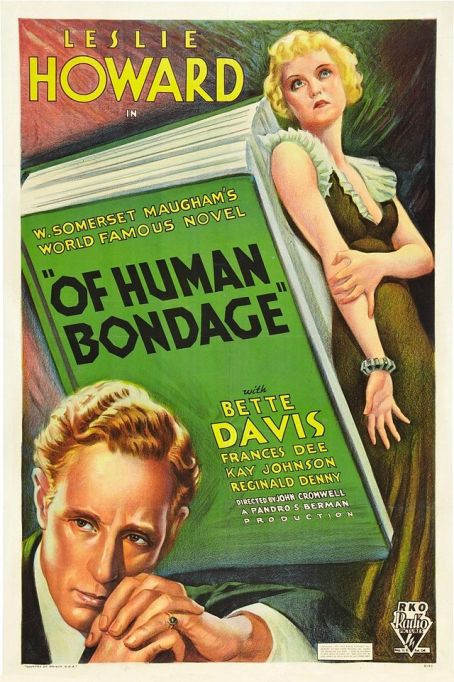
Embracing the Melodrama Part II #7: Of Human Bondage (dir by John Cromwell)


Of_Human_Bondage_Poster

“I don’t mind.” 

— Mildred Rogers (Bette Davis) in Of Human Bondage (1934)

For the next three weeks, I will reviewing, in chronological order, 126 cinematic melodramas.  It’s a little something that I like to call Embracing the Melodrama Part II.  We started things off yesterday by taking a look at the silent classic Sunrise.  Today, we continue with a quick look at the 1934 literary adaptation, Of Human Bondage.

Of Human Bondage opens with Philip Carey (Leslie Howard) living in Paris and struggling to make a living as a painter.  The son of a prominent doctor, Philip is self-conscious about both his club foot and his abilities as an artist.  When he invited an older artist to take a look at his work, Philip is informed, “There is no talent here.  You will be nothing but mediocre.”  Philip gives up his artistic ambitions and instead enters medical school.

Philip turns out to be just as miserable and moody as a medical student as he was when he was a painter.  (Indeed, Philip may be one of the most miserable characters in cinematic history.)  However, he does meet and becomes rather obsessed with a waitress named Mildred (Bette Davis).  For her part, Mildred has little use for Philip or any of the other men who are constantly hitting on her.  Whenever Philip asks her out, Mildred replies, “I don’t mind.”  When Philip asks if he might kiss her goodnight, Mildred coolly replies, “No.”

Philip remains obsessed with Mildred, to the extent that he nearly flunks out of medical school because he can’t stop thinking about her.  Mildred, however, eventually leaves Philip for the far more wealthy Emil Miller (Alan Hale).  Eventually, Philip meets Norah (Kay Johnson), a romance novelist who falls as deeply in love with Philip as he did with Mildred.  However, when the now pregnant Mildred reenters his life, Philip abandons Norah and goes back to her.

And so it goes for the next few years.  Philip obsesses over Mildred.  Mildred abandons Philip.  Philip moves on.  Mildred reenters Philip’s life.  With each reappearance, Mildred appears to be growing weaker and sicker but she’s never so weak that she can’t yell at Philip and ridicule him for having a club foot…

It’s a little bit strange to admit to enjoying a film like Of Human Bondage because, when you get right down to it, it’s an unpleasant story about an unlikable man being manipulated by a heartless woman.  But, interestingly enough, it’s Mildred’s unapologetic anger that make her such a compelling character.  If Philip was in any way a sympathetic character, the film would be almost unbearably grim.  But since Philip is such a weak-willed character and is so full of self-pity, you can’t help but be happy that Mildred is around to call him out on his bullshit.  Everyone else in the film is so awful and boring, that you can’t help but appreciate the fact that Mildred never holds back.

Have you ever wondered why, every Oscar telecast, the Academy makes a point of letting us know that an independent accounting firm counted all of the ballots?  Well, it’s because of this film.  Or, more specifically, it’s because of Bette Davis’s ferocious performance.  In 1935, when Davis somehow failed to be nominated for best actress, there was such outrage and so many people assumed that the nomination process had been rigged that the Academy actually allowed people to write in her name on their ballots.  (Davis still lost to Claudette Colbert.)  In order to avoid any future controversy, the Academy hired a private accounting firm to count and hold onto the ballots.  (And if you’re curious about how that desire to avoid controversy is working out for the Academy, I was one words for you: Selma.)  When, the next year, Bette Davis won the Oscar for best actress, it was widely assumed that it was largely to make up for being snubbed for Of Human Bondage.

If you want to see a good Leslie Howard film, go with Berkeley Square.  But if you want to see a great Bette Davis film, watch Of Human Bondage.

http://www.youtube.com/watch?v=5j6eBs-coEQ