4 Shots From 4 Films is just what it says it is, 4 shots from 4 of our favorite films. As opposed to the reviews and recaps that we usually post, 4 Shots From 4 Films is all about letting the visuals do the talking.
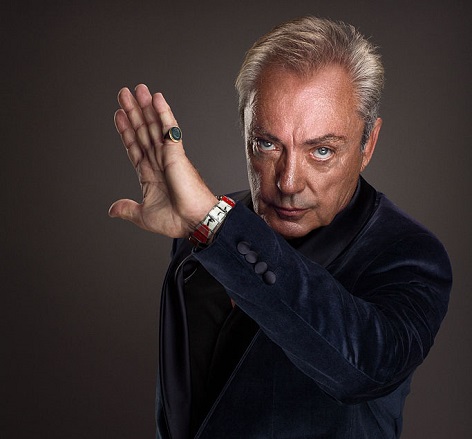
In memory of Udo Kier, here are…
4 Shots From 4 Udo Kier Films
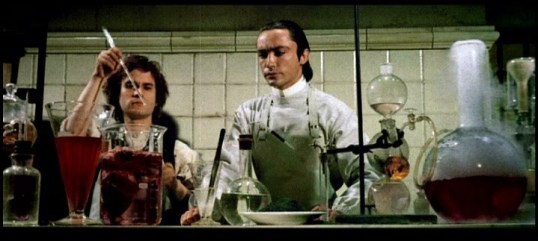
Flesh For Frankenstein (1973, dir by Paul Morrissey, DP: Luigi Kuveiller)
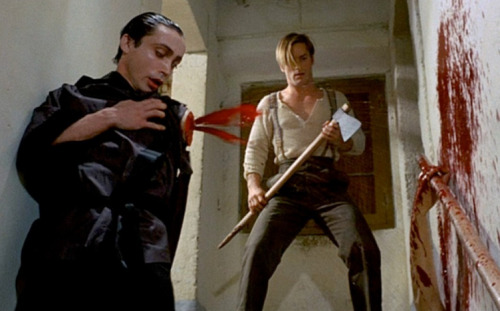
Blood For Dracula (1974, dir by Paul Morrissey, DP:Luigi Kuveiller)
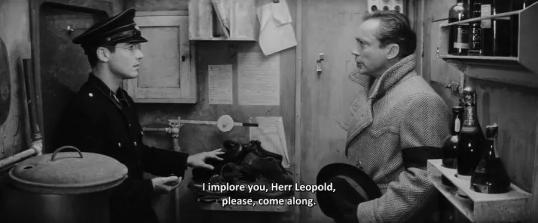
Europa (1991, directed by Lars Von Trier, DP: Henning Bendtsen, Edward Kłosiński, Jean-Paul Meurisse. Released as Zentropa in North America)
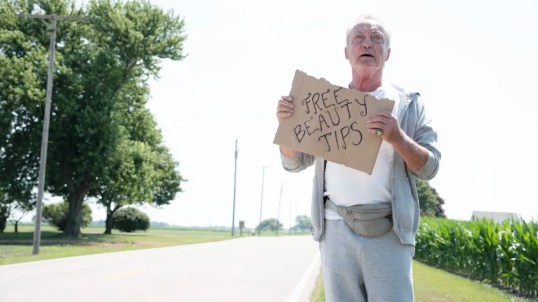
Swan Song (2021, dir by Todd Stephens, DP: Jackson Warner Lewis)
Since today is Boris Karloff’s birthday, I thought I would devote this edition to everyone’s favorite reanimated corpse, Frankenstein’s Monster! Over the years, there’s been a lot of movies about the Monster. Here are the trailers for six of them!
The Curse of Frankenstein (1957)
Believe it or not, there was a time when it was felt that the story of Frankenstein and his Monster has been played out. With the Universal films bringing in less and less money, many felt that the Monster’s days were behind it. Then, Hammer, Peter Cushing, and Christopher Lee came along and said, “No! This is what Frankenstein is all about!”
At least, I assume that’s what they said. I hope they did.
2. Jesse James Meets Frankenstein’s Daughter (1965)
You can’t keep a good Frankenstein down as Jesse James discovered in this 1965 western.
3. Lady Frankenstein (1971)
In this Italian film, the Baron’s daughter continues her father’s scientific experiments! I guess Jesse James wasn’t the only one to meet Frankenstein’s Daughter!
4. Flesh for Frankenstein (a.k.a. Andy Warhol’s Frankenstein) (1973)
Udo Kier is the Baron and Andy Warhol may have been the producer of this film. Or he may have just lended his name out for the money. It depends on who you ask.
5. Blackenstein (1973)
Of course, following the success of Blacula, there was a blaxploitation take on Frankenstein.
6. Frankenhooker (1990)
And, of course, who can forget Frankenhooker?
I hope that your Halloween is full of the type of creativity and scientific curiosity that made the Frankenstein family legendary!
Kier is 77 years old. This German actor has over 260 film credits to his name, having worked with everyone from Dario Argento to Paul Morrissey to Gus Van Sant to Alexander Payne to Rob Zombie to Lars von Trier. Though he’s appeared in every genre of film, he’s best remembered for his horror appearances. In fact, his career got a major boost when he was cast in two horror films that were produced by Andy Warhol. (As with all things Warhol, there’s more than a little debate as to how much Andy was actually involved.) In 1973, Kier played Baron Von Frankenstein in Flesh For Frankenstein. In 1974, he played Dracula in Blood for Dracula. Both films were deliberately over-the-top in both their gore and their performances and they helped launch Udo Kier on the path to cult stardom. Take, for example, the scene below. This is from Flesh for Frankentein. Kier’s Baron meets his end but not before giving a lengthy monologue. One thing to keep in mind is that this film was originally released in 3D so, while Kier was giving his speech, the Baron’s organs were hanging out over the audiences.
(If you have a hard time with gore, I would not suggest watching this scene.)
Happy birthday, Udo Kier! Thank you for putting your heart into ever role!
Here are just a few things to be experienced in 1973’s Flesh For Frankenstein:
A fanatical Baron von Frankenstein (Udo Kier) needs a brain for his latest creation so his assistant, Otto (Arno Jurging) goes out with a giant pair of hedge clippers, snips off a divinity student’s head, and then runs off with it.
An incredibly sexy farmhand named Nicholas (Joe Dallesandro) speaks with a thick and very modern New York accent, despite living in Germany in the 19th century. Meanwhile, everyone around him speaks with an extra-thick German accent.
The Baron announces to Otto, “To know life, you must fuck death in the gall bladder!”
Nicholas has an affair the Baroness von Frankenstein (Monique van Voreen), who in one scene loudly sucks on Nicolas’s armpit.
The Baron gets rather obviously turned on while removing organs from a body.
The Baron’s children decapitate their dolls and take a perverse pleasure in being cruel. Some of this could possibly be because the Baron and the Baroness are also brother and sister.
The Baron rants and raves about how, by bringing the dead back to life, he will be able to create the perfect Serbian race, one that will only take orders from him and which will …. well, do something. The Baron has a lot of plans but he’s not always clear on just what exactly the point of it all is.
Speaking of points, one character eventually gets a spear driven through his back an out of his chest. Despite the fact that his heart is literally hanging off the tip of the spear, he still manages to get out a very long and very emotional monologue before dying.
Now, of course, you have to remember about that scene with the heart is that Flesh for Frankenstein was originally shot in 3D, which means that audiences in 1973 would have literally had that heart dangling over their heads while waiting for that endless monologue to stop. How the audience would react to that would have a lot to do with whether or not they were in on the joke.
And make no mistake, Flesh For Frankenstein is not a film that’s meant to be taken too seriously. It’s a satire of …. well, just about everything. Baron Frankenstein, with his sexual hang-ups and his obsession with creating a perfect male and a perfect female so that they can have perfect Serbian children, is the ultimate parody of the mad scientists who usually populate these films and Udo Keir gives a truly mad performance in the role. One need only compare Keir’s Frankenstein to the coldly cruel version that Peter Cushing played in Hammer’s “serious” Frankenstein films to see just how much Keir embraced the concept of pure batshit insanity. Whereas Keir joyfully overacts every moment that he’s on-screen, Joe Dallesandro pokes fun at the traditional image of the strong, silent hero by barely reacting to anything at all. The film’s nonstop flow of blood parodies the excesses of the horror genre while Nicholas’s affair with the Baroness satirizes not only Marxism but also an infinite number of European art films. Flesh for Frankenstein is a film that is so deliberately excessive that it often feels as if it’s daring you to stop watching. Of course, you don’t stop watching because you know the movie will probably start making fun of you as soon as you turn your back on it.
Flesh For Frankenstein is also known as Andy Warhol’s Frankenstein. Warhol actually had little do with the movie, beyond lending his name. The film was directed by Paul Morrissey, who served as Warhol’s “house director” during the Factory years. The best Factory films were defined by the combination of Warhol’s detachment with Morrissey’s political and religious conservatism. With Flesh For Frankenstein, Morrissey not only satirizes what he viewed as being the excesses of European and horor cinema but he also satirizes the fact that there’s an audience for his satire. Flesh For Frankenstein is definitely not a film for everyone but, in this case, that can be considered a compliment. It’s an audacious and wonderfully over-the-top movie, one that would be followed by Blood for Dracula.
One final note: Because the film was made in Italy, Antonio Margheriti was credited as being a co-director on the film with Morrissey. While Margheriti did do some second unit work, it is generally agreed that he was not, in any way, a co-director. Apparently, Margheriti was credited as being a co-director so that the film could receive financial aid from the Italian government. This scheme later led to both Margheriti and producer Carlo Ponti being charged with criminal fraud.
There’s literally been hundreds of film adaptations of Mary Shelley’s novel Frankenstein, or the Modern Prometheus. Everyone from James Whale to Terrence Fisher to Paul Morrissey to Kenneth Branagh to Marcus Nispel has taken a shot at interpreting the legend and the monster’s been played by everyone from Boris Karloff to Christopher Lee to Robert De Niro to Srdjan Zelenovic (who was pretty freaking hot and yummy for a creature stitched together out of random corpses in Flesh for Frankenstein).
However, the very first cinematic version of Frankenstein came out in 1910. Produced by Thomas Edison’s film company, this 10-minute, silent film starred an actor named Charles Ogle as the monster. Frankenstein, himself, was played by Augustus Phillips while his fiancée was played by Mary Fuller. The film was directed by a fellow known as J. Searle Dawley. Dawley reportedly directed over a hundred silent films and most of them are lost to history.
For about 6 decades, it was assumed that Dawley’s Frankenstein was lost as well. However, in the mid-70s, it turned out that one remaining print of the film still existed and was apparently sitting up in someone’s attic in Wisconsin. It also turned out that the film was still in viewable condition.
And now, thanks to a combination of YouTube and the fact that every movie made before 1922 is now in the public domain, I’ve had the opportunity to see this movie for free and even better, here’s your chance to see it for free. Understand that when I say better, I’m speaking from the point of view of someone who is fascinated by history in general and cinematic history in specific. In many ways, this film epitomizes everything that makes it difficult for modern audiences to appreciate the excitement once generated by silent film. The acting is overly theatrical and watching the film makes you appreciate the eventual development of the dolly shot and the zoom lens even more. Add to that, the music that was selected to accompany this video is way too obvious and heavy-handed. I would suggest, before watching, that you mute the video and put your own preferred music on instead.
Still, the film does have a lot of historic interest. I don’t think you can truly judge and appreciate the films of today unless you know something about the films of the past. Watching a movie like the 1910 Frankenstein not only makes you realize how far films have come as an art form but also how much of the medium’s inherent earnestness has been lost with each advance in technology.
Anyway, with all that said, here is the 1910 version of Frankenstein…

 Through the Shattered Lens