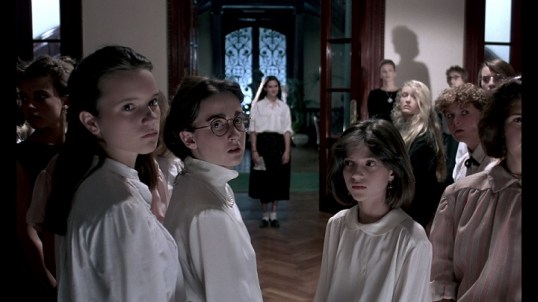
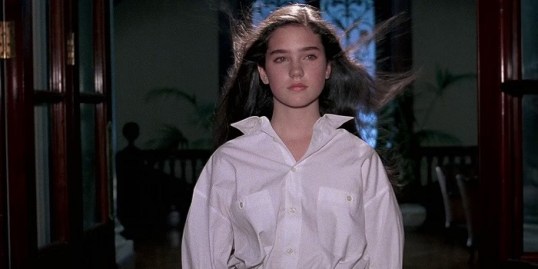
Music Video of the Day: The Valley by Bill Wyman and Terry Taylor (1985, dir by Michele Soavi)


Today’s music video of the day is for an instrumental piece that was composed by Bill Wyman and Terry Taylor for Dario Argento’s 1985 film, Phenomena.

Put together by Michele Soavi, this music video features not only scenes from the film but also clips of Dario Argento directing both Jennifer Connelly and Fiore Argento.  Soavi, of course, went on to have a directorial career of his own, directing four classic horror films before stepping away from feature films to take care of his ailing son.  Soavi has since returned to directing, though most of his subsequent work has been for Italian television.

Enjoy!

Music Video of the Day: The Valley by Bill Wyman and Terry Taylor (1985, dir by Michele Soavi)


Today’s music video of the day is for an instrumental piece that was composed by Bill Wyman and Terry Taylor for Dario Argento’s 1985 film, Phenomena.

Put together by Michele Soavi, this music video features not only scenes from the film but also clips of Dario Argento directing both Jennifer Connelly and Fiore Argento.  Soavi, of course, went on to have a directorial career of his own, directing four classic horror films before stepping away from feature films to take care of his ailing son.  Soavi has since returned to directing, though most of his subsequent work has been for Italian television.

Enjoy!

The Films of Dario Argento: Phenomena


First released in 1985, Phenomena is the Dario Argento film with all the insects.

Phenomena is one of the most divisive of Argento’s film.  Throughout the years, many critics have cited Phenomena as being the first Argento film to not really work.  Some have called it Argento’s worst and most self-indulgent film and the first sign that he had lost his way.  At the same time, I know quite a few people who consider Phenomena to be among Argento’s best films.  The one thing that both camps seem to have in common is that their takes are all inspired by the film’s use of insects.

That said, Argento has always claimed that Phenomena is less about the insects and more about a world in which the Nazis conquered Europe.  Much as with Argento’s claim that Tenebrae is actually a science fiction film, the idea that Phenomena takes place in a Europe controlled by Nazis can be found but only if you specifically look for it.  For instance, the film is set in the Swiss countryside, with a similar emphasis on the mountains and the forests that were present in the German propaganda pictures that were taken of Hitler and his inner circle “relaxing” at his mountain residence.  Much of the film takes place at a private school that is named after Richard Wagner, where the privileged students — with their always crisp uniforms and their haughty attitude — feel as if they could be descendants of the kid who sang Tomorrow Belongs To Me in Cabaret.  One of the chaperones at the school is a German woman named Frau Bruckner (Daria Nicolodi).  Again, much as with Tenebrae, Argento has said the Phenomena takes place in a world where terrible things have happened but the population has collectively decided to forget about them.  Willfully forgotten seems to have been a major theme for Argento in the years following his unhappy experience with Inferno.

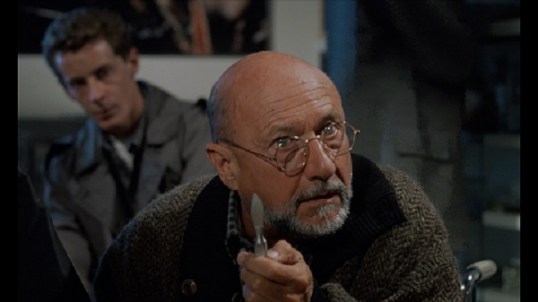
The film opens with the murder of 14 year-old Danish girl named Vera Brandt (played by Fiore Argento, the director’s daughter) who is a part of a tour group but who misses her bus.  When she walks through the Swiss countryside in search of help, she comes across a house that’s not as abandoned as it originally.  She is attacked and beheaded by the house’s resident.  Eight months later, Vera’s decaying and maggot-covered heard is discovered and taken to forensic entomologist John McGregor (Donald Pleasence).  Though McGregor uses a wheelchair, he has a monkey named Inga who takes care of him.  Inga is quite capable with a straight-razor.

Meanwhile, chaperoned by Frau Bruckner, Jennifer Corvino (Jennifer Connelly) has just enrolled in the Richard Wagner Academy For Girls.  Jennifer is the daughter of a Hollywood star.  (Argento originally wanted Jennifer to be Al Pacino’s daughter, with Pacino playing himself.  Pacino reportedly turned Argento down.)  Jennifer is also a sleepwalker who has an intense mental connection with insects.  Insects do her bidding and, in return, Jennifer protects them.  When Frau Brucker and her chauffeur attempt to kill a bee, Jennifer is able to calm down the bee and set it free from the limo.

Jennifer struggles to fit in at the Academy.  Much like Jessica Harper’s Suzy Banyon in Suspiria, she discovers that the other students are an idiosyncratic and not particularly friendly group.  Whereas poor Suzy Banyon just had to accept her situation, Jennifer has an army of insects on her side and she’s willing to call them down on her snooty classmates.  Of course, when Jennifer isn’t communing with the insects, she’s having to deal with the fact that she witnessed a murder while she was out sleepwalking.  Haunted by images of the murder and being stalked by the murderer, Jennifer also learns that Frau Bruckner wants to send her to a mental hospital for being “diabolic.”

Jennifer’s only real friend in Switzerland is John McGregor and it must be said that Donald Pleasence, who was so misused in so many horror films in the 80s and 90s, is perfectly cast as the eccentric but kindly entomologist.  Pleasence was one of those actors who could deliver even the strangest of lines with enough gravity to make them memorable and McGregor’s easy acceptance of the idea that Jennifer has a psychic connection with insects make it much easier for the viewer to accept it as well.  As well, McGregor’s friendship with the monkey is far more touching than it has any right to be.

Phenomena is an odd mix of giallo and fantasy, with the brutal and violent murders uneasily playing out with more lyrical scenes featuring the beauty of Switzerland and the loyalty of the animal kingdom.  Perhaps the best way to view Phenomena is as being an extremely bloody fairy tale, with Jennifer as a Cinderella-figure who depends on nature to stay safe from the adults and the students who stand in for the wicked stepmother and the ugly stepsisters.  Visually, there are moments of haunting beauty in the film.  There are other moments in which Argento seems to be determined to test how long the audience would be willing to accept the idea Jennifer and her insect army.  Because of the whimsical insects, the film is often described as being an oddity in Argento’s filmography but actually, psychic insects and animals would pop up in future Argento films, so it seems that this was something that had obsessed him for a long time.  Either that or the negative reaction afforded to Phenomena inspired Argento to continue to use the insects as his way of letting the critics know his true opinion of their worth.

I have to admit that I am amongst those who like Phenomena.  It’s such a strange film that it’s hard for me not to admire it and, much as with Suspiria, the film benefitted from having a strong female protagonist in Jennifer Calvino.  (For her part, Jennifer Connelly has said that she’s not particularly a fan of Phenomena.)  Finally, this is a film that gave Donald Pleasence a chance to show what an engaging actor he could be when he had the right role.  Critics be damned, I like this movie!

The (Reviewed) Films of Dario Argento:

  1. The Bird With The Crystal Plumage
  2. Cat O’Nine Tales
  3. Four Flies on Grey Velvet
  4. Deep Red
  5. Suspiria
  6. Inferno
  7. Tenebrae

The TSL’s Daily Horror Grindhouse: Demons (dir by Lamberto Bava)


demons

“What the Hell happened to Rosemary?”

— Tony The Pimp (Bobby Rhodes) in Demons (1985)

A lot of what you need to know about Demons, an Italian horror film from 1985, can be summed up by the fact that one of the leading characters is named Tony the Pimp.  Demons is a very self-aware film, one that is not only over-the-top and ludicrous but which is cheerfully aware that it’s over-the-top and ludicrous.  Considering that Demons is an apocalyptic film that ends with nearly the entire cast dead, Demons is a surprisingly good-natured horror film.

The film opens in Berlin.  There’s a mysterious man hanging out at a subway station.  He’s wearing a silver half-mask and, from what we can see of his face, he appears to be heavily scarred.  Interestingly enough, the man is played by Michele Soavi.  (Though Soavi is now best remembered as the director of Dellamorte Dellamore, he was an actor and assistant to Dario Argento when Demons was produced.)  The man doesn’t speak.  Instead, he hands out flyers to random people, inviting them to attend the premiere of a new horror film.

The man obviously does a very good because a truly diverse group of characters show up for the premiere.  There’s a wealthy blind man who comes with his assistant.  (The assistant is played by Dario Argento’s oldest daughter, Fiore.)  There’s an older couple who keep shushing everyone in the audience.  There’s Cheryl (Natasha Hovey), who ends up sitting next to the handsome George (Urbano Barberini, who would later co-star in Dario Argento’s Opera).  And, of course, there’s Tony the Pimp (Bobby Rhoades) who shows up wearing a white suit and with two prostitutes.

The film-within-the-film is a horror film that plays out like an homage to every Italian horror film released in the 1980s.  It deals with four teenagers who stumble across the grave of Nostradamus and end up transforming into blood-thirsty demons.  One of the teenagers is played by Michele Soavi, though it’s never clear whether the teenager and the man in the mask are supposed to be the same person.

As they watch the movie, something strange starts to happen in the audience.  One of the prostitutes scratched her face when she put on a prop mask.  When the same mask appears in the movie, the cut on her face starts to throb.  Soon, she is transformed into a … DEMON!

JUST LIKE IN THE MOVIE!

Needless to say, the arrival of a real-life demon leads to a panic in the theater but guess what?  The doors are locked!  There’s no way out!  When Tony the Pimp breaks into the projection booth, he discovers that there’s no projectionist and the movie cannot be stopped!  On top of that, getting scratched by a demon means that you transform into a demon yourself!

In other words — remember the debate about whether or not horror movies can turn their viewers into murderous monsters?  Well, Demons says that they definitely can…

Demons was directed by Lamberto Bava, son of the famous Mario Bava, and it remains one of the most popular Italian horror films of all time.  With a script that was co-written by Dario Argento (who also produced), Demons is a fun and exciting horror film that cheerfully dares you to take it too seriously.  Watching this energetic film, you can tell that Bava was having a lot of fun with the idea that the world could end as a result of watching just one horror movie.

Demons was a huge box office hit so, naturally, there were hundreds of unofficial sequels.  Though Michele Soavi’s The Church was a Demons film in every way but name, the only official sequel was Demons 2.  We’ll look at that film tomorrow.

My Top Ten Books About The Movies


I love movies and I love books so I guess it would stand to reason that I love books about movies the most of all.  (I also love movies about books but there are far fewer of those, unfortunately.)  Below are my personal favorites.  I’m not necessarily saying that these are the ten greatest film books ever written.  I’m just saying that they’re the ones that I’m always happy to know are waiting for me at home.

10) Soon To Be A Major Motion Picture by Theodore Gershuny — This is one of the great finds of mine my life.  I found this in a used bookstore and I bought it mostly because it only cost a dollar. Only later did I discover that I had found one of the greatest nonfiction books about the shooting of a movie ever written!  Gershuny was present during the filming of a movie called Rosebud in the early 70s.   I’ve never seen Rosebud but, as Gershuny admits, it was a critical disaster that managed to lose a ton of money.  The book provides a fascinating wealth of backstage gossip as well as memorable portraits of director Otto Preminger and actors Robert Mitchum (who was originally cast in the lead role), Peter O’Toole (who took over after Mitchum walked off the set), and Isabelle Huppert.   If nothing else, this book should be read for the scene where O’Toole beats up critic Kenneth Tynan.
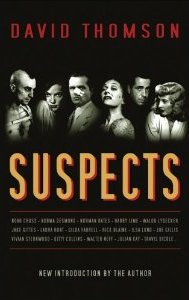
9) Suspects by David Thomson — A study of American cinema noir   disguised as a novel, Suspects imagines what would happen if George Bailey from It’s a Wonderful Life fell in love with Laura from the movie of the same name.  Well, apparently it would lead to Sunset Boulevard’s Norma Desmond having an affair with Chinatown’s Noah Cross and to one of George’s sons, sensitive little Travis, getting a job in New York City as a Taxi Driver.  And that’s just a small sampling of what happens in this glorious mindfuck of a novel.

8 ) Profondo Argento by Alan Jones — Long-time fan Alan Jones examines each of Dario Argento’s films (even Argento’s obscure historical comedy The Five Days of Milan) and proceeds to celebrate and (in many cases) defend Argento’s career.  Jones also interviews and profiles several of Argento’s most frequent collaborators — Daria Nicolodi, Asia and Fiore Argento, Simon Boswell, Claudio Simonetti, Keith Emerson, George Romero, Lamberto Bava, Michele Soavi, and many others.  Jones’ sympathetic yet humorous profile of Luigi Cozzi is priceless.

7)  Spaghetti Nightmares by Luca Palmerini — Spaghetti Nightmares is a collection of interviews conducted with such Italian filmmakers as Dario Argento, Ruggero Deodato, Umberto Lenzi, Lucio Fulci, and others.  Among the non-Italians interviewed are Tom Savini (who, as always, comes across as appealingly  unhinged) and David Warbeck.  (Sadly, both Warbeck and Fulci would die shortly after being interviewed.)  What makes this interesting is that, for once, Argento, Fulci, et al. are actually being interviewed by a fellow countryman as opposed to an American accompanied by a translator.  As such, the subsequent interviews turn out to be some of the most revealing on record.
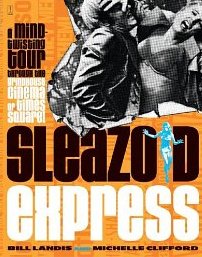
6) Sleazoid Express by Bill Landis and Michelle Clifford — Landis and Clifford’s book is both a history and a defense of the old grindhouse theaters of New York City.  Along with describing, in loving and memorable detail, some of New York’s most infamous grindhouses, they also write about some of the more popular movies to play at each theater.  Along the way, they also offer up revealing profiles of such legendary figures as David Hess and Mike and Roberta Findley.  Reading this book truly made me mourn the fact that if I ever did find myself in New York City, I won’t be able to hit the old grindhouse circuit.

5) Beyond Terror: The Films of Lucio Fulci by Stephen Thrower — Fulci has always been a terribly underrated director and, indeed, it’s easy to understand because, in many ways, he made movies with the specific aim of alienating and outraging his audience.  It requires a brave soul to take Fulci on his own terms and fortunately, Stephen Thrower appears to be one.  Along with the expected chapters on Fulci’s Beyond Trilogy and on Zombi 2, Thrower also devotes a lot of space to Fulci’s lesser known works.  Did you know, for instance, that before he became the godfather of gore, Fulci specialized in making comedies?  Or that he also directed two very popular adaptations of White Fang?  Thrower also examines Fulci’s often forgotten westerns as well as his postapocalyptic sci-fi films.  And, best of all, Thrower offers up a defense of the infamous New York Ripper that, when I read it, actually forced me to consider that oft-maligned film in a new light.  That said, Thrower does admit to being as confused by Manhattan Baby as everyone else.

4) Immoral Tales by Cathal Tohill and Pete Toombs — Tohill and Toombs offer an overview of European “shock” cinema and some of the genre’s better known masters.  The book contains perhaps the best critical examination of the work of Jean Rollin ever written.  The authors also examine the work of Jesus Franco and several others.  This is a great book that reminds us that the Italians aren’t the only ones who can make a great exploitation film.
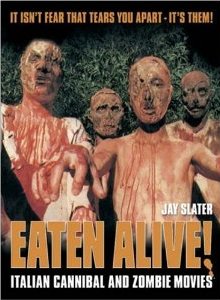
3) Eaten Alive by Jay Slater — This book offers an overview of the Italian film industry’s legendary cannibal and zombie boom.  Along with reviewing every Italian movie to feature even the slightest hint of cannibalism or the living dead (this is one of the few books on Italian cinema that discusses both Pasolini and Lucio Fulci as equals), Eaten Alive also features some very revealing interviews with such iconic figures as Catriona MacColl, Ian McCullough, and especially Giovanni Lombardo Radice.  Radice, in fact, also contributes a memorable “guest” review of one of the movies featured in the book.  (“What a piece of shit!” the review begins.)  Memorable reviews are also contributed by Troma film founder Lloyd Kaufman who brilliantly (and correctly) argues that Cannibal Holocaust is one of the greatest films ever made and Ramsey Campbell who hilariously destroys Umberto Lenzi’s infamous Nightmare City.

2) The Book of the Dead by Jamie Russell — If, like all good people, you love zombies then you simply must do whatever it takes to own a copy of this book.  Starting with such early masterpieces as White Zombie and I Walked With A Zombie, Russell proceeds to cover every subsequent zombie film up through George Romero’s Land of the Dead.  Russell offers up some of the best commentaries ever written on Romero’s Dead films, Fuci’s Beyond Trilogy, Rollin’s Living Dead Girl, and Spain’s Blind Dead films.   The pièce de résistance, however, is an appendix where Russell describes and reviews literally ever zombie film ever made.
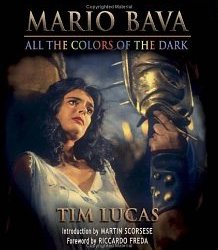
1)  All The Colors Of the Dark by Tim Lucas  — This is it.  This is the Holy Grail of All Film Books.  If you’ve ever asked yourself if any book is worth paying close to 300 dollars, now you have your answer.  This one is.  Tim Lucas offers up the most complete biography of director Mario Bava ever written.  In fact, this may be the most complete biography of any director ever written!  Lucas examines not only Bava’s life but also every single movie that Bava was ever in any way connected to, whether as a director or as a cameraman or as the guy in charge of the special effects.  This is 1,128 pages all devoted to nothing but the movies.  This is the type of book that makes me thankful to be alive and I owe a huge debt of gratitude to Tim Lucas for writing it.