Brad reviews THE SHOP AROUND THE CORNER (1940), starring James Stewart and Margaret Sullavan!


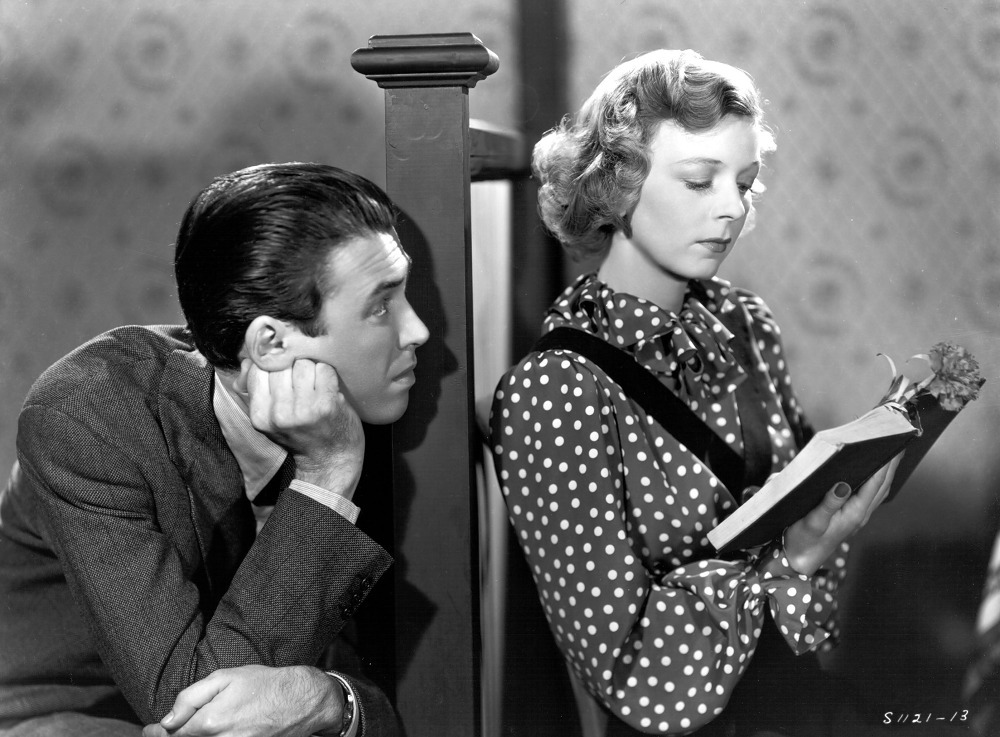
Set in Budapest, Hungary, we meet Alfred Kralik (James Stewart), the dependable head clerk at a retail establishment named Matuschek and Company. In walks Klara Novak (Margaret Sullavan), an attractive young lady who’s desperately in need of a job, so Mr. Matuschek (Frank Morgan) hires her as a new salesgirl. Alfred and Klara immediately take a disliking to each other and give each other quite a hard time at work. As we get to know Alfred and Klara, we find out that each of them is involved in a treasured “pen-pal” relationship with a mysterious someone who truly seems to understand their heart and soul. Wouldn’t you know it, even though they get on each other’s last nerves at the shop, Alfred and Klara are each other’s secret pen-pal! While navigating unexpected drama at work, mainly involving Mr. Matuschek, his wife, and a duplicitous employee, Alfred eventually discovers that Klara is his mystery correspondent without her knowing it. As he tries to reconcile the actions of the lady he knows from work with the heart of the person who wrote those letters, Alfred decides to show Klara who he really is to see if they can fall in love in real life!

THE SHOP AROUND THE CORNER is one of my very favorite romantic comedies, and I’d guess the lead performance of James Stewart is probably the main reason. He’s just perfect in the role of Alfred Kralik… earnest, proud, awkward, vulnerable, and above all else, decent. Stewart’s ability to portray characters with believable decency separate him as one of the all-time greats and that quality is well on display here. Margaret Sullavan, as Klara Novak, matches him perfectly. Known to have a good relationship off screen as well, the chemistry between Stewart and Sullavan is off the charts and their scenes together are quite powerful. Mostly known by me for his performance as the Wizard of Oz, Frank Morgan is also incredible as Mr. Matuschek, at times jealous, volatile, and ultimately benevolent.

Director Ernst Lubitsch, known for his “Lubitsch touch,” has made a movie that has stood the test of time because of its core of emotional truth. Even though it was made well before the days of social media or online dating, THE SHOP AROUND THE CORNER understands just how differently we present ourselves when writing (or online, or on social media), compared to how we actually behave in person. Maybe it’s because THE SHOP AROUND THE CORNER was made in 1940, but I love the way its time-tested story idea is used for comedy and sweet romance, without becoming cynical. That lack of cynicism leaves room not only for comedy and romance but also a genuine compassion for its characters as they deal with the very real emotions of loneliness, pride, jealousy, and fear.

All in all, THE SHOP AROUND THE CORNER may be 85 years old, but its tender and romantic payoff set on Christmas Eve still gets me every time. As far as I’m concerned, this is about as close to perfect as a romantic comedy can get!  

(Author’s note: I’m also a fan of the 1998 remake, YOU’VE GOT MAIL, starring Tom Hanks and Meg Ryan, but I rate it below Lubitsch’s film.)

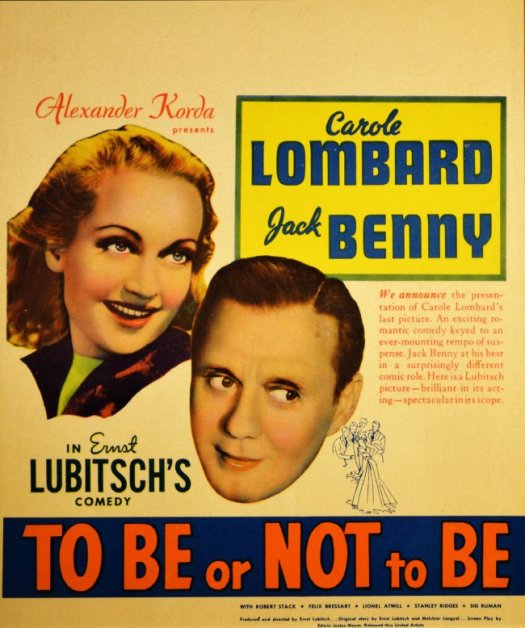
Polish Ham: Jack Benny in TO BE OR NOT TO BE (United Artists 1942)


gary loggins's avatarcracked rear viewer

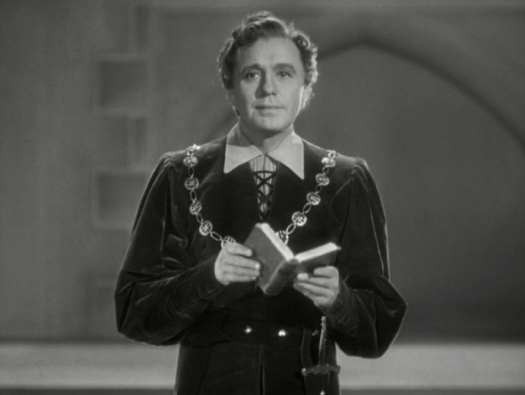
Comedian Jack Benny got a lot of mileage (and a lot of laughs) making fun of his movie career, especially THE HORN BLOWS AT MIDNIGHT . While that film isn’t half as bad as Jack claimed it was, even better was Ernst Lubitsch’s TO BE OR NOT TO BE, a topical (at the time) tale of a band of Polish actors taking on the invading Nazis during WWII. Jack’s got his best film foil here, the marvelous Carole Lombard, and the movie’s got that wonderful “Lubitsch Touch”, a blend of sophistication and sparkling wit evidenced in classic films ranging from THE MERRY WIDOW and DESIGN FOR LIVING to NINOTCHKA and HEAVEN CAN WAIT.

Benny plays Joseph Tura, the self-proclaimed “greatest actor in the world”, and Lombard is his bantering wife Maria. Together, they lead a troupe of actors in Warsaw in a production of “Hamlet”, but every time Tura begins…

View original post 546 more words

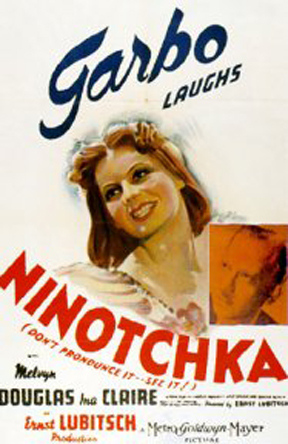
Cleaning Out The DVR #32: Ninotchka (dir by Ernst Lubitsch)


(For those following at home, Lisa is attempting to clean out her DVR by watching and reviewing 38 films by the end of today!!!!!  Will she make it?  Keep following the site to find out!)

Film_ninotchka

Oh my God, I love this movie!

First released in 1939, Ninotchka is many things.  It’s a love story.  It’s a comedy.  It’s a story of international intrigue.  It’s a political satire.  It’s a celebration of freedom.  And, perhaps most importantly, it’s a showcase for one of the greatest actresses of all time, the one and only Greta Garbo!

But you know what?  As great as Garbo is, she’s not the only worthy performer in this film.  Melvyn Douglas plays Garbo’s love interest and his performance is full of charm and class.  And guess who plays the main villain?  BELA LUGOSI!  That’s right — this was one of Lugosi’s few roles that did not require him to play a variation on his famous Dracula.  And, even if he doesn’t have a lot of scenes, Lugosi does a pretty good job in Ninotchka.  It’s interesting to see Lugosi playing an all-too real monster for once.

Ninotchka opens in Paris.  Three Russians are in town and they’re trying to sell some jewelry that was confiscated by the government during the revolution of 1917.  That’s right — they’re communists!  When they first show up in Paris, they make a big deal about hating the decadence of capitalism.  But then they meet Count Leon d’Algout (Melvyn Douglas), who proceeds to introduce them to the wonders of the free market.  Soon, the three of them are holed up in their luxurious hotel, ordering room service and having a nonstop party.

(Leon, incidentally, is working for the original owner of the jewelry.  The jewelry, as you’ve probably guessed, is what Hitchock would have called a macguffin.)

Once it becomes obvious that the first three Russians have been corrupted by western society, Ninotchka (Greta Garbo) is sent to bring them back to Moscow.  Ninotchka is a “special envoy” and, from the minute that she meets Leon, it’s obvious that she’s going to be a lot more difficult to corrupt.  For all of Leon’s charm, he cannot get Ninotchka to smile or drop her “all Marxist business” attitude.

Of course. from the minute that she first appears, we all know that Ninotchka is eventually going to loosen up and come to love both the west and Melvyn Douglas.  But what makes Garbo’s performance truly special is that we like and sympathize with Ninotchka even before she embraces decadence.  Even when Ninotchka is reciting Marxist-Leninist dogma, there’s a playfulness to the way Garbo delivers the lines.

That’s one reason why it’s so much fun to watch as Ninotchka (and Garbo) starts to actually relax and enjoy both Paris and life.  Wisely, the film doesn’t suggest that Paris has changed Ninotchka.  Instead, it merely shows that being in Paris and getting to know Leon has finally allowed her to act like the person that she was all along.

(Before her appearance in Ninotchka, Garbo was known for playing very dramatic roles.  Not only is this film about Ninotchka learning to enjoy herself.  It’s also about Garbo proving that she could play comedy just as well as she could play melodrama.)

Of course, eventually, Ninotchka and the three Russians are forced to return to Moscow and director Ernst Lubitsch does a wonderful job contrasting the glamour of freedom-loving Paris with the drabness of life under communism.  Just when it looks like Ninotchka is going to be forced to spend the rest of her life in her depressing apartment and missing the luxury of being able to wear silk stockings, her boss (Lugosi) tells her that she is being assigned somewhere else.  Ninotchka doesn’t want the assignment but, as Lugosi explains, the revolution doesn’t care what the individual wants.

Will Ninotchka and her friends ever find their way back to freedom and Leon?  Or will she remain trapped in the bureaucracy?  You’ll have to watch the film to find out!

I really liked Ninotchka.  Even 77 years after it was first released, it remains a wonderfully romantic and sweet-natured little comedy.  If you haven’t seen it, you definitely should!

Ninotchka was one of the many great films to be nominated for best picture of 1939.  However, the Oscar went to another famously romantic film, Gone With The Wind.

Lisa Reviews An Oscar Nominee: Blossoms In The Dust (dir by Mervyn LeRoy)


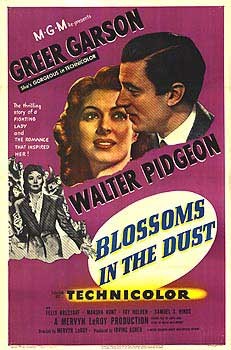
Blossoms_dust_movieposterDid you know that up until the year 1936, if a child was born to unwed parents, it was common practice to actually put the word “illegitimate” on that child’s birth certificate?  As you all know, I am perhaps the biggest history nerd in the world and, while I knew that there was once a huge stigma associated with being born outside of marriage, I did not know just how institutionalized that stigma was.

I’m also proud to say that my home state of Texas — the state that all the yankees love to bitch about — was the first state to ban the use of the word “illegitimate” on birth certificates.  This was largely due to the efforts of Edna Gladney, an early advocate for the rights of children.  Along with starting a home for orphans and abandoned children in Ft. Worth, Edna also started one of the country’s first day care centers for the children of working mothers.

That’s right — there was a time when day care was itself a revolutionary concept.

I have TCM to thank for my knowledge of Edna Gladney, largely because TCM broadcast a 1941 biopic called Blossoms in The Dust.  According to Wikipedia, the film was a highly fictionalized look at Edna’s life but, to be honest, I would have guessed that just from watching the movie.  While Blossoms In The Dust gets the important things right (and it deserves a lot of credit for sympathetically dealing with the cultural stigma of being born to unwed parents at a time when it was an even more controversial subject that it is today), it’s also full of scenes that are pure Hollywood.

In real life, Edna knew firsthand about the challenges faced by children of unwed parents because she was one herself.  Apparently, at the time, that was going too far for even a relatively progressive film like Blossoms In The Dust so, in Blossoms, Edna (played by Greer Garson) is given an adopted sister named Charlotte (Marsha Hunt).  When the parents of Charlotte’s fiancée discover that she was born outside of marriage, they refuse to allow Charlotte to marry their son.  In response, Charlotte commits suicide.

In real life, Edna was born in Wisconsin but, following the death of her stepfather, moved to Ft. Worth to stay with relatives.  Edna was 18 at the time and eventually met and married a local businessman named Sam Gladney.  In Blossoms in The Dust, Edna is already an adult when she first meets Sam (played by Walter Pidgeon, who played Greer Garson’s husband in a number of films) and they meet in Wisconsin.  It’s only after Charlotte dies that Edna marries Sam and it’s only after they’re married that Edna moves to Texas.  Whereas the real life Edna had relatives in Texas, the film’s Edna is literally a stranger in a strange land.

That said, the film is actually rather kind to my home state.  The film spend a lot of time contrasting the judgmental snobs up north with the more straight-forward people who Edna meets after she moves to Ft. Worth and it’s occasionally fun to watch.  (Of course, I would probably feel differently if I was from Wisconsin.)

Blossoms In The Dust was nominated for best picture but it lost to How Green Was My Valley.  Greer Garson was nominated for best actress but she lost to Joan Fontaine in Suspicion.  However, just one year later, Garson would win an Oscar for her performance in the 1942 best picture winner, Mrs. Miniver.  Incidentally, her husband in that film was played by none other than Walter Pidgeon.

Ultimately, Blossoms in the Dust is typical of the type of movies that you tend to come across while watching films that were nominated for best picture.  Some best picture nominees were great.  Some were terrible.  But the majority of them were like Blossoms in the Dust, well-made, respectable, and just a little bit bland.  Blossoms in the Dust is not bad but it’s also not particularly memorable.  If, like me,  you’re a student of history and social mores, Blossoms in the Dust has some historical interest but, when taken as a piece of cinema, it’s easy to understand why it’s one of the more forgotten best picture nominees.