The 1980 film, Contraband, tells a story of the Neapolitan underworld.
Luca Ajello (Fabio Testi) and his older brother, Mickey, have a pretty nice operation going. They pilot boats up and down the coast of Italy, smuggling cigarettes and booze into Naples. It’s given both of them a pretty good life. They own a racehorse. Luca’s got a big house with a beautiful wife (Ivana Monti) and a precocious son. The police are too incompetent to stop them and their disco-loving boss, Perlante (Saverio Marconi), keeps them safe from any interference from the other mob bosses working in Naples.
But then, one night, two men disguised as policeman pull Luca and Mickey over while they’re driving down an isolated road. The fake cops proceed to fire what seems to be over a hundred bullets into Mickey. Luca, having ducked down in his seat, is not spotted by the assassins. Determined to find out who murdered his brother and why, Luca immediately suspects a rival mobster named Scherino but Scherino insists that Mickey’s murder was actually ordered by a mysterious French drug lord known as Il Marsigliese (Marcel Bozzuffi, who also played a French drug smuggler in The French Connection). The French are trying to take over the rackets in Naples and a sudden surge in violence, one which sees nearly every mob boss in Naples murdered on the same day, suggests that Scherino is telling the truth.
Contraband is a brutal Italian crime film, one that is notable for being one of director Lucio Fulci’s final non-horror films. (Contraband was released after Zombi 2 but before City of the Living Dead.) Though the film might not feature any zombies or any talk of “the Beyond,” it’s still unmistakably a Fulci film and some of the film’s brutal violence remains shocking even when seen today. The scene where a duplicitous drug smuggler gets her face melted with a blow torch is nightmarish and it’s followed by a scene where a rival gangster graphically gets the back of his head blown out. (Fulci lingers on the hole in the man’s head, giving us an out-of-focus shot of the people standing behind him.) A later gunfight leads to one gangster dying with a gaping hole in his throat while another has his face shot away, despite the fact that he’s already dead. It’s graphic but it’s also appropriate for the story being told. This is a movie about violent men and, as Fulci himself often pointed out whenever he was challenged about the graphic gore in his films, violence is not pretty. Contraband is not a film that’s going to leave anyone wanting to become a gangster.
The plot is not always easy to follow but, as is typical with a good Fulci film, the striking visuals make up for any narrative incoherence. Fulci’s camera rarely stops moving, creating a sense of unease and pervasive paranoia. Much like the characters in the film, we find ourselves looking in every corner and shadow for a potential threat. A meeting with an informant at a mist-shrouded sulfur pit ends with assassin literally emerging from the mist and stabbing the informant from behind. A later gun battle on a narrow street seems to feature gunmen literally appearing out of thin air. Fabio Testi is ruggedly sympathetic as Luca while Saverio Marconi does a great job as the decadent Perlante. Meanwhile, Marcel Bozzuffi is legitimately frightening in his few scenes as the evil French gangster. He’s a great villain, smug and willing to kill anyone. You don’t have to support organized crime to support the idea of running the French out of Naples.
Contraband is a minor crime classic and proof that there was more to Fulci than just zombies and serial killers. Today would have been Lucio Fulci’s 93rd birthday and it’s also a good day to track down Contraband, an offer that you can’t refuse.

Previous Offers You Can’t (or Can) Refuse:
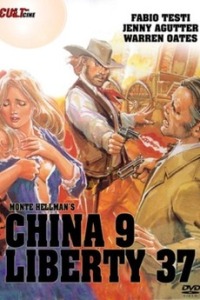 Directed by the legendary Monte Hellman, China 9, Liberty 37 is a revisionist take on the western genre. Fabio Testi plays Clayton Drumm, a legendary gunslinger who is about to be hung for murder. At the last minute, men from the railroad company show up and arrange for Clayton be released. They want him to kill a rancher who is refusing to sell his land. Clayton agrees but, before he leaves for his mission, he gives a brief interview to a writer from “out East.” Cleverly, the writer is played by director Sam Peckinpah, to whose films China 9, Liberty 37 clearly owes a huge debt.
 Catherine loves Matthew but resents his rough ways and feels that he treats her like property. One night, she and Clayton go for a nude swim and then make love. When Matthew finds out, he strikes his wife and, in self-defense, she stabs him in the back. Believing Matthew to be dead, she and Clayton go on the run.
 As a western, China 9, Liberty 37 is more interested in its characters than in the usual gunfights. There are no traditional heroes or villains and Monte Hellman emphasizes characterization over action. Even while he is relentlessly pursuing Clayton and Catherine, Matthew admits that he does not blame Catherine for leaving him. As for Clayton and Catherine, they are both consumed by guilt over their affair. This is one of the few westerns where the main character often refuses to fire his gun.
 Director Monte Hellman is as well-known for the films he did not get to make as for the ones he actually did make. (Originally, Quentin Tarantino wanted Hellman to director Reservoir Dogs. When Tarantino changed his mind and decided to direct it himself, Hellman was relegated to serving as executive producer. A lot of recent film history would be very different if Tarantino and Hellman had stuck to the original plan.) Like a lot of the films that Hellman actually did get to make, China 9, Liberty 37 was only given a sparse theatrical release and was often shown in a heavily edited version. It has only been recently that the full version of China 9, Liberty 37 has started to show up on TCM. It is an interesting revisionist take on the western genre and must see for fans of Monte Hellman, Jenny Agutter, and Warren Oates.
 Through the Shattered Lens