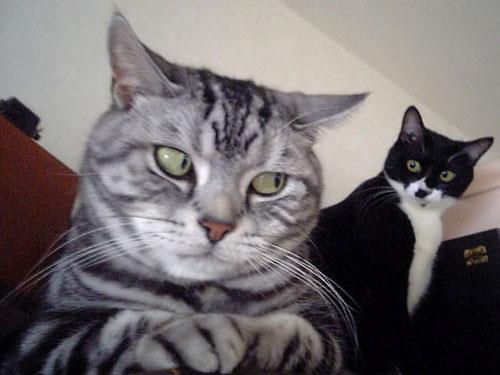
The trailer kitties were still pretty tired from the Super Bowl (they got a little bit too hyper when all the lights went out in the stadium) but I still sent them out to gather six more trailers for this week’s edition of Lisa Marie’s Favorite Grindhouse and Exploitation Film Trailers. Here’s what they returned with.
One quick note: As much as I love the trailer kitties, they occasionally bring me trailers for films that weren’t really grindhouse films. However, the trailer for Pinocchio’s Birthday Party was just weird and creepy enough that I decided to include it anyway.
Hi! As I write this, I am sick and miserable. I’ve spent almost all of today in bed and I imagine that I’ll do the same tomorrow. Hopefully, I’ll feel better on Tuesday. However, just because I’m sick, I’m not going to let that stop me from offering up another edition of Lisa Marie’s Favorite Grindhouse and Exploitation Film Trailers.
Since I’m sick, I sent the Trailer Kitties out to round up 6 trailers for this post. Let’s see what they came back with.
1) The Uncanny (1977)
I can guess why the Trailer Kitties selected this trailer.
2) Twice Dead (1988)
According to the Trailer Kitties, twice as dead means twice as much fun. Cats are like that.
3) Nature of the Beast (1995)
I’m not really sold on this “trailer” but the Trailer Kitties saw that Eric Roberts was in it so they go it into their feline heads that this might be a prequel to The Dark Knight.
4) The Phantom of the Mall (1989)
Fortunately, the Trailer Kitties are bilingual.
5) Black Roses (1989)
Trailers like this one make me doubt the judgment of the Trailer Kitties.
6) In Love (1983)
Believe it or not, this classy-looking trailer is apparently for a hardcore, X-rated film. For that reason, the trailer itself has been rather heavily edited but I’m still going to include it because I like the song that plays over the action. (That said, I’m not real happy about my Trailer Kitties viewing this type of material…)
I recently watched the 2007 horror film Alone With Her and I have to say that I’m surprised that this film isn’t better known. It’s probably one of the better horror films that I’ve seen recently. I say this despite the fact that it’s a “found footage” horror film and, as such, the entire film is presented as being told through the lenses of various spy cameras. I can count on two hands the number of “found footage” films that have actually worked for me. As of right now, Alone With Her is sitting on the tip of my right pinkie finger.
Alone With Her opens with a disturbing montage in which Doug (Colin Hanks) wanders through the streets of the city, following every woman that he sees and secretly filming them with a hidden camera. The fact that this montage plays out at such a naturalistic and unhurried pace makes it all the more disturbing. We watch as Doug does things like stand behind a woman so he can film up her skirt or pretend to shop solely so he can secretly get some leering footage of her cleavage. By the end of this montage, I was already thoroughly creeped out and debating whether I would ever feel safe wearing a skirt in public again.
(Ultimately, I decided that I would continue to wear skirts but that, from now on, I’m going to pepper spray any man who stands less than a foot behind me.)
Eventually, Doug spots a woman named Amy (Ana Claudia Telancon) at a park and follows her back to her home. Over the next few days, he obsessively films her as she unknowingly goes about her life until he finally breaks into her apartment and sets up numerous spy cameras. Now free to observe every aspect of her life, Doug arranges to meet the emotionally fragile Amy. Using the knowledge that he’s gained from spying on her, he strikes up a friendship. However, Amy’s best friend (played by Jordana Spiro) is suspicious of Doug and her suspicions lead to the film’s shockingly violent climax.
I didn’t have high expectations for Alone With Her and I have to admit that I’m still surprised at just how effective this film turned out to be. For a film that doesn’t have much gore or any huge “shock” scenes, Alone With Her is an effectively creepy horror film that sticks with you long after the final frame.
A lot of the credit for the film’s success has to go to the cast. Talancon is likable as Amy and Jordana Spiro brings unexpected nuance to the role of the stereotypically outspoken best friend. Anyone who saw the sixth season of Dexter already knows that Colin Hanks can play a psycho but they still might not be prepared for just how downright creepy Hanks is in this film. The film makes good use of Hanks’s neurotic persona and Hanks does a good job of gradually revealing the empty core that’s hiding behind Doug’s outward affability. As played by Colin Hanks, Doug is the everyman-as-psycho.
However, the real star of the film is director Eric Nicholas. I’m usually not a big fan of horror films that claim to have been assembled from ”found footage.” There are a few noticeable exceptions (like Ruggero Deodato’s Cannibal Holocaust, The Last Exorcism, Apollo 18, and Paranormal Activity 3) but, for the most part, these films never seem to be able to escape from the gimmicky feel of the concept. (Add to that, they often fail to convince us that anyone would actually keep filming even while they’re being pursued by a masked murderer or whatever threat the narrative may supply.) However, Nicholas manages to take the limitations of the found footage genre and transform them into strengths. It helps that this film is about voyeurism and, by presenting what we’re seeing as being “found footage,” Nicholas creates a true sense of unease. By the end of the film, I found myself nervously glancing around my bedroom and wondering if there was anyone secretly watching me. Nicholas creates and sustains such an atmosphere of paranoia that the film’s familiar story takes on a surprising power.
As I stated previously, Alone With Her was a real surprise. It’s a disturbing and all too plausible horror movie that stays with you.
Bad things are happening at the Valley Creek Apartments. The residents are getting naked and getting murdered by a stranger with a knife. Could the murderer by the creepy landlady? Or could it be … someone else? Two detectives (played by director Darla Enlow and Marc Page) are determined to solve the crimes and it quickly turns out that both of them have a connection to every single person who has been murdered. The very angry coroner (Scott Killman) is upset because someone keeps breaking into the morgue and stealing all of the toe tags. An even angrier police captain (Larry Scott) shows up at random moments to yell at the two detectives. Finally, there’s a crime scene photographer (Andrew Lombardo) who seems to enjoy his job way too much. Needless to say, it all concludes with a surprise ending that actually works a lot better than you might expect.
Toe Tags, which was released in 2003, is probably the one of the least known, most obscure films that I’ve ever reviewed for the Shattered Lens. I came across the film as a part of Decrepit Pit Of Nightmares box set, which I bought as the result of reading a review ofLas Vegas Bloodbath that was written by our very own Ryan C., the Trashfilm Guru. So, when you get right down to it, its’ pretty much Ryan’s fault that I watched Toe Tags.
Well, that’s okay because I actually enjoyed the nonstop silliness of Toe Tags. Clocking in at 68 minutes and shot-on-video, Toe Tags is one of those zero budget exploitation films that you have to admire just because it actually managed to get made and released. The whole film has this random, improvised feel to it. The story is quite bold about its refusal to make any sense and, while none of the actors give good performances, they’re all trying so hard that it’s impossible not to like them. My favorite performers were Scott Killman and Larry Scott. You could seriously tell that both of them were having a lot of fun going over-the-top with even the simplest line of dialogue.
The end of the film features about 10 minutes of clips of the actors blowing their lines or cracking up into laughter and, to my surprise, I actually enjoyed this obvious padding. It was nice to see that everyone had fun even while they were having to play dead and it reminded me of the fun that I use to have doing plays in high school. The end credits feature credits like, “Thank you Craig Lamb for the endless supply of blood” and “Production assistant…anyone on the set!,” and, again, they just add to likable drama club feel of the whole production.
(Warning: There’s some nudity in the trailer below and a lot of fake blood.)
One of the great things about writing about films is that occasionally you both get to watch a film that, despite all of your expectations, turns out to be pretty good and then you get to tell other people about it! Case in point: 2012’s Mother’s Day.
Mother’s Day opens with two memorable scenes. In the first scene, we watch as a mysterious woman sneaks into a hospital and kidnaps a baby out of the maternity ward. When a guard attempts to stop her, he ends up with a knife driven into his throat. While we’ve seen similar scenes in other horror movies, it’s rare that we’ve ever seen this scene handled as well as it is in Mother’s Day.
The second scene opens with an almost intrusive close-up of a woman (played by Jaime King) sobbing as she stares at herself in a mirror. Again, it’s not that we haven’t seen this scene in other horror films. Instead, it’s the fact that Jaime King so totally throw herself into those sobs. We believe her tears and immediately, we want to know why she’s crying and we want to know how she’s connected to that baby being kidnapped from the hospital. In just two scenes, Mother’s Day captures our attention and, once it grabs a hold of us, it doesn’t let go for the next two hours.
It turns out that King and her husband have just bought a new house and, on one stormy night, they’re throwing a party with a few of their closest friends. It quickly becomes obvious that, regardless of how happy everyone’s pretending to be, there’s a lot of tension between King and her husband. Something has happened in the past that no one wants to talk about…
Suddenly, three heavily armed men barge into the house and take everyone hostage. The three of them are brothers and they’ve just robbed the bank. The youngest has been shot and is bleeding to death on the couch. The oldest brother explains that they’re looking for their mother. She used to live in the house before King and her husband bought it. The brothers didn’t know that their mother had been kicked out of the house and they’ve been mailing money to the address for the past few months. When King and her husband claim that none of the money ever showed up at the house, the brothers call their mother and soon, mom shows up to take control of the situation.
Mom is named Natalie and she’s played by Rebecca De Mornay. From the minute she shows up, it’s obvious that Natalie is both obsessed with her children and that she’s totally and completely insane. Continually switching between being sweet and psychotic, Natalie is a thoroughly frightening and disturbingly believable monster. De Mornay wisely underplays Natalie’s more showy moments and prevents the character from becoming just another stereotypical movie psycho. Instead, she’s the type of villain that we can easily imagine meeting in the real world. Needless to say, that makes her a hundred time more frightening than any faceless killer with a machete.
Mother’s Day, which was made in 2010 but not released in the U.S. until earlier this year, is a remake of low-budget, 1980 horror film. This is a rare case where the remake is about a thousand times better than the original. Director Darren Lynn Bousman keeps the action moving at a perfect pace and the film’s cast (which includes True Blood‘s Deborah Ann Woll in a showy role) creates a disturbingly credible gallery of rogues and victims.
Mother’s Day is a rarity — a horror remake that not only deserves to be seen but which is so good that the original might as well just be an afterthought.
( An earlier version of this review appeared on HorrorCritic.com.)
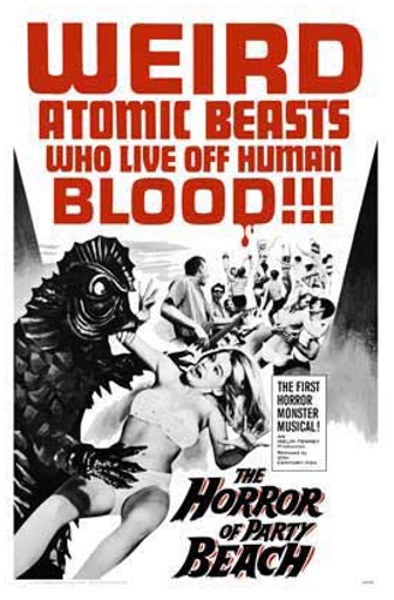
The Horror of Party Beach is a personal favorite of mine but it’s not an easy film to review. Technically, this is a terrible film but it’s also a lot of fun. It’s the type of film that makes the traditional definitions of good and bad irrelevant. In short, this 1964 “horror” film simply has to be seen to be believed.
Party Beach is perhaps the most depressing stretch of sand and surf to ever appear in a 1960s beach film. During the day, the beach is full of amazingly skinny dancers and leather-clad motorcyclists who spend all of their time dancing to music of the Del-Aires. Occasionally, a fight breaks out between the motorcyclists and the dancers but, for the most part, everyone seems to spend their time engaging in witty banter that I imagine was probably dated even in 1964. The skies are permanently overcast and the whole beach just reeks of a combination of societal decline and general ennui.
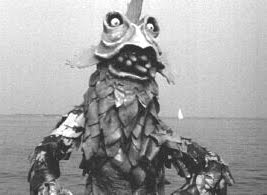
Even worse, the film opens with a toxic waste spill that somehow causes an underwater skeleton to mutate into a creature that’s apparently half-man and half-fish and which also has an insatiable lust for blood and a mouth that appears to be full of hot dogs. Soon, every night, the creatures are wandering around the town, killing people, and dragging the bodies off to the quarry.
One of the first victims is Tina, the wild girlfriend of Hank. Hank is a scientist who has the young Aryan look that most B-movie heroes seemed to have in the early 60s. Seriously, Hank manages to get through the entire film without once getting a single hair out-of-place. You would think that Hank would be upset over Tina’s death but he’s not because, as he told Tina before she died, he’s “no longer the campus bigshot who will do anything for kicks!” It also probably helps that Hank has fallen in love with Elaine, who appears to be about 40 years old but who, in a typically dramatic moment, turns down an invitation to go to a slumber party with all of her teenage friends.
Elaine’s father is Dr. Gavin. Dr. Gavin is also Hank’s boss and we can tell that Dr. Gavin is a genius because he not only wears glasses but he’s also bald and smokes a pipe. Together, Dr. Gavin and Hank try to figure out if there’s any way that the monsters can be stopped.
Dr. Gavin also has a maid named Eulabelle, who appears to have come to Horror of Party Beach straight from an awkwardly racist 1930s comedy. At one point, Eulabelle explains that she’s not only locked the front door but that she’s “double-locked and triple-locked it. Ain’t no monsters gettin’ in here…”
Perhaps if everyone on Party Beach had taken Eulabelle’s advice, many lives could have been saved. But oddly, even after everyone knows that there are monsters among them, the party continues on Party Beach. Not even the fear of death can silence the Del-Aires…
I make no apologies for loving The Horror of Party Beach. Everything about it — from the ludicrous monsters to the expressionless performances of the cast to the thoroughly nonsensical plot — make The Horror of Party Beach a one-of-a-kind experience. I’ve come across quite a few critics who have claimed that The Horror of Party Beach is one of the worst movies ever made but, seriously, it’s way too silly to be truly bad. It may not be a good film but it’s definitely a fun viewing experience.
As I explained yesterday in my review of the 1935 film version of Les Miserables, one of my resolutions for 2013 is to review a film a day, alternating between films that were nominated for an Oscar and film’s that most certainly were not. Today’s film stars two Oscar winners (Cliff Robertson and Ernest Borgnine) but it was not nominated for any awards itself. Along with being ignored by the Academy, this film is unfairly obscure and has an oddly bad reputation among cult movie fans. The movie is a Canadian exploitation film from 1976 and it’s probably even more relevant today than when it was first made. The name of the film? Shoot.
Rex (played by Cliff Robertson) is a veteran of the National Guard, a respected community leader in his small town, and a man who loves his guns. His house is full of guns of all shapes and sizes and he’s so proud of his military background that the living room even appears to have camouflage style wallpaper. From the film’s opening shots, it quickly establishes that Rex is not comfortable being civilized. The few attempts that he makes to speak to his wife are painfully awkward. Rex only feels truly alive during the weekends that he spends out in the wilderness, hunting with his buddies, played by Ernest Borgnine and Henry Silva. His friends look up to Rex as their leader, to the extent that one of them refers to Rex as being the “senior officer in charge.”
During one hunting trip, Rex and his heavily armed friends pause to rest next to a river. Suddenly, on the other side of the river, another group of heavily armed strangers show up. They stare at each other for a few minutes before suddenly, a shot rings out. The two groups start shooting at each other. One man is wounded and another is killed before Robertson and his group retreat to the security of Borgnine’s cabin.
Instead of going to the police, Robertson convinces his group to keep the incident a secret. They return to town, swearing not to tell anyone about what’s happened. However, Robertson’s paranoia gets the better of him. Before long, he’s convinced himself that the other group is going to seek revenge and that the only way to survive is to kill them first. Along with the hot-headed Silva, Robertson recruits a small army of townsfolk to return with him to the wilderness. Only Borgnine questions the wisdom of Robertson’s plan. The whole thing eventually leads to a genuinely shocking and disturbing climax.
Robertson and his friends are obviously meant to be representatives of American gun culture and to call Shoot heavy-handed would be a bit of an understatement. That said, Shoot is still an undeniably effective piece of propaganda. Robertson, Silva, and Borgnine all give excellent performances and director Harvey Hart manages to generate and maintain a good deal of suspense concerning just what (if anything) Robertson is going to find waiting for him in the wilderness. Though the film has its slow spots, the emphasis on characterization and suspense makes the surprise ending all the more effective.
Shoot is not an easy film to see. It has never been released on DVD or Blu-ray and I only happened to learn of it because I was bored one day and I was flipping through one of my film reference books. However, the film has recently been uploaded to YouTube and here it is:
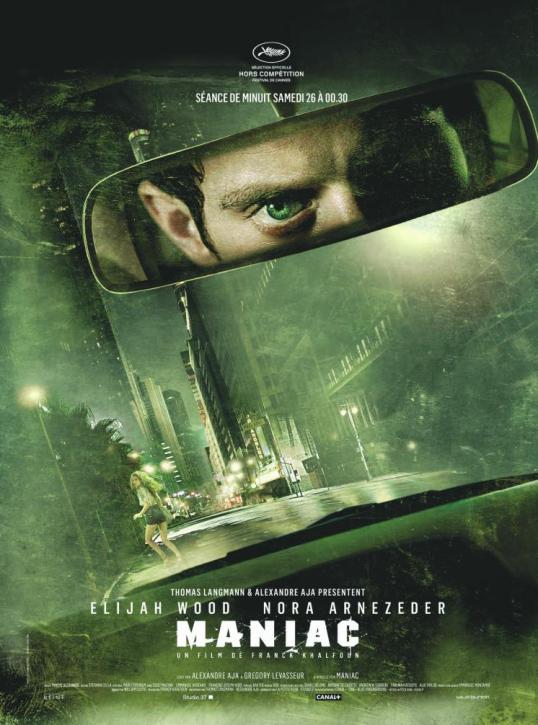
There was one film that had caught my interest once the project was announced in late 2011. The film was going to be the horror remake of the classic, grindhouse slasher flick from 1980 called Maniac. This film is considered by many fan of the grindhouse and exploitation scene as a classic in the slasher genre. It was also hailed by many moral groups as a prime example of how horror cinema was beginning to reach “pornographic levels of violence” especially towards female victims.
So, it was quite an interesting bit of news when the remake was announced and Frodo Baggins himself would take on the role of the film’s serial killer in Frank. It was an inspired bit of casting that gave the film’s early production a much needed boost in interest. It’s now been over a year and the film has made the genre film festival circuits and the buzz surrounding the Franck Khalfoun-directed film is that it more than lives up to the grindhouse and exploitation aesthetics of the original while bringing in a fresh new stylistic take on the slasher genre.
We have below is the first 6 minutes of the Maniac remake and one can see how creepy the POV-style the filmmakers are going to take for the film has turned out.
There’s still no release date announced for Maniac.






 Through the Shattered Lens