Late Night Retro Television Reviews: Chips 1.3 “Dog Gone”


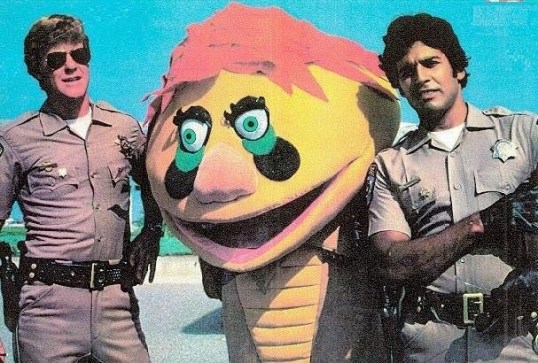
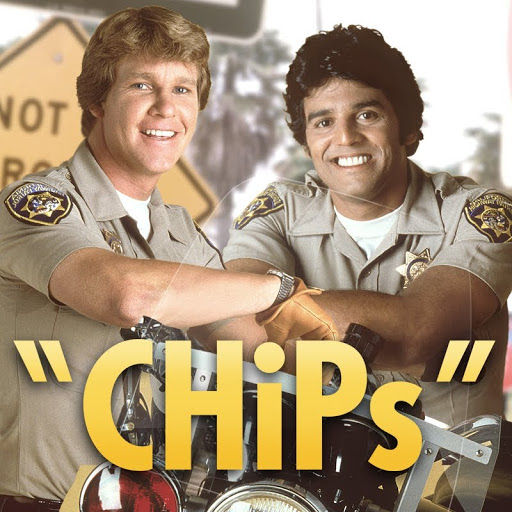
Welcome to Late Night Retro Television Reviews, a feature where we review some of our favorite and least favorite shows of the past!  On Mondays, I will be reviewing CHiPs, which ran on NBC from 1977 to 1983.  The entire show is currently streaming on Freevee!

This week, Baker gets a dog and Ponch makes an enemy!

Episode 1.3 “Dog Gone”

(Dir by Michael Caffey, originally aired on September 29th, 1977)

When an adorable sheepdog puppy ends up on the Los Angeles highway, Baker and Ponch manage to rescue it, though not before it causes a minor wreck on an overpass.  The official CHiP policy is that all stray animals should immediately be turned over to the shelter but Baker takes one look at the puppy and decides that he can’t just leave it with anyone else.  In fact, every member of the highway patrol quickly falls in love with the dog.

Everyone except for Sgt. Getraer, who is allergic to dogs and makes it clear that the puppy is not to be kept around the station.

At first, Baker tries to keep the dog in his apartment but it turns out that the dog likes to bark.  So, Baker heads out to the trailer park where Ponch lives in an RV and apparently spends all of his time watching football while only wearing his boxer shorts.  (One gets the feeling that Erik Estrada had an “at least one shirtless scene per episode” clause in his contract.)  Baker leaves the dog in the RV and then runs off before the half-naked Ponch can protest.

Fortunately, for Baker, Ponch decides that he loves the dog, which he named Fido.

Unfortunately, for Ponch, Fido’s owners eventually show up at the station and ask if anyone has seen their dog.  The dog — who even I, while admittedly not being a dog person, has to admit is cute — is reunited with his family and I guess Ponch is alone again.

Meanwhile, three really stupid criminals — Boots (Bill Adler), Zero (Jeffrey Druce), and Little John (James Crittenden) — are really angry with Ponch because, at the scene of the earlier accident, Ponch prevented Boots from threatening another motorist.  Boots and his friends hops into their dune buggy and decide to stalk Ponch and Baker.  Boots even decides to sabotage Ponch’s motorcycle by loosening the front bolt so that the wheel will eventually come off while Ponch is riding it.  However, these three criminals are so stupid that they sabotage the wrong motorcycle.  As a result, the entire second half of the episode is full of close-ups of Baker’s front tire wobbling as he speeds down the highway.

The subplot with the criminals is really dumb but the way it plays out shows that Larry Wilcox had a point when he complained about the show’s producers always favoring Erik Estrada.  Not only is Ponch the one who faces off against Boots at the scene of the accident but he’s also the one who gets to save Baker’s life at the end of the episode.  When a guilt-stricken Zero goes to Getraer and tells him about what Boots did to the motorcycle, it doesn’t take long for Getraer to figure out that they accidentally sabotaged Baker’s motorcycle instead of Ponch’s.  With Baker unable to hear his radio due to being involved in a high-speed chase, it falls to Ponch to chase after Baker and warn him.  The bike still crashes but Baker is not seriously injured and Ponch …. well, Ponch is just a big damn hero!

(Admittedly, there is a scene earlier in the episode where Baker performs mouth-to-mouth recitation on a motorist who has had a heart attack and saves the man’s life.  But even then, Ponch is the one pushing on the man’s chest to try to get his heart going again.  Baker’s a good cop, the show tells us, but Ponch is a big damn hero.)

This episode …. well, at least the dog was cute!  And the California scenery was lovely to look at.  Still, a cop show like this needs to have some smart or at least intimidating criminals for the cops to do battle with and Boots was such an idiot that it was hard to take anything he and his gang did seriously.  In the end, this was a typical episode of CHiPs, full of stiff acting but impressive motorcycle stunt work.  Probably the most interesting thing about this episode was discovering that Baker was the one with a swinging bachelor pad while Ponch was the one living a solitary life in a trailer park.  I’m just happy that the dog was reunited with its family.

Late Night Retro Television Reviews: CHiPs 1.2 “Undertow”


Welcome to Late Night Retro Television Reviews, a feature where we review some of our favorite and least favorite shows of the past!  On Mondays, I will be reviewing CHiPs, which ran on NBC from 1977 to 1983.  The entire show is currently streaming on Freevee!

This week, Ponch takes a deep breath and he gets real high.

Episode 1.2 “Undertow”

(Dir by Christian I. Nyby II, originally aired on September 22nd, 1977)

On tonight’s episode of CHiPs, a true crisis breaks out.

The California Highway Patrol’s basketball team loses a game!

Now, they would have won the game if Ponch had been playing.  I’m only two episodes into this series and it’s already pretty obvious that there’s apparently nothing that Ponch can’t do.  However, while at the scene of an accident on the highway, Ponch stood right in front of a leaky cannister of nitrous oxide!  He ended up getting so high that he started seeing double, dancing in the halls of the station, and basically just acting like a total jackass.  Of course, he smiled the whole time.  Baker was less amused.

Because of his temporary high, Ponch was sent home and ordered to stay in bed for a day.  He missed the game and the CHiPs lost to some other off-duty branch of California law enforcement.  Fortunately, Sgt. Getraer is able to set up a rematch and, with Ponch now able to play, the CHiPs win by two points!  And, of course, the winning shot is taken by Ponch because there’s nothing that Ponch can’t do.  This episode ends with a series of freeze frames of Ponch winning the game and proving that California has the best highway patrol in the country.

Of course, the basketball game is only the B-plot of this episode of CHiPs.  The main storyline deals with fake tow truck driver (Angelo de Meo) who is listening to the police radio for calls from women who have broken down on the highway.  The driver goes to wherever the women are calling from but, instead of towing their car, he instead steals their money!  The first time that Ponch and Baker chase him, the crooked tow truck driver gets away.  The second time, they catch him.  Of course, both of the chases lead to multi-car wrecks on the highway.  This episode features the first instance of a car flipping over in slow motion on this show.  Apparently, that would go on to become a CHiPs trademark.

Of course, there are other little things that Ponch and Baker have to deal with.  They pull over a drunk driver (Jim Backus) and Ponch, who is high from the nitrous oxide, struggles to give him a sobriety test.  They also pull over an old surfer (Paul Brinegar), who has a talking myna bird in his truck.  The bird was cute.  These scenes did not add up too much but I imagine they were included to drive home the idea that Ponch and Baker are professionals, even if they do spend a lot of time talking about basketball.

This episode was actually kind of fun.  Erik Estrada is not a particularly subtle actor to begin with and this episode actually gives him an excuse to overact even more than usual.  As much fun as it is to watch Estrada bounce off the walls, it’s even more interesting to glance over at Larry Wilcox and see just how much he appears to resent having to work with someone who always has to be the center of every scene.  Neither Wilcox nor Baker seem particularly unhappy about Ponch being sidelined for a good deal of the episode.  Just as in the pilot, the chase scenes were genuinely well-filmed and it was impossible not to enjoy the shots of the motorcycles weaving in and out of traffic.

Next week, Ponch will probably save someone’s life while Baker seethes in the background.  We’ll see!

Late Night Retro Television Reviews: CHiPs 1.1 “Pilot”


Welcome to Late Night Retro Television Reviews, a feature where we review some of our favorite and least favorite shows of the past!  On Mondays, I will be reviewing CHiPs, which ran on NBC from 1977 to 1983.  The entire show is currently streaming on Freevee!

When I was trying to pick a show to review after finishing up Nightmare Café, Jeff suggested that I go with CHiPs, a very 70s show about the adventures of the California Highway Patrol.  I agreed after he showed me two episodes that involved a roller disco.  I mean, how could I resist?

Of course, we won’t get to the roller disco for a while.  That happened at the start of season 3.  Instead, we’re starting at the beginning, with the pilot.  The year was 1977.  Jimmy Carter was president.  Jerry Brown was the governor of California.  And two cops on motorcycles were about to roll into history….

Episode 1.1 “Pilot”

(Dir by Paul Krasny, originally aired on September 15th, 1977)

The pilot for CHiPs doesn’t waste any time in introducing us to our two main characters.  When we first see officers Jon Baker (Larry Wilcox) and Frank “Ponch” Poncharello (Erik Estrada), they’re on their police motorcycles and chasing after a stolen sportscar.  The chase being on the freeway and then eventually leads into Los Angeles.  Unlike the live police pursuits that we regularly see on television, this chase is unique in that there aren’t any other police officers involved, other than Baker and Ponch.  Maybe that’s the way that cops did things in the 70s but it does seem like Baker and Ponch would have had an easier time of it if they had some backup.  As it is, they don’t catch the thief but Ponch does crash his motorcycle.

Sgt. Joseph Getraer (played by Robert “father of Chris” Pine) is not amused to learn that Ponch has damaged another motorcycle.  The pilot wastes no time in establishing that Baker is the responsible, good cop while Ponch is the wild cop who takes risks and is always in trouble with the brass.  In fact, Ponch is on probation because of all the disciplinary reports that have been written against him.  Baker insists that Ponch is a good cop but it does seem like Ponch does manage to frequently crash his motorcycle.

Apparently, Larry Wilcox and Erik Estrada did not get long while they were co-starring on CHiPs.  That’s not surprising.  That tends to happen on a lot shows.  What is interesting is that, even in the pilot, neither one of the actors seems to be making much of an effort to even pretend to like the other.  Whenever Estrada flashes his big smile or dramatically looks up to the heavens, Wilcox looks like he’s having to use every bit of his willpower not to roll his eyes.  I always point out when two performers don’t have any romantic chemistry.  CHiPs is an interesting case where there isn’t even any friendship chemistry.  At no point, during the pilot, do you get the feeling that either Baker or Ponch would really be that upset if the other was reassigned to some other part of the highway patrol.  Even in the scenes where Baker defends Ponch as being a good cop, Larry Wilcox seems to be delivering the lines through gritted teeth. 

As for the episode itself, it really is standard 70s cop show stuff.  The stolen cars are being smuggled in a moving truck and, eventually, Baker and Ponch spot the bad guys on the highway and, after a chase, they catch them.  Of course, before they do that, they deal with two accidents (one involving a glue truck and another featuring a woman trapped in an overturned car and yes, Ponch does get her number) and Baker orders a kid on a bike to pull over so he can give him some advice about riding in traffic.

As I said, it’s all pretty standard.  But that doesn’t matter because, from the first minute we see them, the motorcycles are extremely cool and so are the scenes of Ponch and Baker weaving in and out of traffic while pursuing the car thieves.  Baker may be dull and Ponch might come across as being more than a little flaky but no one is really watching for them.  The pilot is all about celebrating the idea of driving fast on the highway and basically reminding the world that you don’t have to follow the rules, even if you are the one who enforces them!  If you don’t want to join a car theft ring, you can always just get a badge and a motorcycle.  Either way, it’s ton of fun!

For all of the episode’s obvious flaws, it was still easy for me to understand why this pilot led to a series.  Motorcycles are cool!  Will they still be a cool after 100+ episodes of CHiPs?  That’s what we’re about to find out.

October Positivity: Uncommon (dir by Bill Rahn)


The 2015 film, Uncommon, opens with narration from Marc Garcia (Erik Estrada), a high school maintence worker.  Marc tells us that he’s seen a lot at his school.  He’s seen many changes.  He’s watched as school has gone from a home away from home to a frightening place where students come to class carrying bullet-proof backpacks.  He wonders what has caused the change in school.  He suggests that it all started in 1962, when the Supreme Court ruled the school prayer was a violation of the separation of church and state….

And let’s just stop right there.

On the one hand, I do think that, for a growing number of people, there’s a feeling that their life has no purpose and that their existence is empty and meaningless.  Some people would say that’s because our increasingly online world has left people unsure of how to relate to one another and express their emotions.  Some people would say that’s because of the decline of religion.  Some would say that’s because society is obsessed with fame.  Regardless of the reason, when you feel that your life has no purpose, it is undoubtedly a lot easier to justify doing things that, in the past, would have been unthinkable.

That said, when it comes to prayer in public, state-funded schools, the Supreme Court made absolutely the right and the Constitutional decision.  Separation of church and state is one of the most important amendments to be found in the Constitution.  Not only does it prevent the State from telling you what to believe, it also prevents the State from ordering you what not to believe.  If you think the government has a tendency toward being authoritarian now, just imagine what it would be like if they could claim that they were passing the laws of God.

Believe it or not, this is relevant to the film because Uncommon is all about the separation of church and state.  As you may have already guessed, the film’s opinion is the opposite of mine.

Uncommon does open strongly, with Aaron (Ben Davies) helplessly watching as a gunman shoots up his school.  His brother dies in the shooting and Aaron transfers to another high school.  While attending church, Aaron meets and befriend Mike Garcia.  Mike recruits Aaron and his friend, Drew (Wesley Elder), to volunteer at the local assisted living facility.

Meanwhile, at Aaron’s new school, budget cuts have led the principal to announcing that there is no more money to fund the Drama Department or the choir.  The drama kids freak out, especially Hailey (Courtney Buck).  Hailey was counting on getting a theater scholarship to college but how is that going to happen without a theater department!?  Eventually, Hailey and the theater kid come up with a clever idea.  They’ll start a drama club and just put on a show themselves!  But they have to find a faculty sponsor and all of the teachers are busy.  Hey, how about Mike Garcia?  Mike agrees, on the condition that the drama club also help out at the assistant living facility.

Meanwhile, Aaron wants to start a bible study group.  Mr. Stevens (Don Brooks), the atheist social studies teacher, throws a fit and announces that the school cannot sponsor a bible study group.  To be honest, it seems like the easy solution would be for Aaron to just do his bible study group off school grounds but whatever.

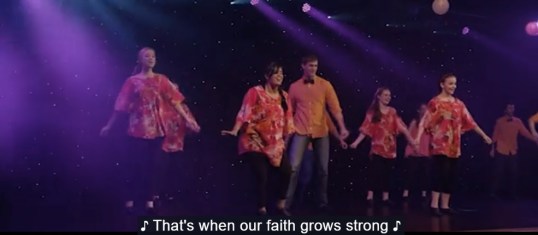
Anyway, Mike introduces Aaron to the Drama kids and Aaron agrees to write their school play, which is based on stories from the Bible and…. well, you can see where this is going, right?  Again, Mr. Stevens throws a fit.  The school board announces that the school cannot sponsor a religious play.  Mike somehow knows a lawyer who files a lawsuit on the behalf of the drama club.  Somehow, the drama kids win their lawsuit and they perform their show.  We only see the first musical number, in which the kids sing that “You got to have faith,” which would seem to prove that Mr. Stevens was right about the show being intended to push religion on the audience.

When people talk about preachy religious films that beat their audience over the head with their message, they’re talking about films like UncommonUncommon is a very earnest film but, in the end, it’s mostly just a case of wish fulfillment.  Despite the fact that there’s no way that the drama club should have been allowed to put on their show at the high school, they were.  Why?  Because this film wanted them to be able to.  But, in the end, Mr. Stevens was right.  Mr. Stevens was obnoxious and hateful but, when he said that a public school can’t put on a show that promotes one religion over another, he was absolutely correct.

Beyond the film’s theological and legal arguments, Uncommon is also a poorly-acted film that is full of corny humor. The drama kids are so overdramatic.  The old people are so quirky.  It gets old pretty quickly.  Erik Estrada was a lot more fun when he was starring in Guns.

October Positivity: Finding Faith (dir by Justin Rossbacher)


The 2013 film, Finding Faith, opens with a skeezy-looking man attempting to abduct a teenage girl.  Of course, what the man doesn’t know is that the girl is not a teenager at all.  Instead, she’s an undercover cop who has spent the last few days engaging in online conversations with the man who tried to kidnap her.  The man is arrested and, as he’s taken away, she comments that she’s glad she won’t have to spend anymore time chatting with him.

Indeed, it’s dangerous world out there.  We tend to laugh about Nigerian prince emails and painfully obvious phishing scams but there’s a lot of unsavory people lurking around online.  Faith Garrett (Stephanie Owens) is an intelligent and popular high school cheerleader who thinks that she’s met a cute boy online.  However, as she soon learns, she wasn’t actually talking to Eddie Blue.  Instead, she was talking to a methhead redneck who was talking to her so that he could figure out the best way to track her down and abduct her.  In New Jersey, there’s a warehouse that is full of abducted teenage girls who are scheduled to be sold to the highest bidder and Faith’s abductor feels that he’ll be able to make a lot of money off of her.

If this sounds familiar, you’ve probably seen Taken or one of the many movies that was inspired by that film.  Or maybe you’ve seen one of the countless Lifetime films in which a mother is forced to grab a gun and rescue her daughters from the people who have kidnapped them.  Finding Faith does feature some gunplay.  Erik Estrada plays Sheriff Mike Brown, who is in charge of the investigation into Faith’s abduction.  Sheriff Brown carries a gun and so do the people working for him.  That said, Finding Faith puts much more emphasis on the power of prayer than the power of firearms.  Faith prays.  Faith’s father prays.  Sheriff Brown prays.  You know who doesn’t pray?  The kidnapper.

Finding Faith is based on a true story.  Indeed, the film was executive produced by the real Sheriff Mike Brown and, judging from some of the performances, it wouldn’t surprise me if some of the film’s cops were played by actual cops.  Because the film is based on a true story and because the threat of being abducted by someone who has been stalking you online actually is something that most people should be aware of, it’s a bit disappointing that Finding Faith isn’t a better movie.  Unfortunately, it’s a bit overlong and it’s plagued with slow spots.  On the plus side, Stephanie Owens gives a good performance in the lead role of Faith.  Erik Estrada tersely delivers his heavy-handed narration and delivers most of his other lines through clenched teeth.  Estrada is one of those actors who never lets you forget that he’s acting.  As a result, he can be entertaining to watch but, at the same time, watching him tends to take the viewer out of the reality of the film.  As an actor, Estrada is better-served by films like Guns than films like Finding Faith.

That said, the film’s final message is to be careful out there and that’s definitely a good idea!

October Positivity: The Cross and the Switchblade (dir by Don Murray)


First released in 1970, The Cross and the Switchblade stars Pat Boone as David Wilkerson.

David is a small-town preacher who heads to Brooklyn in the late 50s.  Having read an article about the prevalence of violent gangs in New York City, David is determined to make a difference and bring some peace to the city.  Why exactly he feels that he can do that, as opposed to someone who is actually from New York and who has some actual experience dealing with gangs, is never really explained.  David starts going to drug dens and back alleys and rooftops in the poorest parts of the city.  At first, no one takes him seriously but, because he refuses to give up, he does slowly start to win the neighborhood’s respect.  He’s even given a place to live so that he’ll no longer have to spend his time sleeping in his car.

(Sleeping in his car?  David really didn’t think this out before heading up to New York, did he?)

David becomes obsessed with trying to reach Nicky Cruz (a young Erik Estrada), who is one of the most fearsome member of the Mau Maus gang.  The problem is that Nicky really doesn’t want to be reached.  He’s been betrayed too many times by the system to trust anyone who claims that they want to help.  Nicky is a lot like the character that Michael Wright played in The Principal, basically threatening to cut off any helping hand this offered to him.  When one of Nicky’s girlfriends begs for a fix of heroin, Nicky instead sends her to the local church with orders to “take care of” David.  When she instead accepts David’s offer of help and gets sober, Nicky becomes even angrier….

The Cross and the Switchblade is an early example of the type of “mainstream” religious film that, as of late, has become popular in America.  It may be about religion but it also has a lengthy fight scene and some mild cursing, as if the film wanted to make sure that everyone watching knew that it was a “real movie” as opposed to just being a religious tract.  The film was shot on location in Brooklyn, which does bring an authentically gritty feel to certain parts of the film.

Unfortunately, the film itself is done in by a slow pace and a few odd casting choices.  One would think that a young Pat Boone would be a good choice for a fresh-faced preacher from Middle America but, instead, Boone gives a rather stiff performance as David Wilkerson and certainly shows none of the charisma that would be necessary to get the film’s gangs to even momentarily put down their weapons and listen to a sermon.  If Boone doesn’t show enough emotion, Estrada shows a bit too much.  The film was Estrada’s acting debut but, even at the age of 21, Estrada had already developed the Shatneresque acting style that makes him so entertaining in films like Guns and Chupacabra Vs. The Alamo but less credible in films where he actually has to play characters who go through a change or learn a lesson.

In the end, perhaps the most interesting thing about this film is that it was directed by Don Murray, the actor who was nominated for an Oscar for Bus Stop and who played the doomed senator in Advice and Consent.  Three years after Cross and the Switchblade, Murray would make quite an impression as the evil Governor Breck in Conquest of the Planet of the Apes.  More recently, he played Dougie’s surprisingly sympathetic boss in Twin Peaks: The Return.  Murray is a great, albeit underrated actor.  But, as a director (or at least as the director of this particular film), he struggled to keep the action moving and far too often, he used gimmicks like slow motion and weird camera angles in an attempt to liven up the story.

The Cross and the Switchblade asks the viewer to choose one or the other.  Ultimately, it doesn’t make a compelling case for either.

March Positivity: This Is Our Time (dir by Lisa Arnold)


The 2013 film, This Is Our Time, opens with a college graduation and a voice-over from Ethan (Shawn Culin-Young), who explains that everyone goes through four stages when they go to college.  The first stage is being excited about getting away from home and being on you own.  The second and third stages are about settling down, choosing your major, and maybe meeting the person with whom you want to spend the rest of your life.  The fourth stage is all about looking forward to graduation and finally getting to enter the real world.

This Is Our Time follows the story of five friends as they discover what comes after the fourth stage.  For two of them, it’s making a living as corporate workers and being pressured to behave unethically.  For two others, it’s marriage and a new life working as missionaries in India, ministering to the needs of leprosy sufferers and their children.  For Ethan, it means giving up his dream of being a writer and working as a waiter at his father’s bar.  But, as Ethan warns us in his narration, one of the five is not going to be alive in a year.  The movie follows the friends as they deal with death and try to learn how to live.

Some of the acting is a bit stiff and the attempt to capture the feel of corporate America feels rather comical.  (Erik Estrada glowers his way through the role of a dishonest executive.)  But, at the same time, the film does end with a message from the founder of Embrace a Village, which actually does provide support for people dealing with Leprosy and the guy is so sincere that it kind of makes you feel guilty for all the snarky thoughts that you had while watching the movie.  Whatever else you might want to say about the film, the intentions are good and there’s something to be said for that.

Add to that, Eric Roberts is in the film.  Roberts plays Ethan’s father and he brings a lot of genuine emotion to the role.  The scene where he breaks down behind the bar in response to having gotten some bad news is well-done.  Roberts is kind of famous for accepting almost any role that’s offered to him and he’s said that he hasn’t actually watched the majority of the films in which he’s appeared.  Who knows if Roberts actually watched this film but, regardless, his performance was definitely the highlight.

Previous Eric Roberts Films That We Have Reviewed:

  1. Star 80 (1983)
  2. Blood Red (1989)
  3. The Ambulance (1990)
  4. The Lost Capone (1990)
  5. Love, Cheat, & Steal (1993)
  6. Love Is A Gun (1994)
  7. Sensation (1994)
  8. Doctor Who (1996)
  9. Most Wanted (1997)
  10. Mr. Brightside (2004)
  11. Six: The Mark Unleased (2004)
  12. Hey You (2006)
  13. In The Blink of an Eye (2009)
  14. The Expendables (2010) 
  15. Sharktopus (2010)
  16. Deadline (2012)
  17. Miss Atomic Bomb (2012)
  18. Lovelace (2013)
  19. Self-Storage (2013)
  20. Inherent Vice (2014)
  21. Road to the Open (2014)
  22. Rumors of War (2014)
  23. A Fatal Obsession (2015)
  24. Stalked By My Doctor (2015)
  25. Stalked By My Doctor: The Return (2016)
  26. The Wrong Roommate (2016)
  27. Stalked By My Doctor: Patient’s Revenge (2018)
  28. Monster Island (2019)
  29. Seven Deadly Sins (2019)
  30. Stalked By My Doctor: A Sleepwalker’s Nightmare (2019)
  31. The Wrong Mommy (2019)
  32. Her Deadly Groom (2020)
  33. Top Gunner (2020)
  34. Just What The Doctor Ordered (2021)
  35. Killer Advice (2021)
  36. The Poltergeist Diaries (2021)
  37. My Dinner With Eric (2022)

Retro Television Reviews: The Love Boat 2.5 “Julie’s Aunt/Where Is It Written?/The Big Deal”


Welcome to Retro Television Reviews, a feature where we review some of our favorite and least favorite shows of the past!  On Wednesdays, I will be reviewing the original Love Boat, which aired on ABC from 1977 to 1986!  The series can be streamed on Paramount Plus!

Things get a bit icky this week.  Ugh!

Episode 2.5 “Julie’s Aunt/Where Is It Written?/The Big Deal”

(Dir by Allen Baron, originally aired on October 14th, 1978)

How icky can one cruise get?

Well, consider this.  On this week’s episode of The Love Boat, Captain Stubing’s uncle (Red Buttons) is a passenger on the boat.  Uncle Cyrus decides that he likes Julie.  How does he express how much he likes Julie?  He invites her to his cabin and then lunges at her and starts kissing her.  Julie runs out of the cabin and Uncle Cyrus chases her through the corridors of the boat.  Once Julie does get away from him, she tells Doc and Gopher about what happened.  Doc and Gopher both think that it’s funny.

(Uhmm, guys, this isn’t some old guy with a crush.  This is someone who invited the cruise director to his cabin …. AND ATTACKED HER!)

Everyone agrees that Julie should just try to avoid Cyrus and that she should not tell the Captain about what happened.  Unfortunately, because Uncle Cyrus told the Captain about how much he enjoys Julie’s company, Stubing insists that Julie spend as much time as possible with Uncle Cyrus.  Every time that Julie goes down to his cabin, Cyrus grabs her and starts kissing her.  Scene after scene, Julie has to push Cyrus off of her so that she can escape, screaming, into the hallway.

Finally, realizing that she can’t go on like this, Julie realizes that she has to do something, even if both Doc Bricker and Gopher refuse to take the situation seriously.  Out of the three choice below, which do you think she goes with?

  1. Call the police
  2. Tell Captain Stubing and demand that he call the police
  3. Have Gopher dress up like a woman and pretend to be a member of the police

If you picked number three, you could have been a writer for The Love Boat!

Ugh!  I hated everything about this storyline!

I wasn’t a fan of the other two storylines as well.  The first featured Hope Lange as Sandra Newberry, the wife of publisher Alfred Newberry (Gene Barry).  She is upset to discover that Alfred has invited a Norman Maileresque writer named Mark Littlejohn (Richard Mulligan) to accompany them on the cruise.  Alfred wants Mark to hurry up and finish the final chapter of his autobiography.  Make wants to steal Sandra away.  In the end, Alfred and Mark get into a fight.  They’re too clumsy to actually hit each other but they do manage to knock out Captain Stubing.  Again, you would think that this would be the sort of thing that would eventually involve the police but instead Stubing just accepts a payment that will come from the royalties of Mark’s book.  Whatever.  Go deal with your uncle, Captain.

Finally, Martin Scott (Allen Ludden) is a businessman who is selling his business to Brad Collins (Sam Groom).  Martin’s daughter, Allison (Mackenzie Phillips), feels like she has to date Brad even though she’s actually in love with a musician named Jim Warren (Erik Estrada).  It was hard not to feel that, intentionally or not, Martin was basically pimping out his daughter.  Again, it was just icky.

This was not a fun cruise.  Hopefully, next week will be better.

Monday Live Tweet Alert: Join Us For Light Blast and Patriot Games!


As some of our regular readers undoubtedly know, I am involved in hosting a few weekly live tweets on twitter.  I host #FridayNightFlix every Friday, I co-host #ScarySocial on Saturday, and I am one of the five hosts of #MondayActionMovie!  Every week, we get together.  We watch a movie.  We tweet our way through it.

Tonight, for #MondayActionMovie, the film will be 1985’s Light Blast!  Selected and hosted by me, this Italian film is the perfect combination of horror, science fiction, action, and Erik Estrada!!  The movie starts at 8 pm et!  Here’s the playlist!

Following #MondayActionMovie, Brad and Sierra will be hosting the #MondayMuggers live tweet.  We will be watching 1992’s Patriot Games, featuring Harrison Ford as Jack Ryan!  The film is available on Paramount Plus and several other streaming services!

It should make for a night of fun viewing and I invite all of you to join in.  If you want to join the live tweets, just hop onto twitter, start the Light Blast playlist  at 8 pm et, and use the #MondayActionMovie hashtag!  Then, at 10 pm et, start Patriot Games, and use the #MondayMuggers hashtag!  The live tweet community is a friendly group and welcoming of newcomers so don’t be shy.   I’ve already reviewed Light Blast for this site and I’ll probably review Patriot Games sometime in the upcoming few weeks!

International Horror Film Review: Light Blast (dir by Enzo G. Castellari)


Produced in Italy and first released in 1985, Enzo G. Castellari’s Light Blast is a hybrid of several different genres.  There’s a lot of action, there’s a bit of horror, and there’s also some sci-fi.  Like the majority of Italian exploitation films that came out during the 80s, it’s designed to have a little something for everyone.

Erik Estrada plays Ronn Warren, a detective with the San Francisco Police Department.  (Though the film was filmed on location and it did star American television star Erik Estrada, it’s still very much an Italian production, complete with badly dubbed dialogue and clumsy attempts to capture the peculiarities of American culture.)  When we first see Ronn, he’s in his underwear and he’s carrying a turkey.  Two inbred criminals are trapped in a bank and they’ve taken hostages.  They’ve demanded that the police provide them with dinner and that the food be delivered by someone “not wearing a stitch of clothing.”  Ronn is happy to oblige, though he doesn’t go completely naked because Ronn is one of those police detectives who has trouble following orders.  Of course, as soon as he gets inside the bank, Ronn proves that he doesn’t need to be fully dressed to stop the bad guys.  He just needs for the bad guys to be stupid enough to continually let their guard down and fall for extremely obvious tricks.

While Ronn is showing off his physique, Dr. Yuri Svoboda (played by Enio Girolami, who is credited as Thomas Moore in this film) is planning on terrorizing the city of San Francisco.  He’s developed a giant laser gun that he transports on top of a van.  Whenever he shoots the laser at any digital clock, it causes people to melt and buildings to explode.  His first victims are a teenage boy and girl who are having sex in an abandoned railroad car.  His next victims are the innocent spectators of a stock car race.  What does Dr. Svoboda want!?

It turns out that he wants a lot of money.  Now, if Dr. Svoboda tried this today, I imagine the city would quickly pay up and Dr. Svoboda would be given a police escort to the airport.  But this film was made in the 20th Century, back when people were still willing to fight back against mad scientists with lethal death rays!  Soon, Ronn Warren is running around San Francisco, battling Dr. Svoboda’s henchmen while trying not to get melted himself.  And, of course, it would not be a movie about San Francisco if there wasn’t at least Bullitt-inspired car chase.  For this chase, Ronn steals a stock car and chases the bad guys throughout the city.  Whenever anyone gets in Ronn’s way, he and the car just jump over them while the film’s synth-heavy musical score goes appropriately crazy.

What to say about Light Blast?  It’s a bit of a dumb movie but, to its credit, it doesn’t take itself too seriously.  The melting effects are both so grotesque and so obviously fake that you won’t know whether to laugh or to scream.  Castellari keeps the action moving quickly and Estrada delivers all of his lines through gritted teeth, an indication that both of them knew better than to worry about things like logic or motivation.  Why Dr. Svoboda melting people?  Because he wants to.  How can he somehow get away with driving around in a van that has a very obvious laser gun on top of it?  There wouldn’t be a film otherwise.  That’s just the way Light Blast is.  It’s stupid but it’s so unapologetic in its stupidity that it’s hard not to be entertained.