Film Review: Transformers: The Movie (dir. by Nelson Shin)


1986 was such a fantastic year.

With movies like Top Gun, Labyrinth and Ferris Bueller’s Day Off already out, the summer would give us Big Trouble in Little China, Aliens, & The Fly (Which at one point you could catch as a double feature with Aliens). The two best announcements at home were that a new baby was on the way and Transformers: The Movie was coming out. By August, we knew the baby would be a boy and a name was already set aside for him. We were naming him after a fallen Officer who was a friend of my father’s on the Force.

Impending older brotherhood was nice, but for 11 year old me, it all took a backseat to the Death of Optimus Prime. Up until then, the most shocking fictional event we had in school was either Return of the Jedi closing the book on Star Wars some years prior, K.I.T.T. getting destroyed (and rebuilt with Super Turbo Boost) in Knight Rider, or Rico losing Angelina in a car bomb during the Season Finale of Miami Vice just a few months back.

I didn’t get a chance to see Transformers: The Movie during the film’s initial run, simply because there wasn’t anyone at home who wanted to sit through it with me. My older brother, through other means, managed to score a VHS copy of the film within the first week or so of its theatrical release. I watched and re-watched that video so many times, and would even pause it to try to draw some of the characters. Eventually, I was able to catch a re-release for the film’s 30th Anniversary.

After two full seasons of the show, Transformers: The Movie was basically Hasbro’s way of cleaning house from the 1984 Generation 1 toy line to introduce a new set. The show sold figures, and the hopes were that the film would do the same. Granted, there were already a large number of Transformers to work with by the time the movie came out. With nearly 50 Autobots and about 35 Decepticons to choose from, the film focused on a few, such as the Insecticons, Dinobots and some of the G1 favorites like Soundwave, Starscream, Jazz & Bumblebee. The Constructicons (and Devestator)were the only group set to be featured in the movie. The Stunticons & Aerialbots would sit this one out. Hasbro really didn’t care too much about the impact of any of these changes on the movie’s plot. While most of the trailers asked “Does Optimus Die?”, their toy commercial line already introduced Rodimus Prime.

Produced by De Laurentiis Entertainment Group (Near Dark, Blue Velvet), Transformers: The Movie takes us to the future of 2005. The Autobots and Decepticons are still fighting it out, with a few changes in the war. The Decepticons own the Transformers home planet of Cybertron, but the Autobots have control of two of Cybertron’s Moons and a city on Earth. Lead by Optimus Prime (Peter Cullen, Eeyore on The Adventures of Winnie the Pooh), the plan is get back to Earth and then handle the Decepticons from there. Of course, the Decepticons and their leader, Megatron (Frank Welker, The Golden Child) find out about this and intercept an Autobot shuttle, outright killing classic show staples Prowl, Brawn, Rachet and Ironhide. I can’t imagine what it was like to be a kid, bring your favorite toy to the movies, only to see the character it’s based on killed on screen. To make things worse, a planet eating transformer named Unicron threatens both parties, including Cybertron. Can Unicron be stopped?


It wasn’t a total loss. We were introduced to new Autobots in the rookie Hot Rod (Judd Nelson, The Breakfast Club), the war hero Kup (Lionel Stander, TV’s Hart to Hart), the fast talking Blurr (John Moschitta, Jr., Dick Tracy), would be leader Ultra Magnus (Robert Stack, Airplane), an Autobot First Lady in Arcee (Susan Blu), and Triple Changer Springer (Neil Ross). The two most famous vocal additions were Leonard Nimoy (Invasion of the Body Snatchers) the new Deception leader Galvatron and Orson Welles (The Third Man) as Unicron. As a kid, it was pretty awesome to know that both Spock and the “No Wine Before It’s Time” guy were joining in all of this. It made Transformers seem a bit larger. My parents would point out that Orson Welles was “the” Orson Welles, but as Citizen Kane wasn’t on my radar (despite my Dad owning and watching it), I associated him with Wine commercials. To both their credit, Nimoy and Welles did just fine with their vocal talents.

While the animation for Transformers was never fantastic, the movie was a bit of an improvement. It never quite reached the levels of anime films like Fist of the North Star & Golgo 13: The Professional. The Soundtrack was ultimately where the film shined, with a mix of rock music from bands like Lion and Stan Bush and a score by Vince DiCola. Coming off of Staying Alive and Rocky IV, DiCola’s work on Transformers: The Movie was great, and remains a go to album for me when music is needed for a situation.

The Death of Optimus Prime was a bit of a shock to the audiences that saw (and cared about) it. Hasbro would eventually bring Prime back temporarily as a Zombie in an episode of the show’s 3rd Season, and then again to lead in the season’s 2 part finale, “The Return of Optimus Prime”.

After seeing the film, I asked me parents for some of the movie based Transformers. Christmas was put on hold by my Mom as she went into labor around Christmas Eve. I was able to open just one gift before Christmas. This happened to be a Hot Rod figure that I found in a toy store back in November, which was quickly snatched and wrapped for the Christmas Pile before I could get to open it. She had my little brother on Christmas Morning, and we eventually celebrated the holiday half a week later. Bless her heart, she gave me almost the entire Movie line – Galvatron, Rodimus Prime, Springer, Cyclonus, and the Predacons (who weren’t in the movie). Playing with them took a backseat to diaper detail, but hey, that Christmas was one of the best.

Overall, Transformers: The Movie is one of those films I happily return to from time to time. It’s not incredible in any major way, but it takes me back to one element of a magical year.
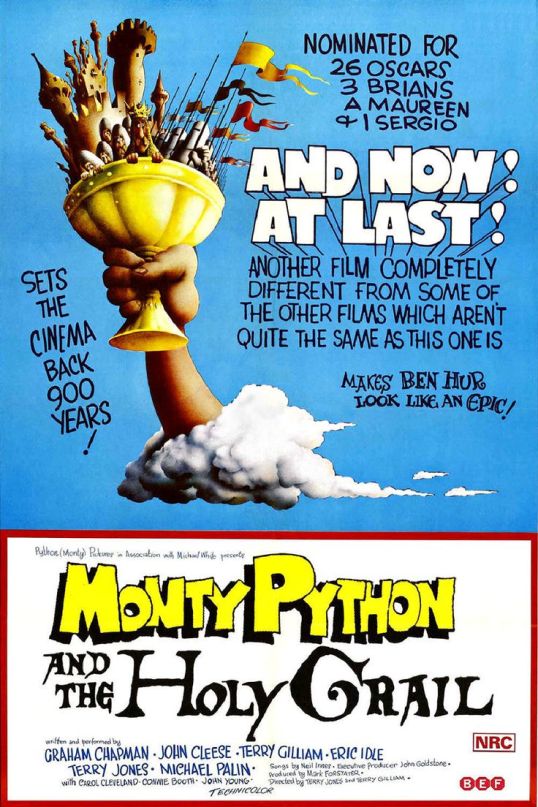
The Unnominated: Monty Python and the Holy Grail (dir by Terry Gilliam and Terry Jones)


Though the Academy of Motion Picture Arts and Sciences claim that the Oscars honor the best of the year, we all know that there are always worthy films and performances that end up getting overlooked.  Sometimes, it’s because the competition too fierce.  Sometimes, it’s because the film itself was too controversial.  Often, it’s just a case of a film’s quality not being fully recognized until years after its initial released.  This series of reviews takes a look at the films and performances that should have been nominated but were,for whatever reason, overlooked.  These are the Unnominated.

Really, Academy?

No nominations for one of the most influential and widely-quoted films ever to be released?

Well, actually, I get it.  Monty Python and the Holy Grail was first released in 1975 and 1975 was an unusually good year for cinema.  Back in the 70s, of course, the Academy only nominated five films for Best Picture and, as a result, a lot of good films were not nominated that year.  There just wasn’t room for them.  Check out the five films that were nominated and ask yourself which one you would drop to make room for a different nominee.

Would you drop:

Barry Lyndon, which was directed by Stanley Kubrick was considered to be the most realistic recreation of the 18th Century to ever be captured on film,

Dog Day Afternoon, in which director Sidney Lumet brilliantly mixed comedy and drama and which featured wonderful performances from Al Pacino, John Cazale, Chris Sarandon, and Charles Durning,

Jaws, the Steven Spielberg-directed hit that changed the face of Hollywood,

Nashville, Robert Altman’s sprawling and ambitious portrait of a country tying to find itself after a decade of trauma,

or

One Flew Over The Cuckoo’s Nest, in which Milos Forman paid tribute to individual freedom and Jack Nicholson gave perhaps the best performance of his legendary career?

I mean, those are five great films.  Even the weakest of the nominees (which, in this case, I think would be the eventual winner, One Flew Over The Cuckoo’s Nest) is still stronger than the average Best Picture nominee.

So, I can understand why there wasn’t room for an episodic and rather anarchistic British comedy, one that largely existed to parody the type of epic and period filmmaking that the Academy tended to honor.  If there had been ten nominees in 1975 and Monty Python and the Holy Grail had been snubbed to make room for something like The Other Side of the Mountain, my feelings might be different but there weren’t.

That said, even if there wasn’t room in the Best Picture slate, what to make of the lack of nominations for a script that is so full of quotable lines and memorable incidents that even people who haven’t seen Monty Python and the Holy Grail are familiar with them?  No nominations for the costumes, the production design, or the cinematography, all of which are surprisingly good for a low-budget film that was directed by not one but two untested neophyte directors?  No nominations for the thrilling music or the Camelot song?  How about a special award for the killer rabbit?

How about at least a best actor nomination for Graham Chapman, who played King Arthur not as a comedic buffoon but instead as being well-intentioned but also increasingly frustrated by the fact that his subjects cared not about his quest or his royal title?  Though 1975 may have been a strong year for movies, it appears that the Academy still struggled to find five best actor nominees and they resorted to giving a nomination for James Whitmore’s performance as Harry Truman in a filmed version of his one-man stage show, Give ‘Em Hell Harry.  Nothing against James Whitmore or Harry Truman but I think we all know that spot belonged to Graham Chapman and his performance as King Arthur.

Monty Python and the Holy Grail is often described as being a satire of the Arthurian legends.  I think, even more than being a film about King Arthur, it’s a film about a group of people trying to make an epic despite not having the resources or the patience to do so.  Python humor has always featured characters who were both foolishly confident and stubbornly aggressive and both of those traits are on wide display in Monty Python and the Holy Grail.  The production can’t afford horses so Arthur and his knights hit two coconuts together to duplicate the sound of the hooves on the ground and when they’re confronted about it, they attempt to change the subject.  Can’t afford to shoot in a real castle?  Simply declare Camelot to be a silly place and walk away.  Can’t afford to get permits to film on a certain location? Film illegally and run the risk of getting arrested just when you’re about to start the film’s climatic battle scene.  Can’t afford to hire God for a cameo?  Use a cut-out.  Can’t afford a real knight?  Just hire some people who get carried away and then hope one of them doesn’t kill the local academic who has shown up to explain the film’s historical context.

“I just get carried away,” John Cleese’s Lancelot says more than once and he has a point.  But the entire movie is about people getting carried away.  The Black Knight is so carried away in his belief in himself that he continues to fight despite having neither arms nor legs.  The villagers are so carried away in their desire to burn a witch that they cheer when it’s discovered that she weighs the same amount as a duck.  (“It’s a fair cop,” the witch, played by Connie Booth, admits.)  Eric Idle’s Sir Robin is so carried away in his ability to answer questions that he doesn’t consider that he might be asked about the capitol of Assyria.  The Knights of the Round Table as so carried away in their dancing and their singing that no one wants to go to the castle.  Even the film’s animator gets carried away, suffering a heart attack and saving Arthur and his surviving knights from a fate worse than death.

Monty Python and the Holy Grail is a very funny film, of course.  We all know that.  (I once read a story about a woman who, having learned she only had a few weeks to live, decided to watch this film everyday until she passed.  I don’t blame her.)  But what I truly love about this film is that, in scene-after-scene, you can literally see the Pythons realizing that they were actually capable of making a real movie.  Michael Palin, especially, seems to be having so much fun playing the eternally pure Sir Galahad that it’s impossible not to get caught up in his happiness.  There’s a joie de vivre that runs through Monty Python and the Holy Grail, even at its darkest and most cynical.  The Pythons are having fun and it’s impossible not to have fun with him.

And, while the Oscars may have snubbed Monty Python and the Holy Grail, the Tonys did not.  When the film was later turned into Spamalot, it received 14 Tony nominations and won three.

Previous entries in The Unnominated:

  1. Auto Focus 
  2. Star 80

Cleaning Out The DVR: And Now For Something Completely Different (dir by Ian MacNaughton and Terry Gilliam)


A tall, dark-haired British man sits behind a desk that is rather oddly sitting in the middle of a field.  He wears a dark suit and he looks quite serious as he says, “And now, for something completely different….”

Cut to a short film about a man with a tape recorder up his nose, followed by another short film about man who has a tape recorder up his brother’s nose.

A Hungarian man tries to buy cigarettes while using an inaccurate English phrasebook.  The publisher of the phrasebook is later brought before the court.

Poor old Arthur Pewty goes to marriage counseling and can only watch impotently as the counselor seduces his wife.  Having filed to stand up for himself, Pewty is crushed by 16-ton weight.

A self-defense instructor teaches his students how to defend themselves when they are attacked by a man with a banana.

A loquacious man in a pub says “nude nudge” and “wink wink” until his drinking companion is finally forced to slam down his drink.

A man who sees double recruits a mountaineer to climb the two peaks of Mt. Kilimanjaro.  Hopefully, they’ll be able to find last year’s expedition, which was planning on building a bridge between the two peaks.

There’s bizarre, almost Dadaist animation, featuring classic works of art interacting with cartoonish cut-outs.

Uncle Sam appears to explain how communism is like tooth decay.  A toothpase commercial explains how taking care of your teeth is like racing a car.  A motor oil company shows how it can destroy darkness and grim.

A prince dies of cancer but the spot on his face flourishes until it falls in love and moves into a housing development.

A man tries to return a dead pigeon.  The store clerk insists the pigeon is merely stunned and then sings about wanting to be a lumberjack.

A general complains that things have gotten much too silly.

The narrator appears randomly, announcing, “And now for something completely different….”

Okay, okay, you get the idea.  First released in 1971, And Now For Something Completely Different was the first film to be made featuring all of the members of Monty Python’s Flying Circus.  It was their initial attempt to break into the American market, a collection of surreal sketches that they had previously performed on television for the BBC.  Unfortunately, at the time, no one in America really knew who Monty Python was and the film failed at the box office, to the extent that many in the UK advised against Monty Python even allowing their program to later air on PBS because it was felt that Americans just wouldn’t get it.  Of course, Americans did eventually get it.  The show remains popular to this very day.  Countless Americans are convinced that they can speak in a perfectly convincing British accent, as long as they’re quoting a line from Monty Python.  The previous 4th of July, when the town band played John Philip Sousa’s Liberty Bell, I saw hundreds of people stamping down their feet at the end of it.  As for And Now For Something Completely Different, it was re-released in 1974 and became a bit of a cult favorite in the States.

That said, the members of Monty Python were never particularly happy with the film.  They were convinced to make the film by Victor Lownes, who was the head of Playboy’s UK operation.  Lownes, however, alienated the members of the group by trying to exert control over the material.  He particularly objected to the character of Ken Shabby, a perv who probably had a stash of sticky Playboys back at this flat.  Lownes also put up very little money for the production, meaning that the Pythons had to resort to shooting the film, without an audience, in a deserted factory.  Apparently, even the deliberately cheap-looking special effects of the television show were considered to be too expensive to recreate for the film.  Michael Palin and Terry Jones both later complained that the film itself was series of scenes featuring people telling jokes while sitting behind desks.

Of course, Lownes’s biggest sin was trying to insinuate that he was somehow the Seventh Python.  (One can only imagine how many people were guilty of the sin over the years.  Claiming to be the Seventh Python was probably a bit like claiming to be the Fifth Beatle.)  When Terry Gilliam was animating the film’s opening credits, the names of the cast were shown in blocks of stone.  Lownes insisted that his name by listed the same way.  Gilliam reluctantly acquiesced but then redid the names of the Pythons so that they were no longer in stone.  Fortunately, Victor Lownes would not involved in the subsequent Python films.

All that said, there’s no denying that And Now For Something Completely Different is a funny movie.  I mean, it’s Monty Python.  It’s John Cleese, Michael Palin, Graham Chapman, Eric Idle, Terry Jones and Terry Gilliam, all youthful and at the heights of their considerable comedic talents.  Even if all of the sketches are familiar from the show, they’re still funny and it’s impossible not to enjoy discovering the way that the movie threads them together.  (Combining the Lumberjack song with the dead parrot sketch worked out brilliantly.  “What about my bloody parrot!?” Cleese is heard to shout as Palin walks through the forests of British Columbia.)  Personally, my favorite Python is Eric Idle but I also love any sketch that involves Michael Palin getting on John Cleese’s nerves.  Everyone knows the dead parrot sketch, of course.  But I also like the vocational guidance counselor sketch.  It’s hard not to get caught up in Palin’s excitement as he discusses his lion tamer’s hat.  Almost as wonderful as Palin’s turn as Herbert Anchovy, accountant was Michael Palin’s turn as the smarmy host of Blackmail.  Actually, maybe Michael Palin is my favorite Python.  I guess it’s a tie between him and Eric.

And Now For Something Different has been on my DVR for quite some time.  I’ve watched it several times.  I’m not planning on deleting it any time soon.

Music Video Of The Day: Crackerbox Palace by George Harrison (1976, directed by Eric Idle)


Yes, this video was directed by Eric Idle of Monty Python fame.  Idle appears in the video, as does Neil Innes.  (Innes plays several roles, including the woman pushing the carriage at the start of the video.)  This video was shot on the grounds of Harrison’s estate, Friar Park (which was also known as, you guessed it, Crackerbox Palace).  The video made its debut on the November 20th, 1976 episode of Saturday Night Live.  SNL, that week, was hosted by Paul Simon and featured both Simon and Harrison as the musical guests.

The name Crackerbox Palace was originally used as the name for the Los Angeles estate that was owned by Lord Buckley, a comedian who was admired by Harrison and whom it was felt that Harrison physically resembled.  Harrison wrote the song after meeting Lord Buckley’s former manager, George Grief.  Harrison also payed homage to Blazing Saddles in the song, repeating Madeline Khan’s famous line of “It’s twoo, it’s twoo” during the instrumental breaks.

This whimsical video reflects Harrison’s sense of humor (not to mention Idle’s).  Harrison, with his reputation for being the spiritual Beatle, never seems to get enough attention for his sense of humor.

Enjoy!