It’s not Christmas without the story of Ebenezer Scrooge and his visit with three ghosts. There have been numerous film versions of this story. The one below comes to us from 1938 and stars Reginald Owen in the role of Scrooge.
This version is surprisingly good, considering that it was apparently shot in a hurry. (The movie hit theaters just a few weeks after filming stopped.) Originally, Lionel Barrymore was going to play Scrooge but he had to drop out due to ill-health. Reginald Owen stepped in and gave a good performance as the famous miser.
(Barrymore himself would more or less play Scrooge a little less than ten years later in Frank Capra’s It’s A Wonderful Life.)
1936’s Speed takes place in Detroit, at the home of Emery Motors.
When Joan Mitchell (Wendy Barrie) shows up to start her new job in the PR department, one of the first things she sees is a car being driven around a race track at a high speed until eventually it crashes. Automotive engineer Frank Lawson (Weldon Heybourn) explains that it’s all a part of making sure the car is safe. At Emery Motors, they crash cars on a daily basis to make sure that both the car and the driver will survive.
Terry Martin (James Stewart), the driver of the crashed car, proceeds to give Joan a tour of the factory. There’s an obvious attraction between the two of them but Joan also seems to have feelings for Frank. Terry and Frank are rivals. Terry may not have Frank’s education but he has instincts and he has common sense. He and his friend, Gadget Haggerty (Ted Healy), have an instinctive understanding of cars. They know how to drive them. They know how to fix them. They know how to make them go really fast.
In fact, Terry is working on a new carburetor, one that he says will increase the speed of Emery’s cars. Frank is skeptical but Terry knows that, if he can enter his car into the Indianapolis 500, he’ll be able to prove that he knows what he’s talking about. Joan comes to believe in Terry and his carburetor. And, fortunately, Joan has a secret of her own that will be very helpful to Terry’s ambitions.
Speed was not Jimmy Stewart’s first feature role but it was his first starring role. 28 years old when he starred in Speed, Stewart is tall, a little bit gawky, and unbelievably adorable. From the minute that Terry climbs out of that wrecked car and introduces himself to Joan, Stewart’s a true movie star. He and Wendy Barrie have a lot of chemistry and are a truly cute couple but Stewart is the one who dominates the film with his straight-forward charisma. Terry may not be the best educated engineer at Emery Motors but he is determined to prove himself and Stewart does a great job of portraying that determination.
As for the film itself, it’s low-budget and it’s short. Automotive enthusiasts might enjoy seeing all of the old cars and getting a chance to see what a car race was about in the days when cars themselves were still a relatively new invention. The film itself starts out as almost a documentary, with Stewart (as Terry) explaining how each car is manufactured on the assembly line. He points out all the machinery that goes into making the car in an almost-awed tone of voice. If the information is a bit dry, it doesn’t matter because it’s impossible not to enjoy listening to Jimmy Stewart speak. In his pre-WWII films, Stewart was the voice of American optimism and that’s certainly the case with Speed.
Speed was not a huge box office success but, in just two years, Stewart would be working with Frank Capra on You Can’t Take It With You, the first Stewart film to be nominated for (and to win) the Oscar for Best Picture of the year.
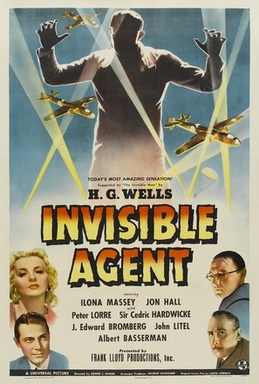
In 1942, the world was at war and everyone, whether a soldier or a civilian, was expected to do their part for the war effort. That included the best and the brightest of Hollywood. Stars like Jimmy Stewart, Clark Gable, and Henry Fonda enlisted in army. Others sold war bonds and narrated patriotic news reels. Even the Universal monsters did their part for the war effort, with the Invisible Man becoming the Invisible Agent in the 1942 film of the same name.
Invisible Agent opens in 1940, with Frank Griffin, Jr. (Jon Hall), the grandson of the original Invisible Man, being confronted by a Nazi (Sir Cedric Hardwicke) and a Japanese spymaster (Peter Lorre) at his print shop in Manhattan. They want his grandfather’s invisibility formula. At first, they offer to pay him for it. Then, when Frank refuses, they threaten to chop off his fingers. Frank manages to escape with both his fingers and the formula. As Frank later tells the Americans, he’s not willing to give the formula to anyone because he knows how dangerous it can be if not used properly. As far as Frank is concerned, the formula must never be used again. Frank does say that he might change his mind under extraordinary circumstances.
The film cuts to a series of headlines announcing that the Japanese have bombed Pearl Harbor. The circumstances are now extraordinary and Frank agrees that it is time to use the formula for the war effort. But he agrees to do so on the condition that only he be allowed to take the formula. Frank becomes the Invisible Agent, taking the formula and then parachuting into Nazi Germany. Unseen, Frank searches for information about Nazi spies in the U.S. and the details of Germany’s plan to bomb New York. Along the way, he meets Maria Sorenson (Ilona Massey), a wealthy German woman who is lusted after by the members of the German high command but who is actually working for the Resistance. Frank also finds himself, once again, coming across the two men who previously threatened him in New York.
Here are the positive things about this film. Invisible Agent has an intriguing premise. The Nazis are such monsters that even the once fearsome Universal monsters are joining the effort to take them down. The film also features two intelligent performances from Cedric Hardwicke and Peter Lorre, both of whom bring some unexpected shadings to their villainous roles. The opening scene in Manhattan plays out like an intense film noir and, once the action moves to Germany, director Edwin L. Marin keeps things moving at a steady pace.
Unfortunately, Invisible Agent has one huge problem that it cannot overcome. Jon Hall gives a remarkably charmless performance in the title role, flatly delivering his lines and showing very little in the way of personality. When you’re not seen for the majority of the film, it’s important to have a voice that’s full of personality. That’s one reason why the previous Invisible Man films benefitted from the casting of actors like Claude Rains and Vincent Prince. Jon Hall, on the other hand, just comes across as being dull. He gives a boring performance, whether visible or not and, as a result, Invisible Agent falls flat in a way that the previous Invisible films did not. There’s no real stakes in his turning invisible because there really wasn’t much to him to begin with.
Still, I thank the Invisible Agent for his service.
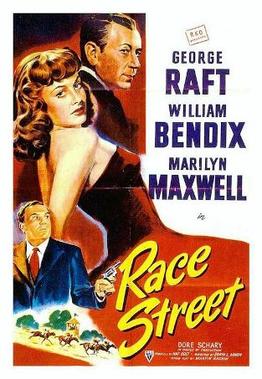
The 1948 film noir, Race Street, tells the story of what happens when the mob comes to San Francisco.
Led by the ruthless Phil Dickson (Frank Faylen, who you might recognize as Ernie the Cab Driver from It’s a Wonderful Life), the mob is looking to move in on San Francisco’s bookmaking rackets. Dickson wants all of the bookies to pay him for protection. Of course, he knows that he’s going to have a hard time convincing some of them to go along with his plans so he comes up with the brilliant idea of making an example of one bookie. He sends two of his men to talk to a small-time bookie named Hal Towers (Harry Morgan). They tell Hal that he can either pay Phil or he can suffer the consequences. Hal says that he’ll suffer the consequences so they promptly through him down a flight of stairs, killing him.
When Hal’s best friend, nightclub owner Dan Gannin (George Raft), discovers what has happened, he swears that he’s going to get revenge. Even after Dickson’s men abduct Dan and give him a brutal beating, Dan remains committed to getting justice for Hal. Lt. Barney Runson (William Bendix), who has been Dan’s best friend since childhood, tries to convince Dan to let the police handle it. He even tries to get Dan’s sister, Elaine (Gale Robbins) and Dan’s mysterious girlfriend, Robbie (Marilyn Maxwell), to convince him to back off but Dan won’t hear of it. Of course, because this is a film noir, Robbie has secret of her own….
Race Street is a low-budget noir that only has a running time of 79 minutes but still somehow finds time to sneak in a few musical performances from Gale Robbins. When the film first started, I have to admit that I wasn’t expecting much. George Raft seemed bored with his role and William Bendix’s opening narration didn’t fill me with much confidence. However, it didn’t take long for the film to win me over. Harry Morgan, for instance, brought a lot of wounded dignity to his relatively small role and his monologue before his murder is surprisingly moving. Frank Faylen was cast against type as the evil mobster but it worked. Seeing the normally amiable Faylen threatening to kill people was a good reminder that not all monsters look like monsters. Some of them look like the friendly Bedford Falls cab driver. As befits a film noir, the film is full of ominous shadows and sudden bursts of violence. The scenes where Hal is murdered and Dan is beaten both stand out as being perhaps a bit more brutal than one might expect a film from 1948 to be.
Race Street is a minor noir but aficionados of the genre should enjoy it. This is a short and no-nonsense film that gets the job done. It’s an offer you should not refuse.
 Through the Shattered Lens