Today’s horror film on the lens is Edward D. Wood’s 1955 epic, Bride of the Monster. The film itself doesn’t feature a bride but it does feature a monster, a giant octopus who guards the mansion of the mysterious Dr. Vornoff (Bela Lugosi). Vornoff and his hulking henchman Lobo (Tor Johnson) have been kidnapping men and using nuclear power to try to create a race of super soldiers. Or something like that. The plot has a make-it-up-as-you-go-along feel to it. That’s actually a huge part of the film’s appeal.
Bride of the Monster is regularly described as being one of the worst films ever made but I think that’s rather unfair. Appearing in his last speaking role, Lugosi actually gives a pretty good performance, bringing a wounded dignity to the role of Vornoff. If judged solely against other movies directed by Ed Wood, this is actually one of the best films ever made.
We have a few traditions here at the Shattered Lens. Every Christmas, we feature Treevenge. Every Halloween, we invite everyone to watch Night of the Living Dead. And every October, we offer up Ed Wood’s classic plea for world peace, Plan 9 From Outer Space.
I guess it’s debatable whether or not Plan 9 From Outer Space can actually be called a horror film. For one thing, it’s scary like not at all. If you actually pay attention to the film, it’s obvious that director Ed Wood was actually trying to deliver a heartfelt plea for world peace (as well as finding use for a minute of footage featuring the late Bela Lugosi). Of course, a lot of others claim that all Wood did was create the worst film ever made.
Now, at the risk of being branded a heretic, Plan 9 From Outer Space is hardly the worst film ever made. First off, lead actor Gregory Walcott actually gives a pretty good performance as Jeff, the confused pilot who is accused of having a “stupid, stupid mind.” And secondly … well, that’s really the only traditional praise that I can give the film. Still, Plan 9 From Outer Space is way too much fun to be truly bad. Yes, you may sit there and wonder, “How was this movie made?” but the fact of the matter is this: it was made and we’re all better off for it. No, Plan 9 From Outer Space is not your standard “horror” film despite the presence of zombies and grave robbers from outer space. However, in its own silly “Look we made a movie!” sort of way, it’s the perfect film for Halloween.
And luckily, it’s also in the public domain! So, allow me to present you with the one and only Plan 9 From Outer Space!
Now, I’ve recently heard some talk about a Plan 9 From Outer Space remake. What would that look like? Well, here’s one possibility…
If I haven’t already made it clear in my previous reviews on this site, I love exploitation films. Regardless of whether they’re blaxploitation or gialli or whether they’re about zombies or cannibals or just people looking for revenge, I love everything about them. I love them because they’re shameless, they’re frequently incoherent, and occasionally, they’re works of pure (if fractured) genius.
However, I have a special place in my heart for the old school exploitation films of the 1930s and 40s. These are the exploitation movies that came out while the American film industry still operated under the puritanical production code. While the mainstream film industry was still struggling with the idea of Clark Gable saying “damn” onscreen, the underground B-movie makers were making the movies that everyone saw but few people ever talked about. These were low-budget movies, filmed on the cheapest stock available and often times edited with all the skill of a chainsaw-wielding maniac. And while these movies were not necessarily impressive technically, they continue to serve as proof that even our elders occasionally enjoyed a dirty joke.
For the most part, these exploitation films were disguised as being public service announcements. Hence, a film like Ruined Souls wasn’t just a movie about young people skinny dipping and having sex. No, it was a warning about the dangers of venereal disease. Typically, once the film had finished showing off all the bad behavior it could, an authority figure (usually a doctor) would show up and explain why those in the audience shouldn’t do any of the things they had just watched. There’s a shamelessness to these old school exploitation films that reminds me why I admire panhandlers who go through the trouble to come up with an entertaining way to ask me for my money.
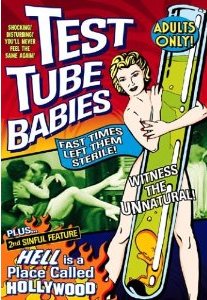
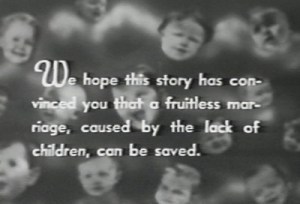
1948’s Test Tube Babies(directed by W. Merle Connell and produced by George Weiss, who would produce most of Ed Wood’s early films) is a typical example of an old school exploitation film. Now the title might lead you to think that this is going to be another horror film about demonic children. However, the exact opposite is true. The message of Test Tube Babies (the film’s PSA) is that any marriage — regardless of how drab and dull — can be saved by forcing the wife to go through hours of excruciatingly painful labor.
The first half of Test Tube Babies plays out roughly like the 1st half of Revolution Road. A boring young man named George meets a frumpy young woman named Cathy. They’re attracted to each other and, since this is the 1940s after all, they get married so that they can have sex. George and Cathy go on a whirlwind honeymoon. They get a house in the suburbs. George gets a job and Cathy settles into the life of being a slave (or “housewife,” as it was apparently known in the 1940s.)
However, is it possible that there is trouble in paradise? Shortly after the honeymoon is concluded, we start to get hints that maybe Cathy isn’t entirely satisfied being an indentured servant. At the breakfast table, Cathy and George talk about how boring their social life is. When George’s womanizing friend Frank comes to visit, Cathy greets him in her nightie and proceeds to dance with him while a simmering George watches. What’s wrong with Cathy? Could it be that she’s suddenly realized that she’s surrendered her own identity just to be someone’s wife? Perhaps it has dawned on her that marriage is really just a societal invention that’s designed to keep anyone from truly challenging the status quo. Or maybe she just needs a child to give her an excuse to remain in a loveless charade of a marriage.
Regardless of the reason why, Cathy is clearly dissatisfied with her new life. Soon, once George is off at work, Cathy invites all of her decadent friends over to the house for a party. This party appears to be the 1940s version of a key party. As Cathy plays hostess, Frank proceeds to make out with another man’s wife and then, from out of nowhere, an elderly lady with bleached blond hair shows up and starts talking about her former life as a burlesque dancer. As Cathy watches in horror (no doubt wondering why she couldn’t have just listened to her husband like a good, dutiful slave), the dancer starts to dance and things quickly escalate until Cathy is finally forced to call George at work and beg him to come home.
One of the reasons I love these old school exploitation films is that they provide a chance to see what our grandparents considered to be risqué. It’s a chance to peer into the repressed sexuality of our elders. So, what can we learn from watching the party scene in Test Tube Babies?
1) To judge from the leering reaction given to the frumpy clothing worn by the female guests, Sears was apparently the Victoria’s Secret of the 1940s.
2) The entire party sequence ends with a bizarre catfight between two women, over the course of which both women somehow end up naked. This serves to prove that, much as I always suspected, men have always been the same.
In a plot development that was later shamelessly ripped off by Revolution Road, all of this suburban decadence leads to Cathy and George realizing how empty their “perfect” sham of a marriage really is. Whereas Kate Winslet decided that this emptiness was linked to her sacrificing her own identity to be a wife, Cathy decides that the marriage is empty because she’s not yet a mother. After all, what could be better than bringing another human being into the world for the sole purpose of justifying a failed marriage? Never mind that neither George nor Cathy comes across like the type of people who could actually raise a happy child. What’s important here is to go through the societal motions.
Cathy, of course, wants to get pregnant immediately because you know us women. We’re just slaves to the old biological clock. However, despite George’s best efforts, Cathy simply cannot get knocked up. She wonders if maybe something’s wrong with her. George is quick to agree that something could be wrong with her so, like any good American couple, they go to a doctor to specifically find out what’s wrong with the wife.
(Interestingly enough, just to judge from the movie’s dialogue and the fact that Cathy is shocked when told to undress before being examined, it would appear that this is not only the first time that she’s ever been to a gynecologist but perhaps the first time she’s even heard the term “gynecologist.” To judge from this movie, apparently women in the 40s were simply locked up in the attic until some idiot came by and paid their dowry.)
It’s here that the movie takes a truly shocking turn as it is revealed that — gasp! — nothing is wrong with the wife. Instead, George is sterile. And this, of course, leads us to the whole concept of test tube babies and how they can even save the most pointless of marriages.
Now, the filmmakers obviously knew that this would a bitter pill for a 1948 audience to swallow so, in order to make sure we understand that this sort of thing actually does happen, we are introduced to Dr. Wright. If for no other reason, see this movie for Dr. Wright. With his oily hair, his ever-present smirk, and an equally ever-present cigarette, Dr. Wright is probably the creepiest gynecologist this side of Jeremy Irons in Dead Ringers. As played by exploitation vet Timothy Farrell, Dr. Wright is the only character in the film to seem to realize that he’s surrounded by idiots.
In the great tradition of old school exploitation, Dr. Wright is used to explain and justify the concept of a test tube baby. By doing so, Dr. Wright justifies and excuses all of the “decadence” that has previously been put up on-screen. Dr. Wright also makes a good argument for the health benefits of cigarettes. Seriously, I have never seen a doctor smoke as much as Dr. Wright. Literally, his every scene is enveloped in a cloud of smoke. He smokes while conducting a consultation, he smokes in between operations, and apparently he even smokes while conducting his examinations. (Which reminds me of a story concerning an ex-boyfriend but the less said about that the better…) Perhaps his best scene comes when, spying a nervous George in a hospital waiting room, Dr. Wright suggests that George “smoke a cigarette and relax.” (“I’ve already gone through two packs!” George replies and everyone shares a cancerous laugh.)
In the end,what can you really say about this odd little time capsule? As far as old school exploitation is concerned, it’s not a classic in the way that a movie like Reefer Madness is. Still, the movie holds a strange fascination for me. Some of it, of course, is the whole “so-good-that-its-bad” factor. This movie has that in spades. However, I think an argument can be made that movies like Test Tube Babies provide a view into the American subconscious that more mainstream films simply can not. Freed up from the confines of the Hollywood production code, the old school exploitation movies could give the people what they wanted to see as opposed to what they felt they should want to see.
Perhaps that’s the real appeal of a movie like Test Tube Babies. Its proof that people were fucked up before any of us were born and that they’ll continue to be fucked up long after we’re gone.
Then again, perhaps I’m just reading too much into an amusingly bad B-movie.
Perhaps it would be best to give the movie the final word…
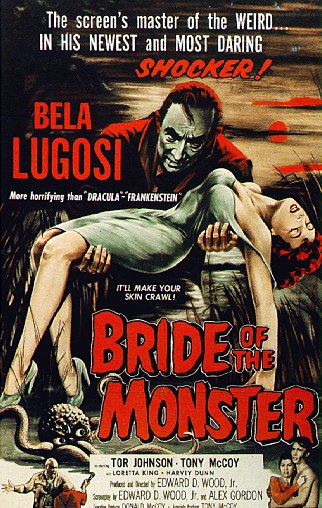 Today’s horror film on the lens is Edward D. Wood’s 1955 epic, Bride of the Monster. The film itself doesn’t feature a bride but it does feature a monster, a giant octopus who guards the mansion of the mysterious Dr. Vornoff (Bela Lugosi). Vornoff and his hulking henchman Lobo (Tor Johnson) have been kidnapping men and using nuclear power to try to create a race of super soldiers. Or something like that. The plot has a make-it-up-as-you-go-along feel to it. That’s actually a huge part of the film’s appeal.
 Through the Shattered Lens