Lisa Cleans Out Her DVR: Hemingway’s Adventures Of A Young Man (dir by Martin Ritt)


(Lisa is currently in the process of cleaning out her DVR!  It’s going to take a while.  She recorded this 1962 literary adaptation off of FXM on January 30th!)
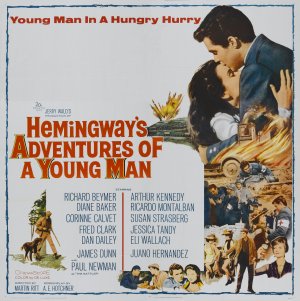
Hemingway’s Adventures Of A Young Man is one of those films that you just know was made specifically to win Oscars.  It’s a big prestige production, complete with a historical setting, an epic scope and big, all-star cast.  That most of those stars appear in relatively small roles was undoubtedly meant to evidence of the film’s importance.

“Look!” the film seems to shout at times, “This is such an important film that even Paul Newman was willing to stop by for a day’s work!”

The film is based on ten short stories by Ernest Hemingway and, loosely, A Farewell to Arms.  The stories all dealt with the early life of Nick Adams, who was a literary stand-in for Hemingway.  Since the Nick Adams stories were autobiographical (and, for that matter, so was A Farewell to Arms), the film can also be viewed as biopic.  Richard Beymer (who, a year earlier, had starred in West Side Story and who is currently playing Ben Horne on Twin Peaks) may be playing Nick Adams but the film leaves little doubt that he was actually meant to be playing Ernest Hemingway.

The film opens with Nick hunting with his father, Dr. Harold Adams (Arthur Kennedy).  He is present when his father travels to an Indian camp and helps to deliver a baby.  He respects his father but Nick wants to see the world and the film follows him as he explores America, working odd jobs and meeting colorful characters along the way.  Paul Newman shows up as a punch-drunk boxer and proceeds to overact to such an extent that he reminded me of Eric Roberts appearing in a Lifetime film.  Nick meets rich men, poor men, and everything in between.  He works as a journalist.  He works as a porter.  Eventually, when World War I breaks out, Nick enlists in the Italian army and the film turns into the 100th adaptation of A Farewell to Arms.

And really, I think it would have been an enjoyable film if it had been directed by someone like Otto Preminger, George Stevens, or maybe even Elia Kazan.  These are directors who would have embraced both the pulpy potential of the Nick Adams stories and the soapy melodrama of the war scenes.  A showman like Preminger would have had no fear of going totally and completely over the top and that’s the approach that this material needed.  Instead, Hemingway’s Adventures Of A Young Man was directed, in a painfully earnest style, by Martin Ritt.  Ritt tries to imitate Hemingway’s famously understated style with his understated direction but, cinematically, it’s just not very interesting.  Ritt portrays everything very seriously and very literally and, in the end, his direction is more than a little dull.

Sadly, the same can be said for Richard Beymer’s performance in the lead role.  Beymer comes across as being the nice guy who everyone says you should marry because he’ll be able to get a good and stable job and he’ll probably never go to jail.  Two months ago, when I watched and reviewed Twin Peaks, I really loved Beymer’s performance as Ben Horne.  He just seemed to be having so much fun being bad.  Unfortunately, in Hemingway’s Adventures Of A Young Man, he never seemed to be having any fun at all.  No wonder he temporarily put his film career on hold so that he could fully devote himself to working as a civil rights activist.

In the end, this is a movie that’s a lot more fun to look at than to actually watch.  Visually, the film is frequently quite pretty in an early 1960s prestige movie so sort of way.  And there are some good performances.  Eli Wallach, Ricardo Montalban, Susan Strasberg, Arthur Kennedy — there’s a whole host of performers doing memorable supporting work.  Unfortunately, even with all that in mind, this well-intentioned film largely falls flat.
Lisa Watches An Oscar Nominee: The Verdict (dir by Sidney Lumet)


Verdict1

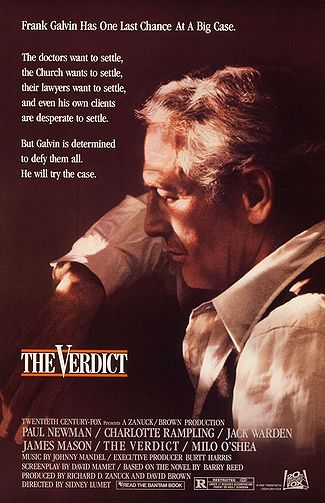
Speaking of the good, old-fashioned star power of Paul Newman, The Hustler and Butch Cassidy and the Sundance Kid were not the only films to receive an oscar nomination as the result of his charisma.  There’s also The Verdict, a 1982 best picture nominee that would probably be forgotten if not for Paul Newman’s performance.  However, since Paul Newman did play the lead role in The Verdict and he did give an amazing lead performance, The Verdict was nominated for best picture and, 33 years later, it ended up on TCM where I just watched it.

That’s the power of good acting.

Paul Newman plays Frank Galvin, a Boston-based attorney.  At one time, Frank was a lawyer at an elite firm.  But he has since fallen on hard times.  Now, he’s the type of attorney who crashes funerals and hands out his card.  He spends his spare time at his favorite bar, playing pinball and telling long jokes while stumbling about in a drunken haze.  In many ways, Frank represents everything that people hate about personal injury attorneys but, since he’s played by Paul Newman, you know that he’s going to turn out to be a good guy.

Frank only has one friend left in the world, his former mentor Mickey (Jack Warden).  Looking to help Frank out, Mickey sends Frank a medical malpractice suit.  A woman at a Catholic Hospital was given an anesthetic during child birth that has led to her now being brain dead.  Both the woman’s family and the Archdiocese are looking for a settlement.  The family needs the money to pay for her medical care.  The Archdiocese just wants the case to go away.  All Frank has to do is accept whatever settlement deal is offered…

However, something has changed for Frank.  He’s visited the comatose woman and, looking at her trapped in a vegetative state, he’s decided that the hospital needs to be held responsible for its mistake.  He rejects the settlement and takes the case to court, looking for both justice for the victim and redemption for himself.

That’s easier said than done, of course.  The Archdiocese has hired Ed Concannon (James Mason, perfectly cast), one of the best and most powerful attorneys in Boston.  Ed has a huge legal team working on the case.  Frank has Mickey.  As well, the Judge (Milo O’Shea) makes little effort to hide his contempt for Frank.

Probably the only bright spot in Frank’s life is that he’s met a woman.  Laura (Charlotte Rampling) meets him in a bar and soon, they’re lovers and Frank is confiding in her about the case.  What he doesn’t suspect is that Laura herself is a spy, hired by Concannon.

It looks like all is lost but then Frank discovers that there is one nurse (Lindsay Crouse) who might be willing to tell the truth about what happened at the hospital…

In many ways, The Verdict is a predictable film.  From the minute we first meet him, we know that Frank is going to be redeemed.  From the minutes that we hear about the case, we know who we’re supposed to root for and who we’re supposed to hiss.  Just about every courtroom cliché is present, right down to a surprise witness or two…

But no matter!  The Verdict may be predictable but it works.  As he proved with 12 Angry Men, Director Sidney Lumet knew how to make legal deliberations compelling and the entire film is full of small but memorable details that elevate it above its simplistic storyline.  As a director, Lumet gets good performances from his cast and, as a result, this is a film where the hero is flawed and the antagonists aren’t necessarily evil.  Even the Bishop of the Archdiocese of Boston (who, in most films, would have been a cardboard villain) is given a scene where he’s allowed to show some humanity.

And, of course, Paul Newman is great in the role of Frank.  When we first meet Frank, he looks and sounds terrible.  Indeed, it’s strange to see Paul Newman playing a character who is essentially such a loser.  (Even Eddie Felson in The Hustler had an appealing swagger about him.)  It’s during the scenes where Frank considers the woman in a coma that Newman starts to reveal that there’s more to Frank than what’s on the rough surface.  By the end of the film, Frank may be a hero but Newman doesn’t play him as such.  He’s still has that alcoholic rasp in his voice and his eyes still betray hints of insecurity and a fear that, at any minute, he’s going to screw up and mess everything up.  It’s a great performance, one for which Newman received a nomination for best actor.

Speaking of star power, Bruce Willis also shows up in The Verdict.  He’s an extra who appears as an observer in the courtroom.  He’s sitting a few rows behind Paul Newman.  (He’s also sitting beside Tobin Bell, the Jigsaw Killer from the Saw films).  It’s probably easiest to spot Willis towards the end of the film, when the verdict is read.  Bruce breaks out into a huge grin and almost looks like he’s about to start clapping.  Bruce only gets about 10 second of screen time but he acts the Hell out of them!

Thanks to Paul Newman, The Verdict is a memorable and entertaining film.  Be sure to watch it the next time it shows up on TCM.

12 Reasons To Love 12 Angry Men


Everyone already knows that the 1957 Best Picture nominee 12 Angry Men is a classic.  We all know the film’s story — a teenage boy is on trial for murdering his family.  11 jurors want to convict.  1 juror doesn’t.  Over the next few hours, that one juror tries to change 11 minds.  Some of the jurors are prejudiced, some of them are bored, and some of them just want to go home.  And, as the film reminds us, all 12 of them have a huge  responsibility.  You don’t need me to tell you that this is a great movie.  Therefore, consider this to be less of a review and more of an appreciation of one of the best movies ever made.

1) The film is the feature debut of director Sidney Lumet.  As any student of American film can tell you, Sidney Lumet was one of the most important directors in the history of cinema.  After beginning his career in television, Lumet made his film directing debut with 12 Angry Men and he was rewarded with a much deserved Oscar nomination for best director.

2) The film’s story is actually a lot more complex than you might think.  12 Angry Men is such an influential film and its story has been imitated so many times that it’s easy to forget that the film’s plot is a lot more nuanced than you might think.  Despite what many people seem to think, Juror Number 8 never argues that the defendant is innocent.  Instead, he argues that the state has not proven its case beyond a reasonable doubt and, as a result, the defendant cannot be convicted.  That’s an important lesson that is too often forgotten.

3) The movie celebrates the power of one person determined to do the right thing.  Again, that’s a lesson that remains very relevant today.

4) As Juror Number Eight, Henry Fonda makes human decency believable.

5) As the angry and bullying Juror Number Three, Lee J. Cobb is the perfect antagonist.

6) As Juror Number Ten, Ed Begley makes Cobb seem almost reasonable.  To be honest, the scene where Begley’s racist ranting causes all of the other jurors to stand up and turn their back on him feels a bit too theatrical.  But it’s still undeniably effective.  Alone among the jurors, Juror Number Ten is the only one without any hope of redemption.  It’s a bit of a thankless role but Begley does what he has to do to make the character believable.

7) E.G. Marshall makes the wealthy Juror Number Four into a worthy opponent of Fonda without crossing the line into prejudice like Cobb and Begley.  In many ways, Marshall’s role is almost as important as Fonda’s because Marshall’s performance reminds us that not all disagreements are the product of ignorance or anger.

8) As the Jury Foreman, Martin Balsam is the epitome of every ineffectual authority figure.

9) As Juror Number Seven, Jack Warden is hilariously sleazy.

10) As Juror Number Nine, Joseph Sweeney grows on you.  The first time I saw the film I thought that Sweeney went a bit overboard but, on more recent viewings, I’ve come to appreciate Sweeney’s performance.

11) As Juror Number Twelve, Robert Webber is hilariously shallow.  Juror Number Twelve is in advertising and Webber seems like he was right at home on Mad Men.

12)  Though they don’t get as much of a chance to make an impression, John Fiedler, Jack Klugman, Edward Binns, and George Voskovec all do good work as the other jurors.  If there’s ever been a film that proves the value of a great ensemble, it’s 12 Angry Men.

Scenes I Love: 12 Angry Men


With the recent passing of filmmaker Sidney Lumet I’ve gone through some of the films of his I’ve come to see as favorites of mine. One film which always came to the forefront whenever I spoke about Lumet as a filmmaker is his directorial film debut in 1957 with his adaptation of 12 Angry Men. Of all his films this is the one which I always go back to time and time again. Part of me is somewhat biased in regards to this film since I was part of a class reading of the original teleplay and played the role of Juror #3.

The scene in the film which I love the most has to be when Juror #8 (played with calm assurance by Henry Fonda) and Juror #3 (played with seething rage by Lee J. Cobb) finally get into it after a very long deliberation in trying to find a consensus on the guilt or innocence of the defendant in their case. I love how in this scene everything that’s right about the American jury system was being upheld by Juror #8. How the guilt or innocence of the defendant should come down to just the facts of the case and combing through all the testimony. How emotions and personal feelings and bias should never enter the equation. It is a person’s life in their hands and it is a responsibility too great to leave it to emotions to find the verdict.

This scene also shows the darker side of the American jury system in that there will be, at times, people chosen to preside as a juror in a case will come in with emotional baggage and a hidden agenda which clouds their decision making. They don’t look at the facts and testimony at hand but at what they believe to be true no matter what the facts may say otherwise. this is how the jury system becomes twisted and becomes part and parcel to the notion that justice is never truly blind but always colored by human frailties and prejudices.

Even 54 years since the films first premiered it still holds a powerful effect on me and those who sees it for the first time. It helps that you have a master filmmaker in Sidney Lumet guiding an exceptional cast of actors. One could come to the conclusion that the audience has the angel on one shoulder with Juror #8 and the devil on the other with Juror #3. All in all, a great scene that always stays with me long after the film has ended.