Shattered Politics #21: Kisses For My President (dir by Curtis Bernhardt)


Kisses_for_My_President_-_1964_-_Poster

If there’s anyone who deserves to be the subject of a big budget biopic, it’s Victoria C. Woodhull.  Back in the 19th century, at a time when women were not even allowed to vote, Victoria C. Woodhull was not only the first woman to ever work as a stockbroker but also the first to ever found her own newspaper.  A fierce advocate for women’s right and free love, Victoria Woodhull was also the first woman to ever run for President.  She was nominated in 1872 by the Equal Rights Party and, for the crime of trying to cast a vote for herself, she spent election day in jail.

Since that day, many more women have run for President but none have been elected.  Since 1984, two women have received major party nominations for vice president but neither came close to being elected.  Since 1964, Margaret Chase Smith, Shirley Chisholm, Patsy Mink, Ellen McCormack, Patricia Schroeder, Elizabeth Dole, Carol Mosely-Braun, Michele Bachman, and Hillary Rodham Clinton have all campaigned for the presidential nomination of one of the two major political parties but none of them have been nominated.

I do believe that a woman will be elected President within my lifetime.  In fact, it could even happen in 2016.  But until then, the only place where you can find a female President is on TV and in the movies.

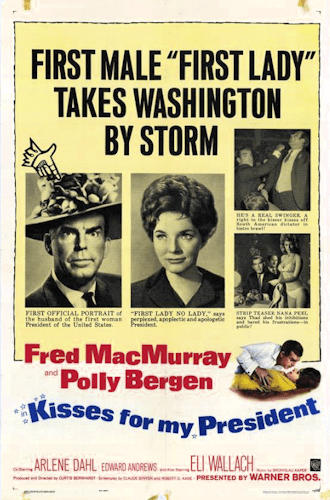
Take, for instance, today’s final entry in Shattered Politics, the 1964 film Kisses For My President.  This may very well have been the very first movie to feature a woman as President.  Needless to say, in 1964, this idea was considered so outrageous that it had to be played for laughs.

Kisses For My President starts with an image of hundreds of women chanting “We want Leslie!”  We get a shot of Fred MacMurray looking out over the crowd.  The next scene, the new President is being sworn in.  We start with a close-up of the chief justice reciting the oath of office to “Leslie Harrison McCloud.”  The camera pans over to Fred MacMurray, listening intently.  However, just when 1964 audiences were expecting MacMurray to swear to uphold the constitution, the camera pans yet again, over to …. Polly Bergen!

“OH MY GOD!” audiences in 1964 gasped, “LESLIE McCLOUD IS A WOMAN!”

That’s right.  Polly Bergen is playing President Leslie McCloud and Fred MacMurray is playing her husband, Thad.  As the film makes apparent in its opening scenes, Thad is not quite sure what his role is supposed to be.  He has an office in the White House but it’s just so … feminine!  And it’s full of painting of previous first ladies who were all ladies!  And, at one point, Thad even imagines a picture of himself wearing a lady’s hat!

Oh my God!

Now, to be fair to the movie, Polly Bergen does get a few scenes where she shows herself to be a strong President.  There’s a great scene where she coolly dismisses a condescending senator (Edward Andrews) who suggests that, as a woman, Leslie might not be up to the task of standing up to America’s enemies.  It’s a brief scene but it’s a good one.

But, ultimately, it’s impossible to ignore the fact that Kisses For My President, a film about the first female President, is mostly interested in how Thad handles being “first gentleman.”  It’s a film that imagines a historic moment for women and then focuses on what it would mean for one man.

How 1964!

On the one hand, Kisses For My President is a dated comedy that runs way too long and tries to get too much mileage out of one joke (i.e., Fred MacMurray looking confused).  However, the film also features a great performance from Eli Wallach.  Playing a strutting dictator named Vasquez, Wallach is a lot of fun and the scenes where MacMurray shows him around Washington are the best in the film.  I also appreciated the fact that the President’s daughter reacts to the restrictions of living in the White House by dating a guy that she knows her parents will hate, largely because I would have done the same thing in her situation.

I’m a little bit torn on the ending of Kisses For My President.  (Should I spoil it?  No, I don’t think I will.)  On the one hand, it’s outrageously sexist and seems to suggests that Leslie — despite being a strong President during the few times we actually get to see her doing the job — should have been content to just be a wife and mother.  On the other hand, it’s one of those endings that would seem to perfectly capture the dominant culture of the time when the film was made.  So, it has some worth from a historical point of view.

When last I checked, Kisses For My President is currently available for free on YouTube. The film is interesting as a historical document if nothing else.
 

Shattered Politics #17: Advise & Consent (dir by Otto Preminger)


Advise-&-Consent-(1)

In case you hadn’t heard, U.S. Sen. Barbara Boxer has recently announced that she’s retiring in 2016.  For the first time in decades, there’s going to be an open senate seat in California.  There’s been a lot of speculation about who might run for the seat and, for the most part, it’s all been the usual political suspects.  The state’s attorney general is running.  A few congresspeople might run.  Token billionaire Tom Steyer is thinking of getting into the race.

What disappoints me is that, as of right now, it doesn’t look like any celebrities are planning on running.  You know what would have made the Golden Globes perfect?  If George Clooney had announced his candidacy while accepting his Cecil B. DeMille award.  (At the very least, it might have given Amal something to smile about, as opposed to just sitting there with a condescending smirk on her face.  Seriously, what’s up with that?)  But even beyond George Clooney, there’s all sorts of celebrities who could run.  Charlie Sheen lives in California, after all.  Jeff Bridges might not be able to run in Montana but what about California?

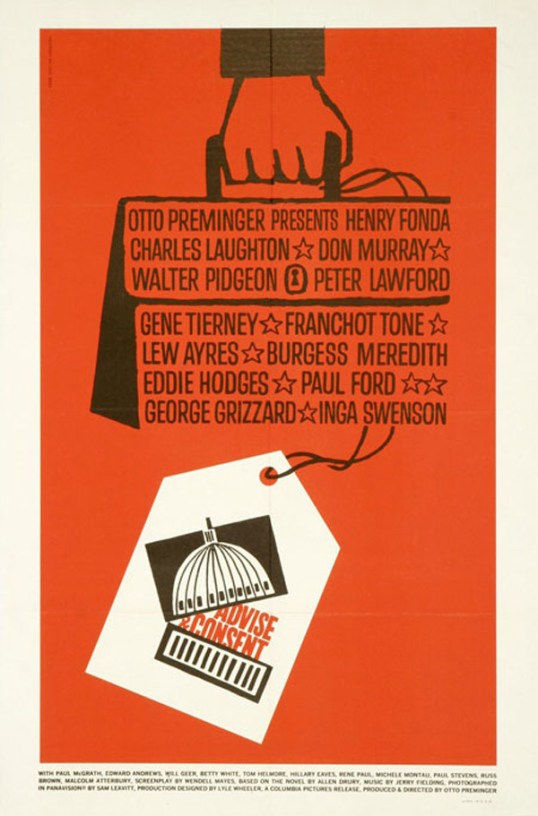
I was discussing this with a friend of mine who suggested that Betty White should run because who could vote against Betty White?  Speaking for myself, I could easily vote against Betty White but I do think there would be something appropriate about Betty White serving in the U.S. Senate.  After all, in 1962, she played a senator in Otto Preminger’s political epic, Advice & Consent.

White played Sen. Bessie Adams of Kansas and was only given a few minutes of screen time.  She’s one of many performers to show up in Advise & Consent‘s version of the U.S. Senate.

For instance, Walter Pidgeon plays Sen. Bob Munson, who is the Senate majority leader and, as a result, the closest thing that this sprawling film has to a central character.  His job is to make sure the President’s agenda is pushed through Congress.

And then there’s Peter Lawford, as Sen. Lafe Smith, who always has a different girl leaving his hotel room.  When Advise & Consent was made, Lawford was President Kennedy’s brother-in-law.  Interestingly enough, one of Kennedy’s former girlfriends — actress Gene Tierney — shows up in the film as well, playing Bob Munson’s lover.

George Grizzard plays Sen. Fred Van Ackerman, who is about as evil as you would expect someone named Fred Van Ackerman to be.  Grizzard gives one of the better performances in the film, which just goes to prove that it’s more fun to play an evil character than a good one.

Don Murray is Sen. Brigham Anderson, a senator who is being blackmailed by Van Ackerman’s lackeys.  Despite being happily married to Mabel (Inga Swenson), Anderson is leading a secret life as a gay man.  The scene where Anderson steps into a gay bar may seem incredibly tame today but it was reportedly very controversial back in 1962.

And finally, there’s Sen. Seabright Cooley.  You may be able to guess, just from his overly prosaic name, that Cooley is meant to be a southerner.  That, of course, means that he wears a white suit, is constantly fanning himself, and speaks in lengthy metaphors.  Sen. Cooley is played by Charles Laughton, who overacts to such a degree that I’m surprised that there was any oxygen left over for anyone else.

All of these senators have been tasked with deciding whether or not Robert Leffingwell (Henry Fonda) will be the next secretary of state.  Fonda, not surprisingly, is the epitome of urbane liberalness in the role of Leffingwell.  However, Leffingwell has a secret.  Back in the 1930s, Leffingwell was a communist.  When Sen. Cooley introduces a witness (Burgess Meredith) who can confirm this fact, Leffingwell offers to withdraw as the nominee.  However, the President (Franchot Tone) refuses to allow Leffingwell to do so.  Instead, with the help of Van Ackerman, he tries to pressure Anderson into supporting Leffingwell’s nomination.

This, of course, leads to melodrama and tragedy.

As far as literary adaptations directed by Otto Preminger are concerned, Advise & Consent is better than Hurry Sundown while being nowhere to close to being as good as Anatomy of a Murder.  It’s a film that is occasionally entertaining, often draggy, and, if just because of all the different acting styles to be found in the cast, always interesting to watch.

And, for what it’s worth, Betty White makes for a convincing senator.  So, perhaps the people of California should watch Advise & Consent before voting for Tom Steyer…

Shattered Politics #11: The Phenix City Story (dir by Phil Karlson)


PhenixCityPoster

If A Man Called Peter was the epitome of a stereotypical 1950s film, The Phenix City Story is the exact opposite.  Like A Man Called Peter, The Phenix City Story was released in 1955.  And like A Man Called Peter, The Phenix City Story is based on a true story.  However, beyond that, A Man Called Peter and The Phenix City Story might as well have been taking place on different planets.

And, in many ways, they were.  The Phenix City Story not only takes place in Phenix City, Alabama but it was filmed there as well and featured a few actual citizens in the cast.  Not only was The Phenix City Story telling a true story but the story was being told by some of the same people who actually lived through it.  That makes The Phenix City Story brutally realistic, with brutal being the key word.

And, just in case we have any doubt about the film’s authenticity, it actually opens with a 15 minute documentary in which Clete Roberts (who was an actual news reporter) interviews several citizens of the town.  All of them, speaking in thick Alabama accents and nervously eyeing the camera, assure us that what we are about to see is true.  Quite a few of them also tells us that they still live in fear of losing their lives as a result of everything that happened.

What’s amazing is that, once the actual film does get started, it manages to live up to all of that build up.  The Phenix City Story is a shocking film that remains powerful even 60 years after it was initially released.

As the film opens, we’re informed that Phenix City, Alabama is home to some of the most dangerous and violent criminals in the state.  From his club, crime boss Rhett Tanner (Edward Andrews) runs a shadowy organization that not only controls Phenix City but the entire state of Alabama as well.  The police ignore his crimes.  The majority of the town’s citizens are too scared to stand up to him.  When a returning veteran of the Korean War, John Patterson (Richard Kiley), tries to stand up to Tanner, the result is even more violence.  A young black girl is kidnapped and murdered, her body tossed on John’s front lawn as a warning.  John’s best friend is killed but Tanner uses his influence to have the death ruled accidental.

Finally, John and a group of other reformers convince John’s father — Albert Patterson (John McIntire) — to run for Attorney General.  Albert runs on a reform platform and exposes both the corruption of Phenix City and how Tanner’s power extends through the rest of the state as well.  When Albert wins the Democratic primary, he’s gunned down in the street and it’s up to John to avenge his death…

To say that The Phenix City Story is intense would be an understatement.  As directed by Phil Karlson, there’s not a single frame of The Phenix City Story that’s not full of menace and danger.  The stark black-and-white cinematography is full of shadows and the camera moves almost frantically from scene to scene, occasionally catching glimpses of dark figures committing acts of violence and cars speeding away from who knows what outage.  It’s a dark film but, ultimately, it’s also a hopeful one.  It suggests that evil will triumph when good men do nothing but that sometimes you can depend on good men — like Albert and John Patterson — to actually step up.

The Phenix City Story shows up on TCM occasionally and you should keep an eye out for it.  It’s one of the best B-movies ever made.

Back to School #35: Sixteen Candles (dir by John Hughes)


11171951_800

The 80s are often considered to be the golden age of teen films and that’s largely due to the work of one man, John Hughes. A  former advertising copywriter and a contributor to National Lampoon, Hughes went on to direct and write some of the most influential films of all time.  By deftly mixing comedy with themes of alienation, rebellion, and youthful disillusionment, Hughes changed the way that teenagers were portrayed onscreen and his influence is still felt today, in everything from Juno to Superbad to Easy A to … well, just about any other recent film starring Michael Cera.

(Okay, I know Michael Cera was not in Easy A but it really seems like he should have been…)

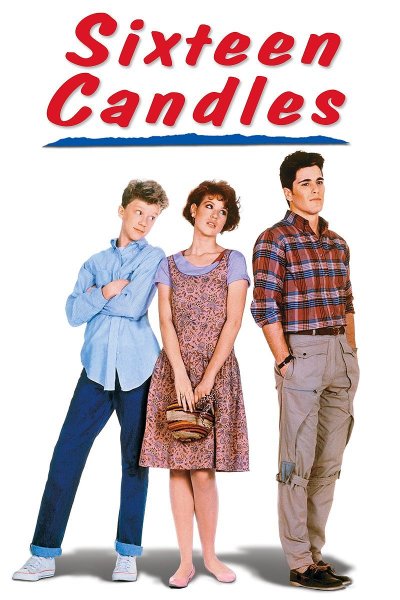
Hughes made his directorial debut in 1984 with Sixteen Candles, a comedy about love, birthdays, and weddings set in an upper class suburb of Chicago.  (I have to admit that, much like with My Tutor, one reason that I like this film is because I like seeing where everyone lives.)  As the film opens, Samantha Baker (Molly Ringwald) is not having a particularly good time.  For one thing, everyone is so wrapped up in her older sister’s wedding that they’ve forgotten about Sam’s sixteenth birthday.  Her house is full of wacky grandparents (and one foreign exchange student named Long Duk Dong).  At school, Sam is in the unenviable position of being neither popular enough nor unpopular enough to actually be noticed by anyone.  Instead, she’s just there.  She has a crush on Jake Ryan (Michael Schoeffling) but is convinced that Jake doesn’t even know that she’s alive.  (Of course, she’s wrong.)  She’s also being pursued by a character who is occasionally referred to as being “Farmer Ted” but is listed in the end credits as simply being “The Geek.”  (I’m going to refer to him as “The Geek” because Farmer Ted makes him sound like he should be killing people in a SyFy original movie.)  As played by Anthony Michael Hall, The Geek isn’t your typical high movie nerd.  Instead, he’s the outspoken and confident king of the nerds and he’s proud of it.  The Geek is madly pursuing Sam and has made a bet with his friends (including John Cusack) that he’ll not only have sex with her but he’ll prove it by bringing them her panties.  (BAD GEEK! — but fortunately, Anthony Michael Hall gives such an energetic and likable performance that you can forgive him.)

There are parts of Sixteen Candles that have not aged well.  And, by that, I’m mostly referring to the character of Long Duk Dong, who is so well-played by Gedde Watanabe that it’s tempting to ignore just how racist the portrayal of his character really is.  As well, I know that a lot of my more erudite friends would probably only briefly look away from their copy of Thomas Piketty’s Capital In The 21st Century, just long enough to pronounce that Sixteen Candles is essentially a film about “first world problems.”

Well, maybe it is.  But I don’t care.  I like it.  John Hughes’s script is full of classic lines and funny characters, Anthony Michael Hall is likable as the Geek, and, as played by Michael Schoeffling, Jake Ryan is the epitome of the perfect guy.  If your heart doesn’t melt a little when he says that he’s looking for true love, it can only be because you don’t have a heart.  And finally, Sam remains a character that we can all relate to.  As played by Molly Ringwald, she’s the perfect sullen everygirl.

Of course, an undeniable part of the charm of Sixteen Candles comes from the fact that it really is a film that could not be made today.  Sixteen Candles may take place in an entirely different world from films like The Pom Pom Girls and Suburbia, but it’s still just as much of a time capsule.

First off, there’s about a thousand apps out there that will make sure that you never forget anyone’s birthday.  If the film was made today, Sam’s parents would have checked their e-mail and found a message from Facebook telling them that “Samantha Baker has a birthday this week!”  They could have just written “Happy birthday to a wonderful daughter!” on her wall and half of Sam’s problems would have been solved.

Secondly, it’s doubtful that, if the film was made today, the Geek would be able to get away with just showing everyone’s Sam’s panties.  Instead, they would have demanded nude pics, which would have then been posted on the internet for the entire world to see.  And let’s be honest: “Can I send my friends naked pics of you?” doesn’t quite have the same ring to it as “Can I borrow your underpants for ten minutes?”

hero_EB19840101REVIEWS401010384AR

—–

*And, no, I haven’t read Piketty’s tome.  I have a life to live and movies to see.